Bernstein Interprets SpaceX's First Quarterly Report Since IPO: How Does the $239 Target Price Hold Up?

marsbit2026-08-06 tarihinde yayınlandı2026-08-06 tarihinde güncellendi

Özet

Bernstein maintains its "Outperform" rating and $239 price target for SpaceX following its first earnings report as a public company. The Q2 2026 results showed strong growth, with revenue reaching $7.814B, a 92% year-over-year increase, beating expectations. The Starlink Connectivity business remained the profit driver, generating $1.656B in operating income. The AI segment saw revenue surge 247% to $2.561B, though it required massive capital expenditures of $15.828B. The $239 target is based on a sum-of-the-parts valuation projecting 2031 revenue of $554B, significantly below CEO Elon Musk's accelerated goal of $1 trillion by 2030. Bernstein's model assumes AI computing prices will eventually fall to around $10/watt, not the $30-$50/watt range cited by management. The valuation hinges on three key pillars: continued profit growth from Connectivity, the AI business converting its heavy investment into scalable revenue, and the Starship achieving full and rapid reusability to enable low-cost expansion. While quarterly performance was strong, post-IPO stock lock-up expirations and execution risks around Starship and AI returns contributed to a subsequent share price decline.

SpaceX's first quarterly earnings since going public have presented the market with an even more aggressive growth story: the Connectivity business continues to contribute profits, AI computing revenue is growing rapidly, and Musk has moved forward the target year for reaching $1 trillion in annual revenue from 2031 to 2030, suggesting it could be achieved as early as 2029.

According to the company's SEC filing, Space Exploration Technologies Corp. Class A common stock has begun trading on Nasdaq and Nasdaq Texas under the ticker SPCX. Following the release of its Q2 results for the period ending June 30 on August 4, Bernstein maintained its 'Outperform' rating and a $239 price target. Based on the closing price of $125.33 on August 4 as cited in the report, this implies an approximate 91% upside potential.

However, the $239 target price is not predicated on the full realization of the $1 trillion revenue goal. Bernstein's own revenue forecast for SpaceX in 2031 is $554 billion, significantly lower than management's vision; its AI computing price model also still assumes a long-term decline to approximately $10 per watt. In other words, higher computing prices and more aggressive revenue targets represent potential upside beyond the current valuation.

On August 5, SpaceX's stock price fell further to $108.27, a single-day drop of 13.6%. This indicates the market is not solely focused on this quarter's performance but is simultaneously weighing AI capital expenditures, potential stock supply pressure from the post-IPO lock-up period expiration, and whether Starship can enter a phase of high-frequency, low-cost launches.

Revenue Growth of 92%, Connectivity Remains the Profit Pillar

SpaceX's Q2 revenue reached $7.814 billion, a year-on-year increase of 92%. The consensus cited by Axios from S&P Visible Alpha was $6.9 billion, while Bernstein's report used a market consensus of $6.546 billion. Despite differing methodologies, both point to the same conclusion: revenue this quarter significantly exceeded expectations.

The company's Q2 diluted loss per share was $0.09, also better than the market expectation of a $0.24 loss per share. The three business segments combined posted an operating loss of $143 million, far better than the $1.73 billion market expectation used by Bernstein, primarily due to a narrower AI segment loss and Connectivity margins higher than expected.

Looking at the segments, the most stable currently remains the Connectivity business centered on Starlink. Starlink user count reached 12 million by the end of Q2, an increase of 1.7 million from Q1, with average monthly revenue per user remaining stable at $66.

Connectivity's quarterly revenue was $4.291 billion, with operating profit of $1.656 billion, corresponding to an operating margin of approximately 38.6%, higher than the 37% market expectation used by Bernstein. It is also SpaceX's only currently profitable business segment at the operating level, providing crucial support for the company's continued investments in AI and Starship.

The Space business completed 38 launches in Q2, comprising 10 customer launches and 28 internal launches, delivering a total mass to orbit (MTO) of 485 tons. This segment's revenue was $962 million, higher than the market expectation of $874 million, but operating losses still reached $542 million due to increased Starship R&D investment.

The AI business possesses both the greatest revenue elasticity and funding requirements. By the end of Q2, SpaceX's nominal compute capacity reached 1.4 GW, up from 1.0 GW in Q1, with expectations to exceed 2 GW by the end of 2026. The AI segment's quarterly revenue was $2.561 billion, a year-on-year increase of 247%, with AI solutions and infrastructure revenue reaching $2.194 billion.

The AI business's operating loss was $1.257 billion, corresponding to an operating margin of approximately -49.1%, but this is a significant improvement from the Q1 operating loss of $2.469 billion; segment adjusted EBITDA turned positive to $1.146 billion from a Q1 loss of $609 million.

Meanwhile, the AI business's quarterly capital expenditure in Q2 reached $15.828 billion, higher than Q1's $7.723 billion. SpaceX's total Q2 capital expenditure reached $18.369 billion. Whether this massive investment can translate into sustained revenue and cash returns remains one of the market's key concerns.
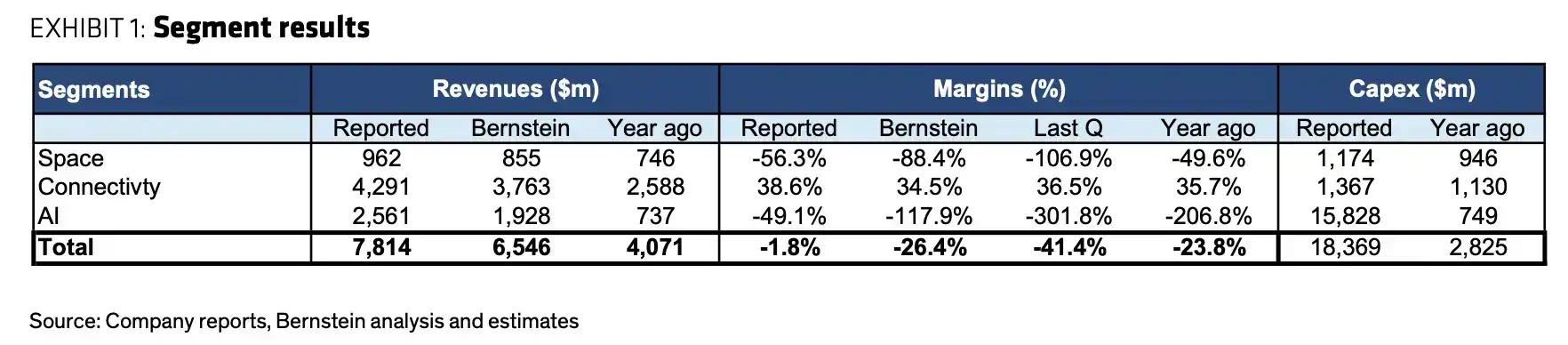
Table of SpaceX's Q2 performance by its three business segments. Connectivity contributes the main profit, while AI segment capital expenditure reached $15.828 billion. Source: Bernstein

AI Compute Opens Revenue Potential; A Trillion in Revenue Can't Rely Solely on Satellite Internet

The most notable change from the earnings call was Musk moving the target year for reaching $1 trillion in annual revenue from 2031 to 2030, suggesting it could be achieved as early as 2029. Management also presented expectations for an annualized revenue run rate of at least $100 billion, though this Bernstein report summary does not explicitly state the corresponding timeframe.

To approach this target, SpaceX clearly cannot rely solely on Starlink user growth. Connectivity needs to continue expanding its consumer, enterprise, and government customer base; the AI business needs to convert massive compute capacity into long-term contracts and stable revenue; and Starship needs to reduce the costs of satellite deployment and orbital data center construction.

Among these, AI compute pricing is the most sensitive variable.

Musk stated that compute service pricing could remain in the range of $30 to $50 per watt, noting this assessment aligns with prices agreed upon in deals with Anthropic and Google. In contrast, Bernstein's current model still assumes compute prices will eventually revert to approximately $10 per watt.

This means that the $30 to $50 per watt range is not the base assumption already incorporated into Bernstein's $239 target price, but rather potential model upside. If SpaceX can maintain higher prices while expanding capacity, its long-term revenue and EBITDA could significantly exceed Bernstein's current forecasts.

However, the sustainability of this price range remains uncertain. Customer contract terms and cancellation clauses, AI compute supply and demand dynamics, semiconductor supply, and competitor expansion could all impact actual realized prices.

Capacity expansion targets are similarly aggressive. SpaceX's nominal compute capacity was 1.4 GW at the end of Q2. The company expects to exceed 2 GW by the end of 2026, approach 10 GW by the end of 2027, and move toward 20 GW in 2028. If this pace is realized, SpaceX's business structure will evolve beyond just rocket launches and satellite internet, extending further into large-scale AI infrastructure.

Key financial and valuation projection table. Bernstein forecasts SpaceX's revenue for 2025-2027 to be $18.674 billion, $40.236 billion, and $84.990 billion respectively, with the EV/Adjusted EBITDA multiple decreasing from 245.7x to 37.2x.

The Prerequisite for High-Frequency Launches is Full Reusability for Starship

In SpaceX's valuation framework, Connectivity answers the question "Is there a current profit foundation?", AI compute answers "How much faster can revenue grow?", and Starship answers "Can future scale be achieved at a sufficiently low cost?"

If SpaceX is to approach $1 trillion in annual revenue around 2030, relying solely on Starlink user growth is insufficient. Starship's launch frequency, payload capacity, and degree of full reusability will directly impact the costs of next-generation Starlink satellite deployment, orbital data center construction, and the expansion of other space businesses.

Management has still presented a very aggressive timeline. The company plans to continue advancing Starship orbital flights and V3 satellite deployment, while attempting more complex booster and upper stage recovery maneuvers. Its long-term goal is to approach a daily launch rate by the end of 2027, operating five launch pads, with two in Texas and three in Florida.

Achieving this frequency requires SpaceX not only to reuse the booster but also to solve the upper stage recovery problem for Starship. Bernstein believes a durable heat shield is key to full upper stage reusability. Musk indicated that flight number 13 may have addressed the heat shield issue, but analysis is not yet complete and will require further flights for validation.

Regulatory approvals, launch pad construction, flight anomalies, and iteration cycles could also affect the pace at which Starship transitions from high-frequency testing to industrialized operations. Therefore, full reusability remains the most critical, yet also the most uncertain, component in Bernstein's valuation model.

The $239 Target Price Relies on Three Pillars Being Realized in Tandem

Bernstein's $239 12-month target price is derived by calculating the 2030 enterprise value based on projected 2031 EBITDA for each business, using sum-of-the-parts valuation and forward EV/EBITDA multiples, then discounting each segment's valuation back to mid-2027. Connectivity and AI are discounted using late-stage venture capital discount rates of 25% and 35%, respectively.

Notably, Bernstein's model projects SpaceX's 2031 revenue at $554 billion, significantly lower than management's $1 trillion target. Its long-term compute price assumption also remains a reversion to approximately $10 per watt, not the $30 to $50 per watt suggested by Musk.

Therefore, the $239 target price does not require SpaceX to fully achieve all of management's vision but still incorporates strong business expansion assumptions. It requires at least three elements to be realized in tandem: continued profit growth from Connectivity, AI compute translating high capital expenditure into scaled revenue, and Starship achieving its planned full reusability milestones.

SpaceX's stock price has declined noticeably since its IPO, yet Bernstein maintains its $239 price target and Outperform rating. Source: Bernstein

This also explains why SpaceX's stock price fell significantly after the earnings release despite Q2 revenue and earnings per share exceeding expectations. Quarterly performance can only demonstrate that current growth remains strong; it cannot directly alleviate market concerns about AI investment returns, post-lock-up stock supply, and Starship execution risk.

If AI compute pricing can be maintained in the $30 to $50 per watt range for a longer duration, Starship's full reusability progresses as planned, and Starlink consumer and enterprise customer growth continues, Bernstein's current model still has room for upward revision. Conversely, if compute contract fulfillment, semiconductor supply, or Starship development progress falls short of expectations, the $239 target price itself will face pressure.


Trend Kriptolar

İlgili Sorular

QWhat is Bernstein's target price for SpaceX and what is the implied upside based on the August 4th closing price?

ABernstein maintains a target price of $239 for SpaceX. Based on the August 4th closing price of $125.33, this represents an implied upside of approximately 91%.

QAccording to the article, what are the three key elements Bernstein's $239 target price relies on being fulfilled?

ABernstein's $239 target price relies on three key elements: 1) Continued profit growth from the Connectivity (Starlink) business, 2) AI computing transforming high capital expenditures into scaled revenue, and 3) Starship successfully achieving full and rapid reusability as planned.

QWhat was SpaceX's Q2 revenue and how did it compare to market expectations?

ASpaceX's Q2 revenue was $7.814 billion, representing 92% year-over-year growth. This significantly exceeded market expectations, which Bernstein cited as $6.546 billion and another consensus at $6.9 billion.

QWhat is the critical difference between Bernstein's and SpaceX management's assumptions regarding the long-term price of AI computing power?

AThe critical difference is the assumed long-term price per watt for AI computing. SpaceX management (Musk) suggests prices could remain in the $30-$50/watt range based on recent deals. In contrast, Bernstein's valuation model still assumes the price will eventually fall to around $10/watt.

QWhy did SpaceX's stock price fall sharply after the release of its strong Q2 earnings, according to the article?

AThe stock price fell because the market was looking beyond the strong quarterly results. Investors were simultaneously weighing concerns about the return on massive AI capital expenditures, potential selling pressure from the post-IPO lockup expiration, and the execution risk of Starship achieving high-frequency, low-cost launch capability.

İlgili Okumalar

Writing Censorship Resistance into the Protocol: Who Decides If an Ethereum Transaction Can Be On-Chained?

Building censorship resistance into the protocol: who decides if an Ethereum transaction gets into a block? In Ethereum, censorship resistance is a technical capability, not a political stance. A key challenge emerges from the current Proposer-Builder Separation (PBS) model, where specialized Builders construct most blocks. This centralizes the power to include transactions, creating risks, as Builders can exclude certain transactions under external pressure. The core problem is ensuring any transaction following protocol rules gets a fair chance to enter a block. To address Builder dominance, Ethereum researchers are exploring Inclusion Lists—mechanisms allowing validators to specify transactions that must be included if valid and space permits. Two primary proposals are detailed: 1. **FOCIL (Fork-Choice Enforced Inclusion Lists)**: Distributes the power to create an inclusion list from a single Proposer to a randomly selected committee of validators. If a Builder ignores the committee's aggregated list, the network's consensus rules will reject the block, making censorship costly. 2. **FairFIL (Fair Forward Inclusion Lists)**: Focuses on accountability and economic disincentives. Builders must publicly list valid transactions they exclude, creating a verifiable record. Persistently censoring transactions by omitting them from this list can lead to escalating penalties, including loss of block rewards. For users, these mechanisms aim to improve transaction inclusion certainty without changing how they interact with wallets. Valid, fee-paying transactions should no longer be indefinitely delayed by a Builder's choice. While Builders retain control over transaction ordering for MEV extraction, their gatekeeping power over *who gets in* is constrained. Current status: FOCIL is advancing in Ethereum's development pipeline, while FairFIL is an earlier-stage research proposal. Ultimately, Ethereum's approach acknowledges that not all participants will remain neutral. The goal is to make censorship observable, expensive, and unsustainable through protocol-level rules, moving the network's credible neutrality from a social promise to a technically enforced property.

marsbit1 dk önce

Writing Censorship Resistance into the Protocol: Who Decides If an Ethereum Transaction Can Be On-Chained?

marsbit1 dk önce

Dice vs. Hackers: Why South Korean Bitcoiners Escaped the Coldcard Hack Unscathed

South Korea's Bitcoin community suffered minimal direct losses from the recent Coldcard hardware wallet hack, despite the device's popularity among its most experienced users. An error in random number generation in certain Coldcard models allowed attackers to access vulnerable seed phrases, leading to the theft of over 1,596 BTC (approx. $130M) from thousands of addresses globally. Analyst Koji Higashi attributes Korea's resilience not to luck, but to a long-standing community culture of self-custody and caution. Local leaders have long promoted generating seed phrases independently from any device, relying on offline, analog methods like dice rolls or coin flips to create true randomness, followed by offline BIP39 phrase creation and verification. In contrast, English-speaking self-custody communities, despite high technical literacy, experienced more significant losses. Higashi links this to greater reliance on influencers, some with ties to the manufacturer (Coinkite), creating an echo chamber of trust in the device's security without independent verification. Korean leaders, lacking commercial ties, provided more neutral risk assessments that their followers heeded. The incident underscores applying Bitcoin's "don't trust, verify" principle not just to code, but to information sources. The key takeaway is to create seed phrases using independent physical methods where possible and to default to distrusting any device's built-in random number generator.

cryptonews.ru4 dk önce

Dice vs. Hackers: Why South Korean Bitcoiners Escaped the Coldcard Hack Unscathed

cryptonews.ru4 dk önce

Senate to Vote on CLARITY Act Before August Recess, Lummis Says

U.S. Senator Cynthia Lummis (R-WY), chair of the Senate's digital assets subcommittee, stated the Senate may work past Friday and through the weekend to secure a vote on the CLARITY Act before the August recess. This vote would force senators to take a public position on the bill. Over 300 pages of amendments, requested by Democrats, have been prepared after 11 months of negotiations, with final discussions ongoing regarding CFTC jurisdiction, law enforcement provisions, and ethics rules for senior federal officials. Key unresolved issues, per Democratic staff, include securities protection, illicit finance, national security, and presidential conflicts of interest. A bipartisan counterproposal, allowing state attorneys general to enforce federal crypto ethics rules, has been sent to President Trump, who reportedly agreed to broader restrictions than those applied to previous presidents. Lummis asserted that if the bill fails, it will be due to Democratic opposition. Regulators have expressed support. CFTC Chairman Michael S. Selig endorsed congressional action for clearer digital asset rules, while SEC Chairman Paul Atkins expressed optimism about the bill's passage. The CLARITY Act aims to divide oversight between the CFTC and SEC, providing distinct regulatory frameworks for cryptocurrencies and securities. Proponents argue this clarity will help retain crypto companies, capital, and innovation within the United States, preventing an exodus to jurisdictions like Switzerland or Singapore. The approaching recess deadline increases pressure to secure the 60 votes typically needed. With Republicans holding 53 seats, Democratic support is crucial. A Senate vote would lock in each legislator's stance before negotiations with the House on a final bill text.

cryptonews.ru15 dk önce

Senate to Vote on CLARITY Act Before August Recess, Lummis Says

cryptonews.ru15 dk önce

İşlemler

Spot

Popüler Makaleler

$S$ Nedir

SPERO'yu Anlamak: Kapsamlı Bir Genel Bakış SPERO'ya Giriş İnovasyonun manzarası gelişmeye devam ederken, web3 teknolojilerinin ve kripto para projelerinin ortaya çıkışı dijital geleceği şekillendirmede önemli bir rol oynamaktadır. Bu dinamik alanda dikkat çeken projelerden biri SPERO, $$s$$ olarak adlandırılmaktadır. Bu makale, SPERO hakkında ayrıntılı bilgi toplamak ve sunmak amacıyla, meraklılar ve yatırımcıların web3 ve kripto alanlarındaki temellerini, hedeflerini ve yeniliklerini anlamalarına yardımcı olmayı amaçlamaktadır. SPERO,$$s$$ Nedir? SPERO,$$s$$, kripto alanında merkeziyetsizlik ve blok zinciri teknolojisi ilkelerini kullanarak etkileşimi, faydayı ve finansal kapsayıcılığı teşvik eden bir ekosistem yaratmayı amaçlayan benzersiz bir projedir. Proje, kullanıcıların yenilikçi finansal çözümler ve hizmetler sunarak eşler arası etkileşimleri yeni yollarla kolaylaştırmayı hedeflemektedir. SPERO,$$s$$'nin temel amacı, bireyleri güçlendirmek ve kripto para alanındaki kullanıcı deneyimini artıran araçlar ve platformlar sağlamaktır. Bu, daha esnek işlem yöntemlerini mümkün kılmayı, topluluk odaklı girişimleri teşvik etmeyi ve merkeziyetsiz uygulamalar (dApp'ler) aracılığıyla finansal fırsatlar yaratmayı içermektedir. SPERO,$$s$$'nin temel vizyonu kapsayıcılık etrafında dönmekte olup, geleneksel finansal sistemlerdeki boşlukları kapatmayı ve blok zinciri teknolojisinin faydalarından yararlanmayı hedeflemektedir. SPERO,$$s$$'nin Yaratıcısı Kimdir? SPERO,$$s$$'nin yaratıcısının kimliği bir miktar belirsizdir, çünkü kurucusu(ları) hakkında ayrıntılı arka plan bilgisi sağlayan sınırlı kamuya açık kaynaklar bulunmaktadır. Bu şeffaflık eksikliği, projenin merkeziyetsizlik taahhüdünden kaynaklanabilir—birçok web3 projesinin paylaştığı bir etik anlayışı, bireysel tanınmanın yerine kolektif katkıları önceliklendirmektedir. Topluluk ve onun kolektif hedefleri etrafında tartışmaları merkezileştirerek, SPERO,$$s$$, belirli bireyleri öne çıkarmadan güçlendirme özünü taşımaktadır. Bu nedenle, SPERO'nun etik anlayışını ve misyonunu anlamak, tek bir yaratıcının kimliğini belirlemekten daha önemlidir. SPERO,$$s$$'nin Yatırımcıları Kimlerdir? SPERO,$$s$$, kripto sektöründe yeniliği teşvik etmeye adanmış girişim sermayedarlarından melek yatırımcılara kadar çeşitli yatırımcılar tarafından desteklenmektedir. Bu yatırımcıların odak noktası genellikle SPERO'nun misyonuyla uyumlu olup, toplumsal teknolojik ilerlemeyi, finansal kapsayıcılığı ve merkeziyetsiz yönetimi vaat eden projeleri önceliklendirmektedir. Bu yatırımcı temelleri, yalnızca yenilikçi ürünler sunan projelere değil, aynı zamanda blok zinciri topluluğuna ve ekosistemlerine olumlu katkılarda bulunan projelere de ilgi duymaktadır. Bu yatırımcıların desteği, SPERO,$$s$$'yi hızla gelişen kripto projeleri alanında dikkate değer bir rakip haline getirmektedir. SPERO,$$s$$ Nasıl Çalışır? SPERO,$$s$$, onu geleneksel kripto para projelerinden ayıran çok yönlü bir çerçeve kullanmaktadır. İşte benzersizliğini ve yeniliğini vurgulayan bazı temel özellikler: Merkeziyetsiz Yönetim: SPERO,$$s$$, kullanıcıların projenin geleceğiyle ilgili karar alma süreçlerine aktif olarak katılmalarını sağlayan merkeziyetsiz yönetim modellerini entegre etmektedir. Bu yaklaşım, topluluk üyeleri arasında sahiplik ve hesap verebilirlik duygusunu teşvik etmektedir. Token Kullanımı: SPERO,$$s$$, ekosistem içinde çeşitli işlevler sunmak üzere tasarlanmış kendi kripto para token'ını kullanmaktadır. Bu token'lar, işlemleri, ödülleri ve platformda sunulan hizmetlerin kolaylaştırılmasını sağlayarak genel etkileşimi ve faydayı artırmaktadır. Katmanlı Mimari: SPERO,$$s$$'nin teknik mimarisi, modülerlik ve ölçeklenebilirliği destekleyerek projenin evrimi sırasında ek özelliklerin ve uygulamaların sorunsuz bir şekilde entegrasyonuna olanak tanımaktadır. Bu uyum sağlama yeteneği, sürekli değişen kripto manzarasında geçerliliği sürdürmek için hayati öneme sahiptir. Topluluk Katılımı: Proje, işbirliği ve geri bildirim teşvik eden mekanizmalar kullanarak topluluk odaklı girişimlere vurgu yapmaktadır. Güçlü bir topluluk oluşturarak, SPERO,$$s$$, kullanıcı ihtiyaçlarını daha iyi karşılayabilir ve piyasa trendlerine uyum sağlayabilir. Kapsayıcılığa Odaklanma: Düşük işlem ücretleri ve kullanıcı dostu arayüzler sunarak, SPERO,$$s$$, daha önce kripto alanında yer almamış bireyler de dahil olmak üzere çeşitli bir kullanıcı tabanını çekmeyi hedeflemektedir. Bu kapsayıcılık taahhüdü, erişilebilirlik yoluyla güçlendirme misyonuyla uyumludur. SPERO,$$s$$ Zaman Çizelgesi Bir projenin tarihini anlamak, gelişim yolculuğu ve kilometre taşları hakkında kritik bilgiler sağlar. Aşağıda, SPERO,$$s$$'nin evriminde önemli olayları haritalayan önerilen bir zaman çizelgesi bulunmaktadır: Kavram Geliştirme ve Fikir Aşaması: SPERO,$$s$$'nin temelini oluşturan ilk fikirler, blok zinciri endüstrisindeki merkeziyetsizlik ve topluluk odaklılık ilkeleriyle yakından uyumlu olarak geliştirildi. Proje Beyaz Kağıdının Yayınlanması: Kavramsal aşamayı takiben, SPERO,$$s$$'nin vizyonunu, hedeflerini ve teknolojik altyapısını ayrıntılı bir şekilde açıklayan kapsamlı bir beyaz kağıt yayımlandı ve topluluk ilgisini ve geri bildirimini toplamak amacıyla sunuldu. Topluluk Oluşturma ve Erken Katılımlar: Projenin hedefleri etrafında tartışmalar yürüterek destek toplamak ve erken benimseyenler ile potansiyel yatırımcılar için bir topluluk oluşturmak amacıyla aktif iletişim çabaları gerçekleştirildi. Token Üretim Etkinliği: SPERO,$$s$$, yerel token'larını erken destekçilere dağıtmak ve ekosistem içinde başlangıç likiditesini sağlamak amacıyla bir token üretim etkinliği (TGE) gerçekleştirdi. İlk dApp'in Yayınlanması: SPERO,$$s$$ ile ilişkili ilk merkeziyetsiz uygulama (dApp) faaliyete geçti ve kullanıcıların platformun temel işlevleriyle etkileşimde bulunmalarını sağladı. Sürekli Gelişim ve Ortaklıklar: Projenin tekliflerine sürekli güncellemeler ve iyileştirmeler yapılmakta olup, blok zinciri alanındaki diğer oyuncularla stratejik ortaklıklar, SPERO,$$s$$'yi rekabetçi ve gelişen bir oyuncu haline getirmiştir. Sonuç SPERO,$$s$$, web3 ve kripto paranın finansal sistemleri devrim niteliğinde dönüştürme ve bireyleri güçlendirme potansiyelinin bir kanıtıdır. Merkeziyetsiz yönetime, topluluk katılımına ve yenilikçi tasarlanmış işlevselliğe olan bağlılığıyla, daha kapsayıcı bir finansal manzaraya doğru bir yol açmaktadır. Hızla gelişen kripto alanındaki herhangi bir yatırımda olduğu gibi, potansiyel yatırımcılar ve kullanıcılar, SPERO,$$s$$ içindeki devam eden gelişmelerle ilgili olarak kapsamlı bir araştırma yapmaları ve düşünceli bir şekilde katılmaları teşvik edilmektedir. Proje, kripto endüstrisinin yenilikçi ruhunu sergileyerek, sayısız olasılığını keşfetmeye davet etmektedir. SPERO,$$s$$'nin yolculuğu hala devam ederken, temel ilkeleri, teknoloji, finans ve birbirimizle etkileşim biçimimizi etkileyebilir.

331 Toplam GörüntülenmeYayınlanma 2024.12.17Güncellenme 2024.12.17

$S$ Nedir

AGENT S Nedir

Agent S: Web3'te Otonom Etkileşimin Geleceği Giriş Web3 ve kripto para dünyasında sürekli gelişen manzarada, yenilikler bireylerin dijital platformlarla etkileşim biçimlerini sürekli olarak yeniden tanımlıyor. Bu tür öncü projelerden biri olan Agent S, açık ajans çerçevesi aracılığıyla insan-bilgisayar etkileşimini devrim niteliğinde değiştirmeyi vaat ediyor. Otonom etkileşimlerin yolunu açarak, Agent S karmaşık görevleri basitleştirmeyi ve yapay zeka (AI) alanında dönüştürücü uygulamalar sunmayı hedefliyor. Bu detaylı inceleme, projenin karmaşıklıklarına, benzersiz özelliklerine ve kripto para alanındaki etkilerine dalacaktır. Agent S Nedir? Agent S, bilgisayar görevlerinin otomasyonunda üç temel zorluğu ele almak üzere özel olarak tasarlanmış çığır açıcı bir açık ajans çerçevesidir: Alan Spesifik Bilgi Edinimi: Çerçeve, çeşitli dış bilgi kaynaklarından ve iç deneyimlerden akıllıca öğrenir. Bu çift yönlü yaklaşım, alan spesifik bilgi açısından zengin bir veri havuzu oluşturmasını sağlar ve görev yürütmedeki performansını artırır. Uzun Görev Ufukları Üzerinde Planlama: Agent S, karmaşık görevlerin verimli bir şekilde parçalanmasını ve yürütülmesini kolaylaştıran deneyim artırımlı hiyerarşik planlama kullanır. Bu özellik, çoklu alt görevleri etkili ve verimli bir şekilde yönetme yeteneğini önemli ölçüde artırır. Dinamik, Homojen Olmayan Arayüzlerle Başlama: Proje, ajanlar ve kullanıcılar arasındaki etkileşimi geliştiren yenilikçi bir çözüm olan Ajan-Bilgisayar Arayüzü'ni (ACI) tanıtmaktadır. Çok Modlu Büyük Dil Modellerini (MLLM'ler) kullanarak, Agent S çeşitli grafik kullanıcı arayüzlerini sorunsuz bir şekilde gezinebilir ve manipüle edebilir. Bu öncü özellikler aracılığıyla, Agent S, makinelerle insan etkileşimini otomatikleştirmede karşılaşılan karmaşıklıkları ele alan sağlam bir çerçeve sunarak, AI ve ötesinde birçok uygulama için zemin hazırlıyor. Agent S'nin Yaratıcısı Kimdir? Agent S'nin kavramı temelde yenilikçi olsa da, yaratıcısı hakkında spesifik bilgiler belirsizliğini koruyor. Yaratıcı şu anda bilinmiyor, bu da projenin yeni aşamasını veya kurucu üyeleri gizli tutma stratejik tercihini vurguluyor. Anonimlikten bağımsız olarak, odak çerçevenin yetenekleri ve potansiyeli üzerinde kalıyor. Agent S'nin Yatırımcıları Kimlerdir? Agent S, kriptografik ekosistemde oldukça yeni olduğundan, yatırımcıları ve finansal destekçileri hakkında ayrıntılı bilgiler açıkça belgelenmemiştir. Projeyi destekleyen yatırım temelleri veya organizasyonları hakkında kamuya açık bilgilerdeki eksiklik, finansman yapısı ve gelişim yol haritası hakkında sorular doğuruyor. Destekleyicilerin anlaşılması, projenin sürdürülebilirliğini ve potansiyel pazar etkisini değerlendirmek için kritik öneme sahiptir. Agent S Nasıl Çalışır? Agent S'nin temelinde, çeşitli ortamlarda etkili bir şekilde çalışmasını sağlayan son teknoloji bir sistem yatmaktadır. İşleyiş modeli birkaç ana özellik etrafında inşa edilmiştir: İnsan Benzeri Bilgisayar Etkileşimi: Çerçeve, bilgisayarlarla etkileşimleri daha sezgisel hale getirmeyi amaçlayan gelişmiş AI planlaması sunar. Görev yürütmedeki insan davranışını taklit ederek, kullanıcı deneyimlerini yükseltmeyi vaat eder. Anlatı Belleği: Yüksek düzeyde deneyimlerden yararlanmak için kullanılan Agent S, görev geçmişlerini takip etmek amacıyla anlatı belleğini kullanarak karar verme süreçlerini geliştirir. Episodik Bellek: Bu özellik, kullanıcılara adım adım rehberlik sağlayarak, çerçevenin görevler gelişirken bağlamsal destek sunmasına olanak tanır. OpenACI Desteği: Yerel olarak çalışabilme yeteneği ile Agent S, kullanıcıların etkileşimleri ve iş akışları üzerinde kontrol sağlamasına olanak tanır ve Web3'ün merkeziyetsiz felsefesiyle uyumlu hale gelir. Dış API'lerle Kolay Entegrasyon: Çeşitli AI platformlarıyla uyumluluğu ve çok yönlülüğü, Agent S'nin mevcut teknolojik ekosistemlere sorunsuz bir şekilde entegre olmasını sağlar ve geliştiriciler ile organizasyonlar için cazip bir seçenek haline getirir. Bu işlevsellikler, Agent S'nin kripto alanındaki benzersiz konumuna katkıda bulunarak, karmaşık, çok aşamalı görevleri minimum insan müdahalesi ile otomatikleştirir. Proje geliştikçe, Web3'teki potansiyel uygulamaları dijital etkileşimlerin nasıl gelişeceğini yeniden tanımlayabilir. Agent S'nin Zaman Çizelgesi Agent S'nin gelişimi ve kilometre taşları, önemli olaylarını vurgulayan bir zaman çizelgesinde özetlenebilir: 27 Eylül 2024: Agent S'nin kavramı, “Bilgisayarları İnsan Gibi Kullanan Açık Bir Ajans Çerçevesi” başlıklı kapsamlı bir araştırma makalesi ile tanıtıldı ve projenin temelini sergiledi. 10 Ekim 2024: Araştırma makalesi arXiv'de kamuya açık olarak yayınlandı ve çerçevenin derinlemesine bir incelemesini ve OSWorld benchmark'ına dayalı performans değerlendirmesini sundu. 12 Ekim 2024: Agent S'nin yetenekleri ve özellikleri hakkında görsel bir içgörü sağlayan bir video sunumu yayımlandı ve potansiyel kullanıcılar ve yatırımcılarla daha fazla etkileşim sağlandı. Bu zaman çizelgesindeki işaretler, sadece Agent S'nin ilerlemesini değil, aynı zamanda şeffaflık ve topluluk katılımına olan bağlılığını da göstermektedir. Agent S Hakkında Ana Noktalar Agent S çerçevesi gelişmeye devam ederken, birkaç ana özellik öne çıkmakta ve yenilikçi doğasını ve potansiyelini vurgulamaktadır: Yenilikçi Çerçeve: İnsan etkileşimine benzer bir bilgisayar kullanımı sağlamak üzere tasarlanan Agent S, görev otomasyonuna yeni bir yaklaşım getiriyor. Otonom Etkileşim: GUI aracılığıyla bilgisayarlarla otonom olarak etkileşim kurabilme yeteneği, daha akıllı ve verimli hesaplama çözümlerine doğru bir sıçrama anlamına geliyor. Karmaşık Görev Otomasyonu: Sağlam metodolojisi ile karmaşık, çok aşamalı görevleri otomatikleştirerek süreçleri daha hızlı ve daha az hata payı ile gerçekleştirebilir. Sürekli İyileştirme: Öğrenme mekanizmaları, Agent S'nin geçmiş deneyimlerden öğrenmesini sağlar ve sürekli olarak performansını ve etkinliğini artırır. Çok Yönlülük: OSWorld ve WindowsAgentArena gibi farklı işletim ortamlarında uyumlu olması, geniş bir uygulama yelpazesine hizmet edebilmesini sağlar. Agent S, Web3 ve kripto alanında kendini konumlandırırken, etkileşim yeteneklerini artırma ve süreçleri otomatikleştirme potansiyeli, AI teknolojilerinde önemli bir ilerlemeyi temsil etmektedir. Yenilikçi çerçevesi aracılığıyla, Agent S dijital etkileşimlerin geleceğini örneklemekte ve çeşitli sektörlerde kullanıcılar için daha sorunsuz ve verimli bir deneyim vaat etmektedir. Sonuç Agent S, AI ve Web3'ün birleşiminde cesur bir sıçramayı temsil ediyor ve teknoloji ile etkileşim biçimimizi yeniden tanımlama kapasitesine sahip. Henüz erken aşamalarında olmasına rağmen, uygulama olanakları geniş ve çekici. Kritik zorlukları ele alan kapsamlı çerçevesi ile Agent S, otonom etkileşimleri dijital deneyimin ön plana çıkmasına taşımayı hedefliyor. Kripto para ve merkeziyetsizlik alanlarına daha derinlemesine girdikçe, Agent S gibi projelerin teknoloji ve insan-bilgisayar işbirliğinin geleceğini şekillendirmede önemli bir rol oynayacağı kesin.

792 Toplam GörüntülenmeYayınlanma 2025.01.14Güncellenme 2025.01.14

AGENT S Nedir

S Nasıl Satın Alınır

HTX.com’a hoş geldiniz! Sonic (S) satın alma işlemlerini basit ve kullanışlı bir hâle getirdik. Adım adım açıkladığımız rehberimizi takip ederek kripto yolculuğunuza başlayın. 1. Adım: HTX Hesabınızı OluşturunHTX'te ücretsiz bir hesap açmak için e-posta adresinizi veya telefon numaranızı kullanın. Sorunsuzca kaydolun ve tüm özelliklerin kilidini açın. Hesabımı Aç2. Adım: Kripto Satın Al Bölümüne Gidin ve Ödeme Yönteminizi SeçinKredi/Banka Kartı: Visa veya Mastercard'ınızı kullanarak anında Sonic (S) satın alın.Bakiye: Sorunsuz bir şekilde işlem yapmak için HTX hesap bakiyenizdeki fonları kullanın.Üçüncü Taraflar: Kullanımı kolaylaştırmak için Google Pay ve Apple Pay gibi popüler ödeme yöntemlerini ekledik.P2P: HTX'teki diğer kullanıcılarla doğrudan işlem yapın.Borsa Dışı (OTC): Yatırımcılar için kişiye özel hizmetler ve rekabetçi döviz kurları sunuyoruz.3. Adım: Sonic (S) Varlıklarınızı SaklayınSonic (S) satın aldıktan sonra HTX hesabınızda saklayın. Alternatif olarak, blok zinciri transferi yoluyla başka bir yere gönderebilir veya diğer kripto para birimlerini takas etmek için kullanabilirsiniz.4. Adım: Sonic (S) Varlıklarınızla İşlem YapınHTX'in spot piyasasında Sonic (S) ile kolayca işlemler yapın.Hesabınıza erişin, işlem çiftinizi seçin, işlemlerinizi gerçekleştirin ve gerçek zamanlı olarak izleyin. Hem yeni başlayanlar hem de deneyimli yatırımcılar için kullanıcı dostu bir deneyim sunuyoruz.

2.0k Toplam GörüntülenmeYayınlanma 2025.01.15Güncellenme 2026.06.02

S Nasıl Satın Alınır

Tartışmalar

HTX Topluluğuna hoş geldiniz. Burada, en son platform gelişmeleri hakkında bilgi sahibi olabilir ve profesyonel piyasa görüşlerine erişebilirsiniz. Kullanıcıların S (S) fiyatı hakkındaki görüşleri aşağıda sunulmaktadır.

活动图片