Author: Zhao Ying
Source: Wall Street News
Former a16z partner and renowned technology analyst Benedict Evans recently published an in-depth analysis, pointing directly to four fundamental strategic dilemmas faced by OpenAI beneath its apparent prosperity. He argues that despite OpenAI's massive user base and ample capital, it lacks a technological moat, suffers from insufficient user stickiness, faces rapid competition catching up, and has a product strategy constrained by lab R&D directions, all of which threaten its long-term competitiveness.
Evans points out that OpenAI's current business model does not possess a clear competitive advantage. The company has neither unique technology nor has it formed network effects. Only 5% of its 900 million weekly active users are paying, and 80% of users sent fewer than 1000 messages in 2025—equivalent to an average of less than three prompts per day. This "a mile wide, an inch deep" usage pattern indicates that ChatGPT has not yet become a daily habit for users.
Meanwhile, tech giants like Google and Meta have caught up with OpenAI technologically and are leveraging their distribution advantages to capture market share. Evans believes the real value in the AI field will come from new experiences and application scenarios that have yet to be invented, and OpenAI cannot create all these innovations alone. This forces the company to fight on multiple fronts simultaneously, laying out a comprehensive strategy from infrastructure to the application layer.
Evans's analysis reveals a core contradiction: OpenAI is attempting to build competitive barriers through massive capital investment and a full-stack platform strategy, but it remains questionable whether this approach can succeed in the absence of network effects and user lock-in mechanisms. For investors, this means a need to reassess OpenAI's long-term value proposition and its true position in the AI competitive landscape.
Vanishing Technical Advantage: Intensifying Model Homogenization
Evans notes in his analysis that currently about six institutions can launch competitive frontier models, with performance being largely equivalent. Companies leapfrog each other every few weeks, but none has established a technical lead that others cannot match. This stands in stark contrast to platforms like Windows, Google Search, or Instagram—which achieved self-reinforcing market share through network effects, making it difficult for competitors to break the monopoly regardless of investment.
This trend towards technical parity could change due to certain breakthroughs, most obviously the achievement of continuous learning capabilities, but Evans believes OpenAI currently cannot plan for this. Another potential differentiating factor is the scale effect of proprietary data, including user data or vertical industry data, but existing platform companies also have advantages in this regard.
Against the backdrop of converging model performance, competition is shifting towards brand and distribution channels. The rapid market share growth of Gemini and Meta AI confirms this trend—for the average user, these products look very similar, and Google and Meta have strong distribution capabilities. In contrast, Anthropic's Claude model often tops benchmark tests but has near-zero consumer awareness due to its lack of a consumer strategy and product.
Evans draws an analogy between ChatGPT and Netscape, which had an early advantage in the browser market but was ultimately defeated by Microsoft leveraging its distribution advantage. He believes chatbots face the same differentiation problem as browsers: they are essentially just an input box and an output box, with extremely limited room for product innovation.
Fragile User Base: Scale Masks Lack of Stickiness
Although OpenAI has a clear lead with 800 to 900 million weekly active users, Evans points out that this data masks a serious user engagement problem. The vast majority of users who already know about and know how to use ChatGPT have not cultivated it into a daily habit.
Data shows that only 5% of ChatGPT users pay. Even among American teenagers, the proportion using it a few times a week or less is much higher than those using it multiple times daily. OpenAI's "2025 Year in Review" event disclosed that 80% of users sent fewer than 1000 messages in 2025, which at face value equates to an average of less than three prompts per day, and even fewer actual conversations.
This shallow usage means most users do not see the differences in personality and focus between different models, nor do they benefit from stickiness-building features like "Memory." Evans emphasizes that the memory feature can only bring stickiness, not network effects. Meanwhile, usage data from a larger user base could be an advantage, but it's questionable how big this advantage is when 80% of users use it at most a few times a week.
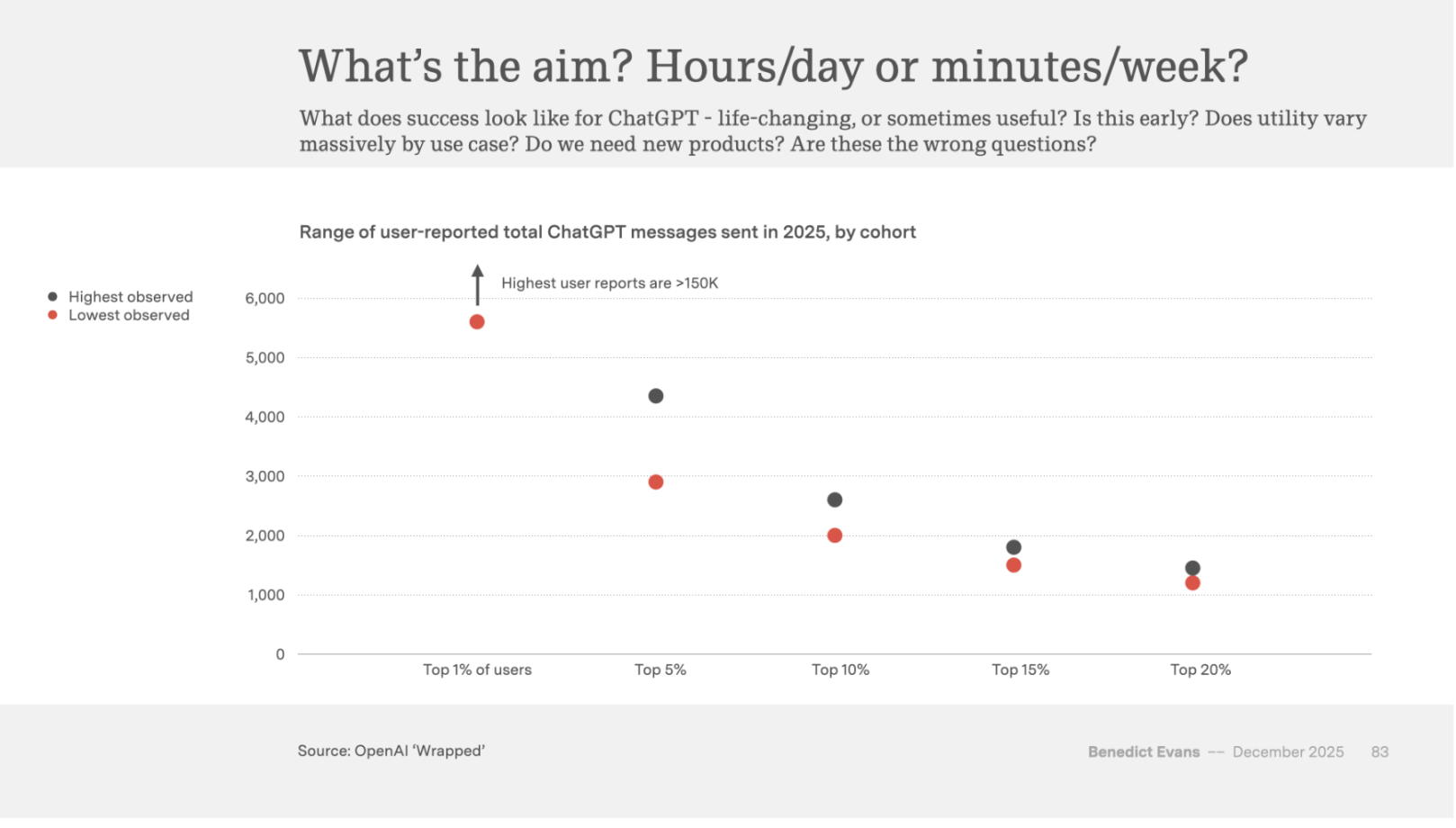
OpenAI itself has acknowledged the issue, proposing a "capability gap" between model capabilities and actual user usage. Evans sees this as sidestepping the fact that product-market fit is unclear. If users can't figure out what to use it for on an ordinary day, it means it hasn't changed their lives.
The company launched an advertising program partly to cover the service costs for the over 90% of non-paying users, but more strategically, this allows the company to offer these users the latest, most powerful (and most expensive) models, hoping to deepen user engagement. However, Evans questions whether giving users a better model will change the situation if they can't think of what to do with ChatGPT today or this week.
Platform Strategy in Question: Lack of a True Flywheel Effect
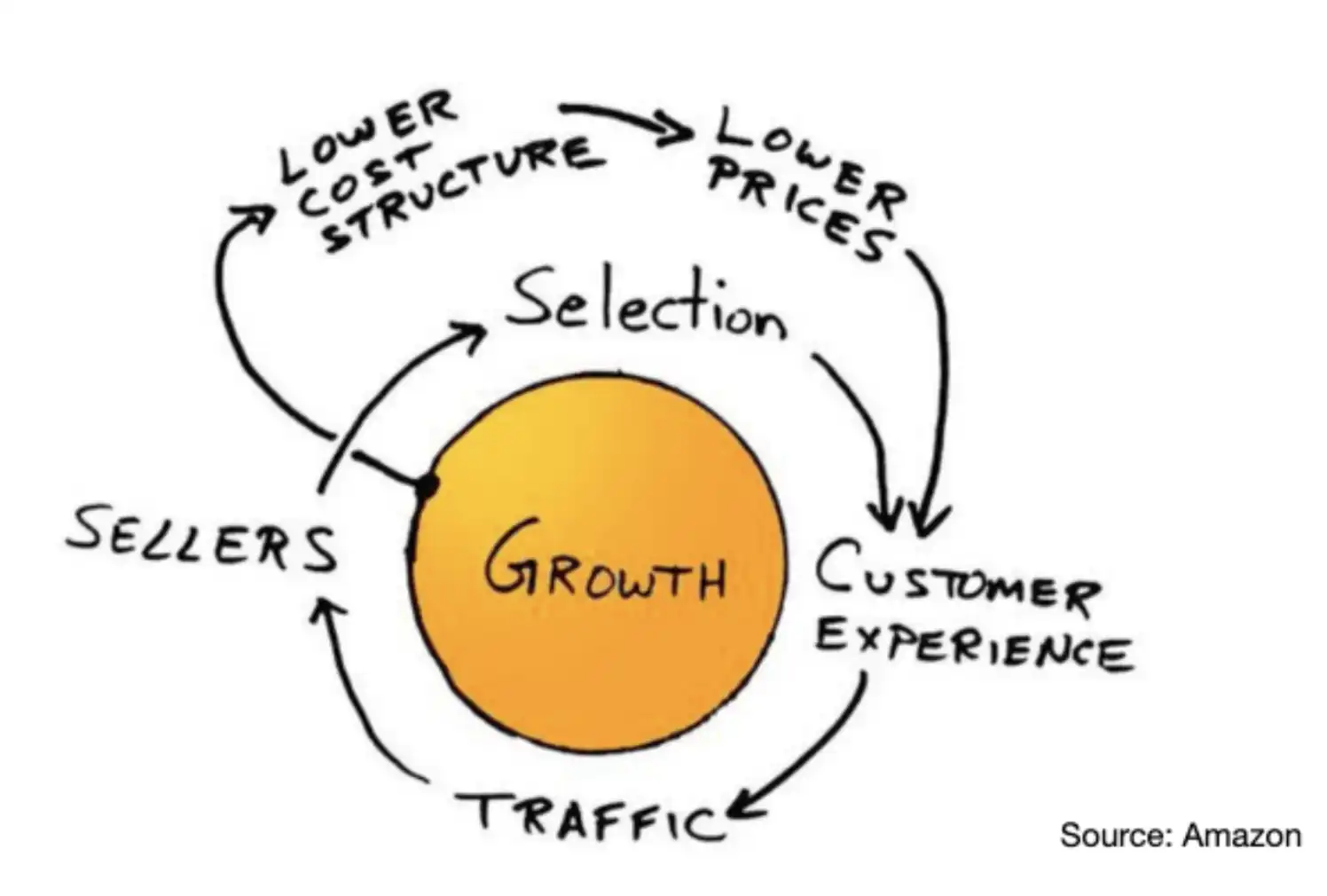
Last year, OpenAI CEO Sam Altman attempted to integrate the company's various initiatives into a coherent strategy, presenting a chart and quoting Bill Gates: "A platform is when the economic value of everybody that uses it exceeds the value of the company that creates it." Meanwhile, the CFO released another chart showcasing a "flywheel effect."
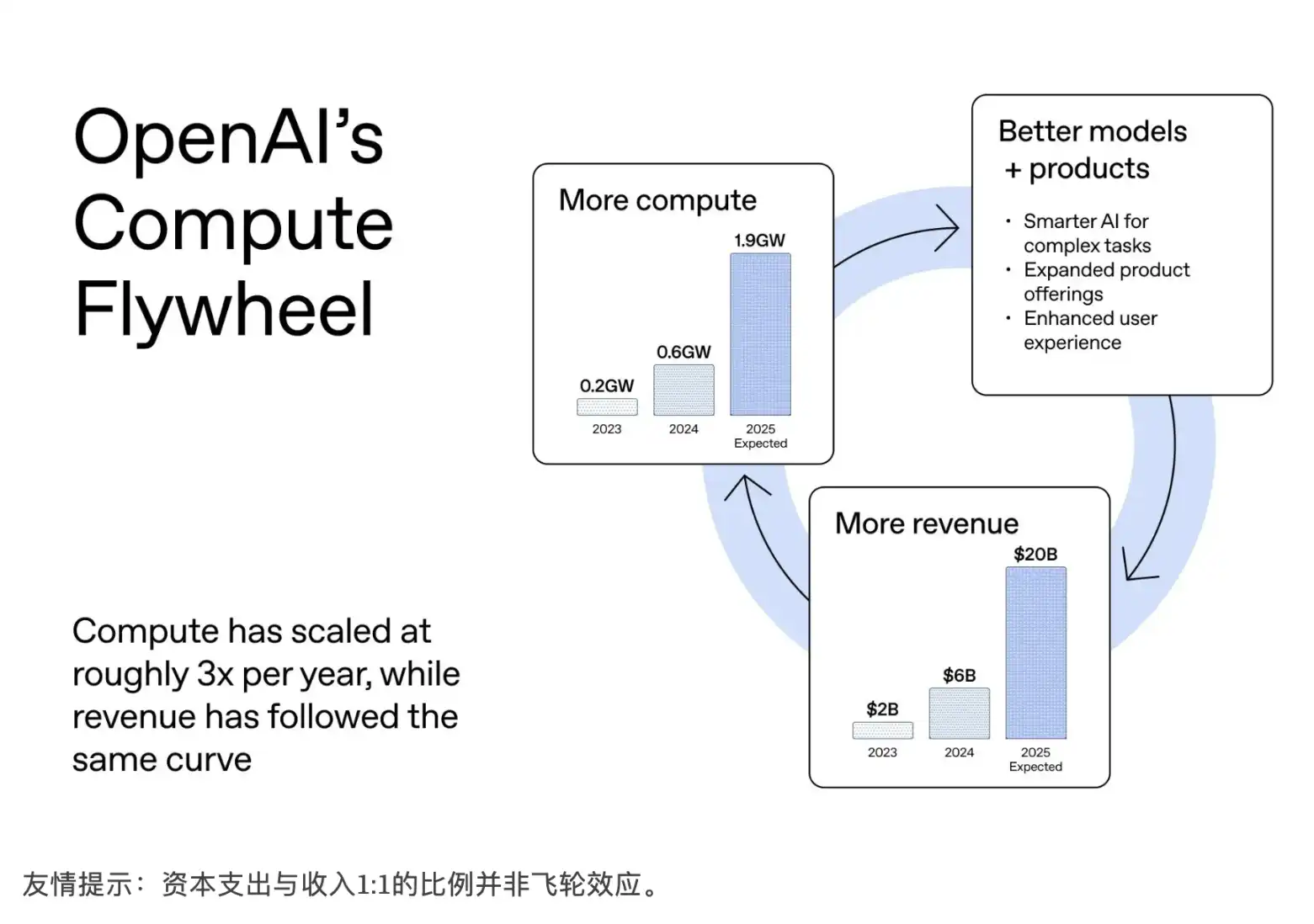
Evans considers the flywheel effect an elegant, coherent strategy: capital expenditure itself forms a virtuous cycle and becomes the foundation for building a full-stack platform company on top of it. Starting with chips and infrastructure, building up each layer of the tech stack; the higher you go, the more you help others use your tools to create their own products. Everyone uses your cloud, chips, and models, and then at higher layers, the layers of the tech stack reinforce each other, forming network effects and an ecosystem.
However, Evans bluntly states that he doesn't believe this is the right analogy, that OpenAI does not possess the platform and ecosystem dynamics that Microsoft or Apple once had, and that flywheel chart does not actually depict a true flywheel effect.
In terms of capital expenditure, the four major cloud computing firms invested about $400 billion in infrastructure last year and announced at least $650 billion for this year. OpenAI claimed a few months ago to have future commitments of $1.4 trillion and 30 gigawatts of computing power (with no clear timeline), while actual usage at the end of 2025 was 1.9 gigawatts. Lacking the large-scale cash flow from an existing business, the company achieves these goals through financing and using others' balance sheets (partly involving "recurring revenue").
Evans believes that massive capital investment might just buy a seat at the table, not a competitive advantage. He draws an analogy between AI infrastructure costs and aircraft manufacturing or the semiconductor industry: no network effects, but the process for each generation of products becomes more difficult and expensive, eventually leaving only a few companies able to sustain the investment required to stay at the frontier. However, while TSMC has a de facto monopoly in cutting-edge chips, this does not give it leverage or value capture ability further up the tech stack.
Evans points out that developers had to build apps for Windows because it had almost all the users, and users had to buy Windows PCs because it had almost all the developers—that's network effects. But if you invent a great new app or product using generative AI, you simply call the base model running in the cloud via an API, and the user doesn't know or care which model you used.
Lack of Product Leadership: Strategy Constrained by the Lab
Evans begins his article by quoting OpenAI product lead Fidji Simo from 2026: "Jakub and Mark set the long-term research direction. After months of work, amazing results emerge, and then the researchers contact me and say: 'I have something cool. How are you going to use it in chat? How for our enterprise products?'"
This stands in stark contrast to Steve Jobs' famous 1997 quote: "You've got to start with the customer experience and work backwards to the technology. You can't start with the technology and try to figure out where to sell it."
Evans argues that when you are the product lead at an AI lab, you cannot control your own roadmap; your ability to set product strategy is very limited. You open your email in the morning to find out what the lab research has produced, and your job is to turn it into a button. Strategy happens elsewhere, but where?
This issue highlights the fundamental challenge facing OpenAI: unlike Google in the 2000s or Apple in the 2010s, OpenAI's smart and ambitious employees do not have a truly effective product that others cannot replicate. Evans suggests that one interpretation of OpenAI's activities over the past 12 months is that Sam Altman is deeply aware of this and is trying to convert the company's valuation into a more lasting strategic position before the music stops.
For most of last year, OpenAI's answer seemed to be 'everything, all at once, immediately.' App platform, browser, social video app, collaboration with Jony Ive, medical research, advertising, etc. Evans believes some of this looks like "throwing everything at the wall," or simply the result of rapidly hiring lots of aggressive people. At times, it also gives the feeling that people are replicating the forms of previously successful platforms without fully understanding their purpose or dynamic mechanisms.
Evans repeatedly uses terms like platform, ecosystem, leverage, and network effects, but he acknowledges these terms are widely used in the tech industry with rather vague meanings. He quotes his university medieval history professor Roger Lovatt: "Power is the ability to make people do what they do not want to do." This, he suggests, is the real question: Does OpenAI have the ability to make consumers, developers, and enterprises use its system more, regardless of what the system actually does? Microsoft, Apple, and Facebook once had this power, as did Amazon.
Evans believes a good way to interpret Bill Gates's quote is that what a platform truly achieves is leveraging the creativity of the entire tech industry, so you don't have to invent everything yourself; you can build much more, at scale, but all of it is done on your system, under your control. Foundation models are indeed multipliers; a lot of new things will be built with them. But do you have a reason why everyone must use your product, even if competitors have built the same thing? Is there a reason why your product will always be better than competitors', no matter how much money and effort they invest?
Evans concludes that without these advantages, then all you have is execution, day after day. Executing better than everyone else is certainly an aspiration, and some companies have done it for extended periods, even convincing themselves they've institutionalized it, but it is not a strategy.