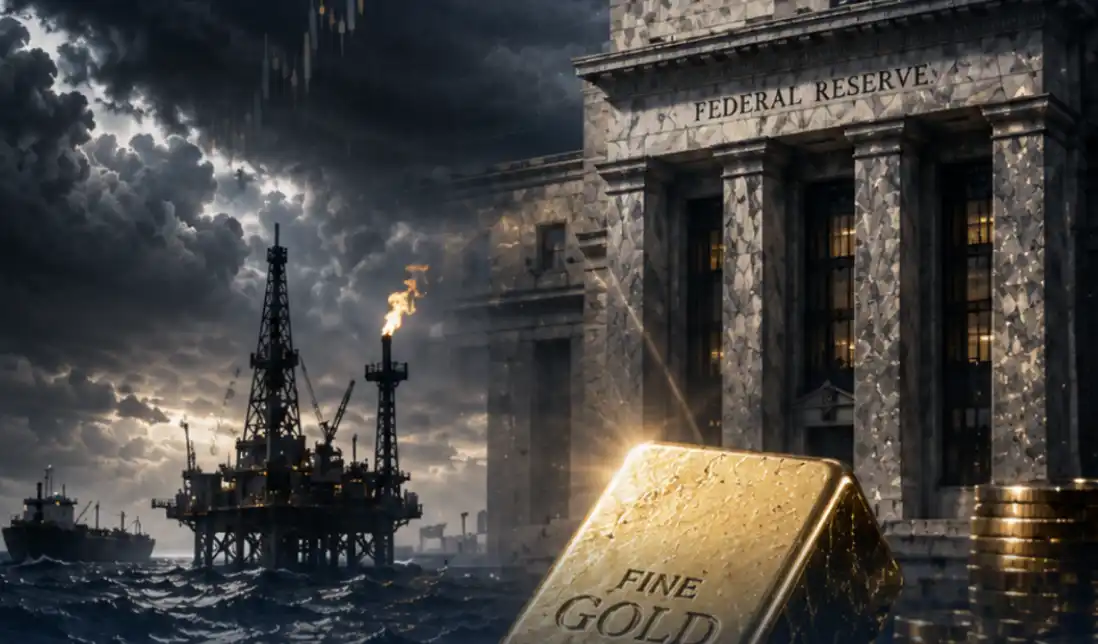
Behind the Gold's Pullback Lies a More Significant Issue: The Loosening of the Old System

Odaily星球日报2026-03-23 tarihinde yayınlandı2026-03-23 tarihinde güncellendi

Özet

Gold's recent pullback has drawn superficial comparisons to the 1979 cycle, but the underlying global dynamics have fundamentally shifted. In 1979, gold fell due to extreme Fed rate hikes under Volcker and a renewed belief in U.S. credit stability, which attracted capital back to dollar assets. Today, the situation is inverted. The U.S. faces massive debt, uncontrolled deficits, and a financial system hypersensitive to interest rates. The critical change is the structural challenge to the dollar-centric system itself, particularly the petrodollar cycle. The ongoing Middle East conflict is not an isolated event but a self-reinforcing crisis that disrupts energy flows, elevates costs, and strains fiscal capacities—undermining the dollar’s role in global energy trade. This suggests that the recent gold sell-off is a short-term profit-taking move after a strong rally, rather than a loss of long-term value. The broader narrative is one of a deteriorating monetary order: the U.S. can no longer easily suppress inflation with high rates or assert global dominance as before. As the world reassesses the entire credit system, gold is poised to assume a new role as a hedge against systemic fragility.

Original | Odaily Planet Daily (@OdailyChina)

Author | Xiao Fei

Today, many bloggers are trying to use the events of 1979 as a rigid analogy to understand the recent consecutive pullbacks in gold.

The path does indeed look similar: Middle East conflict, rising oil prices, resurgent inflation, gold rising first and then falling. Simply comparing the K-line charts might seem sufficient to pontificate.

But upon closer examination, the operating logic of the entire world and macro expectations have undergone earth-shattering changes. Armchair strategizing by drawing K-lines is meaningless, but a comparative exploration of the underlying fundamentals can allow us to glimpse the bigger picture.

Learning from History: What Happened in 1979

The key to 1979 lies in two events following the Iranian Revolution.

The first event was the Fed drastically changing the entire game rules with extreme interest rate hikes. After Paul Volcker took office, he pushed interest rates all the way up to nearly 20%. At such interest rate levels, holding cash itself became the best asset, and gold, which yields no return, was systematically abandoned.

The second event was the global flow of funds back into the US credit system. The Cold War entered a period of detente, US-Soviet confrontation ceased to escalate continuously, and the US began moving towards unipolar dominance. Around 1982, the market was trading on the expectation of "the US re-stabilizing the global order." Funds returned to dollar-denominated assets, and gold lost its support.

Therefore, the rise and subsequent fall of gold back then was because soaring interest rates + strong enough US credit pushed the price down through the reconstruction of the authoritative system.

Today and Tomorrow: The System is Loosening

Applying the same logic today, the key variables are precisely the opposite; we are standing on the cliff on the other side of the mountain.

Today's reality is: US debt规模 has ballooned to its limit, the fiscal deficit is chronically out of control, the entire financial system is highly sensitive to interest rates, and not cutting rates already counts as tightening.

More noteworthy is the change in the underlying structure. The other reason for gold's decline back then was that global funds once again believed in the US.

But the nature of the Middle East conflict today is completely different. It is not only not a local event that can be quickly concluded through negotiation (even though Trump occasionally spouts nonsense), but it has even evolved into a self-reinforcing system. This conflict is cyclically producing results and having叠加 effects: energy is being hit, shipping is being disrupted, costs are being pushed higher, finances are being burdened—all participants are locked into this structure.

Furthermore, this conflict touches the most core part of the dollar system—energy. If US control in the Middle East declines, if oil is no longer stably priced in dollars, or if relevant countries begin to重新选择 settlement methods, then the problem is not just oil prices, but: the petrodollar cycle itself could be shaken.

Once this narrative develops fissures, the foundation of dollar credit is no longer solid. And the "gold as a hedge narrative" we've always understood is inherently a hedge against this very credit system.

This comparison becomes quite interesting.

Over forty years ago, gold pulled back because that system became stronger. Now, the decline is happening during a process where the system itself is being challenged and颠覆. Back then it was "capital flowing back," now it's "capital searching for a new anchor."

Today's gold is closer to a阶段性 release: the sharp rise has already priced in the conflict and inflation, short-term funds are starting to realize profits, and the market is entering a rebalancing phase.

Changing Variables

Returning to the beginning, comparing the 1979 gold K-line with today's is of no value, but the "changing variables" within it are worth pondering deeply.

In 1979, the US dollar was the answer. In 2026, the US dollar is also being repriced.

The logic of how conflict transmits to inflation via energy, how inflation affects interest rates, and how interest rates change asset pricing is already different. Today's world has become more absurd, more complex, long past the era where order could be re-stabilized by one extreme interest rate hike.

With conflict spillover, Trump's policy flip-flops, energy prices remaining high, and the US no longer having the ability to suppress inflation with interest rates, the world might reprice the entire credit system.

At that moment, gold will also assume a new role.

İlgili Sorular

QWhat were the two key events in 1979 that led to the decline in gold prices, according to the article?

AThe two key events were: 1) The Federal Reserve, under Paul Volcker, implemented extreme interest rate hikes, pushing rates to nearly 20%, making cash a more attractive asset than non-yielding gold. 2) Global capital flowed back into the U.S. credit system as the Cold War eased and the market began trading on the expectation of 'the U.S. re-stabilizing the global order.'

QHow does the current U.S. financial situation differ from that of 1979 in terms of its ability to control inflation with interest rates?

AToday, the U.S. national debt has ballooned to its limit, the fiscal deficit is chronically out of control, and the entire financial system is highly sensitive to interest rates. The article states that 'not raising rates is already considered tightening,' implying the U.S. no longer has the capacity to aggressively hike rates to suppress inflation as it did in 1979.

QWhat core part of the dollar system is being challenged by the current conflict in the Middle East, as mentioned in the article?

AThe current conflict is challenging the core of the dollar system: energy. If U.S. influence in the Middle East declines, if oil is no longer stably priced in U.S. dollars, or if relevant countries begin to choose alternative settlement methods, the petrodollar cycle itself could be shaken.

QWhat fundamental structural change does the article suggest is causing capital to 'look for a new anchor' today, as opposed to flowing back to the U.S.?

AThe article suggests the fundamental change is a crack in the narrative of U.S. dollar credit. The U.S.'s ability to control global order and stabilize the petrodollar system is being challenged, leading to a loss of confidence. Therefore, capital is no longer flowing back to U.S. credit but is instead searching for a new foundation or 'anchor' for value.

QAccording to the article, what new role might gold assume in the future financial system?

AThe article posits that if the world begins to 'reprice the entire credit system' due to sustained high energy prices, an inability to control inflation with interest rates, and a challenged U.S. dollar system, gold will assume a new role, likely as a more prominent hedge against systemic credit risk and a fundamental store of value outside the traditional financial system.

İlgili Okumalar

The Gold Buy-on-the-Dip Guide: Watch Interest Rates, Not Just War

"Gold Buying Guide: Focus on Interest Rates, Not Just War" Four months ago, gold buyers likely didn't anticipate buying at a peak that even a war couldn't sustain. After hitting a record high of $5,596 on January 29, gold entered a bear market just 91 days later, its fastest decline since 2008. A key trigger was the Fed's hawkish shift, highlighting that monetary policy, not geopolitics, is the primary driver. The article argues that the traditional "buy gold in turmoil" script has changed. While the US-Iran conflict initially boosted prices, the sustained rally in oil prices heightened inflation fears, forcing central banks to maintain or consider tighter policy. Since gold yields no interest, higher rates increase its opportunity cost, eroding its appeal. This dynamic was evident when gold fell sharply on May 18 despite positive peace talks, as lower oil prices eased inflation and thus rate hike pressures. The recent sell-off is also part of a broader market deleveraging. Correlations between gold, Nasdaq, and Bitcoin spiked as leveraged investors sold liquid assets to cover losses, creating a synchronized downturn. Historically, gold bottoms align with policy shifts, not conflict resolutions. The 2008 and 2022 bear markets ended with shifts to extreme easing and peak inflation expectations, respectively. For potential buyers, the author suggests monitoring three signals: 1) Peak interest rate hike expectations, 2) Reopening of the Strait of Hormuz (to ease oil/inflation pressure), and 3) A return to net inflows for Gold ETFs, indicating the end of forced selling. While predicting the exact bottom is impossible, the author's personal strategy involves scaling into a position across price levels like $4000, $3700, and $3500, committing no more than 30% of the intended total allocation initially, and adding the remainder only if key signals emerge. The core conclusion: In turbulent times, watching interest rates is more crucial than watching wars.

marsbit9 dk önce

The Gold Buy-on-the-Dip Guide: Watch Interest Rates, Not Just War

marsbit9 dk önce

Recent On-Chain Review: No Clear Narrative Under U.S. Stock Market Pressure, Just Hype

This article analyzes the current state of the Solana meme coin and community token ecosystem, highlighting a market caught between two dominant forces: attention-based PvP and a gradual return to community-centric projects. The first part explores the "Attention PvP" dynamic, where success is driven by celebrity endorsements, viral events, and speed. Examples include $JOTCHUA, which surged after its meme creator's social media activity, and $WORLDCUP, which outperformed a similar Base chain project ($PITCH) largely due to influencer support. The recent "pump.fun GO" feature, allowing bounty tasks for token promotion, is critiqued for fostering sensationalist and often negative stunts—like people getting token tickers tattooed on their bodies for rewards—reminiscent of old internet shock content. In contrast, the article points to a resurgence of organic, community-driven tokens that survive market volatility through strong holder bases and shared ideology, not just hype. Influencer Ansem is cited, arguing that durable meme coins rely on communities willing to endure losses and promote their core message daily. Examples given are older tokens like $neet (anti-work ethos), $troll, $buttcoin, and $triplet, which have maintained relative price stability. A prime example of this community-build model is the new project $KINS, the token for the browser-based MMORPG Kintara. Its success stems not from advanced graphics but from consistently delivering updates, fostering player trust, and creating genuine engagement (e.g., in-game economies, events, property auctions). It has attracted a growing player base and even notable KOLs as participants, demonstrating that sustainable growth can come from building trust rather than orchestrating pumps. The article concludes by questioning whether the market is ultimately a game of mutual trust or mutual deception, expressing hope that such reflection might lead to a healthier ecosystem.

marsbit9 dk önce

Recent On-Chain Review: No Clear Narrative Under U.S. Stock Market Pressure, Just Hype

marsbit9 dk önce

On-Chain Scene on Opening Day: $20 Billion Already Staked, How Do On-Chain Contracts Know Who Wins?

On the opening day of the 2026 World Cup, over $2 billion had already been wagered on just the "tournament winner" contracts on platforms like Polymarket and Kalshi. This article explores how these blockchain-based prediction markets actually function once the games begin. It breaks down the massive volume and explains how single-game and tournament-long contracts are priced, with values moving between 1-99 cents to reflect implied probabilities. A key mechanism highlighted is "elimination zeroing," where a team's "champion yes" contract immediately settles to zero once they are mathematically eliminated. The core technical question answered is: how does a smart contract "know" who won a real-world match? The answer lies in oracles. The article details two primary paradigms: UMA's "optimistic oracle" (used by most of Polymarket), which allows a challenge period after a proposed result, and Chainlink's multi-source data aggregation (used by FIFA partners like ADI Predictstreet), which automates settlement with minimal dispute windows. Finally, the article injects a note of caution, citing research estimating that a significant portion of historical trading volume on these platforms might be "wash trading" to inflate numbers. It concludes by contrasting the legal status of these "event contracts" under CFTC rules in the U.S. versus traditional, state-regulated sports betting. As the tournament progresses, the real-time operation of this multi-billion dollar machine—its settlements, eliminations, and underlying mechanisms—becomes a story as compelling as the football itself.

marsbit24 dk önce

On-Chain Scene on Opening Day: $20 Billion Already Staked, How Do On-Chain Contracts Know Who Wins?

marsbit24 dk önce

Sequoia Dialogue with Jensen Huang: Computing Model Undergoes a 60-Year Transformation; You Won't Be Replaced by AI, But You Will Be Dimensionality-Reduced by 'Those Who Master AI'

NVIDIA founder and CEO Jensen Huang, in a conversation with Sequoia Capital's Konstantine Buhler, argues that we are witnessing the most significant computing shift in 60 years—from retrieval-based to generative computing. Instead of just storing and retrieving data, future systems will generate highly personalized content (text, images, video) on demand, powered by massive "AI factories." Huang envisions a global "intelligence network" that will envelop the planet, following the historical patterns of energy and communication grids. He outlines a five-layer investment framework: 1) Energy, 2) Chips/Computers, 3) Infrastructure (data centers), 4) AI Models, and 5) Applications. He predicts this ecosystem will reach a scale of $20 trillion annually. Crucially, Huang pushes back against fears of AI-driven job loss. He distinguishes between specific "tasks" (e.g., typing, analyzing images) and overall "jobs" (e.g., CEO, radiologist). While AI automates tasks, it increases efficiency and demand for the higher-value problem-solving aspects of professions, thus creating more jobs and "up-leveling" careers. The real risk, he asserts, is not being replaced by AI, but being outperformed by someone who effectively leverages it. He urges everyone to embrace AI as a tool for augmented capability and innovation.

marsbit1 saat önce

Sequoia Dialogue with Jensen Huang: Computing Model Undergoes a 60-Year Transformation; You Won't Be Replaced by AI, But You Will Be Dimensionality-Reduced by 'Those Who Master AI'

marsbit1 saat önce

İşlemler

Spot
Futures
活动图片