How did a company manage to more than double its net profit attributable to the parent company while its revenue grew by less than 9% in the first half of the year? What's the story behind this counterintuitive script?
Recently, Wavelength Optoelectronic (301421) submitted its 2026 interim report. The period's operating revenue was 243 million yuan, a year-on-year increase of 8.89%. However, the net profit attributable to the parent company was 28.85 million yuan, surging 102.65% year-on-year; the non-GAAP net profit was 24.26 million yuan, with an even higher increase of 127.31%.
At the same time, the operating cash flow turned positive from -2.37 million yuan in the first half of last year to 28.08 million yuan, a year-on-year growth of 1283%, and the company also took the opportunity to launch a dividend plan of 1 yuan per 10 shares.
Located in Nanjing, Wavelength Optoelectronic might be relatively unfamiliar to many. In the same city, there's a more well-known leader in optical components: Morpho Optical.
Since its IPO in 2023, Wavelength Optoelectronic's revenue has grown steadily. However, its profitability has been somewhat disappointing, mainly because this industry is still dominated by foreign brands, and domestic companies have a weaker market share in high-end optical components.
So why did Wavelength Optoelectronic suddenly stand out in 2026? What undervalued factors are hidden behind their performance that the market hasn't yet priced in?

Quiet Shift in Product Structure
The biggest contributor to the profit doubling this year is the dramatic change in product structure, which accounts for about 76% of the profit increment.
Breaking it down, Wavelength Optoelectronic has three main business segments.
In the first half of the year, optical components revenue was 116 million yuan, a year-on-year increase of 29.35%, with a gross margin of 34.30%, up 6.87 percentage points year-on-year. This represents the rapid expansion of a typical high-margin business.
Optical assembly revenue was 109 million yuan, up 5.87%, with a gross margin of 35.37%, an increase of 1.72 percentage points, showing relatively stable performance.
Meanwhile, the optical system solutions business is contracting significantly, with revenue of only 18.34 million yuan, a decrease of 40.53% year-on-year. Although its gross margin also increased by 6.62 percentage points to 32.43%, its scale has shrunk to a negligible level.
It can be seen that Wavelength Optoelectronic's high-margin businesses are growing larger, while low-margin businesses are shrinking. Through this increase and decrease, the overall gross margin rose from 30.07% to 34.64%, an increase of 4.57 percentage points.
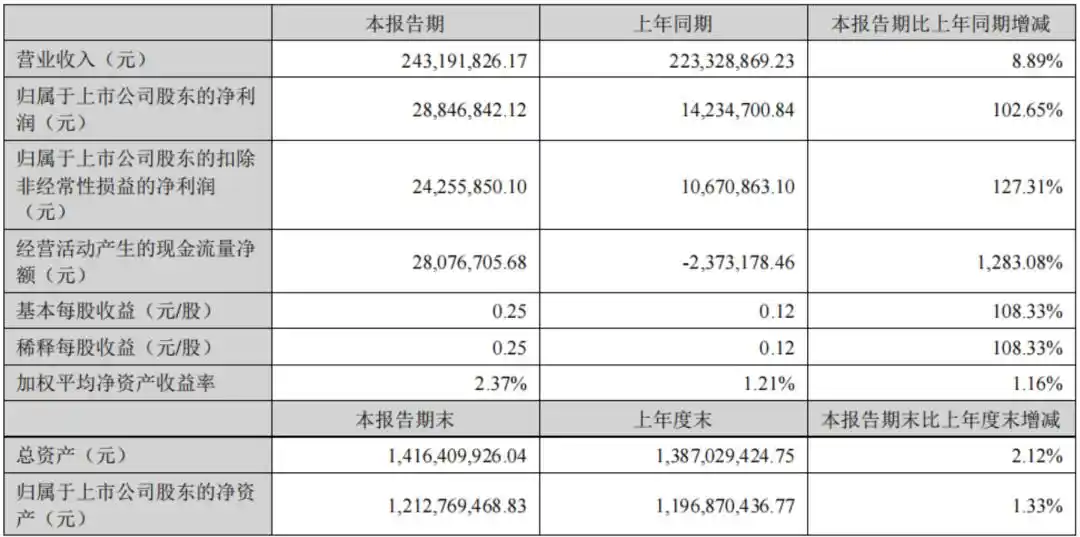
Based on the revenue of 243 million yuan, the increase in gross profit is approximately 11.1 million yuan, accounting for 76% of the net profit increment of 14.61 million yuan. Simply put, Wavelength Optoelectronic hasn't done anything earth-shattering; it has just let the profitable businesses earn more and shrunk the unprofitable ones.
The Underestimated 'De-Germaniumization'
In the first half of the year, Wavelength Optoelectronic's revenue grew by 8.89%, but its operating costs increased by only 1.78%. The growth rate of costs was much lower than that of revenue, indicating the release of economies of scale.
The optical components industry is capital-intensive. When capacity utilization increases, the unit fixed cost naturally decreases. This is basic manufacturing logic.
However, what truly deserves attention is a severely undervalued factor on the cost side: the substitution of metal germanium by chalcogenide glass.
The traditional core material for infrared optics is metal germanium, which is expensive and subject to volatile prices. Wavelength Optoelectronic has been continuously developing chalcogenide glass materials in recent years. This material offers advantages such as lower cost, lighter weight, and ease of mass production through small-size molding.

According to an analysis of the interim report by Securities Times, the substitution with chalcogenide glass is accelerating. This is not just a short-term cost reduction but a fundamental shift in the material system.
Once the substitution is complete, Wavelength Optoelectronic's cost curve in the infrared optics field will be systematically lowered. This is a long-term positive factor that has hardly been factored into the current valuation.
Optimization of Expense Efficiency
The third amplifier is relatively straightforward.
In the first half of 2025, the non-GAAP net profit was only 10.67 million yuan. With such a small base number, any improvement on the numerator side naturally amplified the growth rate.
At the same time, sales expenses in the first half of 2026 increased by only 1.22%, far below the revenue growth rate of 8.89%, indicating improved sales efficiency—each yuan of sales expense is now driving more revenue.
Now, the following factor might be the key variable that determines the future valuation direction of Wavelength Optoelectronic.
On June 18, 2026, Wavelength Optoelectronic announced that its actual controller, Huang Shengdi, had been granted bail pending trial due to "false declaration of germanium-containing lenses for export." Tracing the timeline, customs initiated an audit in April 2025, the case was transferred to the anti-smuggling department in July, and the company immediately halted the related export business.
Throughout 2025, the company showed a situation of "increasing revenue without increasing profit," dragged down by volatile germanium prices and inventory write-downs.
However, the flip side of the coin is that the customs audit acted as a catalyst for material structure upgrading. After the suspension of the involved export business, the company was forced to accelerate the substitution of germanium material with chalcogenide glass.
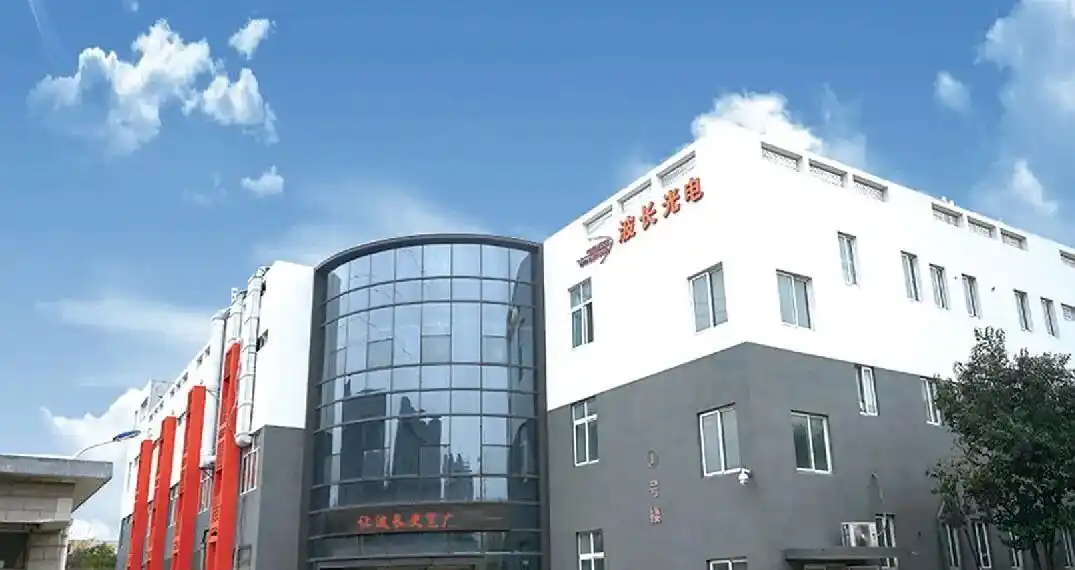
By the first half of 2026, Wavelength Optoelectronic's infrared business revenue grew 19.77% year-on-year, with gross margin also improving—while this narrative of crisis forcing transformation might be somewhat unexpected, the data has already provided validation.
The direction of the criminal case involving the actual controller remains uncertain, representing a sword of Damocles hanging over the company.
However, from a business perspective, the process of "de-germaniumization" is already irreversible and may be progressing faster than the market expects.
Issues with the Semiconductor Business
Another highlight in the interim report is the semiconductor and related fields.
Revenue in this field in the first half of the year was about 35 million yuan, of which the semiconductor business contributed approximately 18 million yuan, an 83% year-on-year increase.
Products already cover areas such as parallel light source systems for mature process nodes, optical lenses supporting light source equipment for advanced process lithography, and key components for measurement and inspection equipment.
However, it is necessary to see clearly that the semiconductor revenue base of 18 million yuan is extremely small. The high growth rate of 83% is built on a low base, and its sustainability remains to be verified.
Currently, the semiconductor business accounts for only about 7.4% of total revenue, serving more as support for valuation imagination space rather than being the main profit contributor.
Comparing horizontally with peers, Morpho Optical's semiconductor business already accounts for 37% of revenue, has entered the supply chains of leading customers like KLA, Camtek, and Meta, and enjoys a high gross margin of 54%. It is positioned in a higher-end segment but has less room for growth elasticity.
Fuguang Co., Ltd. follows a differentiated route focused on security and military/defense specialty optics. Wavelength Optoelectronic's positioning is to upgrade from industrial laser optics to semiconductor optics, still in the early stage of volume ramp-up. It has significant imagination space but less certainty than the former two companies.
Based on the latest market capitalization, Wavelength Optoelectronic's trailing-twelve-month (TTM) P/E ratio is about 184 times. Even based on the expected full-year 2026 profit, the P/E ratio exceeds 130 times. Additionally, accounts receivable grew by 19.64% year-on-year, far exceeding the revenue growth rate, indicating collection pressure that deserves caution.
For a company in the midst of business transformation with semiconductor revenue of only 18 million yuan, the price the market has given already contains quite optimistic expectations.
The doubling of profit is a fact, but the logic needed to support a doubling of the stock price still requires data from more quarters for verification.
This article is from the WeChat public account "Deep Water Finance Society", author: Wu Hai