Behind NEAR's Doubling: Three Major Catalysts Driving the Token Price

marsbit2026-05-26 tarihinde yayınlandı2026-05-26 tarihinde güncellendi

Özet

NEAR token's price surged from $1.24 to over $2.5 in May 2026, significantly outperforming the broader market. This rally is driven by three key factors: 1) A strong AI narrative, bolstered by co-founder Illia Polosukhin's background as a co-author of the seminal Transformer paper and NEAR's strategic focus on decentralized AI infrastructure. 2) The launch of privacy features like Confidential Payments and Confidential Intents within the NEAR Intents layer, enabling private cross-chain transfers for major assets and addressing MEV concerns. 3) A sustainable tokenomics model with nearly 100% circulation unlocked and a new buyback mechanism where all protocol fees from the growing NEAR Intents ecosystem (with TVL exceeding $80M) are used to repurchase and stake NEAR tokens, reducing sell-side pressure.

Author: Ma He, Foresight News

On May 25, the price of the NEAR blockchain token stood at $2.37. Since early May, NEAR has surged from a low of $1.24 to a high of $2.5, with its market cap returning to over $3 billion. While mainstream crypto assets like Bitcoin experienced volatility, NEAR charted an independent course, emerging as one of the most outstanding performers alongside tokens like ZEC, ONDO, and HYPE. What exactly are the reasons behind its explosive growth?

The AI Narrative

NEAR co-founder Illia Polosukhin is a seasoned figure in the AI field. Illia is one of the eight co-authors of the seminal Transformer paper, alongside others including Ashish Vaswani and Noam Shazeer, who were from Google Brain / Google Research. This paper introduced the Transformer architecture, which relies entirely on attention mechanisms, greatly enhancing parallel training efficiency and model scale. This is the origin of today's mainstream large model frameworks like ChatGPT, Claude, and Gemini.

NEAR has made AI a core strategy from its early days. In February this year, NEAR officially launched the Near.com super-app, integrating cross-chain swaps, privacy tools, and smart contract management into one platform, with built-in AI capabilities supporting autonomous agent application scenarios. In November 2023, Illia officially assumed the role of CEO of the NEAR Foundation, primarily focusing on the core AI narrative.

In May, Nvidia's earnings report spurred a resurgence in the overall AI sector, with NEAR being viewed as a representative of decentralized AI infrastructure, alongside projects like TAO.
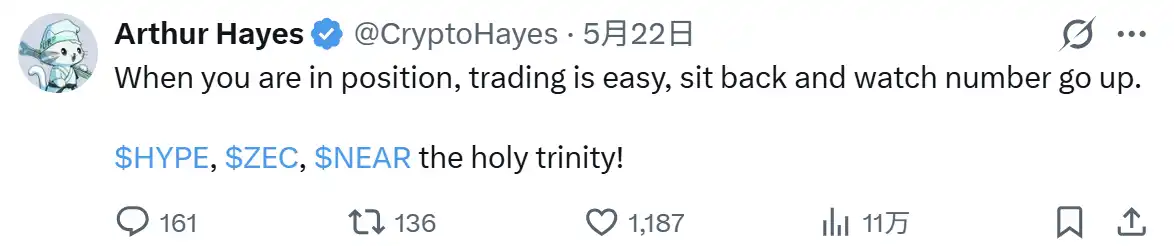
On May 22, BitMEX co-founder Arthur Hayes, in an article, listed NEAR alongside HYPE and ZEC, directly igniting market sentiment.

Privacy-Focused Blockchain

Blockchain has long faced the privacy dilemma of "transparency equals publicity." The surge of privacy coins like ZEC and XMR has refocused industry attention on the privacy sector, prompting various protocols, including public chains, to integrate privacy features.

Founded in 2018, NEAR's initial core positioning was not AI, but scalability. Its earliest progress also centered on continuously optimizing sharding technology, positioning itself as one of the hot "Ethereum killer" public chains of that time.
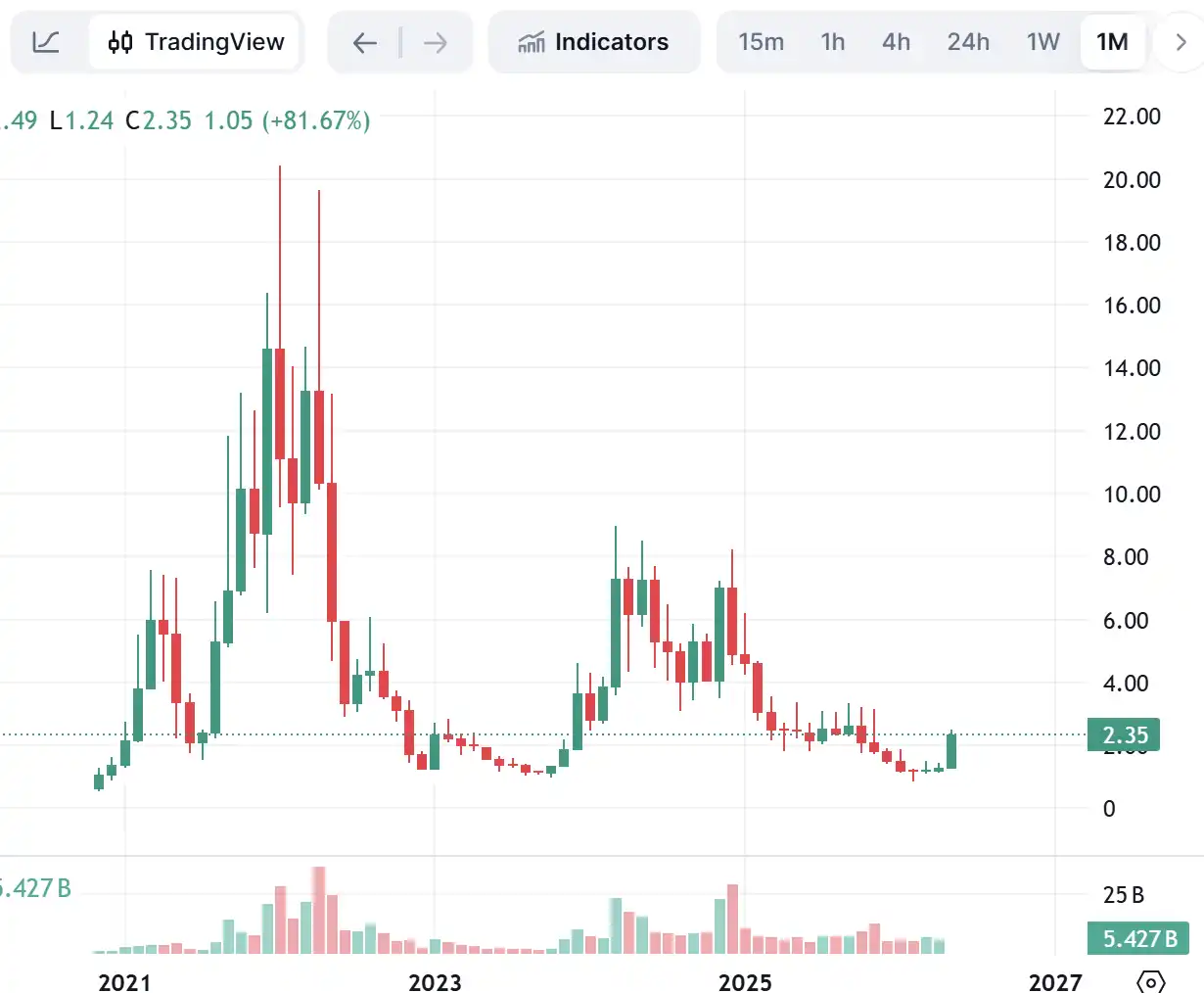
Because of this, NEAR's public sale on CoinList once crashed the platform's website. During the 2020-2021 bull cycle, NEAR skyrocketed from $0.5 to a peak of $20.59, becoming one of the most eye-catching star tokens of that era.

However, fast-forwarding to the current cycle, the vast majority of older tokens and new VC tokens have been shunned by the market. Therefore, even in this bull cycle, NEAR only peaked at $9 in 2024 before declining steadily, hitting a low of $0.84 in 2026.

After the official launch of NEAR Intents, privacy demand became crucial. Intents are core to cross-chain transactions, allowing users to express their intent for execution. However, public on-chain large transactions are vulnerable to MEV (Maximum Extractable Value) attacks, a significant drawback for institutions, large holders, and ordinary DeFi users alike.

The NEAR team began planning privacy as a key complement to Intents. In late May this year, the NEAR Intents team launched Confidential Payments and Confidential Intents features, supporting private cross-chain transfers of assets like ETH, BTC, SOL, and USDC across 35+ chains. The sender, amount, and path are all hidden, with only the result displayed on the target chain, utilizing private sharding and TEE (Trusted Execution Environment) bridging.
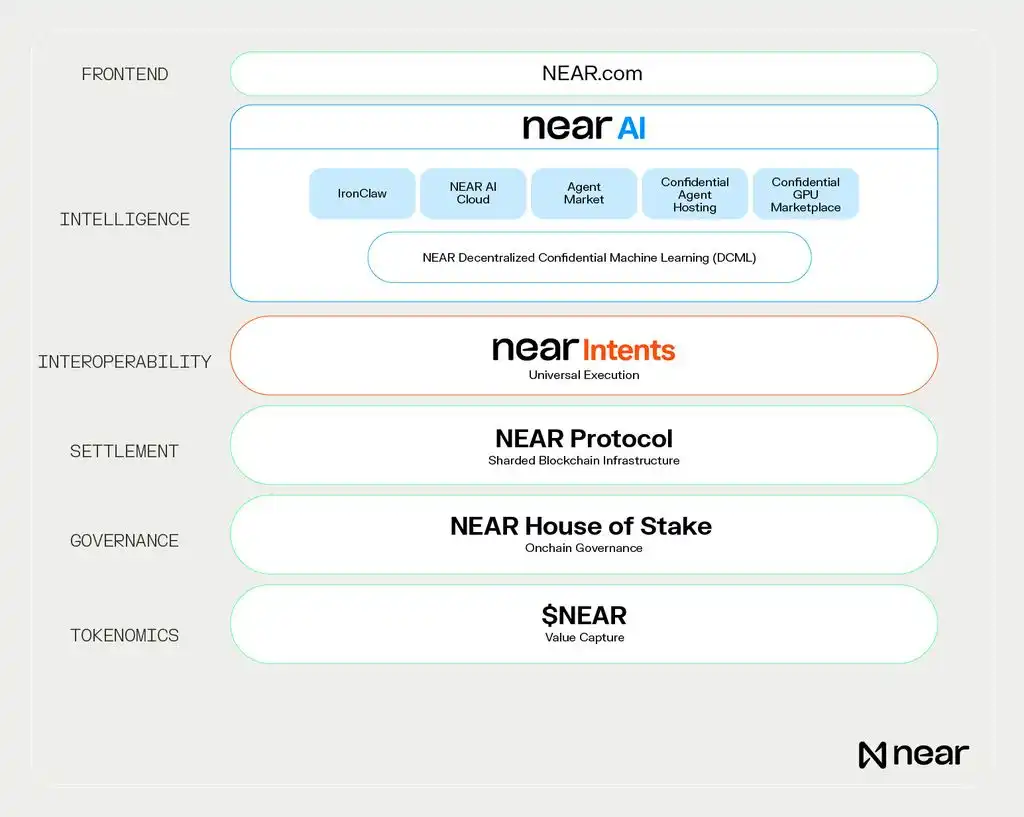
NEAR also opened a privacy mode, where user balances, transfers, and transaction activities are privatized by default. This ensures data doesn't leak, whether for ordinary users, enterprise users, or AI agents executing complex strategies. Concurrently launched Confidential Treasuries (Trezu) further support private multi-sig, payroll, and cross-chain payments, having cumulatively processed $68 million in confidential transactions.

Compared to pure privacy coins like Zcash, NEAR strikes a more practical balance between privacy, usability, and cross-chain capabilities, directly targeting enterprise-level demand and driving a recovery in TVL and developer activity.

NEAR Intents Fee Buyback

In October 2025, NEAR completed the unlocking of the final batch of its initial supply, achieving nearly 100% circulation.
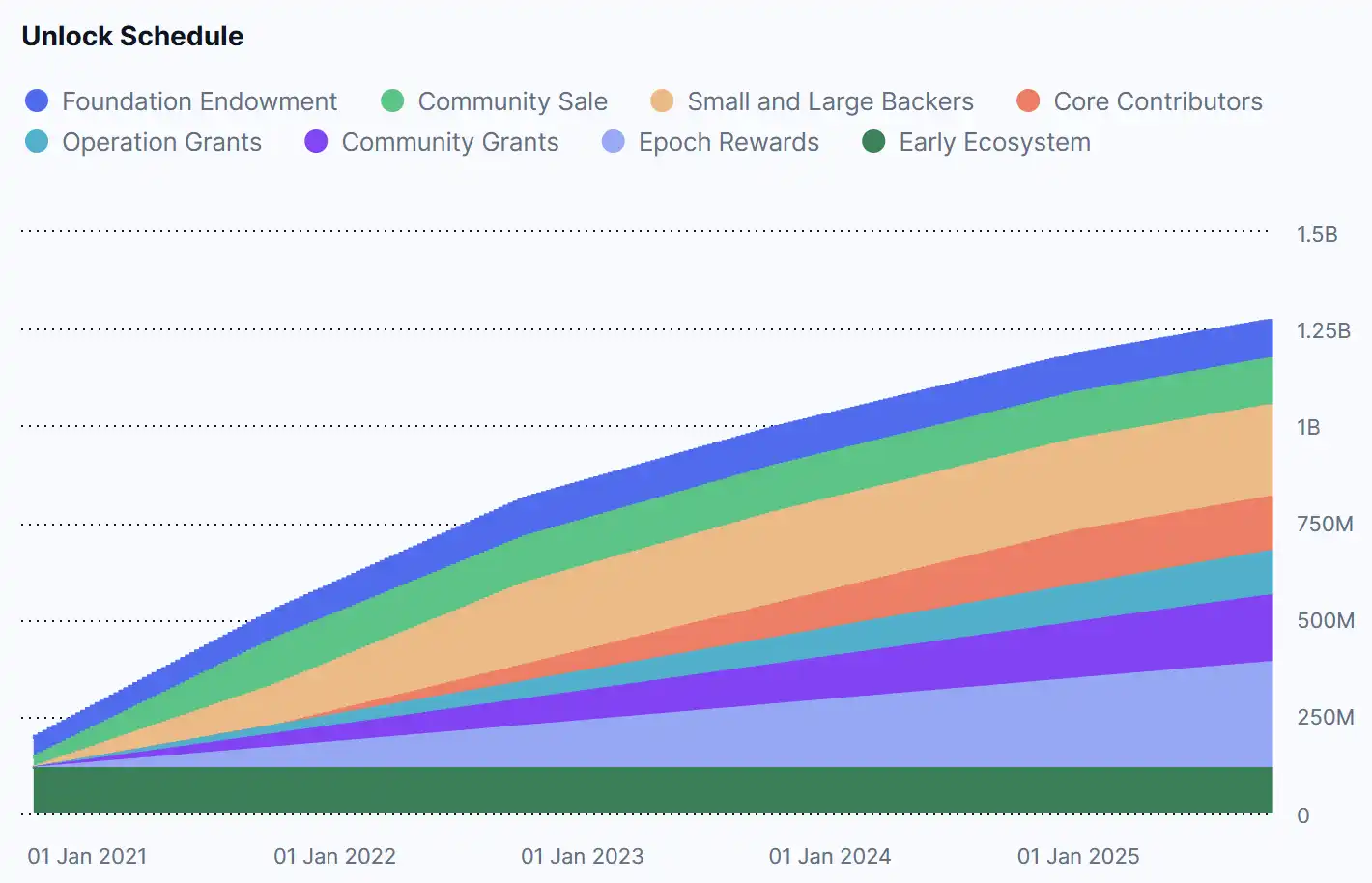
NEAR implemented a dual mechanism of inflation and burning from its mainnet's early days: a maximum annual inflation of 5% (permanently halved to 2.5% via an upgrade in October 2025), with 90% allocated as rewards to validators and 10% going to the protocol treasury. Entering 2026, the project has no more major or linear unlock events, only regular epoch reward emissions (approximately 5.4 million NEAR released in the last 30 days, about 0.4% of total supply).

Additionally, the fee revenue generated by NEAR Intents is directly used to buy back NEAR tokens in the market, providing significant buying pressure.

The Intent-driven cross-chain transaction layer on the NEAR protocol allows users to simply express their desired outcome (e.g., swap BTC for SOL), and it provides the optimal execution path, supporting multiple chains, no bridging/wrapped assets, and low fees.

NEAR Intents previously had two fee components: protocol fees and distribution fees (shared with third-party integrators), but protocol fees now all go through the buyback path. The repurchased NEAR is not necessarily burned immediately; instead, it can be staked, locked, or removed from liquidity after repurchase. While still counted in total supply, this reduces circulating supply pressure and can also generate staking rewards.
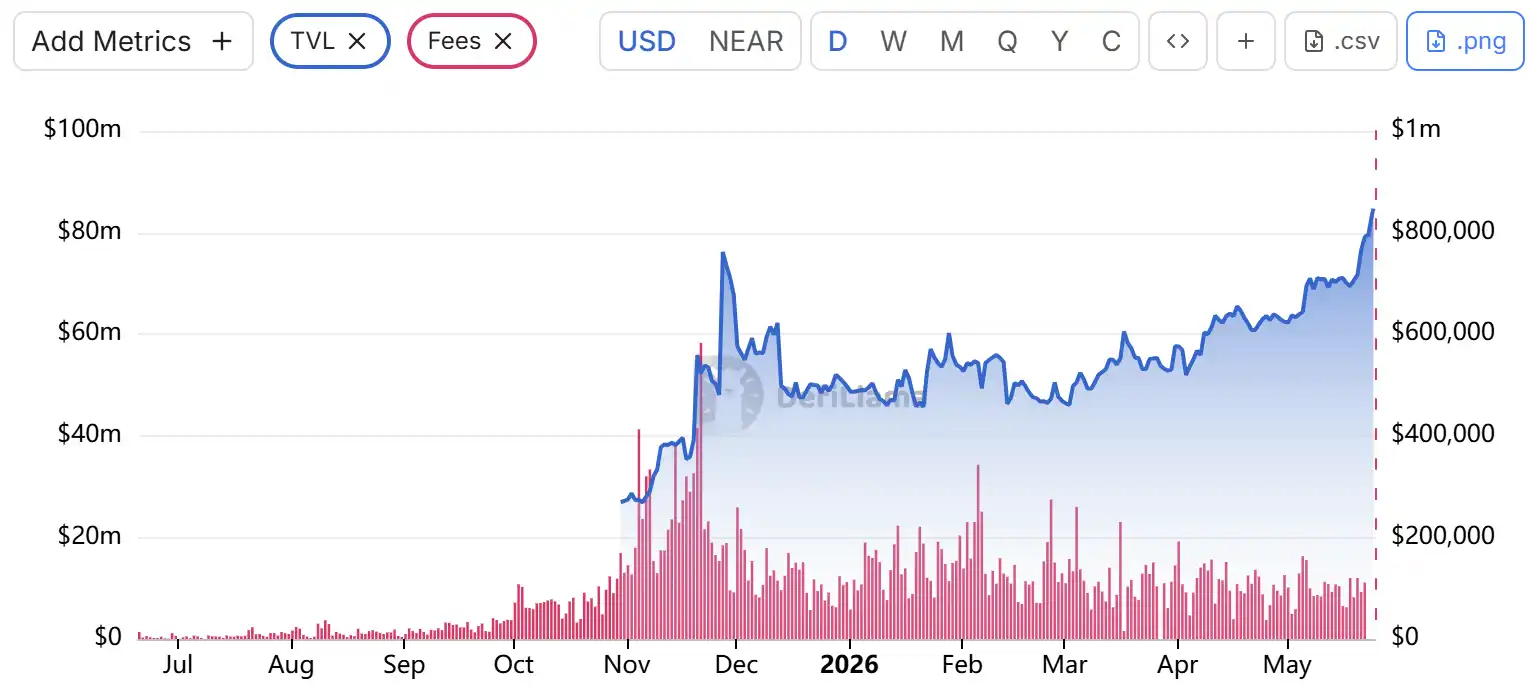
According to the latest data from defiLlama, NEAR Intents' TVL has exceeded $80 million, generating daily fees fluctuating around $100,000, translating to a monthly buyback amount near $3 million.

At the end of this month, its core development team, Near One, also announced the latest technical progress. By the end of Q2 2026, the team will release dynamic re-sharding, significantly improving scalability. Additionally, the team will introduce and upgrade NEAR's post-quantum secure signature scheme in June this year, enhancing its resistance to quantum computing.


İlgili Sorular

QWhat are the three main factors mentioned in the article driving NEAR's recent price surge?

AThe three main factors are: 1) AI Narrative, leveraging the co-founder's AI background and NEAR's strategic focus on decentralized AI. 2) Privacy-Focused Public Chain features, enhancing cross-chain privacy for users and institutions. 3) NEAR Intents fee buyback mechanism, which uses protocol fees to purchase NEAR tokens, reducing selling pressure.

QWho is Illia Polosukhin, and what is his connection to the AI field?

AIllia Polosukhin is a co-founder of NEAR. He is a seminal figure in AI, being one of the eight co-authors of the original Transformer paper from Google Brain/Research. This paper introduced the Transformer architecture, which is the foundation for all major large language models like ChatGPT, Claude, and Gemini.

QHow does NEAR's privacy technology, specifically Confidential Intents, work to protect user transactions?

ANEAR's Confidential Intents and Confidential Payments functions hide the sender, amount, and transaction path during cross-chain transfers of assets like ETH, BTC, SOL, and USDC across 35+ chains. Only the final result is visible on the destination chain. This privacy is achieved using a combination of private sharding and TEE (Trusted Execution Environment) bridging.

QWhat is the NEAR Intents fee buyback mechanism and how does it impact the token's supply?

AThe NEAR Intents protocol uses its fee revenue to buy back NEAR tokens from the open market. These bought-back tokens are then typically staked, locked, or have their liquidity removed. This action reduces the circulating supply and selling pressure on the token, while the staked tokens can also generate yield.

QAccording to the article, what is the current approximate monthly buyback amount driven by NEAR Intents fees?

ABased on data from defiLlama cited in the article, NEAR Intents generates approximately $300,000 in fees per month, which is used for the token buyback program.

İlgili Okumalar

Misjudged A-Shares: Resilience, Expectations, and Confidence

China's A-share market recently faced selling pressure, especially in tech sectors, initially triggered by a global tech sell-off that began in South Korea. However, the article argues this is a case of "mistaken injury" and highlights the market's underlying resilience. This resilience stems from three main pillars: **1) Tech Sector Fundamentals:** Unlike Korea's market dominated by a few memory chip stocks, China's tech sector is diversified across computing, communications, electronics, and semiconductors, supported by dual narratives of global AI supply chains and domestic substitution. Core areas like optical modules and fiber optics continue to show strong earnings growth. **2) "National Team" Support:** State-backed institutions and large corporations have made significant market purchases and announced buybacks, providing liquidity and signaling confidence. This is seen as a stabilizing policy signal, often associated with market bottoms. **3) Broader Market Pillars:** Other major sectors are showing endogenous recovery momentum. Consumer stocks benefit from stabilizing CPI and signs of sector recovery (e.g., liquor price hikes). Cyclical sectors like aluminum have high earnings, potential price increases due to tight supply, and low valuations. The financial sector offers stable dividends and low valuations. The conclusion is that the sell-off was driven by external contagion, not a collapse in fundamentals. With strong policy support and recovering momentum across key sectors, the A-share market possesses the toughness to regain stability.

marsbit2 dk önce

Misjudged A-Shares: Resilience, Expectations, and Confidence

marsbit2 dk önce

The Clarity Act's Journey Through Congress: The Thorny Path of Bipartisan Compromise in the U.S.

The U.S. Congress is struggling to advance the crypto market structure bill known as the Clarity Act, with bipartisan compromise proving difficult. Key hurdles include unresolved disputes over "yield" products and, more critically, the inclusion of strong ethics provisions for elected officials—a non-negotiable demand for many Democrats. While a compromise on yield was reached in May, securing only limited Democratic support in committee, the separate Senate Agriculture Committee version later passed with no Democratic votes due to the ethics impasse. As Republicans push for a full Senate vote in July, demands for ethics rules have expanded, and other contentious issues like developer protections and concerns from law enforcement and large banks further complicate negotiations. Despite consensus on the need for legislation, the path forward is unclear. Recent discussions between senators and White House officials aim to find acceptable ethics language. Some lawmakers question whether a compromise text can garner enough bipartisan support, with one Democrat stating the current proposal lacks the strong ethics provisions required for their vote. Potential short-term goals for the crypto community include symbolic Senate action before the August recess, a longer-term aim for passage by 2026, or establishing a detailed framework that addresses ethics and other compromises. The process remains arduous, relying on the traditional, vote-by-vote effort to build bipartisan support.

marsbit21 dk önce

The Clarity Act's Journey Through Congress: The Thorny Path of Bipartisan Compromise in the U.S.

marsbit21 dk önce

Are Kalshi and Polymarket Founders at Odds? This Business Rivalry Is More Brutal Than You Think

"The Rivalry Between Kalshi and Polymarket Founders Turns Bitter and Litigious" The intense feud between Tarek Mansour, CEO of Kalshi, and Shayne Coplan, founder of Polymarket, has escalated far beyond typical business competition into personal animosity and regulatory battles. Both lead billion-dollar prediction market platforms, but their approaches differ sharply. Kalshi positions itself as the compliant operator, securing U.S. regulatory approval before launching. In contrast, Polymarket initially operated offshore, allowing U.S. users to access its platform via VPN, which drew regulatory scrutiny. The conflict reached a peak in November 2024 when FBI agents raided Coplan's New York apartment. While Coplan publicly blamed political motives, his team privately suspected Kalshi was involved. According to sources, Kalshi's lawyers had previously reported Polymarket's operations to federal prosecutors, highlighting its accessibility to U.S. users despite a ban. This incident fueled mutual accusations and underhanded tactics, including social media smear campaigns and attempts to sabotage each other's major business deals. Their rivalry also played out in Washington, influencing regulatory debates. Kalshi actively lobbied against Polymarket's practices, framing them as illegal and unethical. Polymarket, after facing a CFTC fine and investigation, later acquired a licensed U.S. firm to launch a domestic app, regaining a foothold. Despite the hostility, both companies have seen massive growth, with combined trading volumes soaring. However, increased regulatory scrutiny, particularly around insider trading on Polymarket's platform, continues to pose challenges. The founders' deep-seated mutual disdain ensures their battle for market dominance remains as much a personal vendetta as a commercial one.

marsbit30 dk önce

Are Kalshi and Polymarket Founders at Odds? This Business Rivalry Is More Brutal Than You Think

marsbit30 dk önce

İşlemler

Spot
活动图片