Beginner Hacker's Guide: How to Ace Your First Hackathon

marsbit2026-01-13 tarihinde yayınlandı2026-01-13 tarihinde güncellendi

Özet

A Beginner Hacker's Guide: How to Ace Your First Hackathon This guide provides essential tips for first-time hackathon participants to maximize their learning and success, regardless of winning. Key advice includes: * **Choosing the Right Event:** Start with well-organized hackathons from major companies (e.g., Google, AWS) or on established platforms like DoraHacks for clear rules and valuable feedback. * **Understanding the Rules:** Thoroughly read and adhere to all submission guidelines and judging criteria to avoid disqualification. * **Focus on Quality, Not Just Prizes:** Avoid reusing old projects. Instead, focus on creating something new that genuinely aligns with the hackathon's theme. * **Communicate Early and Often:** Engage with organizers, mentors, and the community on platforms like Discord for clarifications and help instead of working in isolation. * **Learn from Others:** Study past winning submissions on platforms like DoraHacks to understand what makes a project stand out. Network with other participants during the event. * **Perfect Your Demo:** Create a clear, concise 1-3 minute demo video and compelling documentation. Your presentation is as important as the project itself. * **Manage Time Wisely:** Plan your time effectively, delegate tasks in a team, and leave ample time to prepare your final submission. * **Keep Building:** View the hackathon as a starting point. Whether you win or not, continue to develop your project, learn from...

Ready to sign up for your first hackathon? Maybe you're a college student looking to build something cool over the weekend, or an indie developer exploring new tech and meeting like-minded people. Whatever the case, welcome! You're about to experience one of the best ways for developers to learn, create, and grow.

But most beginners don't realize this: the people who get the most out of a hackathon aren't necessarily the ones who win prizes. Prizes are great, but the skills, portfolio projects, and connections you gain have a much longer shelf life.

This guide will help you avoid common beginner pitfalls so you can walk away with a full load of gains, whether you win or not.

1. How to Choose Your First Hackathon and Platform

Not all hackathons are created equal. As a beginner, it's recommended to start with events hosted by large companies, such as Google or AWS's AI-themed hackathons, or events from major crypto tech companies like Circle or Binance. These hackathons have clear rules, responsive organizers, and judges who provide valuable feedback (and yes, the rewards are usually quite generous).

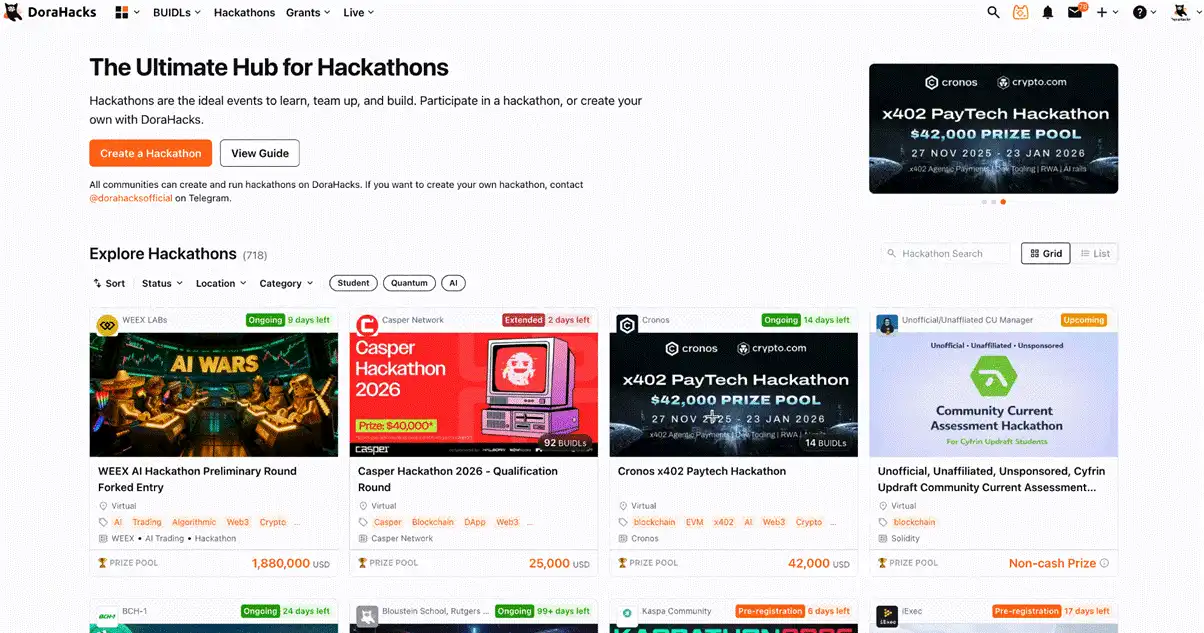
A reliable platform can help filter out the noise. DoraHacks is one of the world's primary hackathon platforms. Thanks to the trust of hackers and the industry, DoraHacks consistently collaborates with leading enterprises and communities to host hackathons in various tech fields like AI and blockchain. The platform's reputation means both organizers and participants have a basic quality guarantee. Furthermore, the platform archives hundreds of thousands of past projects; you can research before competing and learn from previous winners (more on that later).

Be cautious of smaller platforms or hackathons with vague information—your time is precious, so spend it on competitions that respect that.
2. Treat the Rules as Your Lifeline (This is Crucial for Your Submission)

This might sound obvious, but you'd be surprised how many excellent projects get disqualified for not following the rules. Before writing your first line of code or description, thoroughly read the rules. Understand exactly what details to submit and in what format.

Pay attention to eligibility requirements; check submission materials like demo videos, GitHub repositories, or any documentation; note any restrictions; and understand the judging criteria.
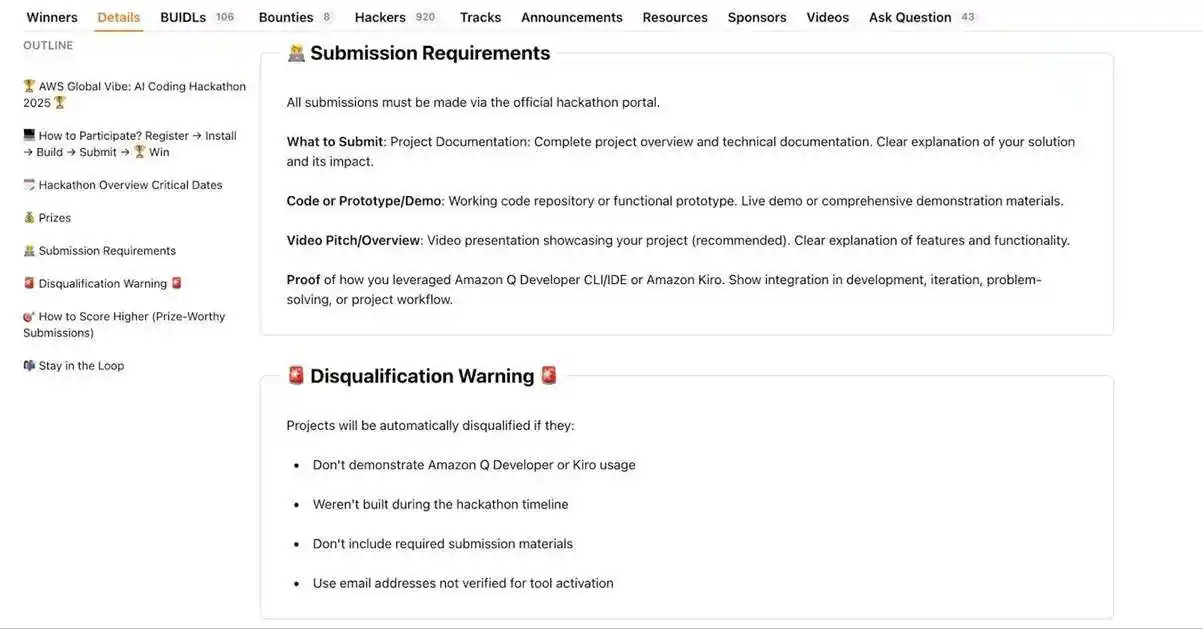
Rules for the 2025 AWS AI Vibe Coding Hackathon

The rules aren't red tape; they're a contract between you and the organizers. Following them not only shows professionalism but also ensures your efforts are judged fairly.

3. Don't Be a "Bounty Hunter"

Tempted to submit the same project to every hackathon hoping to get lucky? Stop. Organizers and judges can easily spot recycled, off-topic projects, and these submissions usually don't fare well.

Most hackathons have themes for a reason. Even if there's an "open track," judges will still evaluate how well your project aligns with the hackathon's goals. Submitting an unrelated dating app at a blockchain hackathon won't be a good fit, no matter how polished it is.

Instead of spreading yourself thin across ten unrelated competitions, focus on a few that genuinely match your interests and skills. You'll produce better work and make a stronger impression on judges and sponsors who actually care about these issues.

4. Communicate Early and Often

Many beginners treat hackathons like an exam—heads down, no talking, figure it all out alone. This is a big mistake. Good hackathons have organizers, mentors, and community channels specifically to help you succeed. Use them!

If the rules are unclear, ask for clarification before going down the wrong path. If you hit a technical snag, reach out to a mentor or post in the community Discord. If you're unsure if your idea fits the theme, check with the organizers early; don't wait until judging to find out. For example, on DoraHacks, you can message the organizers directly.

Don't struggle alone when help is readily available.
5. Learn from Other Hackers

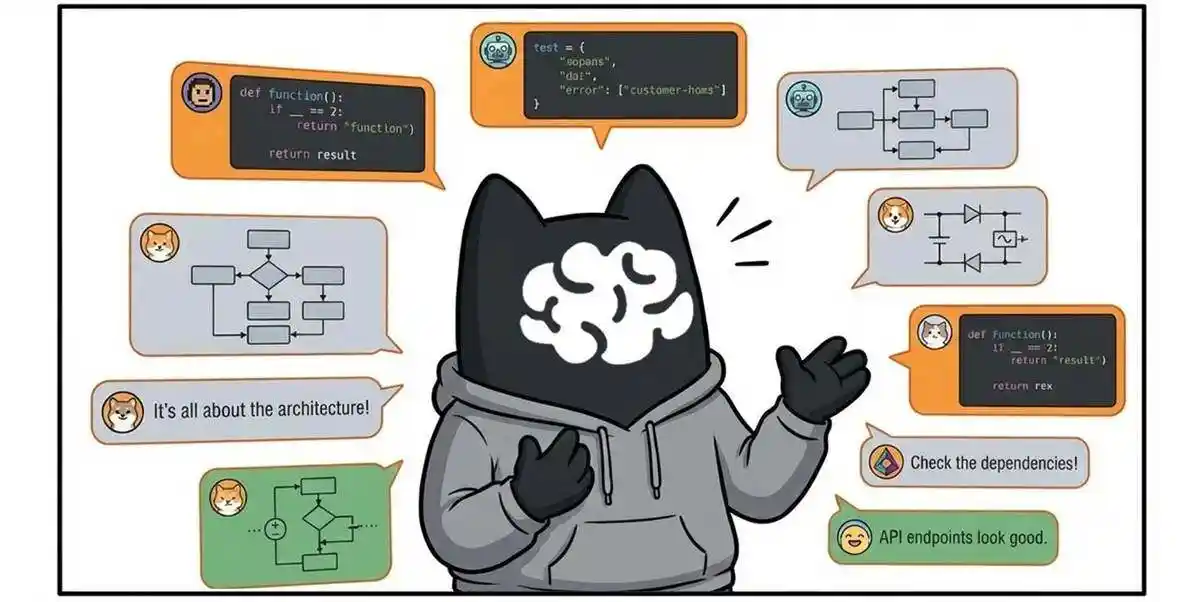
One of the most underrated benefits of hackathons is the opportunity to learn from other participants. You're surrounded by people solving similar problems with different approaches, skill levels, and perspectives.

Studying past projects is one of the fastest ways to improve. On DoraHacks, you can browse a vast archive of past projects (like this one), filter by category, and see exactly what winning teams submitted. Watch their demo videos, read their project pages, and observe how they present their ideas. Notice what makes top projects stand out: a clear problem statement, a polished demo, strong alignment with the theme. Equally important: observe what weaker projects lack so you can avoid the same pitfalls.

During the competition, interact with other participants too. Share your progress, ask what others are working on, and don't be afraid to give or receive feedback. The hacker community is generally very supportive; today's competitor could be your collaborator or co-founder tomorrow.
6. Submit a Great Demo

A great project with a poor presentation often loses to a decent project with an amazing demo. Judges have limited time and dozens of submissions to review. Make it easy for them.

Your written description is crucial: use clear language, logical flow, and don't assume judges have background information you haven't provided. Screenshots, diagrams, and links to a working demo all make your submission stronger.

Keep your demo video concise and clear: explain the problem you're solving, show how your solution works, highlight what's unique—aim for 1 to 3 minutes total, unless the rules specify otherwise.
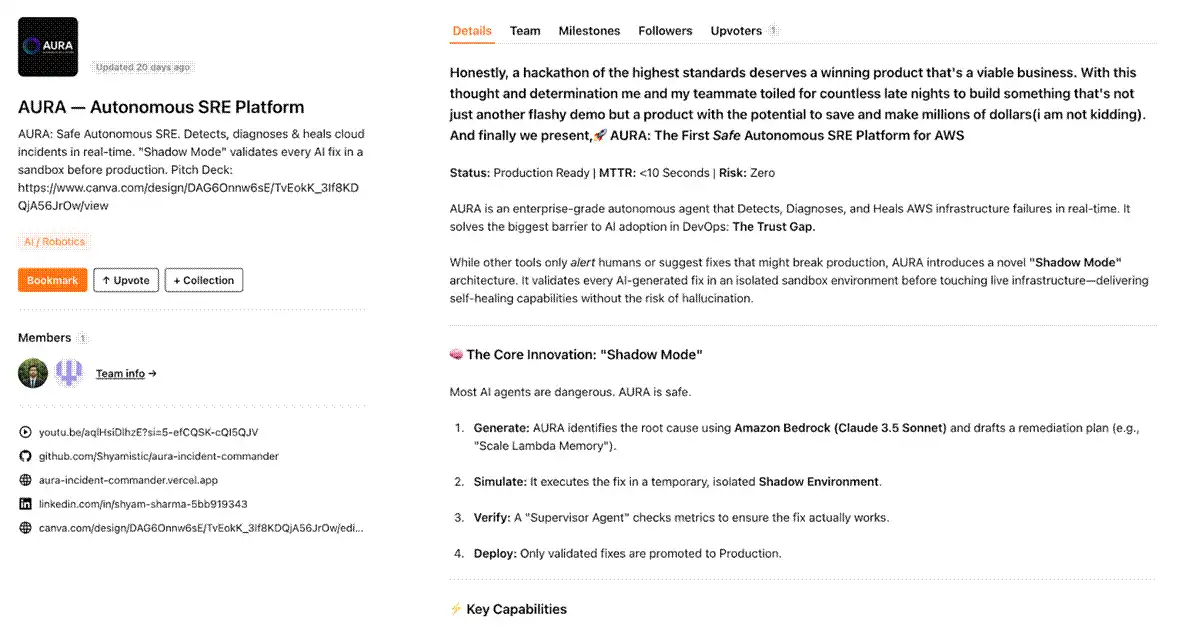
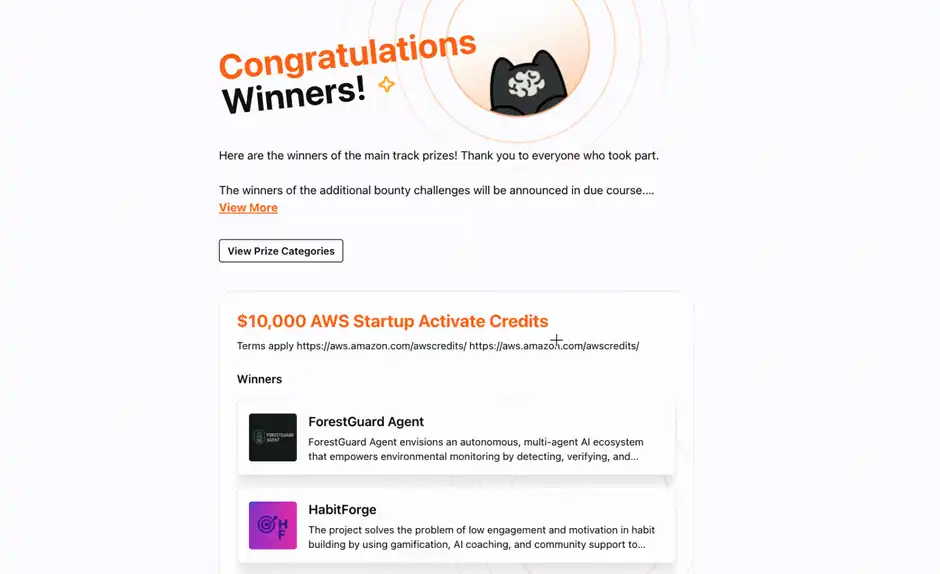
An example of a winning project on DoraHacks

Treat your submission like a pitch. You're not just showing what you built; you're convincing the judges why it matters.

7. Manage Your Time Wisely

Hackathons have deadlines, and they arrive faster than you think. Poor time management is the most common reason potentially great projects end up with incomplete submissions.

Always reserve time for submitting your materials. Recording the demo video, writing documentation, packaging everything up—these take longer than you think. Don't wait until the last minute.

If you're on a team, define roles clearly. Working in parallel is efficient only if everyone knows their responsibilities.

8. Accept the Outcome and Keep Building

Hackathons are competitions, and competitions have winners and losers. You might give it your all and walk away empty-handed. It stings, but it's completely normal.

The difference between a successful hacker and a frustrated one is how they respond. If you don't win, ask yourself what you learned. If the idea is solid and you keep iterating seriously, opportunities will find you. Many successful projects didn't win their first hackathon either but found their moment through continuous improvement.

The hackathon ends, but your work doesn't have to. If the project has potential, keep developing it. Hackathon projects are excellent portfolio pieces, and continued progress shows potential employers or investors that you're serious.

Countless amazing projects are born at hackathons and then disappear forever. The excitement fades, life gets busy, and that brilliant idea never gets another commit. Don't let that happen to you.

Celebrate the wins, learn from the losses, and then keep competing. In the long run, persistence matters more than luck.

Conclusion: Play the Long Game

Your first hackathon is just the beginning. You'll make mistakes, learn lessons, and probably wish you'd done some things sooner. That's okay; everyone starts from zero.

The people who get the most out of hackathons treat each one as a step in a longer journey. They accumulate skills, expand their network, and build a track record of consistent participation and delivery. Over time, victories come not from luck but from becoming stronger.

So, find a hackathon on DoraHacks that excites you, read the rules, chat with the organizers, learn from others, and keep creating. Leave the rest to time.

Happy hacking!

About DoraHacks

DoraHacks is a leading global hackathon community and open-source developer incentive platform. DoraHacks provides a toolkit for all parties to empower them to organize hackathons and fund early-stage ecosystem startups.

DoraHacks is committed to driving a global hacker movement in Web3, AI, quantum computing, and space technology. To date, over 30,000 startup teams have received more than $300 million in total funding through the DoraHacks community. Numerous open-source communities, enterprises, and technology ecosystems are actively utilizing DoraHacks and its BUIDL AI capabilities to organize hackathons and provide financial support for open-source initiatives.

Website | Twitter | Discord | Telegram | Binance Live | Youtube

İlgili Sorular

QWhat is the most important thing to do before writing any code for a hackathon?

ARead the rules thoroughly to understand submission requirements, format, eligibility, and judging criteria.

QWhy should new hackers avoid being 'prize miners'?

ASubmitting the same project to multiple unrelated hackathons is easily spotted by judges and usually results in poor outcomes due to lack of relevance to the theme.

QWhat is a key benefit of studying past projects on platforms like DoraHacks?

AIt is one of the fastest ways to learn what makes winning projects successful, such as clear problem statements, polished demos, and strong theme alignment.

QWhat is a crucial element for a successful project submission that many beginners overlook?

AA good demo, including a clear and concise 1-3 minute video that explains the problem, shows the solution working, and highlights its unique value.

QWhat should a hacker do if their project doesn't win a hackathon?

ALearn from the experience, ask what was gained, and continue building and iterating on the project, as persistence is more important than luck in the long run.

İlgili Okumalar

Super-Rich Hoarded Record Cash in February, Stock Market Hit New Highs Four Months Later: Who's Getting Fooled?

In February, the total assets in US money market funds reached a record high of approximately $8.25 trillion, a trend highlighted by high-net-worth individuals increasing their cash holdings. Notably, Warren Buffett's Berkshire Hathaway amassed a $381.7 billion cash pile ahead of his 2025 retirement, while other prominent figures like Peter Thiel sold tech stocks, fueling narratives of wealthy investors seeking safety. However, by June, the trend reversed. Money market fund assets fell to around $7.87 trillion, indicating a flow of capital back into equities. Concurrently, the S&P 500 and Nasdaq reached all-time highs, with the S&P 500 surpassing 7600 points. This market surge occurred despite the earlier defensive moves, highlighting a potential opportunity cost for those who retreated to cash. Analysis shows that since early 2022, the S&P 500's total return significantly outpaced that of prime money market funds. The capital shifted from equities appears to have been partly reallocated into alternative investments like real estate, art, and private credit, especially among ultra-high-net-worth individuals. Meanwhile, major investment banks like Goldman Sachs and Morgan Stanley have raised their year-end targets for the S&P 500, citing AI-driven earnings growth, while also cautioning about risks including market concentration and economic fragility beneath the surface rally.

marsbit15 dk önce

Super-Rich Hoarded Record Cash in February, Stock Market Hit New Highs Four Months Later: Who's Getting Fooled?

marsbit15 dk önce

Robot Vacuums Have Been Competing for 20 Years, So Why Are 90% of Chinese Households Still Hesitant?

The article explores why over 90% of Chinese households are still hesitant to adopt robotic vacuum cleaners despite two decades of industry development, identifying a core "trust gap" as the primary barrier. The central issue is not a lack of need, but user concerns about reliability in dynamic, real-world home environments. Common anxieties include the robot dragging pet waste, colliding with transparent objects, tangling in cords, scattering cat litter, getting stuck on thresholds, missing corners under furniture, and requiring high-maintenance bases that develop odors. The industry's past focus on competing on technical specs (suction power, mopping functions) has not adequately addressed these practical usability and trust problems. The piece then examines DJI's entry into the market with its ROMO 2 model as a potential new approach. Leveraging its expertise in spatial perception and obstacle avoidance from drones, DJI's solution emphasizes "less intervention" through three key principles: less manual re-cleaning, less user rescue missions, and less maintenance. Specific ROMO 2 features highlighted include advanced obstacle recognition (handling transparent objects and small items), adaptive leg mechanisms for climbing thresholds (up to 8.5cm), an extendable arm for reaching under furniture, AI for identifying and appropriately handling different mess types (e.g., avoiding scattering dry debris), and a self-cleaning base designed to minimize user upkeep. The article argues the next phase of competition should shift from a "parameter race" to a "trust race." It draws a parallel to the iPhone's simplification of the smartphone, suggesting that focusing on a reliable, low-hassle user experience—where people feel confident leaving their floors to the machine—is what's needed to finally convince the vast majority of观望ing families. The ultimate test for products like the ROMO 2 will be long-term user adoption, retention, and口碑, not just technical specifications.

marsbit15 dk önce

Robot Vacuums Have Been Competing for 20 Years, So Why Are 90% of Chinese Households Still Hesitant?

marsbit15 dk önce

The Unclear American Economy: Resilient or Cooling Down?

**U.S. Economic Outlook: Resilient or Cooling Down?** This analysis examines whether the U.S. economy is heading towards a recession. While still growing, the economy shows significant signs of strain. Key data points include Q1 2026 GDP growth of 1.6% and Q1 PCE inflation at 4.5% (annualized), more than double the Fed's target. The labor market remains resilient but is softening, with unemployment at 4.3%. Critical recession indicators present a mixed picture: the yield curve has normalized after a prolonged inversion (historically a late-cycle signal), and the Conference Board's Leading Economic Index has been declining. Current recession probability for 2026 is estimated at 19%, but rises to 41% for 2027, indicating heightened delayed risks. Major pressures are building: a wall of corporate debt refinancing at higher rates, depleted consumer savings, a contracting housing sector, and an energy price shock. The economy exhibits stagflationary characteristics—high inflation alongside slowing growth—which constrains the Federal Reserve's policy options. Historical patterns show recessions are often preceded by Fed tightening and yield curve inversions. If a recession occurs, it is expected to be mild, similar to 2001 rather than 2008. For investors, a defensive portfolio shift toward staples, healthcare, and short-term high-quality bonds may be prudent, while maintaining a long-term, diversified perspective. Key developments to monitor include upcoming GDP, employment, and inflation data, as well as policy signals from the new Fed Chair.

marsbit22 dk önce

The Unclear American Economy: Resilient or Cooling Down?

marsbit22 dk önce

The Most Advanced Large Models Are Now Subject to Export Controls Like Enriched Uranium

In an unprecedented move mirroring the control of enriched uranium, the US Commerce Department has imposed an export control ban on Anthropic's advanced AI models, Fable 5 and Mythos 5, forcing their global shutdown. This marks the first time a purely digital entity—a set of neural network weights—has been subjected to such hardware-like strategic export restrictions, based not on physical scarcity but on its concentrated "capability density." The article draws a direct parallel to the historical control of nuclear technology, arguing that just as uranium ore becomes a controlled substance only when enriched to a critical threshold, AI capabilities become subject to regulation when compressed into a single, potent, and easily accessible interface. This "enriched AI" is seen as crossing a threshold where its aggregated power poses a potential threat. The author predicts three major consequences over the next decade. First, capability auditing will become institutionalized, with governments setting compliance checklists and thresholds for model power, triggering automatic export controls. Second, jurisdictional boundaries will blur as US export controls extend their reach globally, governing any user of American AI services regardless of location, forcing non-US entities to reconsider their AI supply chain dependencies. Third, a technological bifurcation will occur, splitting the AI landscape into a restricted, high-risk track of advanced US proprietary models and a more reliable track of open-source or locally developed alternatives, where guaranteed access may outweigh raw performance. The core crisis exposed is the lack of a legal property rights framework for AI "intelligence." While companies invest heavily in integrating these models into their production systems, legally they only purchase a service that can be revoked at any time, leaving them with no recourse for their sunk investments. The conclusion warns of a permanently fractured digital world where the most capable models may not be the most usable, and clear, unassailable ownership of technology will become paramount.

marsbit35 dk önce

The Most Advanced Large Models Are Now Subject to Export Controls Like Enriched Uranium

marsbit35 dk önce

İşlemler

Spot
Futures
活动图片





