Barclays Backs Crypto Company Ubyx Amid Growing Stablecoin Clearing Race

bitcoinist2026-01-08 tarihinde yayınlandı2026-01-08 tarihinde güncellendi

Özet

Barclays has made its first direct investment in the stablecoin sector by acquiring an equity stake in Ubyx, a startup that provides a clearing and settlement layer for stablecoins. This move reflects a broader trend of traditional banks exploring digital currency infrastructure within regulatory boundaries. Ubyx aims to reduce market fragmentation by enabling standardized redemption and settlement of stablecoins across different issuers and blockchains. The investment aligns with Barclays' ongoing initiatives in digital money, including participation in a consortium exploring a G7-backed stablecoin and tokenized deposit pilots. While stablecoins like Tether dominate crypto liquidity, regulators remain cautious about systemic risks. Barclays' backing signals growing institutional interest in compliant stablecoin infrastructure.

Barclays has made its first direct move into the stablecoin sector, taking an equity stake in Ubyx, as global banks quietly position themselves for a future where digital settlement becomes more common.

While the investment is modest in disclosed detail, it signals how traditional lenders are approaching stablecoins not as speculative assets, but as infrastructure that could reshape payments and treasury operations if regulation allows.

Ubyx, founded in 2025, operates a clearing and settlement layer for stablecoins, digital tokens typically pegged one-to-one with fiat currencies such as the U.S. dollar. Its goal is to reduce market fragmentation by allowing stablecoins from different issuers and blockchains to be settled and redeemed in a more standardized manner.
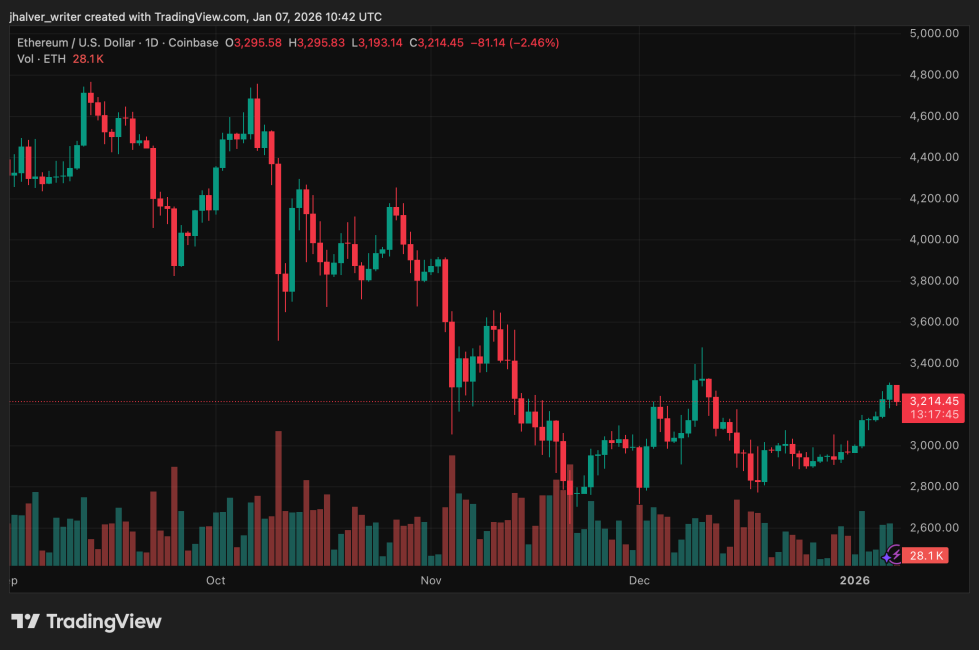
ETH's price moving sideways on the daily chart. Source: ETHUSD on Tradingview

The Case for Regulated Tokenized Cash

Barclays said the investment aligns with its broader work on “new forms of digital money,” emphasizing that any development would sit within existing regulatory boundaries.

The bank did not disclose the size of its stake or Ubyx’s valuation. However, the decision places Barclays among a growing list of large financial institutions seeking exposure to stablecoin rails without directly issuing tokens or operating outside compliance frameworks.

The bank’s interest is not new. In October, Barclays joined a group of global lenders, including Goldman Sachs and UBS, to explore the issuance of a jointly backed stablecoin by G7 currencies.

It has also participated in tokenized deposit pilots and other distributed ledger initiatives, reflecting a cautious but consistent approach to blockchain-based settlement.

Ubyx’s Role in a Crowded Infrastructure Layer

Ubyx positions itself as an intermediary between stablecoin issuers and regulated banks or fintech firms. Its platform supports what it calls universal redemption, allowing businesses to deposit stablecoins from multiple issuers directly into existing accounts at face value.

The startup raised $10 million in seed funding in mid-2025, with backing from Galaxy Ventures, Coinbase Ventures, Founders Fund, and Paxos. Barclays’ entry adds a major UK banking name to that list, blending traditional finance interest with crypto-native capital.

Regulation Support for the Competitive Market

Stablecoins already play a central role in the crypto market’s liquidity, led by Tether, which has approximately $187 billion in circulation.

However, most usage remains inside trading venues. Regulators, including the Bank of England, continue to weigh limits and safeguards to prevent risks such as deposit flight during periods of stress.

That tension defines the current stablecoin race. Banks want faster, programmable settlement. Regulators want control and clear accountability. Infrastructure providers like Ubyx are betting that standardized, compliant clearing can bridge the two worlds, and Barclays’ backing suggests that major lenders are watching closely.

Cover image from ChatGPT, ETHUSD chart from Tradingview

İlgili Sorular

QWhat is the significance of Barclays' investment in Ubyx?

ABarclays' investment in Ubyx marks its first direct move into the stablecoin sector and signals how traditional lenders are approaching stablecoins not as speculative assets, but as infrastructure that could reshape payments and treasury operations if regulation allows.

QWhat does Ubyx do in the stablecoin ecosystem?

AUbyx operates a clearing and settlement layer for stablecoins, aiming to reduce market fragmentation by allowing stablecoins from different issuers and blockchains to be settled and redeemed in a more standardized manner.

QWhich other major financial institutions has Barclays collaborated with regarding stablecoins?

AIn October, Barclays joined a group of global lenders, including Goldman Sachs and UBS, to explore the issuance of a jointly backed stablecoin by G7 currencies.

QWho were the initial backers of Ubyx in its seed funding round?

AUbyx raised $10 million in seed funding in mid-2025 with backing from Galaxy Ventures, Coinbase Ventures, Founders Fund, and Paxos.

QWhat is the main tension in the current stablecoin market according to the article?

AThe main tension is between banks, which want faster, programmable settlement, and regulators, who want control and clear accountability to prevent risks such as deposit flight during periods of stress.

İlgili Okumalar

The AI Agent Era Accelerates Its Arrival: Questflow Defines a New Paradigm of Financial Intelligence with On-Chain AI Brokerage

The AI Agent era is accelerating, with the CB Insights AI 100 list highlighting global investment confidence. The focus has shifted from whether AI works to its speed of deployment and ability to manage complex workflows, with autonomous AI Agents driving this transformation. At the forefront is Questflow, a Singapore-based startup redefining financial intelligence through its on-chain AI brokerage. Unlike tools that merely provide data dashboards, Questflow deploys AI Agents that proactively scan markets, form judgments, and execute trades via a conversational interface—operating 24/7 without requiring manual confirmation for each decision. This embodies the new AI paradigm of agents capable of executing multi-step workflows autonomously. Questflow's mission is to democratize institutional-grade trading intelligence. Historically reserved for the ultra-wealthy, this capability is now accessible starting from just $1 through Questflow's "AI Clone + Copy Trade" model. The platform charges only a 1% execution fee, aligning its incentives directly with users and eliminating traditional management or performance fees. The timing is opportune, aligning with key trends identified by CB Insights: the scalable deployment of AI Agents, accelerated AI adoption in financial services, and the maturation of on-chain infrastructure. With robust liquidity on platforms like Hyperliquid and Polymarket, alongside advancements in AI reasoning and non-custodial wallet security, Questflow is positioned to merge the roles of broker, fund, and exchange into a single, accessible platform for millions.

链捕手42 dk önce

The AI Agent Era Accelerates Its Arrival: Questflow Defines a New Paradigm of Financial Intelligence with On-Chain AI Brokerage

链捕手42 dk önce

Why Pricing Social Interactions is Doomed to Fail?

Titled "Why Putting a Price on Social Interaction Is Doomed to Fail," this article critiques attempts to monetize social networks directly through SocialFi models, arguing their inevitable failure stems from a fundamental misunderstanding of media dynamics. Using Marshall McLuhan's theory of "hot" and "cold" media, the author posits that social networks are inherently "cold" media. Their value isn't contained in individual posts but is co-created through user participation, interpretation, and fragmented, ongoing interaction (e.g., replies, shares). This ambiguity and need for user involvement are core to their function. The article asserts that SocialFi projects like Friend.tech failed because introducing real-time, tradable financial pricing (a definitive "hot" signal) into this "cold" environment doesn't add a layer—it replaces the medium's essence. The unambiguous price signal overshadows and nullifies the nuanced, participatory social signal. Users become traders, not participants, and when speculative profits vanish, the underlying social ecosystem—never genuinely cultivated—collapses entirely. This principle extends beyond crypto. The author argues platforms like Twitter have gradually "heated up" through metrics (likes, retweets counts, algorithmically defined value), shifting users from participants to performers and eroding organic engagement. The solution isn't to abandon capital but to manage its entry point. Successful models like Substack, Patreon, or Bandcamp allow capital to "condense" at specific, isolated nodes (e.g., subscriptions, one-time payments) without permeating and "heating" every social interaction. They preserve the core "cold," participatory medium while enabling monetization at designated boundaries. The NFT boom and bust serves as a stark parallel: the ancient "cold" medium of collecting (valued for story, community, gradual accumulation) was rapidly destroyed by platforms that introduced real-time floor prices, rarity scores, and trading dashboards, transforming collectors into speculators and vaporizing cultural value when prices fell. The core lesson: "Liquidity equals heat." Injecting high liquidity and definitive pricing into a "cold" participatory medium doesn't optimize it; it fundamentally alters and destroys its value-creating mechanism. The future lies not in pricing every social gesture but in finding precise, non-invasive points for capital to condense without overheating the entire ecosystem.

marsbit50 dk önce

Why Pricing Social Interactions is Doomed to Fail?

marsbit50 dk önce

İşlemler

Spot
Futures
活动图片


