Banks Prepare To Spend $100 Million+ To Stop Crypto Bills, Expert Warns

bitcoinist2026-03-11 tarihinde yayınlandı2026-03-11 tarihinde güncellendi

Özet

The fight over US crypto legislation is intensifying into a direct clash between the digital asset industry and the established banking sector. According to Dennis Porter, CEO of the Satoshi Action Fund, the banking industry is preparing a massive lobbying push, potentially exceeding $100 million, to counteract efforts to advance crypto market structure and stablecoin legislation. Porter warns that this creates a significant counterbalance to crypto lobbying groups and could lead lawmakers to withdraw support. He states that crypto industry faces political challenges, including low public trust and ethical concerns linked to Trump family involvement. Furthermore, market structure legislation is politically difficult as it covers a wide range of complex issues. The banking industry holds an advantage due to its entrenched local influence, including physical branches and jobs in lawmakers' districts. Porter cautions that if the dispute escalates into an open lobbying war, it could jeopardize the already tight Senate vote. He also notes that the legislative window is narrowing as midterm elections approach, with electoral incentives increasingly shaping the calendar.

The fight over US crypto legislation is turning into a direct clash between digital-asset firms and one of Washington’s oldest power centers. In an interview with Pete Rizzo, Satoshi Action Fund founder and CEO Dennis Porter said the banking industry is preparing a nine-figure lobbying push that could complicate efforts to advance both market structure legislation and stablecoin rules.

Crypto’s D.C. Outlook Just Got Darker

Porter said the core dispute is no longer just about whether Congress wants to regulate crypto, but on whose terms. President Donald Trump has publicly backed keeping the GENIUS Act intact, Porter noted, which he described as a positive sign for crypto firms. But he argued that support from the White House does not resolve the deeper standoff with banks, especially around stablecoins and the issue of rewards programs that banks view as a threat to deposits.

“The bank lobby has come out and said that they do plan to spend to counteract the crypto industry,” Porter said. “They said they’re raising nine figures, which is right up there with the Fairshake number. So that does create that counterbalance where they can essentially assert themselves into the ecosystem and start to peel some of these lawmakers off.”

That matters because, in Porter’s telling, crypto is entering the fight without a clean political backdrop. He said Democrats have grown more cautious around digital-asset legislation as Trump family involvement in the sector has raised ethics concerns among both lawmakers and voters.

At the same time, he described market structure as a far more expansive and politically difficult package than stablecoin legislation, since it touches not only securities-versus-commodities questions but also DeFi, illicit finance, ethics provisions and the makeup of the CFTC.

Porter argued that this leaves the legislation exposed to a wider set of objections and delays. He said there is still a path forward if key Democrats become comfortable with revisions, but added that the bill currently lacks a decisive forcing mechanism and has been pushed aside while lawmakers focus on a housing package.

The bank-crypto standoff, he suggested, could become especially dangerous if it turns into an open lobbying war. “If we end up in a situation where they’re directly lobbying against each other, you could see a lot of not just Democrats peel off this bill, but even possibly Republicans peel off this bill as well,” Porter said. “The vote is already tight in the Senate, very tight.”

His reasoning was straightforward: banks bring not just money, but entrenched local influence. Unlike much of crypto, Porter said, banks can point to branches, jobs and long-standing relationships in lawmakers’ districts. That advantage becomes even more important at a time when, by his own account, the industry is struggling politically.

“And also, crypto really is not popular right now,” Porter said. “Public trust in the crypto space is at an all-time low. Something that we’re deeply concerned about at Satoshi Action. Something that definitely needs some work.”

Porter framed that weakness as both a political problem and a policy argument. In his view, one purpose of market structure legislation is precisely to clean out the “crap” and scams that have damaged the sector’s reputation. But until lawmakers see a clearer consumer and political upside, he suggested, crypto firms may have trouble overcoming resistance from incumbents that view stablecoins as an existential threat to their business model.

He was notably cautious on timing. While some analysts have argued the window effectively closes by summer, Porter said the odds decline as the midterms approach but do not disappear entirely. His broader point was that the legislative calendar is being shaped as much by electoral incentives as by the text of the bills themselves.

At press time, the total crypto market cap stood at $2.34 trillion.
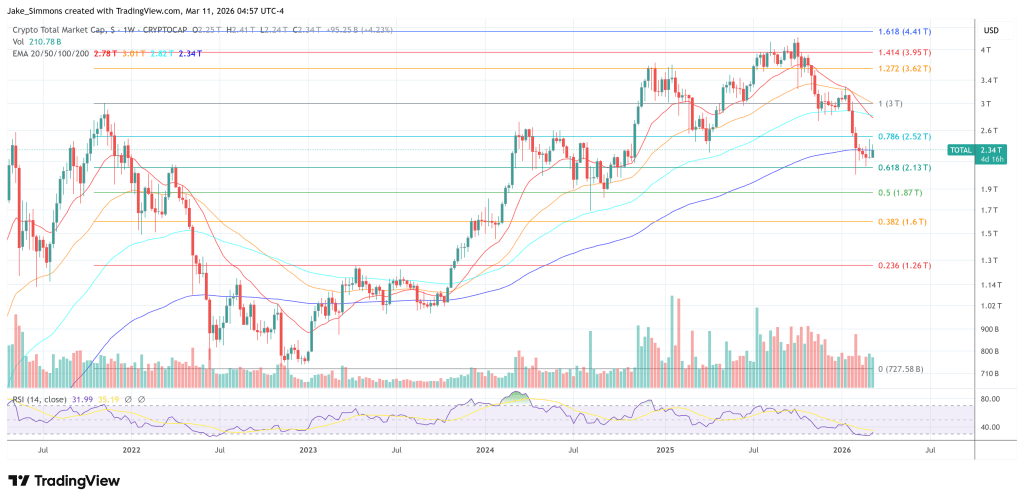
Total crypto market cap, 1-week chart | Source: TOTAL on TradingView.com

İlgili Sorular

QAccording to Dennis Porter, how much money is the banking industry preparing to spend to counteract crypto legislation efforts?

AThe banking industry is preparing to spend a nine-figure sum, which is over $100 million, to lobby against crypto bills.

QWhat are the two main types of US crypto legislation mentioned that are being complicated by this banking push?

AThe two main types of US crypto legislation mentioned are market structure legislation and stablecoin rules.

QWhat reason does Porter give for why banks have a significant advantage in a lobbying war against crypto?

APorter states that banks have an advantage because they bring not just money, but entrenched local influence, including physical branches, jobs, and long-standing relationships in lawmakers' districts.

QWhat does Dennis Porter cite as a major political weakness for the crypto industry in this fight?

AHe cites that 'crypto is not popular right now' and that 'public trust in the crypto space is at an all-time low.'

QBeyond the bank opposition, what other reason is given for why the market structure bill is politically difficult to pass?

AThe market structure bill is described as politically difficult because it is a far more expansive package that touches on securities-vs-commodities questions, DeFi, illicit finance, ethics provisions, and the makeup of the CFTC, leaving it exposed to a wider set of objections.

İlgili Okumalar

In Jinjiang, Fujian, a Storage Super Unicorn Lies Quiet

In Fujian's Jinjiang, a city known for sportswear, lies a quiet semiconductor giant: Fujian Jinhua Integrated Circuit Co. (JHICC). Once a promising domestic DRAM manufacturer alongside Yangtze Memory and ChangXin Memory Technologies (CXMT), its journey was derailed in 2018 when the U.S. placed it on an Entity List and filed criminal charges for alleged trade secret theft. This halted production for years. A turning point came in February 2024 when a U.S. federal court found JHICC not guilty. However, it had lost crucial time. While CXMT soared to become a top-valued A-share company in 2024, JHICC, with an estimated valuation of 80 billion RMB, was just restarting. Its current output is primarily customized DDR4 chips, not the advanced DDR5/HBM demanded for AI, but it still benefits from the broader memory chip upcycle. JHICC's story is tied to Chen Zhengkun, a veteran engineer who left Micron to lead the venture. Founded in 2016 with state-backed funding, JHICC partnered with Taiwan's UMC to develop DRAM technology. Rapid progress was cut short by the U.S. actions, which Micron initiated, partly due to its heavy reliance on the Chinese market. Post-sanctions, Chen's team worked to rebuild the production line with reduced reliance on U.S. technology. According to its records, JHICC achieved small-scale production and revenue growth under immense pressure. It now focuses on the stable "niche" DRAM market (e.g., TVs, routers) with a monthly capacity of ~40,000 wafers, aiming for 60,000 by 2026. It holds over 1,000 patents but remains on the Entity List. For Jinjiang, investing in JHICC was a bold industrial leap. The local government provided unwavering financial and logistical support during the crisis, helping the company survive. JHICC has become the anchor for a growing local semiconductor cluster. Though its scale lags behind domestic peers, JHICC's persistence symbolizes a hard-won foothold in a global market long dominated by Samsung, SK Hynix, and Micron. Having missed one boom, it seeks a place in the new AI-driven memory supercycle.

marsbit14 dk önce

In Jinjiang, Fujian, a Storage Super Unicorn Lies Quiet

marsbit14 dk önce

Must-Watch Events Next Week|CLARITY Act Could Face Senate Vote; SpaceX, Circle to Report Earnings (8.3-8.9)

**Summary: Key Events and Developments to Watch (August 3-9)** The upcoming week is marked by significant financial disclosures, key legislative deadlines, and notable product updates. **Major Financial Events:** Several companies are scheduled to release their Q2 2026 earnings. American Bitcoin (ABTC) will report on August 3, followed by SpaceX and Hut 8 Mining Corp. on August 4, and Circle on August 5. Notably, a significant portion of SpaceX shares (up to 12% of total shares) will be unlocked on August 6 following their earnings release. **Key Legislative Deadline:** The U.S. Senate faces an August 7 deadline to secure 60 votes for the CLARITY Act, a bipartisan bill aiming to establish a federal regulatory framework for cryptocurrencies. The Senate may hold a full vote on the bill during the week. **Economic Data:** The U.S. July Non-Farm Payrolls report will be released on August 7, providing crucial labor market data. **Technology & Product Updates:** * **Shutdowns:** DeFi portfolio tracker Zapper and wallet app Ctrl Wallet will cease operations on August 3. * **Upgrades:** LayerZero will deprecate its v1 relayers on August 3. XRP Ledger's new version 3.3.0, featuring five new functions, is expected next week. * **AI:** Elon Musk announced that the advanced Grok 4.6 AI model is set for release around August 7. * **Bitcoin:** The BIP-110 forced signaling for a potential Bitcoin network change is scheduled to begin around August 8. **Other Notable Events:** Chinese robotics firm Unitree Tech has set its preliminary price inquiry for its IPO for August 5. South Korean exchange Upbit will delist AQT and AERGO tokens on August 3.

marsbit2 saat önce

Must-Watch Events Next Week|CLARITY Act Could Face Senate Vote; SpaceX, Circle to Report Earnings (8.3-8.9)

marsbit2 saat önce

İşlemler

Spot
活动图片





