Banks oppose stablecoin yield deal – Can CLARITY Act find 60 votes?

ambcrypto2026-07-24 tarihinde yayınlandı2026-07-24 tarihinde güncellendi

Özet

The Bank Policy Institute (BPI) has opposed the latest draft of the CLARITY Act, criticizing its provisions on stablecoin yield and illicit finance. The banking industry sought a total ban on stablecoin yield, but the bill's compromise only prohibits passive yield on idle balances. This opposition has influenced lawmakers, reducing tentative Republican Senate support to potentially 49 votes. With the 60-vote threshold needed, securing sufficient Democratic support appears difficult as some pro-crypto Democrats also oppose the bill due to ethics and illicit finance concerns. Senate Majority Leader John Thune expressed doubt the bill can pass before the August recess. Market odds for the bill's passage in 2026 have fallen, leaving its future uncertain.

U.S banking trade group, the Bank Policy Institute (BPI), has opposed the newly released CLARITY Act draft, flagging gaps on key issues.

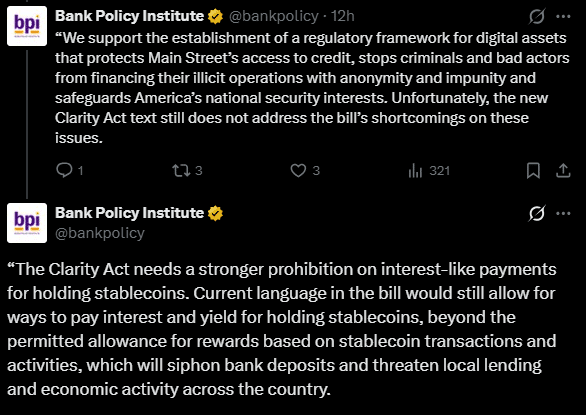
In a statement on Thursday, the 23rd of July, the BPI said the bill still has “shortcomings” on stablecoin yield and illicit finance provisions that should be “strengthened.”
Source: X

The banking industry has been opposed to the earlier stablecoin yield compromise that only allowed incentives based on account activity, not idle balances.

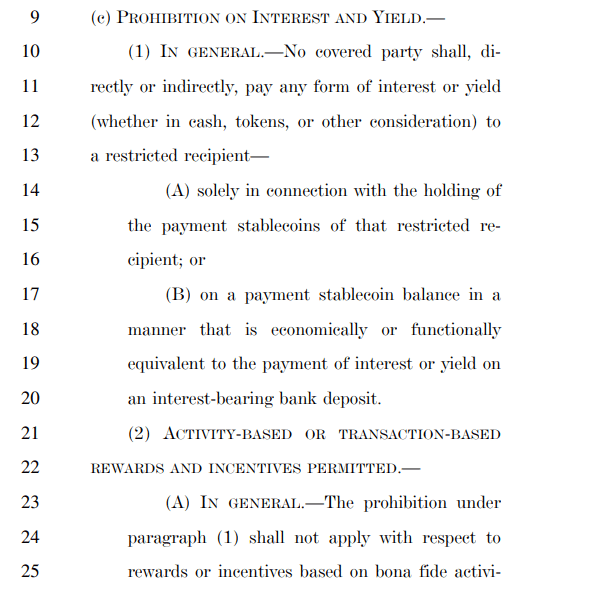
This passive yield ban sought to address banks’ capital flight concerns. The compromise is captured in the new draft (Section 404).
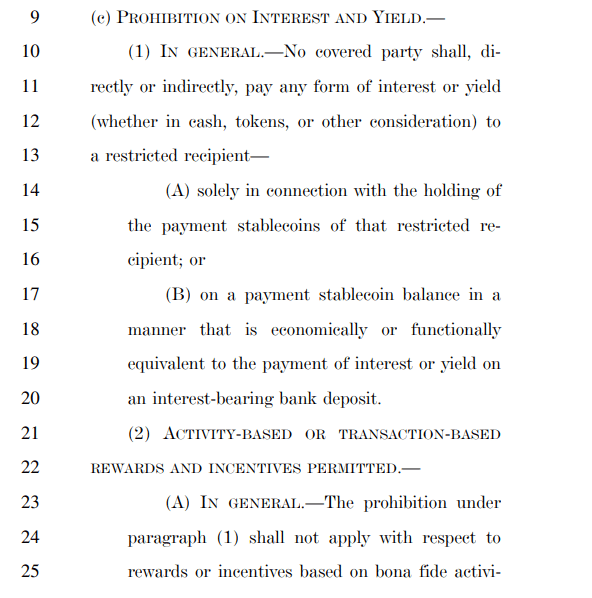
Source: U.S Senate

Unfortunately, the banking industry sought a total ban on any form of stablecoin yield or incentive.

Unsurprisingly, the banking sector has lobbied some lawmakers, including Sen. John Curtis (R-Utah) and Sen. John Cornyn (R-Texas), who now share the banks’ concerns over the crypto bill.

Will the CLARITY Act win the needed 60 votes?

This is bad news for Republicans and the crypto industry.

Before the death of Sen. Lindsey Graham this month, the Republicans had 53 members. Besides, another member, Kentucky’s Senator Mitch McConnell, has been sick for over a month, bringing their headcount to 51.

If Sen. Curtis and Cornyn withhold support for the bill, the Republican support will drop to 49.

In other words, they’ll need 11 Senate Democrats to support the bill to hit the 60-vote threshold. Unfortunately, some pro-crypto Democrats like Sen. Angela Alsobrooks and Ruben Gallego have opposed the bill due to inadequate provisions on ethics and illicit finance, among other issues.

This complicates the 60-vote target if a deal isn’t reached to win over all the key holdouts. On top of this, the timing and Majority Leader’s outlook don’t help the bill’s progress.

Only two weeks remain before the Senate breaks for the August recess. Most analysts had warned that if the bill is not passed by August, it will be as good as dead.

For his part, the U.S. Senate Majority Leader John Thune warned that the bill may fail to pass before the August recess.

I don’t think we’ll be able to get them done. I would like to get at least Clarity started. We’ll see where the votes are.

In response, White House Chief Crypto Advisor Patrick Witt urged Thune to schedule the vote and stop waiting for Democrats.

You’d be waiting forever (for Democrats). Nobody thought that we could actually produce an ethics provision that had real teeth, and that included the President.

For Witt, the new ethics provision addresses Democrats’ concerns.
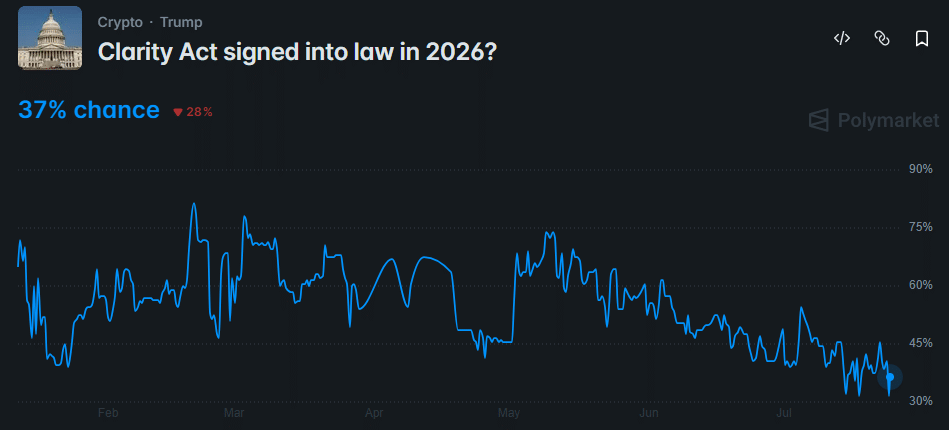
Source: Polymarket

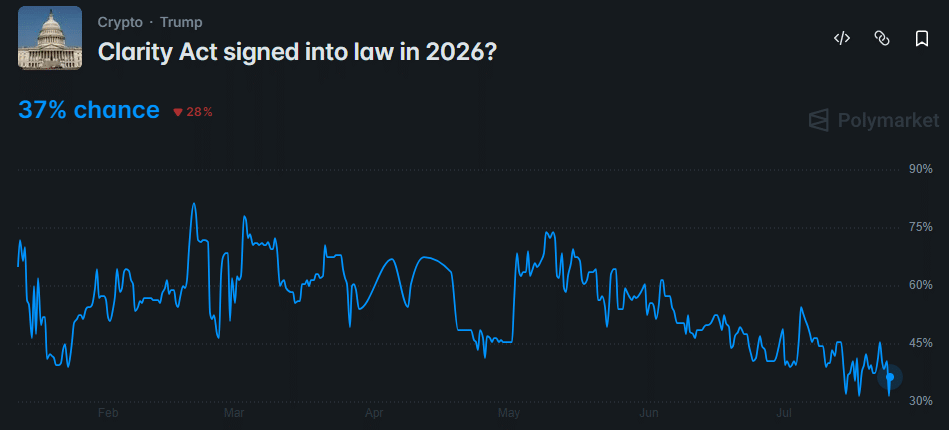
Market expectations for the bill’s passage in 2026 briefly dropped to 32% on Friday. Whether the passage odds will improve in the next two weeks remains uncertain.


Final Summary

  • Tentative Senate backing for the crypto bill has dropped below 50.
  • Majority Leader John Thune doubted the CLARITY Act’s chance of passage before the August recess

İlgili Sorular

QWhat is the main concern raised by the Bank Policy Institute (BPI) regarding the CLARITY Act draft?

AThe Bank Policy Institute (BPI) has opposed the CLARITY Act draft, citing shortcomings on key issues, particularly regarding stablecoin yield provisions and illicit finance controls, which they believe need to be strengthened. They specifically oppose the compromise that allows incentives based on account activity but bans passive yield on idle balances, seeking a total ban on any form of stablecoin yield or incentive instead.

QHow might Senators Curtis and Cornyn's stance affect the Republican support count for the CLARITY Act?

AIf Senators John Curtis (R-Utah) and John Cornyn (R-Texas) withhold their support for the CLARITY Act, Republican support in the Senate would drop from 51 to 49 votes. This is due to recent events like Senator Lindsey Graham's death and Senator Mitch McConnell's illness, which have already reduced their numbers. With only 49 Republican votes, the bill would need 11 Senate Democrats to reach the 60-vote threshold for passage.

QWhy are some pro-crypto Democrats like Senators Alsobrooks and Gallego opposing the bill?

ASome pro-crypto Democrats, including Senators Angela Alsobrooks and Ruben Gallego, are opposing the CLARITY Act due to concerns over inadequate provisions on ethics and illicit finance, among other issues. Their opposition complicates the bill's path to achieving the necessary 60 votes in the Senate.

QWhat did Senate Majority Leader John Thune say about the bill's chances of passing before the August recess?

AU.S. Senate Majority Leader John Thune expressed doubt that the CLARITY Act would pass before the August recess, stating, 'I don’t think we’ll be able to get them done. I would like to get at least Clarity started. We’ll see where the votes are.' He highlighted the tight timeline, with only two weeks remaining before the recess.

QHow did the market's expectation for the bill's passage in 2026 change recently, according to the article?

AMarket expectations for the CLARITY Act's passage in 2026 briefly dropped to 32% on the Friday mentioned in the article. This decline reflects the growing uncertainty and political challenges surrounding the bill's progress as key deadlines approach.

İlgili Okumalar

Bitcoin Withdrawals Continue: 8 Years of Storage in a Coldcard Cold Wallet Ended in Zero

Coldcard Hardware Wallet Hacked: Losses Mount Due to Vulnerable Seed Generation A critical vulnerability in Coldcard hardware wallets has led to a continued wave of fund thefts. According to Galaxy Research, the total stolen has reached 1,367.05 BTC (approx. $88.6 million) from 4,585 addresses, a significant increase from the initial 594.5 BTC reported on July 30, 2026. Most of the stolen funds remain on the attackers' addresses. The issue is not with the current firmware, which Coinkite has updated, but with seed phrases generated on vulnerable devices between March 2021 and the release of fixed firmware versions. Due to a programmer error, devices switched from using a hardware random number generator to the software-based Yasmarang generator, which was initialized with publicly accessible data like the chip's serial number. This made the seed phrases predictable through offline brute-force attacks, meaning wallets remain at risk until funds are moved to a new wallet generated with the patched firmware. Affected devices include Mk2/Mk3 with firmware 4.0.1–4.1.9 (and up to 5.0.3), Mk4/Mk5 up to version 5.6.0, and Q models up to 1.5.0Q. The only exceptions are seeds created with a high-entropy method like at least 50 independent dice rolls or a strong unique BIP-39 passphrase. All other owners must generate a new seed on the fixed firmware and transfer their assets. A case highlighting the human impact involves a 39-year-old long-term investor who lost 2 BTC (approx. $130,000) in minutes. He had accumulated the Bitcoin over eight years through physical labor, viewing it as a financial lifeline and a retirement plan in a country suffering from hyperinflation. His story underscores that even conservative "buy and hold in cold storage" strategies can be compromised by such underlying technical flaws. From a technical perspective, this incident echoes historical failures where weak random number generators undermined cryptographic security, challenging the assumption that offline storage is automatically foolproof.

cryptonews.ru1 saat önce

Bitcoin Withdrawals Continue: 8 Years of Storage in a Coldcard Cold Wallet Ended in Zero

cryptonews.ru1 saat önce

İşlemler

Spot
活动图片