Banks Advance Plans to Create Stablecoins as Bank for International Settlements Questions Their Role

cryptonews.ru2026-08-29 tarihinde yayınlandı2026-08-29 tarihinde güncellendi

Özet

While the Bank for International Settlements (BIS) argues that stablecoins lack key properties to function as money at scale, major global banks are actively developing their own stablecoin plans on public blockchains. BIS head Pablo Hernández de Cos advocates for tokenized bank deposits as a superior foundation for modern digital payments, citing issues with stablecoins regarding uniformity, interoperability, and financial integrity. These problems include exchange rate fluctuations between different stablecoins, settlement complexities across fragmented blockchains, and anonymity concerns. Despite these warnings, a consortium of over a dozen major banks, including Bank of America and Citi, is preparing to launch a bank-issued stablecoin. This shift is driven by competitive pressure and regulatory changes like the GENIUS Act, with banks fearing potential deposit outflows to crypto-native issuers. Data shows stablecoin transaction volumes are massive, but a small fraction represents real-economy payments. While central banks prefer tokenized deposits for core payments, commercial banks increasingly see a strategic need for stablecoins to retain relevance, even as some, like JPMorgan, currently deny having imminent launch plans.

Despite the Bank for International Settlements (BIS) chief's view that stablecoins cannot be considered money on a large scale, the world's largest banks are moving financial settlements and regular transactions onto public blockchains.

Speaking at the Economic Symposium in Jackson Hole on August 28, BIS General Manager Pablo Hernández de Cos stated that a system based on tokenized deposits "looks more promising" than stablecoins. BIS representatives emphasized that tokenized deposits should form the foundation of modern digital payment systems as banks transition their operations to blockchain.

For banks, the dilemma is straightforward: should they adopt blockchain now, or wait for regulators to approve a more technologically advanced version of this innovative solution?

Where Stablecoins Fall Apart, According to de Cos

De Cos's argument centers on three properties he says money must possess: uniformity, interoperability, and financial integrity.

Regarding uniformity, he gave a simple example. If one person holds Tether's $USDT tokens and wants to transfer money to a recipient who only accepts Circle's $USDC tokens, that person would first have to sell $USDT and buy $USDC. However, since the coins' prices can fluctuate on the market, the final transfer amount might not equal one US dollar. The system does not guarantee that two stablecoins will exchange one-for-one.

The interoperability issue creates another problem. Most fiat-backed stablecoins operate on fragmented, permissionless public blockchains and scaling layers. Even a request to transfer the same stablecoin issued on different blockchains from one chain to another requires performing complex—and sometimes costly—procedures.

In contrast, the settlement process for tokenized deposits involves using central bank accounts, as de Cos noted, preserving the nominal redeemability and finality of such deposits.

The Integrity Issue BIS Keeps Returning To

The third issue is financial integrity. According to de Cos, information shows that most stablecoins are currently held in self-custodied wallets and that an increasing number of transfers between blockchain wallets are conducted without any platform performing "Know Your Customer" (KYC) checks. This is vastly different from traditional finance, where bank deposits, the least anonymous form of money, predominate.

In its Annual Economic Report on June 23, the Bank for International Settlements (BIS) presented a similar viewpoint. In the section on stablecoins, it went so far as to state that existing stablecoin designs "do not meet the fundamental properties of money and threaten financial integrity."

Furthermore, the research expressed concern about the concept of "stablecoin dollarization" in developing countries, where the demand for foreign stablecoins could impact capital flows and reduce their monetary sovereignty.

What Payment Data Actually Shows

The discussion on scale is backed by significant figures.

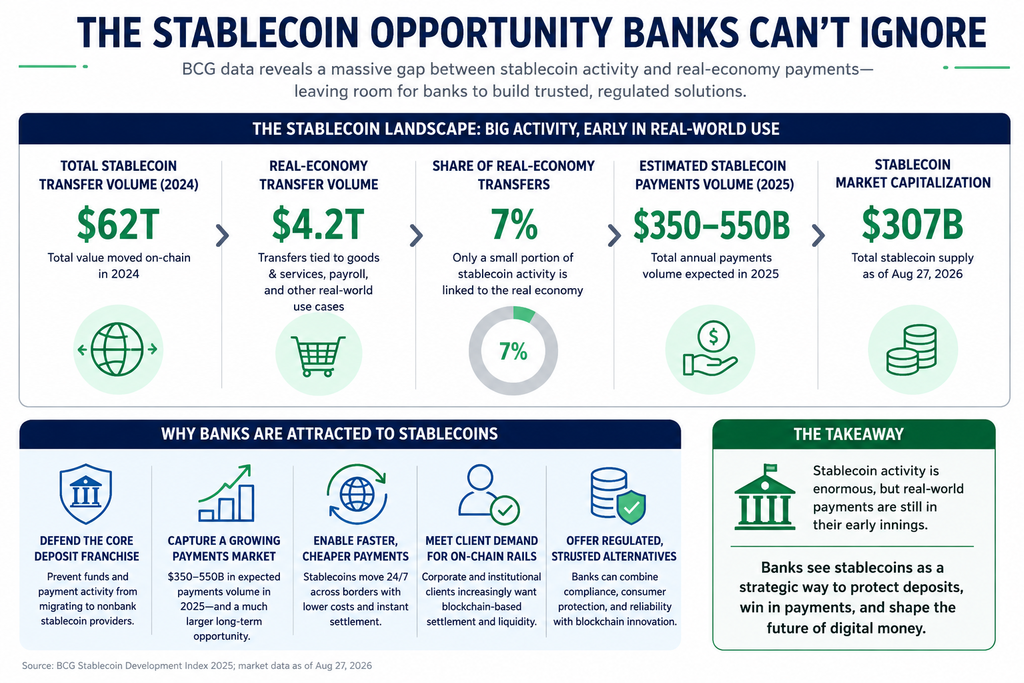
According to an analytical report published in January 2026 by Boston Consulting Group (BCG) and blockchain data analytics firm Allium, over $62 trillion worth of stablecoin transactions occurred on public blockchains in a year. However, of this amount, only about $4.2 trillion (approximately 7% of the total) represented payments made in the real economy.

BCG estimated the observed volume of bilateral payments for goods and services in 2025 to be between $350 and $550 billion, which they termed a minimal figure. Additionally, the article noted that the stablecoin market capitalization grew to $307 billion by December 2025.

Why Are Banks Shifting Policy at All?

These warnings have not stopped banks from moving towards blockchain adoption.

On August 28, Forkast reported that a consortium of over 12 global banks, including Bank of America, Wells Fargo, Santander, Citi, Goldman Sachs, and UBS, is preparing to issue its own stablecoin on public blockchains, rather than leaving the market to Tether and Circle.

The GENIUS Act, which took effect on July 18, 2025, was a legislative measure allowing banks to access the federal level through subsidiaries approved by the Office of the Comptroller of the Currency (OCC), although it prohibited issuers from paying any interest to holders.

Bank of America CEO Brian Moynihan warned that up to $6 trillion in deposits could be withdrawn from banks if stablecoin issuers were allowed to offer yields.

"If it is legalized, we will engage in this business."

Smaller lending institutions are also adopting new technologies. Cryptopolitan reported that 39 state bankers' associations have formed the BankChain Alliance, set to launch in 2027. This initiative aims to provide local banks with shared access to tokenized deposits and stablecoins without relying on crypto platforms.

Are Banks Moving from Research to Creating a Joint Stablecoin?

Today's article in the Seoul Economic Daily states that a major banking group is considering initially issuing a dollar-pegged token, with subsequent expansion to G7 currencies. It also highlights the strategic reason: banks fear stablecoins could divert deposits away from traditional banks.

Feature Stablecoins Tokenized Deposits
What is it? Digital tokens designed to maintain a stable value relative to a reference asset, typically the US dollar. Digital representation of ordinary commercial bank deposits on a programmable ledger.
Issuer Typically a private stablecoin issuer. Commercial bank.
Holder's Claim Claim on the stablecoin issuer's/reserve structure. Direct claim on the issuing bank.
Backing Typically reserves like cash, central bank reserves, Treasury bonds, or other permitted assets. Ultimately, the bank's deposit obligations are part of the banking system.
Redeemability Intended for redemption at $1, but secondary market prices may deviate from par. Exchanges at par as a bank deposit/claim.
Settlement Transfers between token holders on blockchain networks. Payment results in debiting one bank account and crediting another, with interbank settlement ultimately using central bank money.
Blockchain Often public/permissionless networks. Typically permissioned/controlled bank platforms, though hybrid models are possible.
Interoperability Can be fragmented across issuers and blockchains. Higher fungibility achieved when using tokenized central bank reserves.
AML/KYC May involve anonymous wallets and self-custody. Account ownership and activities within regulated bank infrastructure.
Bank Deposits Could potentially divert funds away from banks. Secures deposits within the banking system.
Main Advantage Global reach, programmability, and 24/7 transfer capability. Programmability while preserving the existing bank/central bank monetary structure.
BIS's Preferred Role Specialized uses, not the basis for everyday payments. Handling large daily payments and wholesale settlements.
Current Examples $USDT, $USDC, and other fiat-backed tokens. JPMorgan's deposit token model and other bank tokenization projects.
The differences between stablecoins and tokenized deposits are structural, not merely numerical. | BIS

Central banks want to see tokenized deposits and central bank money at the heart of the blockchain economy, while commercial banks are increasingly concluding that they also need stablecoins. Notably, JPMorgan's position remains that the company has no current plans to issue a stablecoin.

end-content

Trend Kriptolar

İlgili Sorular

QAccording to the head of the BIS, what are the three properties that money should have, and how do stablecoins fail to meet them?

AAccording to the head of the BIS, Pablo Hernández de Cos, the three properties money should have are unity (uniqueness), compatibility (interoperability), and financial integrity. He argues stablecoins fail because: 1) Different stablecoins like USDT and USDC are not guaranteed to exchange at a 1:1 rate (unity). 2) They operate on fragmented, permissionless blockchains, making cross-chain transfers complex (compatibility). 3) Many are held in self-custody wallets with limited KYC checks, raising concerns about financial integrity versus traceable bank deposits.

QWhat is the Bank for International Settlements' (BIS) preferred model for the foundation of modern digital payment systems, and why?

AThe BIS prefers a system based on tokenized bank deposits as the foundation for modern digital payment systems. They argue this model is more promising than one based on stablecoins because tokenized deposits utilize central bank accounts for settlement, preserving nominal redemption and finality. This approach maintains the existing monetary structure, ensures financial integrity through bank-level AML/KYC, and prevents potential disintermediation of commercial bank deposits.

QDespite the BIS's warnings, why are major global banks reportedly planning to issue their own stablecoin on public blockchains?

AMajor global banks are reportedly planning to issue their own stablecoin on public blockchains to prevent deposits from being drained away by private stablecoin issuers like Tether and Circle. They fear that if these private issuers are allowed to offer yield, trillions in deposits could leave the traditional banking system. The passing of the GENIUS law, which allows banks to access the public blockchain space via OCC-approved subsidiaries (though without paying interest), is a key factor enabling this strategic move.

QWhat does the data from Boston Consulting Group (BCG) and Allium reveal about the volume of stablecoin transactions versus payments in the real economy?

AData from BCG and Allium reveals a significant gap between total stablecoin transaction volume and real-economy payments. They estimated that over $62 trillion worth of stablecoin transactions occurred on public blockchains in a year. However, only about $4.2 trillion (approximately 7% of the total) constituted payments made within the real economy. The observed volume of bilateral payments for goods and services in 2025 was estimated to be between $350 billion and $550 billion, which they termed a minimal figure.

QAccording to the article's comparison table, what is a key structural difference between the holder's claim in a stablecoin versus a tokenized deposit?

AA key structural difference is the nature of the holder's claim. For a stablecoin, the holder has a claim on the stablecoin issuer's reserve structure. For a tokenized deposit, the holder has a direct claim on the issuing commercial bank itself, just like a traditional bank deposit. This makes tokenized deposits an integral part of the existing banking system, whereas stablecoins represent a claim on an external, often private, entity.

İlgili Okumalar

Ripple (XRP) Company Announces Plans for Major Future Update

Ripple (XRP) has announced a four-phase plan to prepare the XRP Ledger (XRPL) for future security threats posed by quantum computers. The company's senior director of engineering stated the goal is to build necessary infrastructure before quantum computers become a direct threat, aiming to minimize impact on existing systems, user assets, and network operations. The plan begins with identifying potential quantum vulnerabilities within XRPL, followed by testing quantum-resistant cryptographic methods. The next phase involves parallel testing of existing security mechanisms and new quantum-resistant solutions to ensure reliability and prevent disruption for users and applications. The final phase would involve transitioning the XRPL to more comprehensive, quantum-resistant security standards if the technology matures. Ripple is also developing contingency plans for a faster-than-expected advancement of quantum computing, which could accelerate the transition timeline. A current XRPL feature allowing users to change the keys controlling their accounts without altering the accounts themselves is seen as a potential advantage in any future migration. However, Ripple cannot unilaterally change transaction validation rules or network-wide cryptographic standards; such updates require coordination and approval from independent validators via XRPL's governance process. While quantum computers are not yet capable of breaking the cryptography used by major blockchains like Bitcoin or XRPL, developers across the industry are already evaluating transition scenarios to quantum-resistant algorithms due to the long-term risks they pose to public-key cryptography.

cryptonews.ru15 dk önce

Ripple (XRP) Company Announces Plans for Major Future Update

cryptonews.ru15 dk önce

İşlemler

Spot

Popüler Makaleler

$BANK Nedir

Bank AI: Bankacılıkta Devrimsel Bir Adım Giriş Teknolojideki hızlı ilerlemelerin damgasını vurduğu bir çağda, Bank AI, yapay zeka (AI) ve bankacılık hizmetleri kesişiminde yer almaktadır. Bu yenilikçi proje, finansal manzarayı yeniden tanımlamayı, operasyonel verimliliği, güvenlik önlemlerini ve müşteri deneyimlerini AI'nin gücüyle geliştirmeyi hedefliyor. Bank AI yolculuğuna çıkarken, projenin içeriğine, operasyonel dinamiklerine, tarihsel bağlamına ve önemli kilometre taşlarına dalacağız. Bank AI Nedir? Bank AI, yapay zekanın çeşitli bankacılık operasyonlarına entegrasyonunu hedefleyen dönüştürücü bir girişimi temsil etmektedir. Bu proje, süreçleri otomatikleştirmek, risk yönetimi protokollerini geliştirmek ve kişiselleştirilmiş hizmetler aracılığıyla müşteri etkileşimini artırmak için AI'nin yeteneklerinden yararlanmaktadır. Bank AI'nin temel hedefleri şunlardır: Bankacılık Fonksiyonlarının Otomasyonu: AI teknolojilerini kullanarak, Bank AI rutin görevleri otomatikleştirmeyi, insan kaynakları üzerindeki yükü azaltmayı ve verimliliği artırmayı amaçlamaktadır. Geliştirilmiş Risk Yönetimi: Proje, dolandırıcılık ve diğer tehditlere karşı güvenlik önlemlerini güçlendirerek riski tahmin edip tanımlamak için AI algoritmalarını kullanmaktadır. Bankacılık Hizmetlerinin Kişiselleştirilmesi: Bank AI, müşteri verilerini ve davranışlarını analiz ederek, özel finansal ürünler ve hizmetler sunmaya odaklanmaktadır. Müşteri Deneyimini İyileştirme: Chatbotlar ve sanal asistanlar gibi AI destekli çözümlerin uygulanması, kullanıcıların daha insana yakın etkileşimler yaşamasını sağlamayı hedeflemekte, bankalarla etkileşim biçimlerini devrim niteliğinde değiştirmektedir. Bu hedeflerle, Bank AI, bankacılığı daha verimli, güvenli ve kullanıcı odaklı hale getiren önemli bir oyuncu olarak kendini konumlandırmaktadır. Bank AI'nin Yaratıcısı Kimdir? Bank AI'nin yaratıcısı hakkında detaylar bilinmemektedir. Bu nedenle, mevcut bilgilerde belirli bir kişi veya organizasyon tanımlanmamıştır. Projenin başlangıcı etrafındaki anonimlik soruları gündeme getirse de, bunun iddialı vizyonu ve hedefleri üzerinde bir olumsuz etkisi yoktur. Bank AI'nin Yatırımcıları Kimlerdir? Proje yaratıcılarında olduğu gibi, Bank AI'nin yatırımcıları veya destekleyen organizasyonları hakkında da özel bilgiler açıklanmamıştır. Bu bilgiler olmadan, projenin ilerlemesini destekleyen finansal destek ve kurumsal destek hakkında bir çerçeve çizmek zordur. Yine de, böyle yenilikçi bir alanda gelişimi sürdürmek için sağlam bir yatırım temelinin önemi büyüktür. Bank AI Nasıl Çalışır? Bank AI, geleneksel bankacılık çerçevelerinden ayıran benzersiz faktörlere odaklanarak birden fazla yenilikçi alanda faaliyet göstermektedir. İşte temel operasyonel özellikler: Otomasyon: Makine öğrenimi algoritmalarını uygulayarak, Bank AI bankalar içindeki çeşitli manuel süreçleri otomatikleştirir. Bu, operasyonel maliyetleri azaltır ve insan çalışanların daha stratejik faaliyetlere yönelmelerini sağlar. Gelişmiş Risk Yönetimi: Risk yönetimi uygulamalarına AI entegrasyonu, bankaların dolandırıcılık gibi potansiyel tehditleri doğru bir şekilde tahmin etme araçlarıyla donatılmasını sağlar, böylece müşteri bilgileri ve varlıkları güvence altına alınır. Özelleştirilmiş Finansal Tavsiyeler: Müşteri etkileşimlerinden sürekli olarak öğrenerek, AI sistemleri kullanıcı ihtiyaçlarının daha iyi anlaşılmasını sağlar ve finansal kararlar hakkında özelleştirilmiş tavsiyeler sunar. Geliştirilmiş Müşteri Etkileşimleri: AI destekli chatbotlar ve sanal asistanlar kullanarak, Bank AI daha etkileşimli bir müşteri deneyimi sunar, kullanıcıların sorularını hızlı bir şekilde çözmelerine imkan tanır, bekleme sürelerini azaltır ve memnuniyet seviyelerini artırır. Bu operasyonel özellikler, Bank AI'yi bankacılık sektöründe bir öncü olarak konumlandırmakta ve hizmet sunumu ile operasyonel mükemmeliyet için yeni standartlar belirlemektedir. Bank AI Zaman Çizelgesi Bank AI'nin gidişatını anlamak için tarihsel bağlamına bir göz atmak gerekmektedir. Aşağıda önemli kilometre taşlarını ve gelişmeleri vurgulayan bir zaman çizelgesi bulunmaktadır: 2010'ların Başları: AI entegrasyonunun bankacılık hizmetlerine olan ilgisi arttı, bankacılık kurumları potansiyel faydalarını tanımaya başladılar. 2018: Bankaların temel müşteri hizmetleri ve geliştirilmiş güvenlik yönetimi için risk yönetim sistemlerinde chatbotlar gibi AI araçları kullanmaya başlamasıyla AI teknolojilerinin uygulanmasında belirgin bir artış yaşandı. 2023: AI'nin karmaşıklığı artmaya devam etti ve belge işleme ile gerçek zamanlı yatırım analizi gibi daha karmaşık görevler için üretken AI devreye alındı. Bu yıl, AI teknolojisi sayesinde bankaların sahip olduğu yeteneklerde önemli bir sıçrama yaşandı. 2024-Güncel Durum: Bu yıl itibarıyla, Bank AI yükselişte, devam eden araştırmalar ve geliştirmeler bankacılık operasyonlarındaki yetenekleri daha da artırmaya hazırlanıyor. AI uygulamalarının sürekli araştırılması, heyecan verici gelişmelere işaret etmektedir. Bank AI Hakkında Anahtar Noktalar Bankacılıkta AI Entegrasyonu: Bank AI, bankacılık süreçlerini kolaylaştırmak ve kullanıcı deneyimlerini geliştirmek için yapay zekanın benimsenmesine odaklanmaktadır. Otomasyon ve Risk Yönetimi Vurgusu: Proje, rutin görevlerin yükünü azaltmayı amaçlarken, tahmine dayalı analizlerle güvenlik çerçevelerini geliştirmeye büyük önem vermektedir. Kişiselleştirilmiş Bankacılık Çözümleri: Müşteri verilerinden yararlanarak, Bank AI bireysel kullanıcı ihtiyaçlarına yönelik özelleştirilmiş bankacılık hizmetleri sunar. Gelişime Bağlılık: Bank AI, teknolojinin sürekli evrimi ile uyumlu olmasını sağlamak ve güncel kalmak için sürekli araştırma ve geliştirme çabalarına bağlı kalmaktadır. Sonuç Özetle, Bank AI bankacılık endüstrisinde önemli bir adımı temsil etmekte, yapay zekayı kullanarak operasyonel paradigmaları yeniden şekillendirmekte, güvenliği artırmakta ve müşteri memnuniyetini teşvik etmektedir. Yaratıcı ve yatırımcılar hakkındaki bilgi eksikliklerine rağmen, Bank AI'nin net hedefleri ve işlevsel mekanizmaları, devam eden evrimi için güçlü bir temel sunmaktadır. AI teknolojisi gelişmeye ve bankacılık sektörüyle birleşmeye devam ettikçe, Bank AI finansal hizmetlerin geleceğini önemli ölçüde etkilemeye hazır durumda, bankacılıkla olan anlayışımızı ve etkileşim biçimlerimizi geliştirmektedir.

345 Toplam GörüntülenmeYayınlanma 2024.04.06Güncellenme 2024.12.03

$BANK Nedir

BANK Nasıl Satın Alınır

HTX.com’a hoş geldiniz! Lorenzo Protocol (BANK) satın alma işlemlerini basit ve kullanışlı bir hâle getirdik. Adım adım açıkladığımız rehberimizi takip ederek kripto yolculuğunuza başlayın. 1. Adım: HTX Hesabınızı OluşturunHTX'te ücretsiz bir hesap açmak için e-posta adresinizi veya telefon numaranızı kullanın. Sorunsuzca kaydolun ve tüm özelliklerin kilidini açın. Hesabımı Aç2. Adım: Kripto Satın Al Bölümüne Gidin ve Ödeme Yönteminizi SeçinKredi/Banka Kartı: Visa veya Mastercard'ınızı kullanarak anında Lorenzo Protocol (BANK) satın alın.Bakiye: Sorunsuz bir şekilde işlem yapmak için HTX hesap bakiyenizdeki fonları kullanın.Üçüncü Taraflar: Kullanımı kolaylaştırmak için Google Pay ve Apple Pay gibi popüler ödeme yöntemlerini ekledik.P2P: HTX'teki diğer kullanıcılarla doğrudan işlem yapın.Borsa Dışı (OTC): Yatırımcılar için kişiye özel hizmetler ve rekabetçi döviz kurları sunuyoruz.3. Adım: Lorenzo Protocol (BANK) Varlıklarınızı SaklayınLorenzo Protocol (BANK) satın aldıktan sonra HTX hesabınızda saklayın. Alternatif olarak, blok zinciri transferi yoluyla başka bir yere gönderebilir veya diğer kripto para birimlerini takas etmek için kullanabilirsiniz.4. Adım: Lorenzo Protocol (BANK) Varlıklarınızla İşlem YapınHTX'in spot piyasasında Lorenzo Protocol (BANK) ile kolayca işlemler yapın.Hesabınıza erişin, işlem çiftinizi seçin, işlemlerinizi gerçekleştirin ve gerçek zamanlı olarak izleyin. Hem yeni başlayanlar hem de deneyimli yatırımcılar için kullanıcı dostu bir deneyim sunuyoruz.

999 Toplam GörüntülenmeYayınlanma 2025.05.09Güncellenme 2026.06.02

BANK Nasıl Satın Alınır

Tartışmalar

HTX Topluluğuna hoş geldiniz. Burada, en son platform gelişmeleri hakkında bilgi sahibi olabilir ve profesyonel piyasa görüşlerine erişebilirsiniz. Kullanıcıların BANK (BANK) fiyatı hakkındaki görüşleri aşağıda sunulmaktadır.

活动图片