Australia sues Telegram over alleged failures to remove terror content

cointelegraph2026-07-30 tarihinde yayınlandı2026-07-30 tarihinde güncellendi

Özet

Australia's eSafety Commissioner is suing Telegram in Federal Court, alleging the messaging platform failed to comply with the Online Safety Act by not removing pro-terror content after user complaints. The regulator's investigation claims certain reported material remained visible for weeks and that Telegram did not adequately prevent its spread, including known extremist footage. Potential fines could reach AU$54.6 million. Telegram posted a "freedom of expression" video but issued no formal statement. This case increases global scrutiny of Telegram's moderation. Simultaneously, Russia's FSB charged CEO Pavel Durov with facilitating terrorism for allegedly not removing channels used by Ukrainian intelligence and extremist groups. Durov also faces charges in France related to illegal content distribution. He has criticized government actions as threats to online privacy and free exchange.

Telegram, the messaging platform used by more than 1 billion people worldwide, is facing a major legal challenge in Australia over claims that it failed to stop the spread of terrorism-linked material.

Australia’s online safety regulator, the eSafety Commissioner, launched civil penalty proceedings against Telegram in the Federal Court on Thursday, according to an official statement.

The authority alleged Telegram breached its obligations under the country’s Online Safety Act to address “pro-terror” content by failing to act on multiple user complaints.

The case adds to growing global scrutiny of Telegram’s moderation practices, following legal pressure on CEO Pavel Durov in Russia and France as governments increasingly examine how major online platforms handle harmful content.

Australia alleges Telegram ignored repeated warnings

ESafety said its year-long investigation found that Telegram failed to remove certain unlawful material after becoming aware of it, with some reported content remaining visible for up to three weeks.

The regulator also alleged that Telegram did not take sufficient steps to prevent repeated violations, including removing accounts, channels and groups used to distribute pro-terror material.

According to eSafety, Telegram also failed to detect known extremist content, including footage from the 2019 Christchurch mosque shootings and the 2022 Buffalo mass shooting, before the material was later removed.

Related: Pavel Durov says Telegram to roll out native Gram crypto wallet

The regulator is seeking financial penalties, with violations of Australia’s online safety rules carrying potential fines of up to 54.6 million Australian dollars ($35.8 million).

Telegram has not issued an official statement on the Australian proceedings, but its official X account posted a video captioned “freedom of expression.”

Telegram did not immediately respond to Cointelegraph’s request to comment on this story.

Russia intensifies legal pressure on Durov

Australia’s legal action came a day after Russia’s Federal Security Service (FSB) charged Durov with facilitating terrorist activity and said it had begun procedures to place him on an international wanted list.

Russian authorities alleged that Telegram failed to remove channels, chats and bots that Ukrainian intelligence services, terrorist groups and extremist organizations used to coordinate attacks, recruit operatives and carry out cyber fraud.

Telegram has also not issued an official statement on the latest legal developments in Russia, but posted an image of Durov making a profane hand gesture.
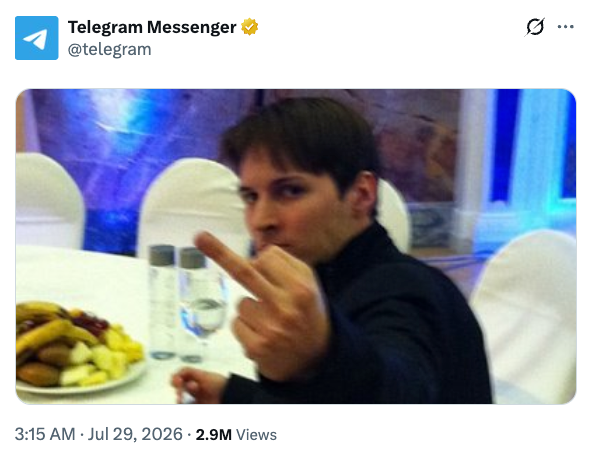
Source: Telegram Messenger

Durov also remains under investigation in France following his August 2024 arrest at Le Bourget Airport. French prosecutors charged him with offenses including complicity in the distribution of illegal content, including material related to organized crime, through Telegram.

Durov has previously criticized what he described as growing threats to online privacy, warning that governments were rolling back protections for the free internet.

“What was once the promise of the free exchange of information is being turned into the ultimate tool of control,” he wrote in an October 2025 post on X.

Magazine: The real reason DeFi projects that survived 2022 crash are shutting down now

Trend Kriptolar

İlgili Sorular

QWhat is the main legal issue facing Telegram in Australia according to the article?

AAustralia's eSafety Commissioner has launched civil penalty proceedings against Telegram, alleging it breached its obligations under the Online Safety Act by failing to remove pro-terror content despite user complaints.

QWhat specific failures did Australia's eSafety regulator allege against Telegram?

AThe regulator alleged Telegram failed to remove reported unlawful material promptly (some content remained for up to three weeks), did not sufficiently prevent repeated violations by removing accounts/channels, and failed to detect known extremist content like footage from the Christchurch and Buffalo shootings before later removal.

QWhat potential financial penalty is Telegram facing in Australia?

AViolations of Australia's online safety rules carry potential fines of up to 54.6 million Australian dollars (approximately $35.8 million).

QWhat legal actions have been taken against Telegram CEO Pavel Durov in Russia?

ARussia's Federal Security Service (FSB) charged Durov with facilitating terrorist activity, alleging Telegram failed to remove channels used by Ukrainian intelligence, terrorist groups, and extremists to coordinate attacks. Russia has begun procedures to place him on an international wanted list.

QWhat is the broader global context for Telegram's legal challenges mentioned in the article?

AThe article states there is growing global scrutiny of Telegram's moderation practices, with legal pressure on CEO Pavel Durov in Russia and France, as governments increasingly examine how major online platforms handle harmful content.

İlgili Okumalar

Qualcomm Chip Price Hike Deals a Blow to Android Phones

Qualcomm has officially announced a new round of price increases for its entire chip portfolio, effective September 1. The hikes, reaching up to 18% for the flagship Snapdragon 8 Elite Gen 6 Pro, follow similar moves by MediaTek, intensifying cost pressures on the already strained smartphone industry. CEO Cristiano Amon confirmed the plan, citing the need to offset rising industry-wide costs and restore declining profit margins. Qualcomm's Q3 FY2026 results showed a 25% drop in net profit, with mobile revenue plunging 20% year-over-year, hitting its lowest level since 2021. The surge in AI computing demand has led memory manufacturers to prioritize HBM production, creating a shortage in general-purpose DRAM and NAND Flash chips. Their prices soared by 93%-98% and 55%-60% respectively in Q1 2026, causing the memory cost share in smartphones to jump from 10%-15% to over 30%. Coupled with the soaring cost of advanced nodes like TSMC's 2nm and packaging, overall chip costs have reached historic highs. These upstream pressures are forcing downstream smartphone brands like Xiaomi, OPPO, and vivo to cut orders for mid-to-low-end models by up to 20% and use cost-saving measures like older chipsets. Reportedly, the Snapdragon 8E5 will be repurposed as a "long-lasting" chip for sub-brand phones in H2 2026. Amid this cost crisis, the Android market remains sluggish. Q2 2026 smartphone shipments in China fell 4.3% year-over-year, marking five consecutive quarters of decline. Major Android brands saw market share drop, while Huawei and Apple, with their in-house chip advantages, gained share. Qualcomm is diversifying into automotive and IoT sectors to reduce reliance on smartphones, but these new segments cannot yet fill the mobile revenue gap. Industry observers warn that the full impact of component cost hikes will hit in the second half of 2026, likely leading to higher-than-expected price increases for Android flagships and a further contraction in the Chinese smartphone market.

marsbit6 dk önce

Qualcomm Chip Price Hike Deals a Blow to Android Phones

marsbit6 dk önce

Breaking: GPT-5.6 Prices Slashed Effective Today

OpenAI has announced significant price cuts for its GPT-5.6 model API, effective immediately. The entry-level **GPT-5.6 Luna** sees the most drastic reduction, with input prices dropping 80% to $0.20 per million tokens and output prices falling to $1.20 per million tokens. The mid-tier **GPT-5.6 Terra** is reduced by 20%, now costing $2.00 (input) and $12.00 (output) per million tokens. The flagship **GPT-5.6 Sol** maintains its original price but introduces a new **Fast mode**, offering speeds up to 2.5 times faster for double the cost. The company attributes these price reductions to efficiency gains achieved through **GPT-5.6 Sol's own involvement in optimizing its production systems**. The model assisted in rewriting GPU kernels and improving speculative decoding, leading to a 20% reduction in end-to-end service costs and over 15% improvement in token generation efficiency. OpenAI emphasizes this process remained human-led. A key focus of the降价 is to lower the barrier for running **AI agent workflows**. By making the capable, tool-calling Luna model significantly cheaper, OpenAI aims to enable more frequent use in cost-sensitive, high-volume tasks like code review and monitoring. This creates a potential feedback loop: model-assisted efficiency gains lead to lower costs, which enables broader agent deployment, which in turn drives further optimization. The new pricing and features will also apply to Codex and ChatGPT Work subscriptions. The changes intensify competition in the large language model market, with OpenAI directly challenging rivals like Anthropic to respond.

marsbit35 dk önce

Breaking: GPT-5.6 Prices Slashed Effective Today

marsbit35 dk önce

South Koreans' 'Gambling Nature' is Actually Forced by Life

This article explores how systemic pressures in South Korea, rather than inherent "gambling" tendencies, drive widespread speculative financial behavior. It begins by noting the high frequency of flights from South Korea to Macau, symbolizing the search for outlets beyond domestic restrictions. The core argument is that ordinary life goals—stable employment, home ownership, and financial security—have become increasingly tied to asset markets due to structural economic factors. South Korea's development model, historically reliant on corporate leverage (chaebols), has evolved into a society where household debt and personal leverage are normalized as pathways to social mobility. Key mechanisms discussed include: * **Housing Policy:** Government measures to improve affordability, like extending mortgage terms to 50 years and the unique *jeonse* (key money) rental system, embed high leverage into the housing market. * **Financial Products:** The recent approval and explosive popularity of single-stock 2x leveraged ETFs (e.g., on Samsung and SK Hynix), easily accessed via mobile apps, lowered barriers to high-risk trading. * **Social Pressure:** Media narratives around soaring corporate profits (e.g., SK Hynix) and employee bonuses create a fear of missing out, pushing individuals to use leverage to "catch up." The article concludes that this "leveraged life" is a product of institutional history and policy choices. When traditional paths to success feel constrained, and policy facilitates debt-based solutions for housing and investment, speculative behavior becomes a rational, if risky, strategy for many. The rapid cycle of regulatory approval for leveraged ETFs followed by a market crash and official apology in mid-2026 exemplifies the system's inherent contradictions. Ultimately, the "bet" is not just on assets, but on using future earnings to secure a place in the present society.

marsbit35 dk önce

South Koreans' 'Gambling Nature' is Actually Forced by Life

marsbit35 dk önce

İşlemler

Spot

Popüler Makaleler

PEOPLE Nasıl Satın Alınır

HTX.com’a hoş geldiniz! ConstitutionDAO (PEOPLE) satın alma işlemlerini basit ve kullanışlı bir hâle getirdik. Adım adım açıkladığımız rehberimizi takip ederek kripto yolculuğunuza başlayın. 1. Adım: HTX Hesabınızı OluşturunHTX'te ücretsiz bir hesap açmak için e-posta adresinizi veya telefon numaranızı kullanın. Sorunsuzca kaydolun ve tüm özelliklerin kilidini açın. Hesabımı Aç2. Adım: Kripto Satın Al Bölümüne Gidin ve Ödeme Yönteminizi SeçinKredi/Banka Kartı: Visa veya Mastercard'ınızı kullanarak anında ConstitutionDAO (PEOPLE) satın alın.Bakiye: Sorunsuz bir şekilde işlem yapmak için HTX hesap bakiyenizdeki fonları kullanın.Üçüncü Taraflar: Kullanımı kolaylaştırmak için Google Pay ve Apple Pay gibi popüler ödeme yöntemlerini ekledik.P2P: HTX'teki diğer kullanıcılarla doğrudan işlem yapın.Borsa Dışı (OTC): Yatırımcılar için kişiye özel hizmetler ve rekabetçi döviz kurları sunuyoruz.3. Adım: ConstitutionDAO (PEOPLE) Varlıklarınızı SaklayınConstitutionDAO (PEOPLE) satın aldıktan sonra HTX hesabınızda saklayın. Alternatif olarak, blok zinciri transferi yoluyla başka bir yere gönderebilir veya diğer kripto para birimlerini takas etmek için kullanabilirsiniz.4. Adım: ConstitutionDAO (PEOPLE) Varlıklarınızla İşlem YapınHTX'in spot piyasasında ConstitutionDAO (PEOPLE) ile kolayca işlemler yapın.Hesabınıza erişin, işlem çiftinizi seçin, işlemlerinizi gerçekleştirin ve gerçek zamanlı olarak izleyin. Hem yeni başlayanlar hem de deneyimli yatırımcılar için kullanıcı dostu bir deneyim sunuyoruz.

591 Toplam GörüntülenmeYayınlanma 2024.12.12Güncellenme 2026.06.02

PEOPLE Nasıl Satın Alınır

Tartışmalar

HTX Topluluğuna hoş geldiniz. Burada, en son platform gelişmeleri hakkında bilgi sahibi olabilir ve profesyonel piyasa görüşlerine erişebilirsiniz. Kullanıcıların PEOPLE (PEOPLE) fiyatı hakkındaki görüşleri aşağıda sunulmaktadır.

活动图片