Atkins' First Year at the Helm of the SEC: A Comprehensive Shift in Crypto Regulation

marsbit2026-04-21 tarihinde yayınlandı2026-04-21 tarihinde güncellendi

Özet

Paul Atkins marked his one-year anniversary as Chair of the U.S. Securities and Exchange Commission (SEC) on April 21, 2025, overseeing a significant shift in the agency’s approach to cryptocurrency regulation. Under his leadership, the SEC dropped multiple enforcement actions against crypto firms, approved several crypto-linked ETFs, and issued guidance clarifying that most cryptocurrencies are not considered securities under federal law. The SEC also signed a memorandum with the CFTC to improve regulatory coordination. These actions reversed the aggressive enforcement stance of his predecessor, Gary Gensler, and aligned with Trump administration promises to support the crypto industry. However, Atkins has faced criticism from Democratic lawmakers, including Senator Elizabeth Warren, who raised concerns over potential conflicts of interest, particularly regarding dropped cases linked to Trump-affiliated companies. While regulatory clarity has improved, the SEC still awaits congressional action to formally define its jurisdiction over digital assets.

Author: Turner Wright

Compiled by: Deep Tide TechFlow

Deep Tide Guide: On April 21, 2025, Paul Atkins was sworn in as Chairman of the SEC, marking exactly one year today. Over this year, the SEC has dismissed multiple lawsuits against crypto companies, approved several crypto ETFs, and signed a memorandum of understanding with the CFTC on coordinating digital asset regulation. However, allegations of conflicts of interest against Atkins by Democratic lawmakers are heating up, and the SEC is still awaiting Congress to pass a market structure bill to clarify its jurisdiction over crypto assets.

On April 21, 2025, Paul Atkins was sworn in as Chairman of the U.S. Securities and Exchange Commission (SEC). As of today, it has been exactly one year.

This year, the SEC has undergone a fundamental shift in its regulatory and enforcement stance on digital assets, in stark contrast to the approach during the tenure of former Chairman Gary Gensler.

During the 2024 election campaign, Trump made several promises to the crypto industry: replacing Gensler, establishing a national Bitcoin (BTC) reserve, and opposing the issuance of a U.S. central bank digital currency. After winning the election in November 2024, Gensler resigned in January 2025, and SEC Commissioner Mark Uyeda served as acting chairman until the Senate confirmed Atkins' nomination.
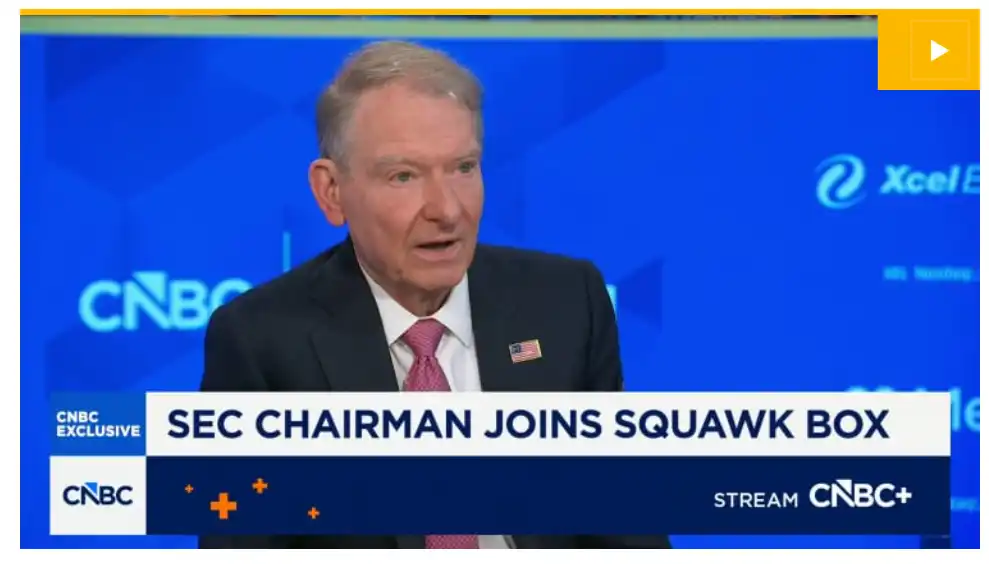
Caption: SEC Chairman Paul Atkins being interviewed on CNBC's Squawk Box on April 20, 2026

Source:CNBC

Even Before Atkins Took Office, the SEC Was Already Shifting

Even before Atkins officially assumed his role, the SEC began sending signals. During Uyeda's acting tenure, the SEC established a crypto working group led by Commissioner Hester Peirce and, starting in February 2025, began dismissing civil enforcement actions and investigations against crypto companies, with Coinbase being the first.

In the 12 months since Atkins officially took office, the SEC has introduced a series of policies widely seen as favorable by the industry:

  • Terminated multiple enforcement actions against crypto companies
  • Approved several exchange-traded funds (ETFs) linked to various crypto assets
  • Signed a memorandum of understanding with the Commodity Futures Trading Commission (CFTC) on coordinating digital asset regulation
  • Issued an interpretive notice clarifying that most cryptocurrencies do not constitute securities under federal law

Atkins himself said in an interview with CNBC on April 21: "The year has passed quickly, but I feel we have made significant progress. When I took office, I promised a new day for the SEC, and we have delivered. We have moved away from the past approach of regulating through enforcement and operating opaquely, and the crypto space is the best example of this."
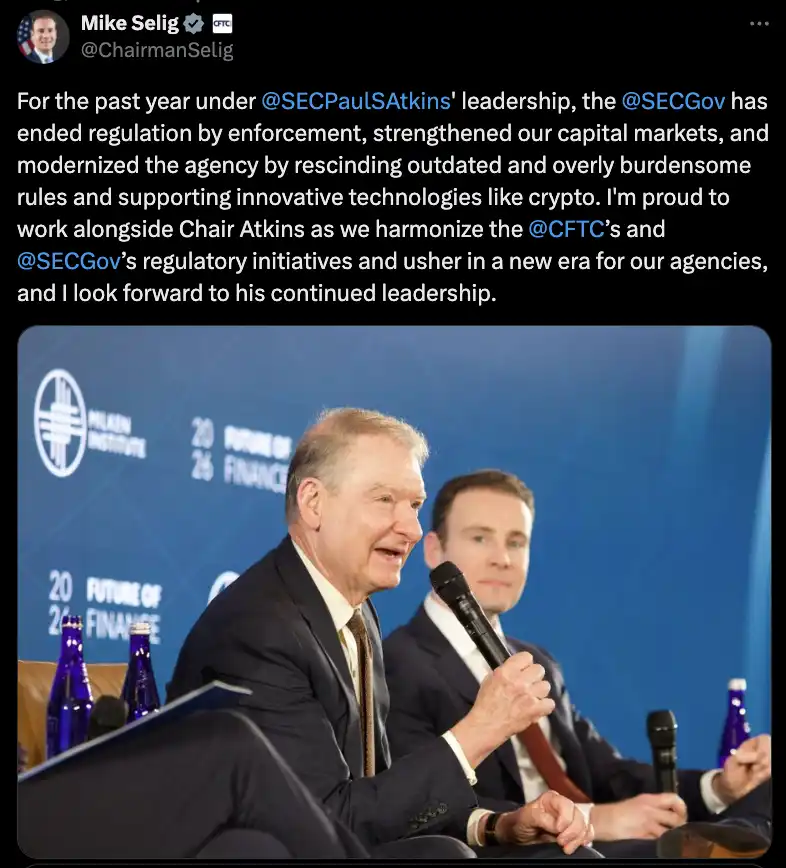
Source:CFTC Chairman Michael Selig

Democratic Lawmakers Focus Fire on Conflicts of Interest

While the crypto industry largely welcomes Atkins' approach, criticism from Congressional Democrats is escalating. The focus is on potential conflicts of interest, as some of the dismissed investigations and enforcement actions involved companies linked to Trump and his family.

Last week, Massachusetts Senator Elizabeth Warren accused Atkins of misleading lawmakers during his Congressional testimony. In a letter dated April 15, Warren pointed out that the SEC's own fiscal year 2025 data shows the number of enforcement actions has dropped to the lowest in a decade.

Despite the clear direction of case dismissals and regulatory relaxation, the SEC is still awaiting Congress to pass a market structure bill to formally clarify the boundaries of its regulatory authority over crypto assets. Until the bill is enacted, the SEC's crypto regulatory framework remains in a transitional state of "administrative guidance + case-by-case handling."


İlgili Sorular

QWhat major changes did the SEC undergo under Paul Atkins' leadership in his first year as chairman?

AUnder Paul Atkins' leadership, the SEC underwent a fundamental shift in its regulatory and enforcement stance on digital assets. This included dropping multiple enforcement actions against crypto companies, approving various crypto-linked ETFs, signing a memorandum of understanding with the CFTC for regulatory coordination, and issuing interpretive guidance clarifying that most cryptocurrencies are not securities under federal law.

QWho was the SEC chairman before Paul Atkins and what was the industry's perception of that leadership?

AGary Gensler was the SEC chairman before Paul Atkins. His tenure was characterized by a starkly different approach, which the crypto industry largely viewed as aggressive enforcement and regulatory uncertainty. This contrasted with the more industry-friendly policies implemented under Atkins.

QWhat is the primary criticism from Democratic lawmakers regarding Chairman Atkins' actions?

AThe primary criticism from Democratic lawmakers, such as Senator Elizabeth Warren, focuses on potential conflicts of interest. They allege that the SEC dropped certain investigations and enforcement actions that involved companies linked to former President Trump and his family, and that Chairman Atkins misled Congress in his testimony about these actions.

QWhat significant action did the SEC take regarding crypto ETFs during Atkins' first year?

AA significant action the SEC took was the approval of multiple exchange-traded funds (ETFs) linked to various crypto assets. This was a major policy shift from the previous administration and was widely seen as a positive development for the industry.

QWhat is the current status of the SEC's regulatory framework for crypto assets, according to the article?

AAccording to the article, the SEC's regulatory framework for crypto assets is currently in a transitional state, operating on a basis of 'administrative guidance + case-by-case handling.' The agency is still waiting for Congress to pass a market structure bill to formally clarify the boundaries of its jurisdiction over crypto assets.

İlgili Okumalar

Wall Street Morning News: V-shaped Rebound at Month-end, but Nasdaq Suffers Worst July in 12 Years; Funds Accelerate Concentration Towards Cloud Giants

Despite a V-shaped rebound at the end of July, the Nasdaq posted its worst July since 2004, while the S&P 500 had its worst July since 2014. Markets were jolted by geopolitical shifts, as President Trump canceled a planned strike on Iran, leading WTI crude to plunge over 8%. This, alongside OPEC+ announcing a supply increase, reversed crude's sharp July gains. Treasury yields surged, with the 10-year yield rising over 30 basis points in July—its largest July increase since 2005. In a rare move, the US and Japan jointly intervened to weaken the USD/JPY, aiming to prevent potential Japanese sales of US Treasuries. While the tech sector faced deleveraging pressure throughout July, cloud giants staged a massive rally on strong earnings. Microsoft, Amazon, and Google collectively added nearly $1.5 trillion in market value last week. Amazon soared over 15% on accelerating AWS growth, Microsoft extended historic gains, Google fully recovered post-earnings losses, and Meta ended an 11-day losing streak. In contrast, Apple tumbled over 7% on supply chain and guidance concerns, ceding its "world's most valuable company" title to Nvidia. The memory and storage sector corrected sharply. Gold edged up 0.91% in July, with analysts viewing the ~30% pullback from January highs as a potential basing period, supported by long-term central bank demand. Key events to watch this week include earnings from Palantir, AMD, SpaceX (its first post-IPO report), and memory giants like Western Digital. The US July non-farm payrolls report on Friday will be critical for gauging the Fed's policy path. SpaceX also faces a significant lock-up expiration, testing market liquidity.

marsbit49 dk önce

Wall Street Morning News: V-shaped Rebound at Month-end, but Nasdaq Suffers Worst July in 12 Years; Funds Accelerate Concentration Towards Cloud Giants

marsbit49 dk önce

Rubin Ultra Makes Major Cuts, Even Nvidia Can't Handle Memory Price Hikes?

NVIDIA's Rubin Ultra, the top-tier variant of the newly announced Rubin AI accelerators, has reportedly seen significant specification downgrades, according to an industry report from SemiAnalysis. Initially designed with four compute dies (4-die), the Rubin Ultra is now said to be reduced to a 2-die design. Key changes highlighted in the report include: * **No increase in peak theoretical compute performance**, remaining at 35 PFLOPs like the standard Rubin. * **Severe reduction in memory capacity** to 192GB using 8-Hi HBM stacks, which is less than the standard Rubin's 288GB using 12-Hi stacks. * **Negligible memory bandwidth improvement** of only 1 TB/s. * **Slightly higher chip-level power consumption**. * The **primary upgrade is a massive increase in scale-up interconnect capacity**, supporting connections for up to 576 GPUs via NVLink, compared to 72 for the standard Rubin. The report suggests the redesign is primarily a cost-optimization move driven by the sharp rise in HBM (High-Bandwidth Memory) prices. By reducing the expensive HBM content and shifting investment towards enhanced system-scale networking, NVIDIA aims to maintain the platform's value for large-scale AI training clusters while managing soaring material costs. The news reportedly triggered a sell-off in South Korean memory stocks, with SK Hynix and Samsung shares falling around 8%, as markets grew concerned that NVIDIA—a major HBM buyer—might be reducing its reliance on high-capacity memory, potentially capping future pricing power for memory makers.

Odaily星球日报1 saat önce

Rubin Ultra Makes Major Cuts, Even Nvidia Can't Handle Memory Price Hikes?

Odaily星球日报1 saat önce

İşlemler

Spot
活动图片