At What Oil Price Would Systemic Market Risk Be Triggered?

marsbit2026-04-03 tarihinde yayınlandı2026-04-03 tarihinde güncellendi

Özet

Based on a UBS analysis, the key threshold for systemic risk in global markets is identified as $150 per barrel of oil. The report warns that breaching this level would trigger a dangerous negative feedback loop: soaring oil prices → resurgent inflation → tighter monetary policy → deteriorating financial conditions → collapsing demand → market panic. The impact of an oil shock is not linear but highly dependent on the initial economic vulnerability. In the current environment of high interest rates and weak growth, the damage from rising oil prices is significantly amplified. For instance, with a 40% baseline US recession probability, oil at $150 per barrel could cause an economic downturn nearly five times more severe than under milder conditions. UBS outlines two scenarios: in an ideal steady state, the US economy might withstand oil prices up to $200 per barrel. However, in a realistic risk scenario where financial markets react negatively, the critical threshold drops sharply to $150. At this level, three systemic pressures emerge: macroeconomic stagflation risks as central banks halt or reverse rate cuts; market-wide sell-offs due to compressed valuations and wider credit spreads; and a simultaneous slump in corporate profits and household consumption. The report cautions that markets are currently underestimating this nonlinear, cliff-like risk. While prices between $100-$130 may cause sector-specific stress, $150 represents a breaking point where localized damage tr...

Author: Bu Shuqing

Source: Wall Street News

As geopolitical conflicts in the Middle East continue to escalate, every rise in international oil prices is testing the limits of the global market's endurance. UBS has drawn a clear red line in its latest research report: $150 per barrel.

According to the Wind Trading Desk, a recent global macro research report from UBS analysts pointed out that once international oil prices break through $150 per barrel and sustain at that level, the US and global markets will face significant systemic risks, with the probability of recession and severe market adjustments greatly increasing.

The bank emphasized that the danger of this critical point lies in its potential to trigger a complete negative cycle: "high oil prices → rebounding inflation → tightening policies → deteriorating financial conditions → collapsing demand → market panic."

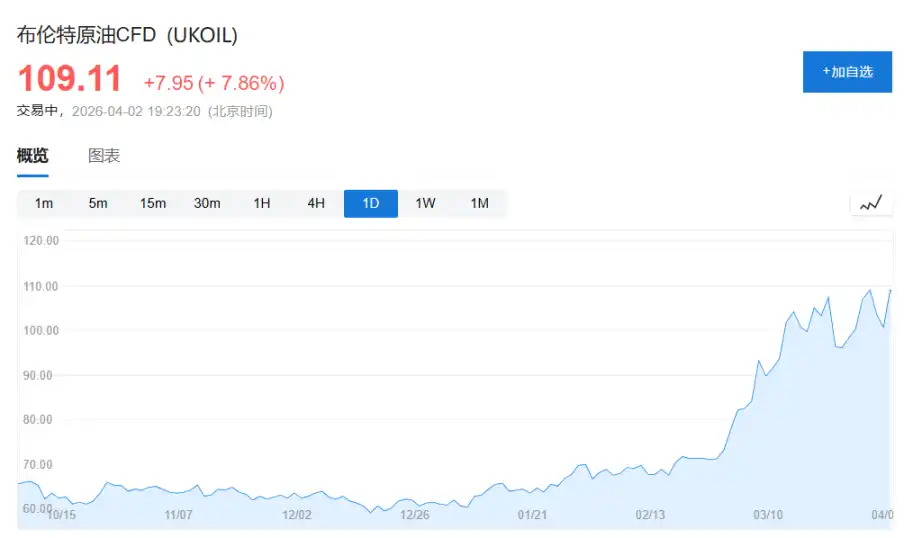
At the time of writing, the international benchmark Brent crude surged nearly 8%, once again approaching the $110 mark. UBS warned that the current market's pricing of oil price risks remains biased towards linear extrapolation, severely underestimating the cliff-like risks near $150 per barrel. Under the shadow of high oil prices, the market has little safety margin left. Protecting against risk and avoiding highly sensitive assets is more important than chasing returns.
Impact Depends on Initial Vulnerability

The UBS report challenges the market's long-held linear perception that "every $10 increase in oil prices drags the economy by a fixed proportion," pointing out that the destructive power of an energy shock highly depends on the initial economic state.

The current global economy is in an environment of high interest rates, weak recovery, and tight credit conditions, with an already elevated baseline probability of recession. This significantly amplifies the transmission effects of an oil price shock.

UBS constructed a three-dimensional analytical framework, using the US composite recession probability, the magnitude of the oil price increase, and the degree of cyclical economic downturn as the three dimensions. The calculation results clearly reveal the nonlinear nature of the risk:

  • When the recession probability is 20% and oil prices are at $100 per barrel, the cyclical economic downturn is only 0.28 standard deviations, indicating a mild impact;
  • If the recession probability rises to 40% while oil prices remain at $100 per barrel, the downturn magnitude expands to 0.81 standard deviations, nearly three times the baseline;
  • And when the recession probability is 40% and oil prices break through $150 per barrel, the downturn magnitude soars to 1.4 standard deviations, with an impact intensity nearly five times the baseline.

This means that the more fragile the economy, the more致命 (fatal) the blow from high oil prices. In the current environment, oil prices rising from $100 to $150 does not mean a 50% increase in pressure, but an accumulation of risk several times over.

$150: The Critical Divide Under Two Scenarios

Based on a pre-Middle East conflict US recession probability of around 30%, UBS provided critical values under two key scenarios. The gap between them reveals the core role of financial market reactions.

In an ideal steady-state scenario, if financial markets are stable with no additional risk发酵 (fermenting), the US economy could theoretically withstand oil prices rising to about $200 per barrel before substantially entering a recession. However, in a realistic risk scenario, once the stock market experiences a significant correction due to high oil prices and risk appetite deteriorates rapidly, the recession临界点 (critical point) would directly drop to $150 per barrel.

UBS pointed out that once $150 per barrel is reached, the world will face三重 (three layers) of systemic pressure:

  • Macro level: Inflation surges for the second time, forcing central banks to interrupt or even reverse interest rate cut cycles, quickly sliding the economy towards stagflation;
  • Market level: Stock market earnings expectations are revised downward, valuations contract, high-yield bond credit spreads widen, and liquidity tightening triggers cross-asset sell-offs;
  • Entity level: Soaring corporate costs squeeze profits, household purchasing power declines, consumption and investment cool down simultaneously, forming a共振下跌 (resonant decline) of the economy and markets.

The report also cited historical comparisons, noting that larger oil price shocks before 2000 had less impact due to stronger initial economic resilience,反而小于 (instead less than) the impact during the 1990 Gulf War period. Today, with the global high-interest-rate environment still present, the financial system is more sensitive to cost increases, and the intensity of a $150 per barrel shock would only be more severe.

Nonlinear Risk: The Blind Spot in Market Pricing

The UBS report specifically warned that the current market's pricing of oil price risks is systematically underestimated, particularly neglecting the threshold effect near $150 per barrel.

According to UBS research, the $100 to $130 per barrel range mostly involves shocks to局部行业 (local industries), pressuring sectors like aviation, logistics, and chemicals, but the overall market remains controllable. Once oil prices stabilize above $150 per barrel, the risk will spread from局部 (local) to全局 (global), escalating from an industry-level issue to a systemic financial risk.

This nonlinear risk manifests on three levels:

  • First, risk transmission accelerates, as high oil prices quickly penetrate the buffers of corporate profits, household consumption, and government finances;
  • Second, policy space compresses, as rising inflation traps central banks in the dilemma of "fighting inflation vs. stabilizing growth," preventing them from promptly supporting the market;
  • Third, confidence collapses rapidly, with significant market corrections and暴露 (exposure) of credit risks叠加 (overlapping), forming a negative feedback loop of "decline → deleveraging → further decline."


İlgili Sorular

QAccording to UBS, at what oil price level would the US and global markets face significant systemic risk?

A150 dollars per barrel.

QWhat negative feedback loop would be triggered if oil prices exceed 150 dollars per barrel?

AThe loop is: High oil prices → rebounding inflation → tightening of monetary policy → deteriorating financial conditions → collapsing demand → market panic.

QWhat is the key factor that determines the destructive power of an oil price shock, as stated in the UBS report?

AThe initial state of the economy, with the impact being highly dependent on the initial economic vulnerability.

QUnder the realistic risk scenario, what is the critical oil price point that would push the US economy into a recession, considering financial market reactions?

A150 dollars per barrel.

QWhat are the three systemic pressures the global economy would face once oil prices hit 150 dollars per barrel?

A1. Macro level: Inflation surges again, forcing central banks to halt or reverse rate cuts, pushing the economy towards stagflation. 2. Market level: Downward revisions to corporate earnings, valuation contractions, widening credit spreads for high-yield bonds, and cross-asset sell-offs due to tightening liquidity. 3. Entity level: Soaring corporate costs, squeezed profits, reduced household purchasing power, and a cooling of consumption and investment, leading to a共振下跌 (resonant decline) of the economy and markets.

İlgili Okumalar

For the First Time Since 1955, S&P 500 Profits Exceed Long-Term Trend by 14%

For the first time since 1955, the S&P 500's earnings per share (EPS) have risen approximately 14% above their long-term historical trend channel, according to a recent report. This highlights a significant fundamental shift: strong corporate profits, not just AI narratives or liquidity, are now underpinning the market's high valuations. The strength of current earnings is evidenced on multiple fronts. Actual quarterly results are consistently beating analyst expectations, with the percentage of S&P 500 companies exceeding profit forecasts and the magnitude of sales surprises near multi-year highs. Furthermore, analysts are *raising* future EPS estimates instead of the typical post-quarter downgrades, with full-year 2026 growth expectations revised sharply upwards from ~13% to nearly 28%. This profit growth is broadening beyond the mega-cap "Magnificent Seven" tech stocks. While these giants remain the primary engine, the majority of S&P 500 sectors are contributing, with median company earnings growth around 13.8%. However, this exceptional strength creates a higher bar for future performance. With profit levels already so elevated, merely meeting elevated expectations may not suffice to push stocks higher. Any disappointment in revenue growth, profit margins, or forward guidance could trigger significant pressure on stretched valuations. Therefore, the sustainability of the earnings support will depend on continued sales expansion, stable margins, the payoff from massive AI investments, and, crucially, whether the positive trend of upward earnings revisions can persist.

marsbit9 dk önce

For the First Time Since 1955, S&P 500 Profits Exceed Long-Term Trend by 14%

marsbit9 dk önce

Once-Hot Web3 Enters Wave of Layoffs

"Once a hot sector, Web3 has entered a wave of layoffs, driven less by AI than by underlying financial pressures. The article details a severe and rapid downsizing across Web3 companies, particularly crypto exchanges, over the past year. It shares accounts from employees like Kevin and Richard, who experienced sudden terminations, often with system access cut off instantly and sometimes with minimal or no severance. Management frequently used pretexts like impossible performance targets or bogus tests to justify dismissals and avoid compensation. The layoffs have created a climate of fear and toxic workplace cultures for remaining employees, characterized by excessive surveillance, pointless meetings, and internal political battles. High-level power struggles and a focus on loyalty over competence further destabilize companies. The author argues the industry's core business model is collapsing. Exchanges, reliant on trading fees and high listing charges, are accused of exploiting projects and retail investors. This, combined with events like a major market crash in October 2025 that wiped out leveraged retail traders, has led to a severe liquidity drought. Venture capital funding has dried up, and many projects lack sustainable revenue. As a result, displaced workers struggle to find new roles. While many transition to the AI sector, they face stigma, with traditional finance and even some AI firms viewing Web3 experience negatively. The article concludes that this downturn is distinct: rather than a simple market cycle, it stems from predatory practices, a lack of innovation, and destructive internal competition that consumed the industry from within while the market shrank."

marsbit24 dk önce

Once-Hot Web3 Enters Wave of Layoffs

marsbit24 dk önce

Being at the Front Lines of the Coldcard Theft Case Made Me Realize Why the Impact is Far Greater Than the Numbers Suggest

Even 5 years after a vulnerability was discovered, no one expected it to fuel the largest Bitcoin theft of the year. On July 30, anomalies were detected: hundreds of Bitcoin were aggregated from numerous addresses in a short timeframe, followed by a rapid expansion of the attack. The perpetrator scanned thousands of addresses, stealing nearly 2,000 BTC worth over $100 million. The cause was quickly identified: a bug in the mnemonic generation process of the Coldcard hardware wallet, specifically a weak random number issue that made the entropy predictable. While initially less noticed in China due to Coldcard's smaller user base, the incident caused an uproar overseas, where Coldcard is highly respected among Bitcoin OGs and maximalists. Panic peaked by July 31, with small transactions (under 1 BTC) reaching a daily volume of 39,600 BTC, the highest since FTX's collapse in 2022. The attack is believed to have been discovered and executed by an AI model, similar to a prior incident that halved Zcash's value, but with potentially more severe psychological impact. The breach shook the core belief system of Bitcoin's most dedicated community. According to Yu Xian, founder of SlowMist, who is assisting some victims, the profound impact lies in undermining trust in a historically reputable, open-source, "perfect" hardware wallet. This erodes confidence in self-custody solutions, leading some users to reconsider the perceived safety of centralized exchanges with robust security measures. For ordinary users, Yu Xian recommends: always use a passphrase with your mnemonic seed; maintain a small amount in a non-passphrase wallet as a canary; and for non-technical users, relying on reputable centralized services might be a simpler option. General advice includes auditing your asset storage methods, staying calm to avoid phishing, and isolating questionable assets. The incident underscores a critical security asymmetry: attackers, unrestricted and highly motivated, can leverage AI far more aggressively than defenders, who face various constraints. This dynamic could lead to even larger-scale breaches in the future, potentially involving core protocols like Bitcoin itself. The industry's challenge is to continuously evolve and strengthen its defenses in this ongoing arms race.

marsbit24 dk önce

Being at the Front Lines of the Coldcard Theft Case Made Me Realize Why the Impact is Far Greater Than the Numbers Suggest

marsbit24 dk önce

İşlemler

Spot
活动图片