"Assets Dormant for Three Years" Will Be Confiscated? The Truth About California's New Bill SB 822 Explained

marsbit2026-01-07 tarihinde yayınlandı2026-01-07 tarihinde güncellendi

Özet

A new California law, SB 822, which takes effect in 2026, has caused concern in the crypto community over fears that inactive exchange accounts could be "confiscated." However, this is a misunderstanding. The law extends the state’s existing Unclaimed Property Law (UPL) to digital assets held on centralized exchanges. Key points: - Assets are considered "unclaimed" only if there has no owner activity for three years AND the exchange is unable to contact the owner. - "Owner activity" is broadly defined and includes logging in, trading, or even just responding to an email, which resets the three-year timer. - Exchanges must send a prominent warning notice 6-12 months before reporting assets to the state. A simple response stops the process. - Crucially, transferred assets are NOT immediately liquidated. The state must hold the original crypto for 18-20 months, allowing owners to reclaim their exact tokens. Only after that may assets be sold for cash. - The law only applies to assets held on centralized exchanges (the "holder"). Self-custodied wallets, like cold wallets or DeFi LP tokens, are completely exempt. - Owners can always claim their property from the state, even years later, though they may receive cash instead of crypto if it was already sold. The article advises users to perform a simple activity (e.g., logging in) annually to keep accounts active or move large holdings to self-custody to avoid the law entirely. It concludes that SB 822, while intrusive, provides a...

Author | Ethan(@ethanzhang_web3)

Recently, discussions within the crypto community about "the U.S. state of California officially confiscating assets from dormant exchange accounts" have been intensifying. Don't panic just yet. Upon closer examination, you'll find this is actually the delayed spread of an "old news" story.

This bill, known as SB 822, was actually signed by California Governor Newsom as early as October 2025 and is set to take effect in 2026. Its essence is to formally replicate the "dormant account management system" (officially called the Unclaimed Property Law, or UPL), which has been operating in the traditional banking system for decades, into the crypto world.

However, there is a significant amount of misinterpretation and panic within the community, with many mistakenly believing that simply "HODLing coins without moving them" will lead to confiscation. Odaily Planet Daily will clarify for readers in this article: Who exactly does this bill regulate and who does it not? Is this so-called "regulatory custody" a trap or a protection? As ordinary investors, how can we take simple steps to securely safeguard our coins.

Core Mechanism: How the "Three-Year Rule" Works When "HODL" Turns into "No Contact"

According to the provisions of SB 822, if a digital asset account shows no "indication of owner interest" for a period of three years, and communications sent by the exchange are returned or undeliverable, the asset will be deemed "unclaimed" and trigger the escheatment process.

This sounds terrifying, as if simply being a long-term "diamond hands" holder will get your assets seized. But that's not the case. The bill defines "indication of owner interest" extremely broadly, which actually forms the first protective barrier for active users.
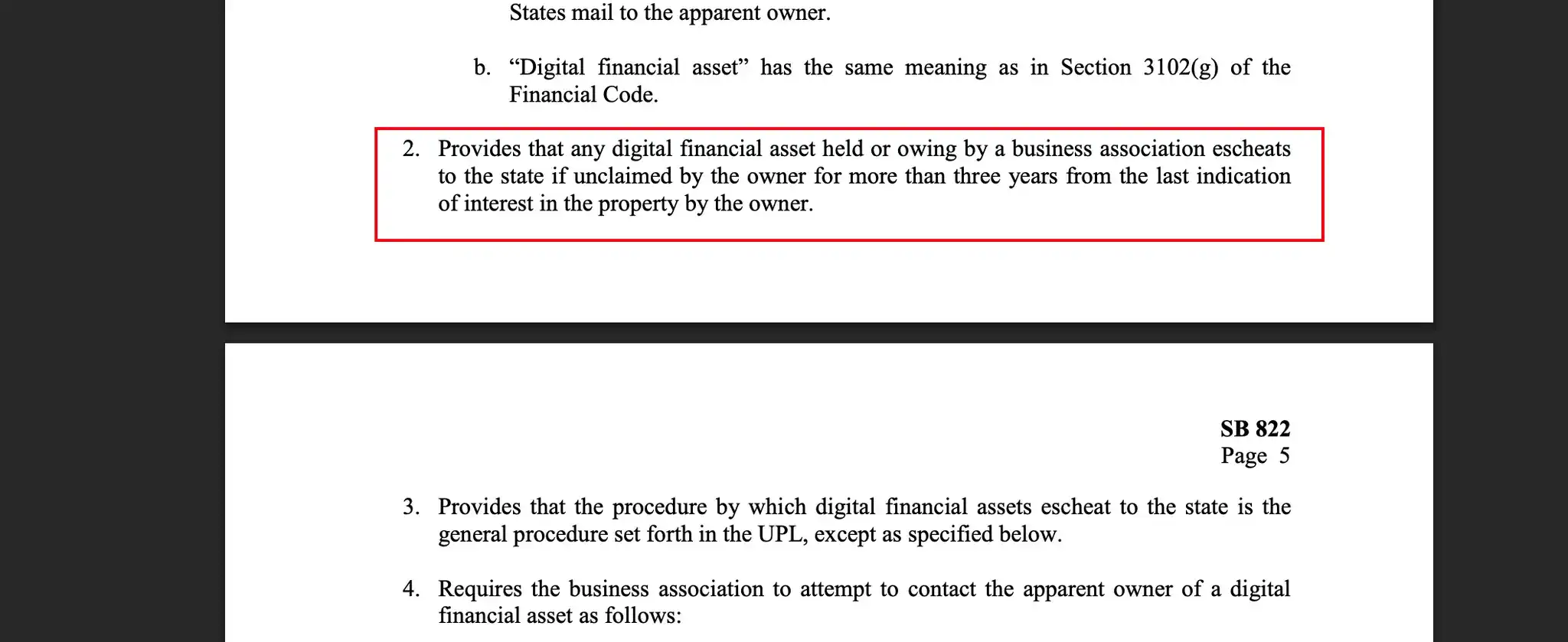
SB822 Bill Original Text

So-called "indication of owner interest" doesn't just mean on-chain transfers or crypto-to-crypto trades. According to the bill text, the following actions are all considered proof that you still control the account and can directly reset the three-year countdown:

  • Logging into the account: Even if you just open the App to check your balance, or log in once via the web portal, it counts as an "electronic access," sufficient to reset the timer.
  • One-time or recurring transactions: Whether buying, selling, depositing, or withdrawing fiat, or even a pre-set recurring investment plan executing one automatic deduction, all count as activity.
  • Cross-account activity: If you have multiple accounts with the same exchange (e.g., a spot account and an earn account), activity on any one of these associated accounts will be considered activity for all.
  • Simple communication: Sending a customer service email, or clicking a confirmation link in a query email from the exchange, are considered "indication of owner interest."

This means that unless you are completely out of contact—not logging in, not trading, and ignoring all emails and notices—your assets will absolutely not be transferred without warning.

Is There a Warning Before "Confiscation"?

To prevent users from losing assets passively due to forgetfulness, SB 822 establishes a clear mandatory notification procedure.

As per the regulations, the exchange, as the holder of the assets, must send a notice to the user 6 to 12 months before reporting the assets to the state government. This notice is not a routine user agreement update; its format has strict legal requirements. The top of the notice must be clearly marked in bold: "The State of California requires us to notify you that your unclaimed property may be transferred to the state if you do not contact us".
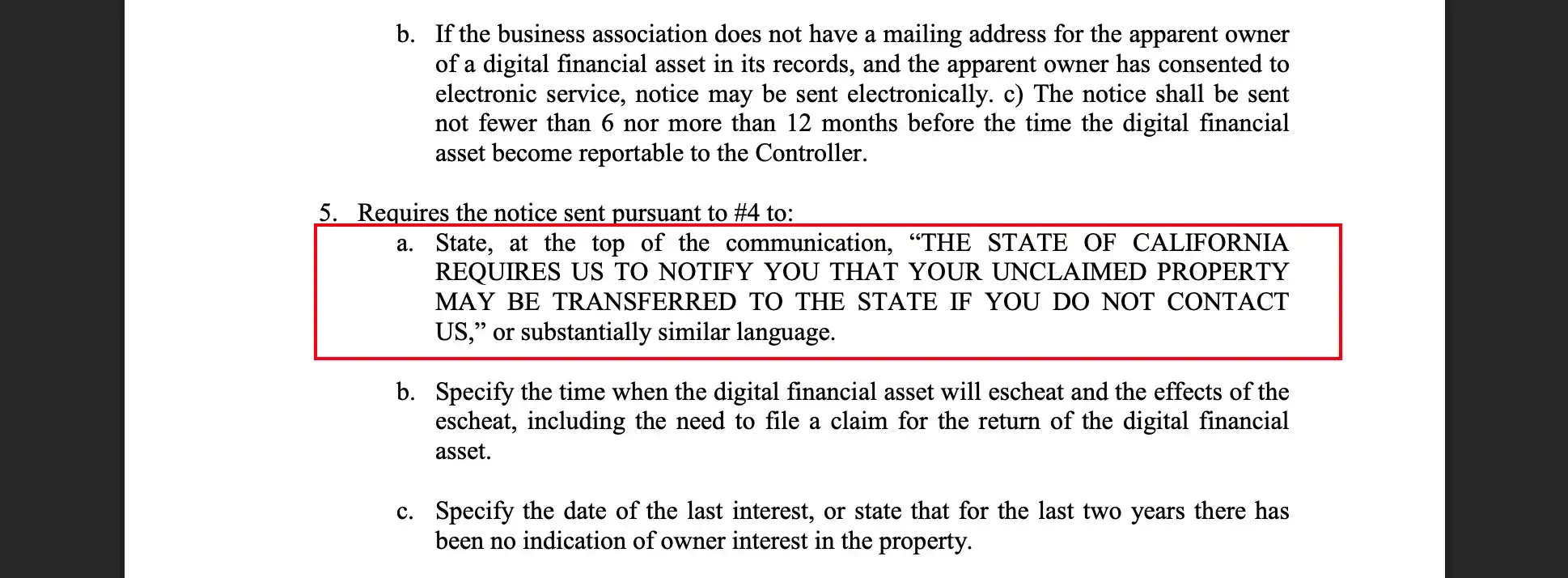
SB822 Bill Original Text

Furthermore, this notice must include a form prescribed by the State Controller's office. The user simply needs to fill out and return this form, or contact the exchange to confirm their identity via phone, online chat, etc., and the account's dormant status will be immediately lifted, and the so-called three-year countdown will be reset to zero.

The Biggest Misconception: Does Transfer Equal "Liquidation"?

Prior to SB 822's implementation, the biggest concern in the community was that assets would be forcibly sold once transferred, similar to traditional securities. However, SB 822 explicitly prohibits immediate forced liquidation, making California the first state in the U.S. to legislate the "in-kind transfer" of unclaimed crypto assets. "In-kind" here refers to the asset itself and the associated private keys.

To achieve this operation, the bill even details the handling of "private keys." If the exchange only holds part of the private key (e.g., a multi-signature wallet), the bill requires it to attempt to obtain the remaining keys within 60 days; if ultimately unable to obtain them, the exchange must continue maintaining the asset until transfer conditions are met, thus technically preventing asset loss.

Going a step further, once assets enter the state's custodial account, they are granted a protection period of 18 to 20 months. During this time, the state government typically will not sell the assets, and the original owner can still apply to reclaim the original quantity of tokens. Only after this protection period ends does the state government have the authority to liquidate them.

Who Acts as Custodian?

Facing the massive demand for digital asset custody, the SB 822 bill authorizes the State Controller to select one or more "qualified custodians" to manage these assets. These custodians must hold a valid license issued by the California Department of Financial Protection and Innovation (DFPI) and must meet a series of strict standards, including:

  1. Security Level: Must possess top-tier cybersecurity measures and private key management capabilities.
  2. Compliant Status: Must qualify as a "financial institution" under the Bank Secrecy Act, bearing anti-money laundering obligations.
  3. Industry Experience: Must have proven experience handling digital assets (e.g., institutional-grade service providers like Coinbase Custody or Anchorage Digital).

Are Cold Wallets Affected?

In community discussions, many experienced players are most concerned about: Are my cold wallets where I control the private keys affected? Are my LP tokens in Uniswap affected?

The answer is clear: They are not affected.

The bill's regulatory target is defined as the "Holder", meaning a third-party centralized institution that has control over the assets. Since self-custody wallets are controlled directly by the user via private keys, there is no third party that can report or transfer assets to the government. As long as the private keys are in your own hands, the assets fall outside the jurisdiction of this bill.

Furthermore, the bill makes precise distinctions regarding "digital financial assets," explicitly excluding in-game virtual currency, commercial reward points (like airline miles), and tokens already registered as securities with the SEC, avoiding over-broad regulation.

Practical Guide: How to Reclaim Transferred Assets?

As mentioned earlier, even if assets have been transferred to the state's name, the property rights of the original owner and their lawful heirs do not disappear, and the right to file a claim with the California State Controller's Office has no time limit. The specific outcome of a claim depends on the timing of the application: if applied for before the assets are liquidated (i.e., within the 18-20 months after government receipt), the owner can reclaim the original quantity of cryptocurrency; if applied for after liquidation, only the net cash proceeds from the sale of the assets can be reclaimed.

It is important to be wary here: as the bill takes effect, fraudulent intermediaries offering to file claims might appear on the market. The California State Controller's Office website (sco.ca.gov) is the only official channel for queries and claims, and this process is free of charge. Any request for an advance fee to "unfreeze" assets is potentially fraudulent.

How to Avoid Custody Risks?

The core of avoiding SB 822 risk lies in periodically breaking the account's silent status. Since the bill's trigger is "no activity for three consecutive years," long-term holders only need to perform simple indications of owner interest regularly. For example, logging into the exchange account once a year, clicking to check the balance, or conducting a very small trade. These actions will all be recorded by the system as active status, thereby resetting the three-year countdown.

For users holding large amounts of assets, the most thorough solution is to withdraw the assets to a non-custodial wallet. Once assets leave the exchange and enter a cold wallet where you control the private keys, they are no longer "custodial assets" as defined by the bill, thus exempt from the Unclaimed Property Law's jurisdiction at the root. This not only avoids政策性 transfer risks but also defends against potential misappropriation or collapse risks of the exchange itself (think of the FTX lesson).

Furthermore, an often overlooked aspect is estate planning. Often, assets become "unclaimed" because the holder passes away unexpectedly, and the family is completely unaware of this digital wealth's existence. SB 822 objectively provides an administrative safety net mechanism for these accidentally lost digital assets. Therefore, acting responsibly towards family wealth, it is advisable to create a memo detailing the location of assets and properly inform family members, ensuring that in extreme cases, they can search through official channels and reclaim these digital inheritances.

Conclusion: The Double-Edged Sword of Compliance

The enactment of the SB 822 bill is undoubtedly another milestone in the process of crypto assets moving towards mainstream adoption. It grants digital assets legal status equivalent to bank deposits and stocks, offering special preferential treatment particularly in preventing forced liquidation. This move also signals that regulators are earnestly recognizing the unique attributes of crypto assets and striving to find a balance between protecting consumer rights and adapting to technological characteristics.

At first glance, the state government's action might seem like "meddling," but delving into its underlying logic reveals it is actually a powerful constraint on third-party custodial power. Without a mature legal framework for establishing rights, those vast fortunes lying dormant due to forgetfulness, accidents, or user disconnection could ultimately become the exchange's "private property."

The SB 822 bill, through administrative backup means, creates a permanent "lost and found" for digital assets, successfully pulling personal wealth that might otherwise have vanished due to platform shutdowns back within the red line of legal protection.


İlgili Sorular

QWhat is the main purpose of California's SB 822 bill regarding digital assets?

AThe main purpose of California's SB 822 bill is to extend the state's existing Unclaimed Property Law (UPL) to the cryptocurrency world. It establishes a process for transferring digital assets held in dormant accounts on centralized exchanges to the state government after a period of inactivity, while providing consumer protections against immediate liquidation and ensuring a path for owners to reclaim their assets.

QWhat specific user actions will reset the 3-year inactivity countdown under SB 822?

AThe following user actions, defined as 'owner activity,' will reset the 3-year inactivity countdown: logging into the account, executing any buy/sell/trade transaction, performing a fiat deposit or withdrawal, having activity in a linked account at the same exchange, or any communication with the exchange, such as responding to an email.

QDoes the SB 822 bill apply to assets held in a self-custody wallet?

ANo, the SB 822 bill does not apply to assets held in self-custody wallets. The law specifically targets 'holders,' which are defined as third-party centralized institutions that have control over the assets. Since the user holds the private keys in a self-custody wallet, there is no third party to report or transfer the assets to the state.

QWhat happens to crypto assets after they are transferred to the state under this law?

AAfter transfer, the state will hold the assets 'in-kind' (as the original cryptocurrency, not immediately sold) for a protection period of 18 to 20 months. During this time, the original owner can file a claim to recover the original amount of tokens. After this period, the state may liquidate the assets, and the owner would then only be able to claim the cash proceeds from the sale.

QWhat is the official and free method for claiming assets that have been transferred to the state?

AThe official and free method for claiming assets is through the California State Controller's Office website (sco.ca.gov). The process does not require any fees, and individuals should be wary of any third-party services that request upfront payments to assist with the claim, as these are likely scams.

İlgili Okumalar

When Doing Cryptocurrency Payment, the First Thing is Licenses, What is the Second?

When launching a crypto payment business, obtaining the necessary licenses is the crucial first step. However, the second, and arguably more critical, step is designing a comprehensive operational framework that forms a coherent business loop. This loop must be clearly understood and executable by all stakeholders: banks, payment partners, exchanges, on-chain analytics providers, regulators, and your internal team. Many projects mistakenly believe a single license permits all operations. Licenses merely grant entry; they don't define how the specific business functions. The real challenge lies in detailing every aspect of the workflow. This involves clarifying the customer base, the flow of fiat and crypto assets, the settlement process, and establishing clear lines of responsibility for risks like AML compliance, sanctions screening, chargebacks, and regulatory inquiries. A robust framework must answer seven core questions: Who are the clients and merchants? Who collects fiat and crypto? Who handles conversion and custody? And who is ultimately accountable for compliance and risk management? Projects often fail not from a lack of licensing, but during due diligence when they cannot convincingly explain these operational details. Therefore, beyond securing licenses, the priority must be constructing a closed-loop system. This system ensures the business model is transparent, risks are managed, responsibilities are delineated, contracts are aligned, and the entire process is comprehensible to partners and regulators. The true competitive edge in crypto payments lies not in acquiring a license quickly, but in integrating licensing, banking, compliance, and operations into a sustainable and executable whole.

marsbit20 dk önce

When Doing Cryptocurrency Payment, the First Thing is Licenses, What is the Second?

marsbit20 dk önce

Arthur Hayes Analysis: AI Bubble Nears Burst, Crypto Market Faces Short-Term Pressure

Arthur Hayes argues that the current AI market is a bubble poised to burst, which will exert downward pressure on the crypto market in the near term. The core trigger is rising oil prices due to the US-Iran conflict and a blockade of the Strait of Hormuz. Higher energy costs directly increase the operational expenses of AI data centers, squeezing profit margins for companies like Google, Anthropic, and OpenAI. Hayes predicts that persistent inflation from high oil prices will force Trump, in a bid to win the November election, to turn public sentiment against the AI industry. He may propose regulations and taxes on data centers and AI companies to appeal to voters concerned about costs and job displacement. Such political rhetoric could shatter market confidence. Furthermore, the market is unlikely to healthily absorb the massive concurrent IPOs of SpaceX, Anthropic, and OpenAI, which together seek valuations in the trillions. The combination of soaring energy costs, overwhelming equity supply, and negative political pressure will puncture the AI bubble. Hayes notes that nearly all new USD liquidity since 2022 has flowed into AI, leaving crypto like Bitcoin behind. When the AI bubble bursts, liquidity will contract sharply, pulling down all risk assets, including cryptocurrencies. In response, Hayes's fund, Maelstrom, has sold all AI-related stocks and non-core cryptocurrencies. It maintains core positions in Bitcoin and Ethereum while increasing exposure to energy sector equities, betting on rising oil and gas prices. He expects Bitcoin to bottom after the AI-led market decline, before rallying again with future monetary easing.

Foresight News34 dk önce

Arthur Hayes Analysis: AI Bubble Nears Burst, Crypto Market Faces Short-Term Pressure

Foresight News34 dk önce

To C, To B, and the Next Big Thing Called To A

After To C and To B, the Next Wave is To A: Serving AI Agents In a recent quarterly earnings call, Meituan's Wang Xing introduced a new concept: To A (To Agent), signifying that future business services will increasingly target AI Agents as primary clients, not just consumers or merchants. This shift implies that internet giants must now consider how to make their services more appealing for AI Agents to recommend, fundamentally altering traditional distribution logic. This "To A era" is prompting an unusual trend of alliances among major tech companies. Unlike previous competitive battles, firms like Meituan, Tencent, JD.com, Huawei, OPPO, and OpenAI are rapidly forming partnerships. The reason is strategic: as AI Agents become the primary user interface, handling tasks from a single command (e.g., "Book a Japanese restaurant for tomorrow"), the risk for platforms is being bypassed entirely. Companies are positioning themselves within this new value chain. Three primary strategies are emerging: 1. **Super-Entry Points + Service Providers:** Platforms like Tencent's Yuanbao, WeChat, and ChatGPT aim to be the first-stop Agent, integrating various services (food delivery, shopping, travel) from partners like Meituan and JD.com. 2. **Apps as Callable Services:** Companies like Meituan, JD.com, and Uber are ensuring their core services remain accessible and callable by external Agents, shifting from front-end apps to back-end capabilities. 3. **System-Level Agent Entry Points:** Smartphone makers (Huawei, Honor, OPPO) are leveraging their OS-level AI assistants to control the initial user command, redistributing it to relevant service apps. While alliances offer mutual benefit—entry points gain service capabilities, and service providers gain traffic—inherent conflicts of interest exist. A dominant Agent platform could eventually attempt to connect directly with suppliers (restaurants, hotels), bypassing current aggregators like Meituan or Ctrip. Other unresolved challenges include the potential for Agent recommendations to become a new form of paid ranking and unclear accountability for faulty recommendations. The current rush to form alliances is a defensive move by service providers to secure their position before the landscape solidifies. In this To A-driven restructuring, the greatest risk is not losing the race but failing to hear the starting gun.

marsbit43 dk önce

To C, To B, and the Next Big Thing Called To A

marsbit43 dk önce

The More Lifelike the Robot, the More Terrifying? Unveiling the 'Uncanny Valley Effect' in the Era of Humanoid Robots

As humanoid robots become increasingly lifelike, they confront a significant psychological barrier known as the "Uncanny Valley Effect," a concept proposed by Japanese roboticist Masahiro Mori in 1970. This phenomenon describes a dip in human comfort and acceptance when robots appear almost, but not perfectly, human. Minor imperfections in facial expressions, eye movements, or skin texture trigger a subconscious sense of unease, as the brain detects something trying, yet failing, to mimic a person. Examples range from the controversial human-like robot Sophia to animated characters in films like *The Polar Express*. The effect poses a key design challenge for robotics companies. Some, like Boston Dynamics, avoid it entirely by creating highly capable but visibly mechanical robots. Others, like Hanson Robotics, push for greater human likeness despite the risk. For consumer robots, especially in homes, most manufacturers opt for stylized or clearly mechanical designs to ensure broader acceptance. While the Uncanny Valley remains a powerful force, its impact may diminish over time through technological advancements that achieve near-perfect realism or through generational familiarity as people grow accustomed to interacting with humanoid machines. Ultimately, navigating this psychological frontier requires as much understanding of human perception as of robotics technology itself.

marsbit43 dk önce

The More Lifelike the Robot, the More Terrifying? Unveiling the 'Uncanny Valley Effect' in the Era of Humanoid Robots

marsbit43 dk önce

İşlemler

Spot
Futures
活动图片