Asia's Web3 Policy Landscape Reshaped: Justin Sun's GWDC Korea Speech Highlights Collaboration and Balance as the Most Scarce Competitiveness in the Next Phase

比推2026-03-23 tarihinde yayınlandı2026-03-23 tarihinde güncellendi

Özet

On March 23, the Hong Kong–Korea Web3 Policy Promotion Alliance Preparatory Committee was officially established, alongside the launch of the "2026 GWDC Global Developers Conference · Seoul (Korea Station)." The online launch event, hosted by Web3Labs, HYPAI Labs, and GWDC, featured key figures including Hong Kong Legislative Council Member Wu Jiezhuang, South Korean National Assembly Member Byung-deok Min, TRON founder Justin Sun, and Bithumb CEO Lee Jae-won. In his keynote speech titled "Asia’s New Web3 Era: Improving Regulatory Systems, Empowering Infrastructure, and Deepening International Collaboration," Justin Sun discussed global regulatory trends, TRON’s infrastructure strategy and AI developments, and the importance of cross-border policy cooperation in the Asia-Pacific region. He emphasized that global regulatory landscape is becoming clearer and more standardized, citing legislative progress in the U.S., E.U. MiCA enforcement, Hong Kong’s stablecoin framework, and pro-innovation environments in Singapore and the UAE. Sun highlighted that regulatory clarity has driven significant market growth, with the stablecoin market expanding from $206 billion to over $320 billion. However, he cautioned that excessive regulation could hinder innovation and stressed the need for balanced policies that foster both safety and growth. He also shared updates on TRON’s development, noting it has over 370 million registered accounts and processes $20–30 billion in daily transaction...

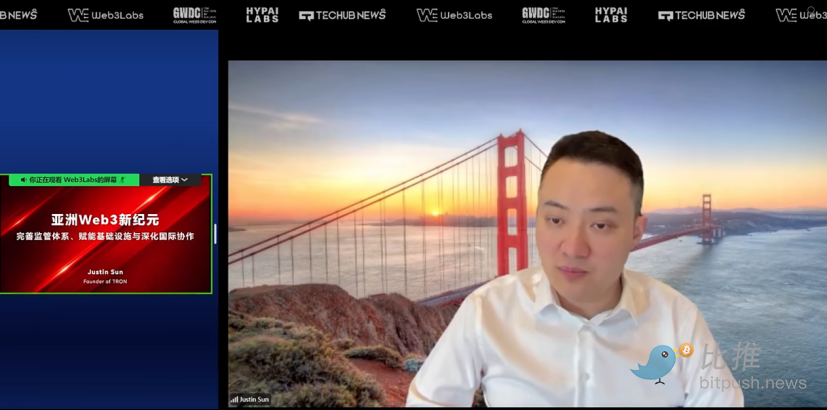
On March 23, the Hong Kong-Korea Web3 Policy Promotion Alliance Preparatory Committee was officially established, simultaneously launching the "2026 GWDC Global Developers Conference · Seoul Station (Korea Station)". This online event was jointly hosted by Web3Labs, HYPAI Labs, and GWDC, bringing together political and business leaders including Hong Kong Legislative Council member Wu Jiezhuang, South Korean National Assembly member Byung-deok Min, TRON founder Justin Sun, and Bithumb CEO Lee Jae-won. The event supported trilingual subtitles in Chinese, English, and Korean, and was broadcast globally via platforms like YouTube.

Justin Sun delivered a keynote speech titled "Asia's New Era of Web3: Perfecting the Regulatory System, Empowering Infrastructure, and Deepening International Collaboration". In his speech, he systematically elaborated on global regulatory trends, TRON's infrastructure strategy and AI frontier layout, as well as core propositions for promoting cross-border policy collaboration in the Asia-Pacific, demonstrating his forward-looking vision and global influence as a leading figure in Asia's Web3 industry, which has attracted high attention from the industry.
Global Regulatory Clarity Accelerates, Web3 Innovation Welcomes a Historic Window of Opportunity

In his speech, Sun pointed out that over the past year, global Web3 regulation has rapidly shifted from an "exploratory design" phase to an "implementation and landing" phase, showing an unprecedented trend towards clarity and convergence. The United States has successively passed a stablecoin bill and established a strategic Bitcoin reserve, with the new leadership of the SEC and CFTC generally holding an open attitude towards the crypto industry; the EU's MiCA regulation has entered a full enforcement phase, focusing on regulating stablecoins and custody businesses; Hong Kong, China has launched a stablecoin regulatory framework and entered the first batch of licensing issuance; Singapore and the UAE continue to be important hubs for crypto startup projects.

The improvement in the regulatory environment is releasing significant market dividends. Sun cited data showing that the stablecoin market size has surged from $206 billion to over $320 billion in the past year, and directions such as tokenized assets and the integration of AI and blockchain technology have also experienced explosive growth. He emphasized that regulatory certainty significantly reduces compliance costs, attracting large-scale entry from traditional financial institutions, and the integration between traditional industries and the Web3 industry is accelerating comprehensively.

However, Sun also cautioned that the impact of regulation on technological innovation is dual. Overly cautious and conservative regulatory policies can also stifle innovation, so regulation must seek "balance," and it is necessary to establish a benign interaction and communication channel between legislators and the industry. "If we only emphasize safety and ignore the momentum of innovation, I'm afraid the currently leading Asian Web3 industry will also lose its global competitiveness," he said.

It is worth noting that just earlier this month, the U.S. Securities and Exchange Commission (SEC) has asked the court to dismiss all charges it made in 2023 against Justin Sun personally, the TRON Foundation, and the BitTorrent Foundation. This development, following the SEC's previous dismissals of lawsuits against well-known crypto institutions such as Binance, Coinbase, and Uniswap, has again become an important milestone in the global crypto industry's compliance process. Sun stated that he will continue to focus on accelerating innovation globally, deepening cooperation with regulatory agencies in various countries, and contributing to the healthy development of the cryptocurrency industry.

TRON: Global Practice of Mature Blockchain Infrastructure and New AI Layout

In his speech, Sun systematically introduced the latest progress of TRON in blockchain infrastructure construction and the field of artificial intelligence.

Since its establishment in 2017, TRON has always been committed to promoting the maturity of the regional ecosystem and the actual application landing. Currently, the TRON network has over 370 million registered accounts, with a daily on-chain transfer volume between $20 billion and $30 billion, making it one of the public chains with the largest stablecoin circulation volume globally. The transaction share of USDT on TRON has long been among the top globally, providing low-cost, high-efficiency underlying support for cross-border payments, DeFi, and daily financial activities for users in the Asia-Pacific and globally.

In terms of infrastructure capabilities, TRON is known for its high throughput, ultra-low transaction fees, and 7×24 global settlement capability, and has become the preferred public chain platform for developers and enterprises in the Asia-Pacific region. In recent years, TRON has continued to increase its investment in the integration of AI and blockchain, launching innovative products such as AINFT; at the same time, through TRON DAO, it continues to support developer conferences, ecological funds, and stablecoin integration projects, helping Web3 projects in South Korea, Hong Kong China, Singapore, and other places to land quickly, and practically promoting ordinary users and small and medium-sized enterprises to enjoy the inclusive benefits of Web3.

Regarding the AI strategic layout, Sun announced that TRON has officially joined the Agentic AI Council hosted by the Linux Foundation, the world's largest open-source technology consortium, as a Gold Member, sitting on the council of this core international organization alongside global technology and financial giants such as OpenAI, Anthropic, Circle, and JPMorgan Chase. Sun commented on this: "The next wave of digital payments will be driven by machines. We are ready for it."

Cross-Border Collaboration is Key to Achieving "Balanced and Safe Regulation"

In the third part of his speech, Sun emphasized the strategic significance of cross-border policy collaboration for building a healthy Web3 ecosystem and expressed high recognition and full support for the establishment of the Hong Kong-Korea Web3 Policy Promotion Alliance.

He pointed out that Web3 is inherently borderless, and the regulatory framework of a single country can easily lead to "regulatory arbitrage" or ecosystem fragmentation risks. Only through cross-regional collaboration mechanisms like this alliance can legislators share best regulatory practices, coordinate stablecoin and custody standards, while fully listening to the voices from the industry front lines, ensuring that regulatory policies can effectively prevent risks, protect user rights, and not stifle innovation vitality.

He believes that Hong Kong, China's pragmatic regulatory framework and South Korea's open attitude towards Web3 are exemplary models of Asia-Pacific regional cooperation, and the synergy between the two will provide an important reference sample for global Web3 regulation.

Sun also specifically introduced TRON's practical achievements in the field of security and compliance. Since 2024, TRON and its partners have jointly established the T3 Task Force to combat financial crime. In nearly two years, it has successfully frozen over $300 million in funds involved in financial crimes across five continents globally, accumulating rich experience in enhancing collaboration with international security agencies and jointly addressing blockchain financial security threats, setting a successful example for industry security and compliance collaboration.

Sun concluded: "The future of Web3 belongs to those pioneers who dare to collaborate and courageously seek balance. The establishment of the alliance today is the starting point of this vision. I and TRON will, as always, contribute our strength, working hand in hand with everyone to promote the Web3 ecosystem in Asia-Pacific and globally towards a new era that is safer, more transparent, and more prosperous."


Twitter:https://twitter.com/BitpushNewsCN

Bitpush TG Communication Group:https://t.me/BitPushCommunity

Bitpush TG Subscription: https://t.me/bitpush

Original link:https://www.bitpush.news/articles/7622311

Trend Kriptolar

İlgili Sorular

QWhat was the main theme of Justin Sun's speech at the GWDC Korea event?

AThe main theme was 'Asia's Web3 New Era: Improving the Regulatory System, Empowering Infrastructure, and Deepening International Collaboration', focusing on global regulatory trends, TRON's infrastructure strategy, AI integration, and promoting cross-border policy cooperation in the Asia-Pacific region.

QWhat significant development did Justin Sun announce regarding TRON's involvement in AI?

AJustin Sun announced that TRON has joined the Agentic AI Council, hosted by the Linux Foundation, as a Gold Member, collaborating with major tech and financial giants like OpenAI, Anthropic, Circle, and JPMorgan to advance AI and blockchain integration.

QHow has the global regulatory environment for Web3 changed recently, according to Justin Sun?

AGlobal Web3 regulation has shifted from 'exploration and design' to 'implementation and enforcement', with increased clarity and convergence. Examples include the U.S. passing stablecoin laws, EU enforcing MiCA regulations, Hong Kong issuing stablecoin licenses, and Singapore and the UAE becoming crypto hubs.

QWhat is the purpose of the Hong Kong-Korea Web3 Policy Promotion Alliance mentioned in the article?

AThe alliance aims to foster cross-regional collaboration, share best regulatory practices, coordinate standards for stablecoins and custody, and ensure policies balance risk prevention and innovation, leveraging Hong Kong's pragmatic framework and Korea's open attitude toward Web3.

QWhat achievement did Justin Sun highlight regarding TRON's efforts in financial security?

ATRON, through the T3 task force, has successfully frozen over $300 million in funds involved in financial crimes across five continents, enhancing international collaboration to address blockchain security threats and setting a benchmark for industry compliance.

İlgili Okumalar

NVIDIA CPU Advances, China's RISC-V Responds: Semiconductor Deep Dive - Part Four

NVIDIA is set to launch its new Vera AI data center CPU in China as early as August, with high pricing. While this move offers a new option, it highlights China's continued dependence on foreign-controlled Arm architecture. In response, the Chinese semiconductor industry is increasingly turning to RISC-V as a strategic alternative for achieving high-performance computing autonomy. The article explores the concept of the "impossible triangle" in CPU development—balancing prosperity, control, and autonomy—and posits that RISC-V's open-source, modular nature offers a unique path to achieving all three. While RISC-V is already dominant in embedded systems, the focus is now shifting to data centers and AI workloads. China has become a global hotspot for RISC-V development, driven by AI-driven compute demand, supply chain concerns from export controls, cost benefits of open-source, and strong policy support. Multiple Chinese companies have reportedly crossed the key performance threshold of 15 SPECint per GHz, a benchmark for entering the high-performance CPU club. Progress extends beyond single-core benchmarks. Companies are developing complete computing subsystems, including commercial-grade coherent network-on-chip (NoC) technology and server processors with up to 40 cores that strictly adhere to the RVA23 standard to ensure software compatibility. Real-world applications are emerging in areas like video transcoding and edge AI. However, significant challenges remain. The RISC-V ecosystem faces fragmentation, immature toolchains and verification processes, and gaps in single-core performance and energy efficiency compared to mature x86 and Arm architectures. The formidable software moat, epitomized by NVIDIA's CUDA, is a long-term hurdle. In conclusion, while RISC-V cannot immediately replace offerings like NVIDIA's Vera, it represents a viable long-term path for China to develop a self-sufficient, high-performance CPU ecosystem. The journey is acknowledged to be long and arduous, requiring sustained effort to overcome technical and ecosystem challenges.

marsbit5 saat önce

NVIDIA CPU Advances, China's RISC-V Responds: Semiconductor Deep Dive - Part Four

marsbit5 saat önce

My Coding Betting Dashboard is Profiting, but Polymarket is Truly Not a Good Place for 'Arbitrage'

The author built a custom monitoring dashboard for Polymarket, a prediction market platform, and tested it with $1,600, achieving over 30% returns. However, the core argument is that Polymarket is not a good venue for traditional arbitrage. The dashboard has two main sections: a "Portfolio Dashboard" for tracking active positions with key metrics like total capital, P&L, and a risk-control module using a tier system (T1, T2, T3), and an "Opportunity Watchlist" for monitoring markets. The article details a critical structural trap in binary markets: a bet with a high perceived probability of success still carries a 100% loss risk if wrong. The author's T1/T2/T3 system is designed to manage this by limiting position sizes based on conviction and time horizon, emphasizing that high confidence should not equal high concentration. A key insight is the danger of "pseudo-diversification"—betting on different markets driven by the same underlying variable. The author concludes that Polymarket offers few true low-risk, arbitrage opportunities. It is instead a high-risk environment where wins can create a false sense of mastery, leading to large losses. The platform is better viewed as a training ground for honing judgment through disciplined, framework-driven betting rather than a reliable income source. The tools help transform intuition into structured, rule-based decisions to mitigate the risk of catastrophic errors.

marsbit8 saat önce

My Coding Betting Dashboard is Profiting, but Polymarket is Truly Not a Good Place for 'Arbitrage'

marsbit8 saat önce

WeChat AI Card Hands-On Guide: Has the AI Shopping Era Arrived?

**"WeChat AI Card" Practical Test Guide: Has the Era of AI Shopping Arrived?** WeChat has officially launched the "AI Exclusive Card," a feature integrated into its Workbuddy AI assistant. This card is designed to handle payments for AI-initiated purchases. Our hands-on test reveals it's not yet a tool for fully autonomous AI shopping, but rather a controlled payment layer for AI agents. The AI Card functions as an isolated sub-wallet within WeChat Pay. Users must bind the card and transfer funds into it from their main wallet. Crucially, every transaction requires explicit user confirmation via smartphone scan; AI cannot spend autonomously. Currently accessible through the Workbuddy agent, the card targets specific digital consumption scenarios: purchasing paid content (reports, data), calling paid APIs/tools, and subscribing to services. Its design prioritizes security and control by separating funds and mandating approval for each payment. We tested a real-world scenario: ordering bubble tea via Workbuddy using a "Meituan Life Assistant" skill. The process encountered multiple hurdles: high "skill" usage costs (exceeding daily free credits), and most importantly, while a payment was successfully initiated, the AI purchased an incorrect product (a mismatched group-buy coupon instead of the desired drink). This highlights the current limitation: the **AI Card only solves the payment step**. The broader challenge lies in the **AI agent's execution chain**—accurately understanding intent, navigating third-party platforms, selecting the right product, and ensuring proper fulfillment. The payment succeeded, but the purchase failed to meet the user's need. In conclusion, the WeChat AI Exclusive Card is a cautious, early-step experiment in AI commerce. It provides a secure, user-controlled payment method for agent interactions but is not yet capable of reliable, end-to-end complex purchases. For now, it's best used for low-value, low-risk digital services with careful user verification at each step. The vision of AI handling complete shopping tasks remains a work in progress.

marsbit11 saat önce

WeChat AI Card Hands-On Guide: Has the AI Shopping Era Arrived?

marsbit11 saat önce

İşlemler

Spot
Futures

Popüler Makaleler

SUN Nasıl Satın Alınır

HTX.com’a hoş geldiniz! SUN (SUN) satın alma işlemlerini basit ve kullanışlı bir hâle getirdik. Adım adım açıkladığımız rehberimizi takip ederek kripto yolculuğunuza başlayın. 1. Adım: HTX Hesabınızı OluşturunHTX'te ücretsiz bir hesap açmak için e-posta adresinizi veya telefon numaranızı kullanın. Sorunsuzca kaydolun ve tüm özelliklerin kilidini açın. Hesabımı Aç2. Adım: Kripto Satın Al Bölümüne Gidin ve Ödeme Yönteminizi SeçinKredi/Banka Kartı: Visa veya Mastercard'ınızı kullanarak anında SUN (SUN) satın alın.Bakiye: Sorunsuz bir şekilde işlem yapmak için HTX hesap bakiyenizdeki fonları kullanın.Üçüncü Taraflar: Kullanımı kolaylaştırmak için Google Pay ve Apple Pay gibi popüler ödeme yöntemlerini ekledik.P2P: HTX'teki diğer kullanıcılarla doğrudan işlem yapın.Borsa Dışı (OTC): Yatırımcılar için kişiye özel hizmetler ve rekabetçi döviz kurları sunuyoruz.3. Adım: SUN (SUN) Varlıklarınızı SaklayınSUN (SUN) satın aldıktan sonra HTX hesabınızda saklayın. Alternatif olarak, blok zinciri transferi yoluyla başka bir yere gönderebilir veya diğer kripto para birimlerini takas etmek için kullanabilirsiniz.4. Adım: SUN (SUN) Varlıklarınızla İşlem YapınHTX'in spot piyasasında SUN (SUN) ile kolayca işlemler yapın.Hesabınıza erişin, işlem çiftinizi seçin, işlemlerinizi gerçekleştirin ve gerçek zamanlı olarak izleyin. Hem yeni başlayanlar hem de deneyimli yatırımcılar için kullanıcı dostu bir deneyim sunuyoruz.

640 Toplam GörüntülenmeYayınlanma 2024.12.12Güncellenme 2025.03.21

SUN Nasıl Satın Alınır

Tartışmalar

HTX Topluluğuna hoş geldiniz. Burada, en son platform gelişmeleri hakkında bilgi sahibi olabilir ve profesyonel piyasa görüşlerine erişebilirsiniz. Kullanıcıların SUN (SUN) fiyatı hakkındaki görüşleri aşağıda sunulmaktadır.

活动图片