As the Yuan Breaks 7, Why Is the Dollar Stablecoin USDT Trading at a Deep Discount?

比推2025-12-30 tarihinde yayınlandı2025-12-30 tarihinde güncellendi

Özet

The Chinese yuan (CNH) broke through the key 7.0 per dollar level in late December 2025, reaching its strongest point since Q3 2024. Concurrently, the USDT stablecoin experienced a rare and significant discount in its over-the-counter (OTC) price in China, falling to around 6.83 yuan—a negative premium of approximately 2.48% against the official exchange rate. This divergence is attributed to two main factors. First, a major external driver is the weakening US dollar. The dollar index fell 9% in 2025, its worst performance in eight years, driven by expectations of a more dovish Federal Reserve under new leadership and a reassessment of the "US exceptionalism" trade. This provided room for non-US currencies like the yuan to appreciate. Second, and more critically for USDT, was a significant regulatory crackdown in China. In early December 2025, Chinese regulators explicitly brought stablecoins like USDT under supervision to combat illegal cross-border capital flows and money laundering. This caused OTC traders to pause operations and many holders to panic-sell their USDT for yuan, creating a surge in supply and a collapse in demand that severely depressed its local price. Analysts conclude that the era of a perpetually strong dollar providing one-way gains is over. Market participants are now advised to move away from betting on unilateral currency moves and instead adopt a risk-neutral stance in a new environment of heightened volatility.

Author: ChandlerZ, Foresight News

Original Title: What Does the Simultaneous Occurrence of the Yuan Breaking 7 and the Discount on the Dollar Stablecoin Mean?


At the end of 2025, the foreign exchange market is undergoing a quiet but intense asset repricing.

In late December, the offshore yuan (CNH) exchange rate against the US dollar broke through the 7.0 mark during intraday trading, reaching as high as the 6.99 range, hitting a new high since the third quarter of 2024. The onshore yuan against the US dollar also touched 7.0133.

While the official exchange rate was still fluctuating around the 7.0 mark, the OTC price of USDT had already fallen below 6.90 much earlier. As of the time of writing, data from multiple exchanges show that the USDT OTC price (Buy 1) is approximately 6.83 yuan, representing a negative premium rate of 2.48% relative to the current exchange rate of 7.0040.

This inversion was almost unimaginable during the strong dollar cycle of the past three years.

The Collapse of the Dollar 'High Ground'

The decline of the US dollar in 2025 is the most important external backdrop for the yuan's strength.

In 2025, the US dollar index plummeted by 9% for the year, marking its worst performance in eight years, reflecting, to some extent, a global reassessment of "US Exceptionalism".
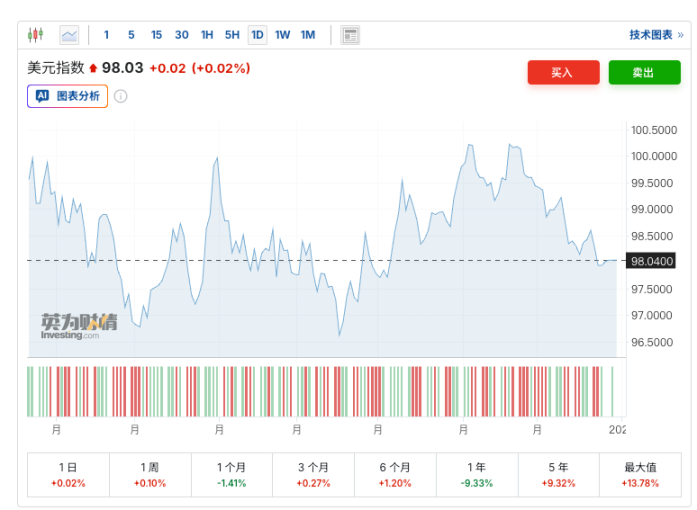
First is the gravitational pull of valuation regression. Although the dollar index has rebounded nearly 2% from its September low, from a fundamental perspective, the dollar is still outrageously "expensive." Data from the Bank for International Settlements (BIS) shows that as of October, the dollar's real broad effective exchange rate (REER), although down from its historical high of 115.1 in January to 108.7, remains at an absolute high. Karl Schamotta, Chief Market Strategist at global corporate payments company Corpay, stated bluntly: "From a fundamental perspective, the dollar is still overvalued."
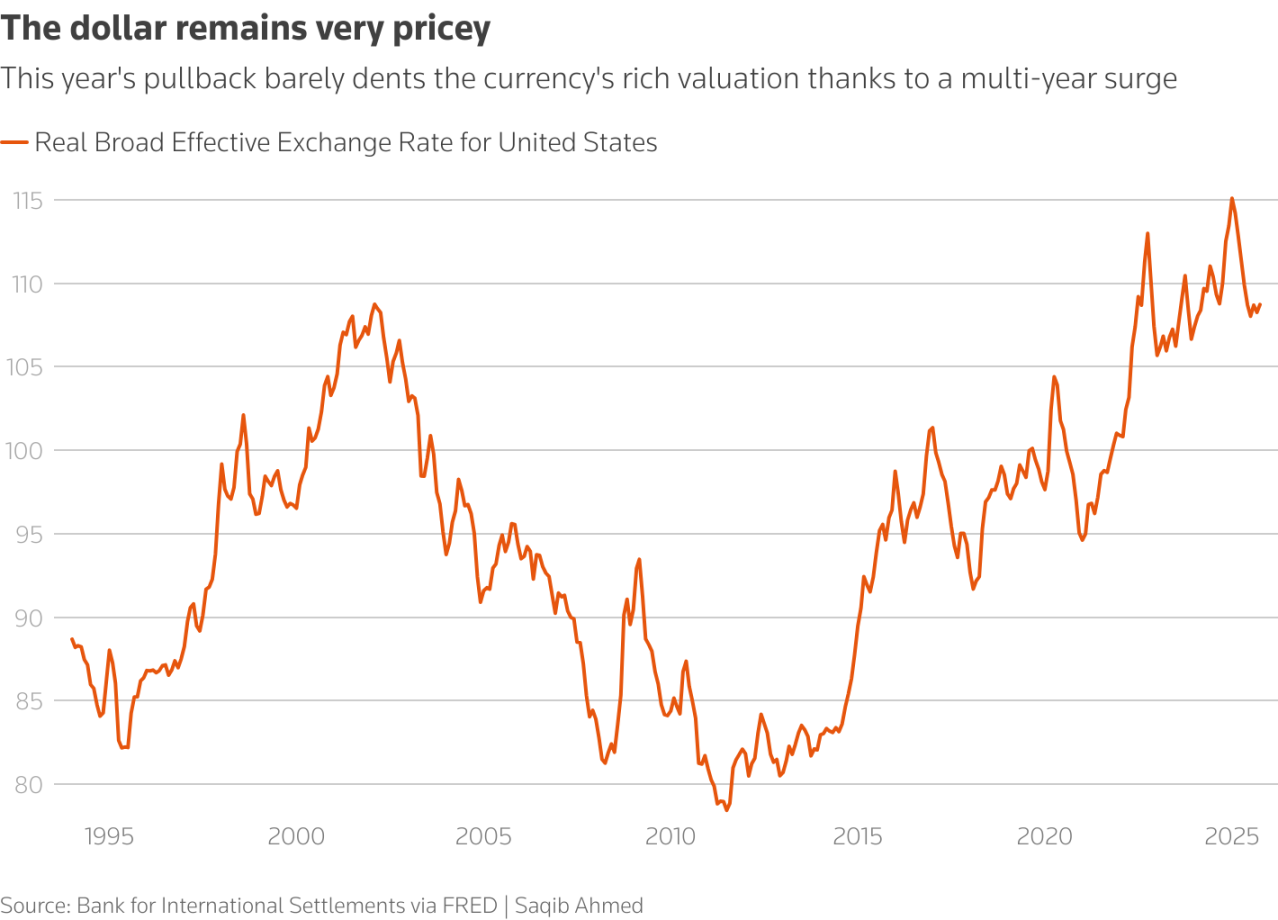
The line chart shows that due to years of sustained gains, this year's correction has barely impacted the dollar's high valuation.

Second is the dovish expectations for the new Fed. The market is pricing in a more accommodative 2025. With Powell set to step down and the Trump administration favoring low-interest-rate policies, leading candidates for his successor, including White House economic adviser Kevin Hassett and former Fed Governor Kevin Warsh, have all shown clear dovish tendencies.

Reuters noted in its year-end market report that the drop in the dollar index is driven more by expectations of Fed rate cuts, narrowing interest rate differentials with other economies, and changes in risk premiums due to the US fiscal deficit and political uncertainty.

And as the relative returns and safety premium of dollar assets are repriced, non-US currencies gain some upward room.

Institutional Consensus: Short-term Upward Momentum, Long-term Intensified Game

With the psychological barrier of 7.0 broken, the biggest question in the current market is whether this marks the start of a new long-term yuan appreciation cycle or is merely a short-term rebound driven by sentiment.

Standing on the threshold of 2026, the consensus among institutions is trending towards冷静 (calmness): short-term惯性向上 (inertia upward), long-term博弈加剧 (game intensifies).

Huachuang Securities believes that in terms of domestic supply and demand, the core factor behind it is foreign exchange settlement and sales. Although December's FX settlement and sales data have not yet been released, logical deduction suggests that the yuan's appreciation itself affects corporate expectations and behavior regarding FX settlement. Coupled with the typically strong seasonal characteristic of higher FX settlement at year-end, these two factors may have jointly driven the stronger performance of domestic supply and demand factors in the second phase of appreciation. On one hand, the continuous appreciation of the yuan exchange rate affects corporate expectations regarding FX settlement decisions; on the other hand, net FX settlement is usually strong at year-end.

However, the macro research team at Guotai Junan Securities also pointed out that the formation of yuan appreciation expectations is not without obstacles. Measuring domestic capital expectations using gold purchasing power parity, the volatility in 2025 was actually not low. Trade frictions in April once pushed domestic capital's depreciation expectations above 7.5, while the start of the Fed's rate cut cycle in September brought domestic capital's appreciation expectations to around 7.0. The reason is essentially that, in an environment where the internal economy has not yet shown significant elasticity, most investors remain somewhat hesitant about trend appreciation.

What Are the Reasons for USDT's Deep Discount?

Crypto market data analyst @Phyrex_Ni analyzed that the deep discount on USDT is mainly due to three reasons:

First: On a macro level, the Chinese yuan is currently strengthening significantly against the US dollar. Since the second half of 2025, the yuan has continued to strengthen. Reasons include the continuation of the Fed's rate-cutting cycle, the weakening US dollar index, and improved Chinese economic data. Holding USDT is equivalent to indirectly holding US dollar assets, which will incur exchange rate losses in the context of yuan appreciation. That is to say, the market itself, anticipating further yuan strength, has already priced in some exchange rate deviation, but this is not the main reason, only a very minor secondary factor.

Second: Chinese regulatory policies have tightened significantly. In early December 2025, the PBOC and twelve other departments jointly issued a document strengthening the crackdown on virtual currency trading speculation, explicitly bringing stablecoins (like USDT) into the regulatory scope, focusing on illegal cross-border capital flows, money laundering, and underground banks using USDT. This has led many OTC merchants and traders to suspend or reduce operations, causing market liquidity to tighten. Some holders, fearing account freezes or regulatory risks, are eager to sell USDT for yuan, increasing supply while demand plummets, directly depressing P2P prices. Historically, every regulatory upgrade in China (e.g., the 2021 ban) has led to negative OTC premiums for USDT. This time the力度 (force) is greater, so the deviation in USDT's exchange rate against the yuan is larger.

Third: The overall crypto market is volatile, and coupled with regulatory negative news, retail and institutional demand for USDT has decreased. Some investors based in mainland China, seeking to avoid risks, hope to offload their USDT as soon as possible, similar to the current negative premium cycle in China's real estate market.

Under the dual pressures of a turning macro cycle and tightening regulatory boundaries, the one-sided safe-haven logic of "holding US dollars means guaranteed gains" that prevailed over the past three years has completely失效 (failed).

For all market participants, the core task now is no longer to bet on whether the next point will be 6.8 or 7.0, but to告别 (bid farewell to) the path dependency on unilateral dollar appreciation. In a future where volatility is significantly elevated, the focus must回归风险中性 (return to risk neutrality).


Twitter:https://twitter.com/BitpushNewsCN

BitPush TG Discussion Group:https://t.me/BitPushCommunity

BitPush TG Subscription: https://t.me/bitpush

Original link:https://www.bitpush.news/articles/7599178

Trend Kriptolar

İlgili Sorular

QWhy did the offshore Chinese yuan (CNH) break through the 7.0 mark against the US dollar in December 2025?

AThe offshore Chinese yuan broke through the 7.0 mark due to a significant decline in the US dollar, which fell 9% throughout 2025, marking its worst performance in eight years. This reflected a global reassessment of 'US Exceptionalism,' alongside expectations of a more dovish Federal Reserve under potential new leadership and narrowing interest rate differentials with other economies.

QWhat were the main reasons for the deep discount in USDT's over-the-counter price relative to the official USD/CNY exchange rate?

AThe deep discount in USDT's price was primarily caused by China's stringent regulatory crackdown on cryptocurrency transactions, including stablecoins like USDT, which reduced market liquidity and increased selling pressure. Additionally, the appreciation of the yuan against the dollar made holding USDT less attractive, and overall crypto market volatility further dampened demand.

QHow did market expectations for the Federal Reserve's policy in 2025 influence the US dollar's performance?

AMarket expectations for a more dovish Federal Reserve in 2025, driven by potential new leadership favoring low-interest policies under the Trump administration, contributed to the US dollar's decline. This led to reduced relative yields and safety premiums for dollar assets, encouraging capital flow into non-US currencies like the yuan.

QWhat role did China's regulatory policies play in affecting USDT's market dynamics?

AChina's regulatory policies, specifically a joint announcement by 13 departments in December 2025 targeting virtual currency transactions and stablecoins like USDT, significantly reduced market liquidity. This caused many traders to pause operations and led to increased selling of USDT as users sought to avoid regulatory risks, resulting in a supply-demand imbalance and deep discount.

QWhat is the consensus among major financial institutions regarding the future trend of the yuan's exchange rate?

AMajor financial institutions consensus is that the yuan may experience short-term upward momentum due to factors like seasonal year-end forex settlements and changing corporate expectations, but long-term trends will involve increased volatility and uncertainty, especially given internal economic challenges and fluctuating investor sentiment towards sustained appreciation.

İlgili Okumalar

Must-Watch Events Next Week|CLARITY Act Could Face Senate Vote; SpaceX, Circle to Report Earnings (8.3-8.9)

**Summary: Key Events and Developments to Watch (August 3-9)** The upcoming week is marked by significant financial disclosures, key legislative deadlines, and notable product updates. **Major Financial Events:** Several companies are scheduled to release their Q2 2026 earnings. American Bitcoin (ABTC) will report on August 3, followed by SpaceX and Hut 8 Mining Corp. on August 4, and Circle on August 5. Notably, a significant portion of SpaceX shares (up to 12% of total shares) will be unlocked on August 6 following their earnings release. **Key Legislative Deadline:** The U.S. Senate faces an August 7 deadline to secure 60 votes for the CLARITY Act, a bipartisan bill aiming to establish a federal regulatory framework for cryptocurrencies. The Senate may hold a full vote on the bill during the week. **Economic Data:** The U.S. July Non-Farm Payrolls report will be released on August 7, providing crucial labor market data. **Technology & Product Updates:** * **Shutdowns:** DeFi portfolio tracker Zapper and wallet app Ctrl Wallet will cease operations on August 3. * **Upgrades:** LayerZero will deprecate its v1 relayers on August 3. XRP Ledger's new version 3.3.0, featuring five new functions, is expected next week. * **AI:** Elon Musk announced that the advanced Grok 4.6 AI model is set for release around August 7. * **Bitcoin:** The BIP-110 forced signaling for a potential Bitcoin network change is scheduled to begin around August 8. **Other Notable Events:** Chinese robotics firm Unitree Tech has set its preliminary price inquiry for its IPO for August 5. South Korean exchange Upbit will delist AQT and AERGO tokens on August 3.

marsbit31 dk önce

Must-Watch Events Next Week|CLARITY Act Could Face Senate Vote; SpaceX, Circle to Report Earnings (8.3-8.9)

marsbit31 dk önce

Stocks Are Plummeting More Sharply Than Cryptocurrencies. Where Has the Money Gone?

Stock Markets Plunge Deeper Than Cryptocurrencies: Where Did the Money Go? In late July, Seoul's Kospi index triggered circuit breakers for two consecutive days, plummeting over 40% from its June high. The collapse was led by heavyweight stocks like SK Hynix, whose record profits still disappointed investors, and devastating leveraged ETFs, with one major product losing over 83% of its value. This signaled a global, forced deleveraging targeting the most crowded trades. Interestingly, while stocks exhibited extreme volatility akin to crypto markets, Bitcoin rose nearly 15% in July after a prior steep drop. Analysis shows the money fleeing equities did not flow into Bitcoin. Instead, Bitcoin had already absorbed its sell-off in May-June, when U.S. spot Bitcoin ETFs saw historic outflows. The true safe-haven beneficiary was gold, whose price rose over 20% year-on-year, highlighting a decoupling between Bitcoin and gold as "digital gold." The sell-off was a targeted unwinding of leveraged positions in tech and semiconductors, accelerated by broker-dealer risk management and shifts in the AI narrative, including new competition from Chinese memory chipmakers. The retreat path was clear: from high-valuation tech stocks to cash and U.S. Treasuries, then to gold. For Bitcoin to attract sustained institutional inflows, conditions like eased global liquidity pressure, a "soft-landing" Fed rate cut, and U.S. regulatory clarity via legislation like the stalled CLARITY Act are needed. Currently, Bitcoin is not a safe haven but an already-cleared asset. Its low correlation with tech stocks, however, makes it a potential diversification play for institutional portfolios once the storm passes. The money isn't here yet, but the positioning is underway.

marsbit31 dk önce

Stocks Are Plummeting More Sharply Than Cryptocurrencies. Where Has the Money Gone?

marsbit31 dk önce

In Conversation with Ray Dalio: We Are Currently in an AI Bubble, with 1% of My Portfolio in Bitcoin

Ray Dalio, founder of Bridgewater Associates, warns in an interview that the current AI boom shows classic bubble characteristics, which could lead to significant economic downturns as seen in past cycles like 1929 or 2000. He explains that speculative enthusiasm, fueled by debt and overvaluation, often precedes a crash when rising rates or taxation force asset sales, causing widespread losses and recession. Dalio also outlines his "Big Cycle" theory, describing an approximate 80-year pattern where widening wealth gaps, massive government deficits, and shifting geopolitical power (like China's rise) create internal conflict and global instability. He emphasizes that we are in a late-cycle, transitional phase where traditional powers like the US and UK face decline. For personal wealth protection, Dalio advises diversification beyond cash into assets like stocks, bonds, real estate, and particularly gold, which he prefers over Bitcoin. While he holds about 1% of his portfolio in Bitcoin as a non-printable hard asset, he views gold as more secure from technological or governmental threats. Regarding AI's impact, Dalio believes it will disproportionately benefit capital owners, worsening inequality by replacing both physical and cognitive labor. He suggests that human intuition and emotional intelligence, combined with AI, will be key for future workers. On taxation, Dalio argues that wealth taxes are impractical and risk triggering asset sell-offs, reducing productive investment. He points to the UK as a cautionary example of debt, low productivity, and political strife. Geopolitically, Dalio foresees a more regionalized world, with the US showing weakness in prolonged conflicts like with Iran, akin to past imperial declines. The ideal outcome, he suggests, is coexisting powerful blocs (e.g., Americas, China-Asia Pacific) without major war.

marsbit4 saat önce

In Conversation with Ray Dalio: We Are Currently in an AI Bubble, with 1% of My Portfolio in Bitcoin

marsbit4 saat önce

Daily 7.2 Trillion KRW: Foreign Capital's Record Net Buying on Friday! Wall Street Says Headwinds for Korean Stock Fund Flows Have Subsided

South Korean stock market sees a dramatic shift in fund flows. On July 31, foreign investors made a record net purchase of approximately KRW 7.2 trillion in KOSPI stocks, marking a fundamental reversal from the persistent large-scale net outflows seen in previous months. This contributed to a significant narrowing of foreign net selling in July to KRW 9.8 trillion, down sharply from KRW 48.4 trillion in June and KRW 44.5 trillion in May. Simultaneously, domestic institutional pressure eased. South Korean pension funds and asset managers turned to a net buying position in July, purchasing KRW 1.0 trillion worth of KOSPI shares, contrasting with net sales in May and June. Market volatility is expected to be dampened by new financial regulations. Effective July 31, the Financial Services Commission tightened access for retail investors to single-stock leveraged ETFs by raising the minimum cash deposit requirement. Trading volumes for these products subsequently dropped to about 50% of their monthly average. Citigroup Research maintains its year-end KOSPI target of 10,000 points. The firm cites several supportive factors: the substantial easing of headwinds from capital outflows, a robust fundamental outlook for the semiconductor sector, historically low market valuations, strong economic fundamentals, and the potential for policy support from financial authorities if needed.

marsbit4 saat önce

Daily 7.2 Trillion KRW: Foreign Capital's Record Net Buying on Friday! Wall Street Says Headwinds for Korean Stock Fund Flows Have Subsided

marsbit4 saat önce

İşlemler

Spot

Popüler Makaleler

O Nasıl Satın Alınır

HTX.com’a hoş geldiniz! O1 exchange (O) satın alma işlemlerini basit ve kullanışlı bir hâle getirdik. Adım adım açıkladığımız rehberimizi takip ederek kripto yolculuğunuza başlayın. 1. Adım: HTX Hesabınızı OluşturunHTX'te ücretsiz bir hesap açmak için e-posta adresinizi veya telefon numaranızı kullanın. Sorunsuzca kaydolun ve tüm özelliklerin kilidini açın. Hesabımı Aç2. Adım: Kripto Satın Al Bölümüne Gidin ve Ödeme Yönteminizi SeçinKredi/Banka Kartı: Visa veya Mastercard'ınızı kullanarak anında O1 exchange (O) satın alın.Bakiye: Sorunsuz bir şekilde işlem yapmak için HTX hesap bakiyenizdeki fonları kullanın.Üçüncü Taraflar: Kullanımı kolaylaştırmak için Google Pay ve Apple Pay gibi popüler ödeme yöntemlerini ekledik.P2P: HTX'teki diğer kullanıcılarla doğrudan işlem yapın.Borsa Dışı (OTC): Yatırımcılar için kişiye özel hizmetler ve rekabetçi döviz kurları sunuyoruz.3. Adım: O1 exchange (O) Varlıklarınızı SaklayınO1 exchange (O) satın aldıktan sonra HTX hesabınızda saklayın. Alternatif olarak, blok zinciri transferi yoluyla başka bir yere gönderebilir veya diğer kripto para birimlerini takas etmek için kullanabilirsiniz.4. Adım: O1 exchange (O) Varlıklarınızla İşlem YapınHTX'in spot piyasasında O1 exchange (O) ile kolayca işlemler yapın.Hesabınıza erişin, işlem çiftinizi seçin, işlemlerinizi gerçekleştirin ve gerçek zamanlı olarak izleyin. Hem yeni başlayanlar hem de deneyimli yatırımcılar için kullanıcı dostu bir deneyim sunuyoruz.

425 Toplam GörüntülenmeYayınlanma 2026.06.19Güncellenme 2026.06.29

O Nasıl Satın Alınır

PROS Nasıl Satın Alınır

HTX.com’a hoş geldiniz! Pharos (PROS) satın alma işlemlerini basit ve kullanışlı bir hâle getirdik. Adım adım açıkladığımız rehberimizi takip ederek kripto yolculuğunuza başlayın. 1. Adım: HTX Hesabınızı OluşturunHTX'te ücretsiz bir hesap açmak için e-posta adresinizi veya telefon numaranızı kullanın. Sorunsuzca kaydolun ve tüm özelliklerin kilidini açın. Hesabımı Aç2. Adım: Kripto Satın Al Bölümüne Gidin ve Ödeme Yönteminizi SeçinKredi/Banka Kartı: Visa veya Mastercard'ınızı kullanarak anında Pharos (PROS) satın alın.Bakiye: Sorunsuz bir şekilde işlem yapmak için HTX hesap bakiyenizdeki fonları kullanın.Üçüncü Taraflar: Kullanımı kolaylaştırmak için Google Pay ve Apple Pay gibi popüler ödeme yöntemlerini ekledik.P2P: HTX'teki diğer kullanıcılarla doğrudan işlem yapın.Borsa Dışı (OTC): Yatırımcılar için kişiye özel hizmetler ve rekabetçi döviz kurları sunuyoruz.3. Adım: Pharos (PROS) Varlıklarınızı SaklayınPharos (PROS) satın aldıktan sonra HTX hesabınızda saklayın. Alternatif olarak, blok zinciri transferi yoluyla başka bir yere gönderebilir veya diğer kripto para birimlerini takas etmek için kullanabilirsiniz.4. Adım: Pharos (PROS) Varlıklarınızla İşlem YapınHTX'in spot piyasasında Pharos (PROS) ile kolayca işlemler yapın.Hesabınıza erişin, işlem çiftinizi seçin, işlemlerinizi gerçekleştirin ve gerçek zamanlı olarak izleyin. Hem yeni başlayanlar hem de deneyimli yatırımcılar için kullanıcı dostu bir deneyim sunuyoruz.

417 Toplam GörüntülenmeYayınlanma 2026.06.22Güncellenme 2026.06.29

PROS Nasıl Satın Alınır

VERONA Nedir

I. Proje Tanıtımı VERONA, zincir soyutlaması aracılığıyla herkes için, her yerde inşa edilmiş bir blok zinciridir. Genel Soyutlama katmanını kullanarak, VERONA, hesaplar, imzalar ve birlikte çalışabilirlik gibi karmaşık blok zinciri işlevlerini doğrudan protokol seviyesinde entegre ederek kendini ayırt eder. Bu yaklaşım, temel teknolojileri anlamaya gerek kalmadan blok zinciri uygulamalarıyla etkileşimde bulunmayı sağlar.1) Temel Bilgiler İsim: VERONA (VERONA)III. İlgili Bağlantılar Resmi web sitesi bağlantısı: https://xion.burnt.com/ Whitepaper: https://xion.burnt.com/whitepaper.pdf Keşif Araçları: https://explorer.burnt.com/ Sosyal Medya: https://x.com/burnt_xion Not: Proje tanıtımı, resmi proje ekibi tarafından yayımlanan veya sağlanan materyallerden alınmıştır, yalnızca referans içindir ve yatırım tavsiyesi teşkil etmez. HTX, ortaya çıkan doğrudan veya dolaylı kayıplardan sorumluluk kabul etmez.

374 Toplam GörüntülenmeYayınlanma 2026.06.22Güncellenme 2026.06.22

VERONA Nedir

Tartışmalar

HTX Topluluğuna hoş geldiniz. Burada, en son platform gelişmeleri hakkında bilgi sahibi olabilir ve profesyonel piyasa görüşlerine erişebilirsiniz. Kullanıcıların A (A) fiyatı hakkındaki görüşleri aşağıda sunulmaktadır.

活动图片














