As Circle, the First Stablecoin Stock, Resolves to Shed Its Label

链捕手2026-05-12 tarihinde yayınlandı2026-05-12 tarihinde güncellendi

Özet

Circle, the "stablecoin stock," reported its Q1 2026 results, showing a 20% YoY revenue increase to $694M despite a 15% drop in net profit due to post-IPO stock-based compensation and operational investments. The company's USDC stablecoin hit a record $770B in circulation with on-chain transaction volume soaring 263% YoY. However, market share slightly declined amid competition. The key market catalyst was the announcement of a $222M pre-sale for the ARC token of Circle's new institutional-focused Layer 1 blockchain, Arc, valuing the network at $30B. Led by a16z, the round included major investors like BlackRock and Apollo. CEO Jeremy Allaire positioned this as a strategic pivot from a stablecoin issuer to a broader internet platform and "financial OS" company. Circle also launched "Agent Stack" products for AI agent payments using USDC. While reaffirming its full-year 2026 guidance, the company noted the financial impact of Arc is not yet included, leaving room for future upside. Following the report, CRCL's stock surged nearly 16%. Wall Street analysts remain largely bullish on the long-term narrative, though some caution about near-term execution risks and the current immaterial contribution of new initiatives like Arc. The focus is now on Arc's mainnet launch, ARC token adoption, and evolving U.S. crypto regulation.

Author: Chloe, ChainCatcher

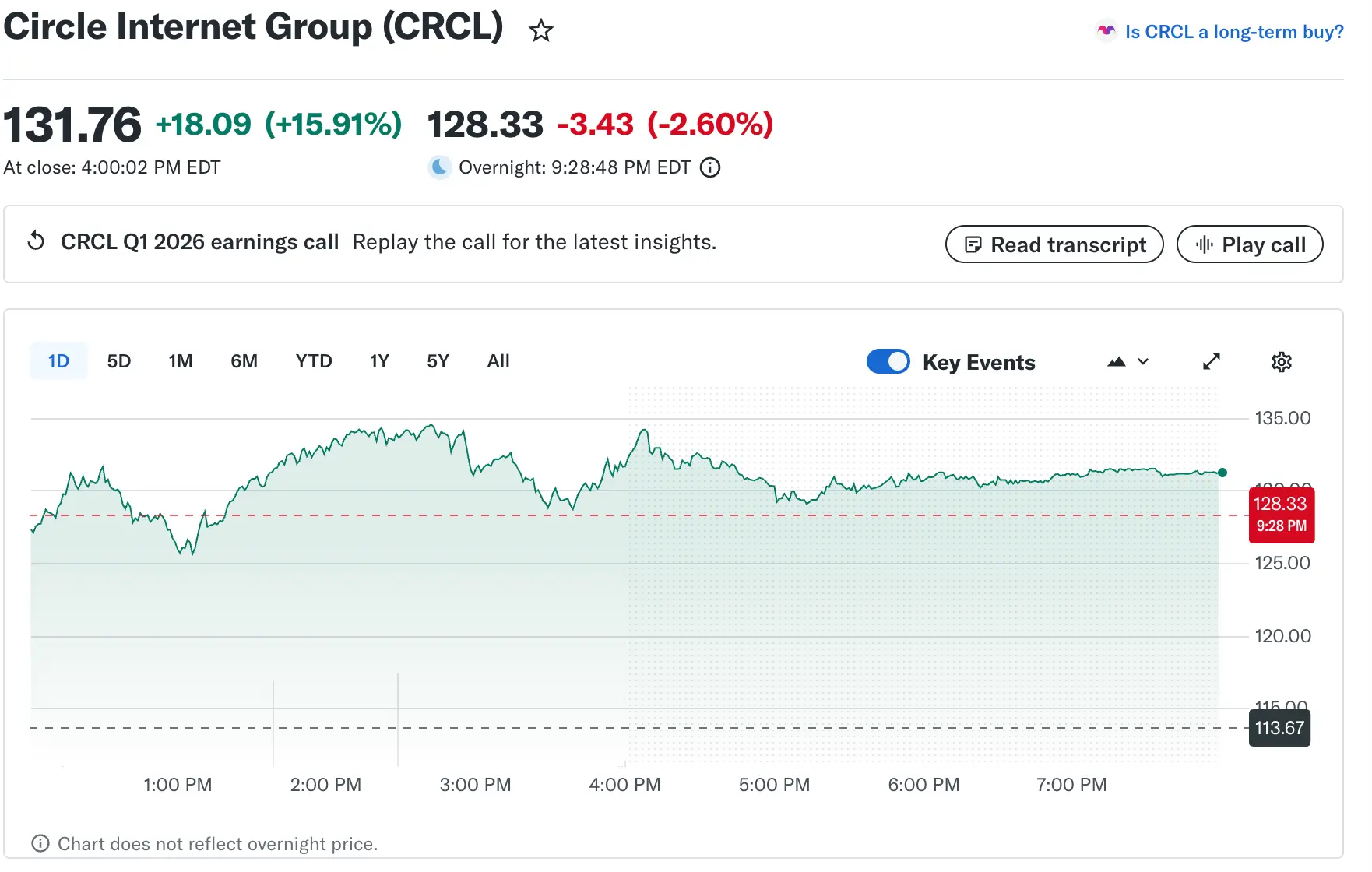
Circle released its first-quarter earnings for 2026 before the market opened yesterday, posting double-digit year-over-year revenue growth and simultaneously disclosing that its new public chain Arc's native token completed a pre-sale of $222 million at a $3 billion valuation. Although net profit declined 15% year-over-year due to increased stock-based compensation and operational investments, market focus remained centered on the long-term narrative of Arc and AI agent payments. CRCL's stock price surged nearly 16% that day, closing at $131.76, hitting a new high since mid-March.
USDC Scale Hits New Record, On-chain Transaction Volume Up 263% YoY

Circle's first-quarter total revenue and reserve income reached $694 million, a 20% increase year-over-year. Breakdown:

  • Reserve Income: $653 million, up 17% YoY, primarily benefiting from a 39% YoY increase in average USDC circulation, partially offset by a 66 basis point decrease in reserve yield (down to 3.5%).

  • Other Revenue: $42 million, roughly doubling YoY, reflecting strong growth in subscription, service, and transaction revenues.

  • Net Income from Continuing Operations: $55 million, down 15% YoY, mainly due to stock-based compensation and related payroll taxes post-IPO, as well as increased investment in products, distribution, and operational infrastructure.

  • Adjusted EBITDA: $151 million, up 24% YoY; Adjusted EBITDA margin was 53%.

Notably, both revenue and net income fell short of Wall Street analysts' expectations prior to the earnings release. According to Bloomberg, sell-side analysts had forecast revenue around $720.8 million and a reserve yield of 3.56%, neither of which were met. However, the adjusted EBITDA of $151 million exceeded the market expectation of $137.9 million, providing some support. This also indicates that the interest rate environment will be one of the most critical external variables for Circle moving forward.

On the operational front, USDC circulation reached $77 billion, up 28% YoY. First-quarter USDC on-chain transaction volume reached $21.5 trillion, a 263% YoY increase, reflecting a significant rise in stablecoin usage density as a payment and settlement medium.

According to Visa Onchain Analytics data, USDC accounted for 63% of stablecoin transaction volume in Q1. Meanwhile, Circle's USYC has become the world's largest tokenized money market fund as of May 7. Other key operational metrics include a USDC "platform retention" balance of $13.7 billion at quarter-end, up 254% YoY; 7.2 million "active wallets" holding over $10 in USDC, up 47% YoY; and a stablecoin market share of 28%, down 62 basis points YoY, directly reflecting competitive pressure from Tether and other rivals.

Public Chain Arc Completes $222 Million Token Financing with Star-Studded Investor Lineup

Circle also announced that the native token ARC for Arc, its institutionally-focused Layer 1 public chain, has completed a $222 million pre-sale, with a fully diluted network valuation of $3 billion. According to crypto asset data platform RootData, the financing was led by a16z with a $75 million investment. Other participating investors include BlackRock, Apollo Funds, Intercontinental Exchange (ICE), Standard Chartered Ventures, ARK Invest, Bullish, and over ten other institutions.
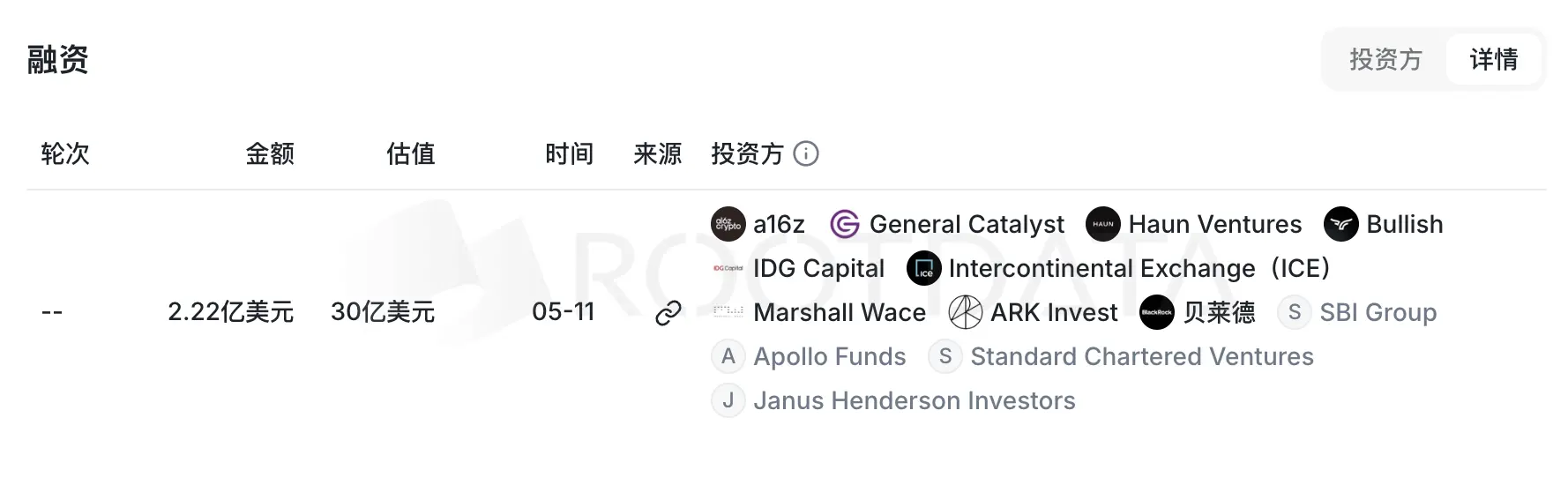
Circle CEO Jeremy Allaire stated that the company is transitioning from a stablecoin issuer to a broader internet platform company, entering the operating system and application business. Regarding token distribution, Circle holds 25% of the initial 10 billion token supply, 60% is allocated to network builders and participants, and 15% is reserved as long-term reserves.

Notably, Circle stated that this financial forecast does not incorporate the financial impact of the ARC token pre-sale, Arc incentive programs, or future Arc-related revenues.

Reaffirms Previously Announced Full-Year Guidance, No Adjustments

Additionally, Circle simultaneously launched a series of "Agent Stack" products, including Circle CLI (Command Line Tool), Agent Wallets, and Agent Marketplace, enabling developers and merchants to create, fund, and monetize AI agent-driven activities using USDC across multiple public chains and payment protocols.

The earnings report also revealed that, in terms of payment business, the Circle Payments Network (CPN) processed an annualized transaction volume of $8.3 billion as of March 31, based on the past 30 days of activity. Managed Payments, launched in April, allows financial institutions to offer stablecoin payment services without managing digital assets themselves.

New enterprise use cases for USDC include: Kyriba embedding USDC into its corporate treasury system, and Polymarket expanding its use of USDC as a core collateral and settlement asset.

Finally, regarding the outlook for the full year 2026, Circle chose to reiterate its previously announced performance guidance without any upward or downward revisions. Specifically, USDC circulation is still expected to maintain a 40% compound annual growth rate (CAGR) over multi-year cycles. FY2026 other revenue is projected between $150 million and $170 million; RLDC margin is expected between 38% and 40%; and adjusted operating expenses are forecast at $570 million to $585 million.

Similarly, this set of guidance does not incorporate the financial impact of the ARC token pre-sale, Arc incentive programs, or future Arc-related revenues, meaning there is room for upward revision once the Arc ecosystem successfully launches.

Majority of Wall Street Analysts Issue Bullish Ratings

Following the earnings release, CRCL surged approximately 16% that day, closing at $131.76, reaching its highest level since March 18. The stock has gained 66% year-to-date, with market capitalization rebounding to around $35 billion.

Wall Street analysts are generally optimistic about Circle's stock price performance over the next 12 months and beyond. According to TipRanks statistics, the consensus target price is $138.50. Among them, Peter Christiansen of Citi gave a 12-month target of $243, while Gautam Chhugani of Bernstein set a target of $190. Along with ten other analysts, all issued "Buy" ratings.

However, analysts still retain some reservations about short-term execution risks. Clear Street analyst Owen Lau pointed out that while the narratives of Arc and Agent Stack are eye-catching, they are "not yet a material business." John Todaro of Needham & Co. noted that recent DeFi protocol hacks could indirectly affect USDC use cases: "If capital leaves DeFi, how does that impact Circle's business?" Andrew Jeffrey of William Blair believes that CRCL stock price volatility will remain high in the short term, but Circle holds a significant advantage in "stablecoin commerce" with multiple catalysts progressing simultaneously.

It can be seen that Circle's earnings report presents a dual structure: the stablecoin business is still scaling rapidly, but unit economics are being compressed by interest rates and distribution costs. The market's willingness to award a 16% single-day gain is more of a bet that the Arc public chain, ARC tokenomics, and AI agent payments can reposition Circle from a stablecoin issuer to a "network financial operating system" in the medium to long term, opening up second and third growth curves beyond the existing USDC spread model.

Perhaps the market's focus going forward will be on the Arc mainnet launch timeline, market acceptance of the ARC token after public circulation, and the impact of subsequent U.S. GENIUS Act and Clarity Act implementations on the overall stablecoin competitive landscape.


İlgili Sorular

QWhat was Circle's stock price performance after the release of its Q1 2026 earnings report?

AFollowing the release of its Q1 2026 earnings report, Circle's stock (CRCL) rose nearly 16% on the day, closing at $131.76, which was a new high since mid-March.

QWhat major development did Circle announce alongside its earnings?

AAlongside its earnings, Circle announced that the native token ARC of its new institutional finance-focused Layer 1 blockchain, Arc, completed a pre-sale of $222 million at a fully diluted network valuation of $30 billion.

QWhat were the key financial results for Circle in Q1 2026?

AIn Q1 2026, Circle's total revenue and reserve income was $694 million, a 20% year-over-year increase. However, net income from continuing operations was $55 million, down 15% YoY. Adjusted EBITDA was $151 million, a 24% YoY increase.

QWho led the funding round for the ARC token?

AThe funding round for the ARC token was led by the venture capital firm Andreessen Horowitz (a16z), which invested $75 million.

QAccording to the article, what is the main transformation that Circle's CEO Jeremy Allaire described for the company?

ACircle's CEO Jeremy Allaire stated that the company is transforming from a stablecoin issuer into a broader internet platform company, entering the operating system and application businesses.

İlgili Okumalar

Ten-Thousand-Word Analysis: From $10 to $290, MRVL Wins the Entire AI Era by 'Not Making GPUs'

Marvell Technology's stock price surged from under $10 in 2016 to a record $290 in June 2026, fueled not by making GPUs, but by dominating AI infrastructure connectivity. This analysis argues the market misvalues MRVL as merely a smaller Broadcom in custom AI chips, overlooking its true, unique position. Marvell's core strength lies in enabling high-speed data flow for AI clusters through three interconnected businesses. First, it holds a commanding ~70% market share in high-speed optical DSPs (essential for data center light modules), a deep-moat business with accelerating growth. Second, its custom AI chip design business serves hyperscalers like AWS, Microsoft, and Google, with a significant revenue pipeline despite lower margins. Third, stable cash flows come from Ethernet switch chips and enterprise storage controllers. Together, they form a full-stack "AI data movement" platform. CEO Matt Murphy's transformative leadership since 2016, involving strategic divestments, key acquisitions (like Inphi for optical DSPs), and securing long-term agreements with major cloud providers, repositioned the company. A pivotal $2 billion strategic investment from NVIDIA in 2026 underscored Marvell's critical role in the AI ecosystem, particularly through collaborations like NVLink Fusion. While Marvell faces risks—including client concentration (losing the Amazon Trainium3 design), lower-margin business mix, competitive threats, insider selling, and complex supply chains—its fundamentals remain strong. The optical interconnect moat is widening with the acquisition of Celestial AI (photonics fabric), and financial metrics show accelerating revenue growth and operating leverage. With a PEG ratio suggesting undervaluation relative to its growth, the thesis is that the market undervalues Marvell's monopolistic position in AI "plumbing" while overemphasizing its competitive custom chip segment. The story transcends investing, symbolizing how in any complex system—from the internet to AI—the value of "connection" ultimately surpasses that of individual "nodes."

marsbit17 dk önce

Ten-Thousand-Word Analysis: From $10 to $290, MRVL Wins the Entire AI Era by 'Not Making GPUs'

marsbit17 dk önce

AI Relay Stations Spark Heated Debate on Zhihu: Behind Cheap Tokens, What Are Users Really Worried About?

A discussion on Zhihu about "AI relay stations" shifted the niche developer topic of "cheap tokens" into broader user awareness. Users moved beyond simply questioning the legitimacy of these services to focus on practical concerns: Where do cheap tokens truly come from? Is the model being accessed the real one? Can relay stations see prompts, code, and API keys? For occasional users, are the risks worth it? The core debate centered less on price and more on trust. A primary worry is model authenticity—the risk of "model swapping," where users paying for a premium model might be routed to a cheaper one, creating an information asymmetry. Others argued that cost comparisons matter; while cheaper than official pay-as-you-go APIs, relay stations may not be the lowest-cost option versus subscriptions, domestic models, or free tiers, making user needs assessment crucial. Speculation about token sources ranged from legitimate bulk discounts to gray-area methods like account sharing or exploiting regional pricing. This opacity makes risk assessment difficult for users. Data security emerged as a critical concern, especially for enterprise use. When processing sensitive information like code, contracts, or client data, the inability to verify a relay station's data handling, retention, or access policies poses significant compliance and confidentiality risks. The evolving consensus suggests relay stations can be used cautiously for low-sensitivity, disposable tasks (e.g., summarizing public info, simple translation). However, they should not be the default for sensitive, professional, or production workflows involving proprietary data, Agents, or automated systems. Recommendations include avoiding large prepayments, not relying on a single service, using test prompts to monitor quality, anonymizing data where possible, and keeping official channels as backups. Ultimately, the discussion framed tokens not just as a billing unit but as a measure of real cost encompassing price, model integrity, data security, and service stability. The popularity of relay stations highlights user demand for affordable access, but the debate underscores a key trade-off: the savings from cheap tokens may come at the price of trust, transparency, and control over one's data and AI experience.

marsbit46 dk önce

AI Relay Stations Spark Heated Debate on Zhihu: Behind Cheap Tokens, What Are Users Really Worried About?

marsbit46 dk önce

In-Depth Research Report on TradFi: The Convergence Wave of Crypto and Traditional Finance

In 2026, the crypto industry is undergoing a profound infrastructure-level transformation—TradFi assets are migrating on-chain at an unprecedented pace. According to CoinGecko's Q1 2026 report, the total value locked (TVL) of tokenized real-world assets (RWA) has surpassed $31 billion, a nearly 4x increase from $7.8 billion at the beginning of 2025, with the sector’s aggregate market capitalization reaching $19.3 billion. Among these, the market cap of tokenized stocks surged from $2 million to $486 million, with Q1 spot trading volume reaching $15.1 billion—a single quarter already surpassing the entire second half of 2025. RWA perpetual contract Q1 trading volume reached a staggering $524.8 billion, far exceeding the $313 billion for all of 2025. Meanwhile, BlackRock's BUIDL fund has reached $2.3 billion in scale and has filed for two new tokenized funds, signaling that the world's largest asset manager's tokenization strategy is evolving from pilot to product suite expansion. HTX, as a core participant in the crypto exchange sector, officially launched TradFi perpetual futures products including NVDA, AAPL, MSFT, META, and SPY in 2026, enabling crypto users to gain 24/7 trading access to core U.S. equities. Boston Consulting Group predicts that global tokenized asset scale could reach $16 trillion by 2030, while McKinsey offers a conservative estimate of approximately $2 trillion. The on-chain migration of TradFi assets is no longer a "future narrative" but a structural transformation unfolding in real time, as crypto exchanges evolve from single crypto asset trading platforms toward "multi-asset-class trading infrastructure."

HTX Learn49 dk önce

In-Depth Research Report on TradFi: The Convergence Wave of Crypto and Traditional Finance

HTX Learn49 dk önce

İşlemler

Spot
Futures
活动图片

