Arthur Hayes’ Bombshell CLARITY Act Warning Just Resurfaced — And The Timing Couldn’t Be Worse

bitcoinist2026-05-20 tarihinde yayınlandı2026-05-20 tarihinde güncellendi

Özet

BitMEX co-founder Arthur Hayes has strongly opposed the CLARITY Act, urging for its veto. He argues that regulation is structurally incompatible with Bitcoin and decentralized systems, which derive value from operating outside regulatory frameworks. Hayes contends the bill primarily benefits centralized exchanges and institutions seeking traditional capital, not decentralized assets. He believes Bitcoin's price is driven by global liquidity and money supply, not legislation. His comments resurface as the CLARITY Act gains significant momentum, having just cleared the Senate Banking Committee with a bipartisan 15-9 vote. The bill now moves toward further reconciliation and votes, with industry warnings that delay could push action to 2030. Hayes's investment positions reflect his thesis: his largest holdings outside Bitcoin are Hyperliquid's HYPE and privacy-focused ZCash, assets rooted in decentralization rather than regulatory accommodation. This stance creates a stark divide as the crypto industry nears a potential U.S. regulatory framework.

Arthur Hayes, co-founder of BitMEX and Chief Investment Officer of Maelstrom, called for the CLARITY Act to be vetoed in a recent interview with Scott Melker, host of The Wolf of All Streets — comments that have resurfaced at a moment of peak legislative momentum, just days after the bill cleared the Senate Banking Committee with a bipartisan 15-9 vote.

Speaking with Melker, Hayes delivered his position without qualification. “The CLARITY Act should be vetoed. We don’t need no regulation.” The remark, amplified by Wu Blockchain (@WuBlockchain) on X, puts him in direct and public opposition to virtually every major centralized exchange, lobby group, and corporate executive in the space — all of whom have spent months treating the bill as the most consequential piece of crypto legislation in US history.

Why Hayes Says The Industry Is Wrong

The argument Hayes is making is not that regulation is inconvenient. It is that regulation is structurally incompatible with what Bitcoin and decentralized systems actually are.

His framing is pointed: the companies lobbying hardest for the CLARITY Act — exchanges, custodians, and institutional platforms — are entities that need regulatory frameworks to operate and attract traditional capital.

The bill clears their path. It does not, in Hayes’ view, do anything meaningful for Bitcoin or genuinely decentralized systems, which derive their value precisely from operating outside any regulatory architecture. “Regulation is for people who own centralized companies — obviously they want this, that makes complete sense,” he said, per reporting of his remarks at Consensus Miami 2026 where he expanded on the same thesis.

The macro argument runs beneath the regulatory one. Hayes has consistently maintained that Bitcoin’s price is driven by global liquidity conditions and fiat money supply expansion — not legislative milestones. “So what is CLARITY going to bring? Nothing — unless there’s more money printing,” he said. “Otherwise, there’s no value here, because it’s just another asset on a bank balance sheet,” per Yahoo Finance’s reporting of his Consensus remarks. AI-related job disruption and rising geopolitical tensions, he argued, may ultimately force central banks toward fresh liquidity injections — and that, not the CLARITY Act, is what actually moves Bitcoin.

The Bill That Just Got Harder To Stop

Hayes’ comments land at an uncomfortable moment for anyone who shares his skepticism. The CLARITY Act cleared the Senate Banking Committee with a 15-9 vote — two Democrats, Ruben Gallego and Andy Kim, crossed the aisle to support it — a margin that surprised even supporters who had anticipated a strict party-line outcome, per Scott Melker’s reporting on Yahoo Finance. The bill now moves toward reconciliation with the Senate Agriculture Committee’s version, a floor vote requiring seven Democratic senators, and ultimately a presidential signature.

Ripple CEO Brad Garlinghouse, speaking at Consensus Miami, warned that if passage doesn’t happen before the summer recess, the probability drops sharply — potentially pushing any action to 2030 or beyond, per dMarket Forces. Senator Bernie Moreno has described the current window as Congress’s last real opportunity before the 2026 midterm calendar complicates everything.

The Portfolio Behind The Conviction

Hayes’ own positions reflect the worldview driving his CLARITY Act argument. Outside Bitcoin, his two largest holdings are HYPE — Hyperliquid’s token, which he targets at $150 by August 2026 — and ZCash, a privacy-focused cryptocurrency he has set a $10,000 long-term price target for, per Stocktwits’ reporting of his Consensus remarks.
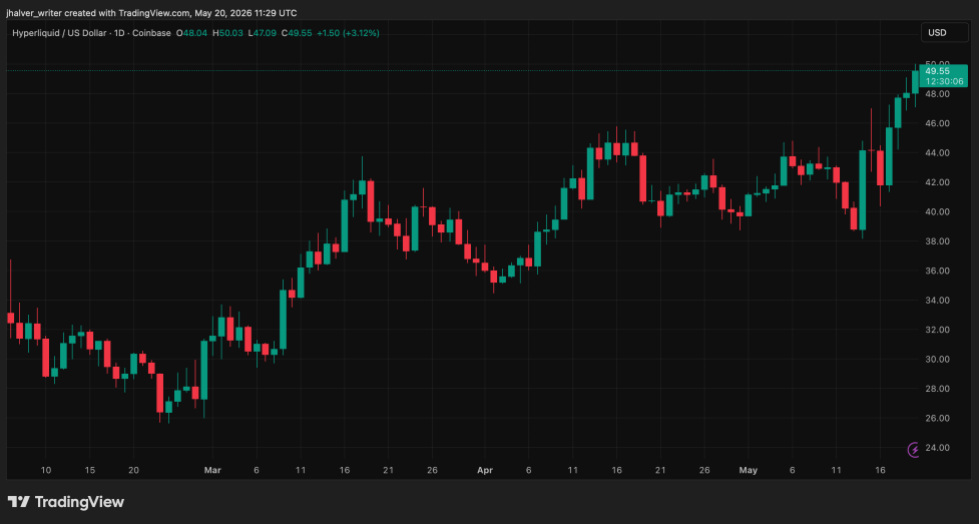
HYPE's price trends to the upside as seen on the daily chart. Source: HYPEUSD on Tradingview

Both are assets whose value proposition is rooted in decentralization and censorship resistance rather than regulatory accommodation. Neither benefits meaningfully from the CLARITY Act. The portfolio is an argument made in capital.

This development marks a critical and genuinely uncomfortable moment for the nascent sector. The industry is closer than it has ever been to a durable US regulatory framework — the Senate Banking Committee just proved it — and one of Bitcoin’s most prominent voices is on record saying that getting there may be exactly the wrong outcome.

Cover image from ChatGPT, HYPEUSD chart from Tradingview

İlgili Sorular

QAccording to Arthur Hayes, why is the CLARITY Act incompatible with Bitcoin and decentralized systems?

AArthur Hayes argues that regulation is structurally incompatible with Bitcoin and decentralized systems because their value is derived from operating outside any regulatory architecture. He states that the CLARITY Act primarily benefits centralized entities like exchanges and custodians who need regulatory frameworks, but does nothing meaningful for genuinely decentralized systems.

QWhat was the margin of the Senate Banking Committee vote on the CLARITY Act, as mentioned in the article?

AThe CLARITY Act cleared the Senate Banking Committee with a bipartisan 15-9 vote.

QBesides Bitcoin, what are Arthur Hayes's two largest cryptocurrency holdings, and what are his price targets for them?

AArthur Hayes's two largest holdings besides Bitcoin are HYPE (Hyperliquid's token) and ZCash. He has a price target of $150 for HYPE by August 2026 and a long-term target of $10,000 for ZCash.

QWhat does Arthur Hayes believe is the primary driver of Bitcoin's price, according to the article?

AArthur Hayes believes that Bitcoin's price is driven primarily by global liquidity conditions and fiat money supply expansion, not by legislative milestones like the CLARITY Act.

QWhat warning did Ripple CEO Brad Garlinghouse give regarding the timeline for passing the CLARITY Act?

ARipple CEO Brad Garlinghouse warned that if the CLARITY Act is not passed before the summer recess, the probability of passage drops sharply, potentially pushing any legislative action to 2030 or beyond.

İlgili Okumalar

Apple Also Has to Pay Rent Now

Apple Pays Rent Too: The Two-Way Flow of "Traffic Tax" and "AI Capability Rent" Between Tech Giants For over two decades, Google has paid Apple an estimated $20 billion annually to remain the default search engine on Safari, a "traffic tax" for a critical user entry point. However, in 2026, the direction of this cash flow partially reversed. Apple agreed to pay Google roughly $1 billion per year to license its Gemini AI models, as Apple's own models reportedly struggled with complex tasks. This creates a unique dynamic: Apple acts as the "landlord" in the established search ecosystem, collecting rent from Google for access. Simultaneously, in the emerging AI arena, Apple becomes the "tenant," paying Google for access to cutting-edge AI capabilities it cannot currently match internally. While Apple claims its new models are "distilled" from Gemini outputs and contain "not a drop" of Google's original code, core dependencies remain. Its knowledge base is refined using Gemini's outputs, and its most powerful cloud model runs on Google's infrastructure. Apple has structured the deal as non-exclusive, allowing it to theoretically switch AI suppliers—a hedge against over-reliance. The future hinges on whether advanced AI models become a commodity (cheap and abundant) or remain a concentrated, scarce resource (expensive and controlled by few). Apple is betting on the former, leveraging its massive device ecosystem to be a powerful, choosy customer. If the latter proves true, its bargaining power could erode. This power dynamic is extending to developers. Apple, Google, and WeChat are all pushing for apps to expose their core functions as standardized "actions" or "intents" that their respective AI assistants (Siri, Gemini, WeChat AI) can directly call. The new scarce resource is no longer just app store visibility, but "being selected by the AI." The currency of "rent" has changed from a 30% revenue share to ceding control over how users interact with an app's functions.

marsbit1 saat önce

Apple Also Has to Pay Rent Now

marsbit1 saat önce

Missed the SpaceX IPO? WEEX's "First Trade Protection" Lets You Experience US Stock Trading Risk-Free.

With the excitement around SpaceX's recent public listing reigniting interest in the US stock market, Chinese investors face significant challenges accessing compliant and convenient trading channels following regulatory actions against major online brokers. This article explores the available options, highlighting their risks and limitations. Traditional paths for US stock investments remain problematic. Qualified Domestic Institutional Investor (QDII) and Listed Open-Ended Fund (LOF) products, while compliant, suffer from high fees, significant purchase premiums, and a very limited selection of assets. Small, unregulated offshore brokers pose substantial risks, including potential insolvency. While secure, VIP accounts at banks in Hong Kong or Singapore require high minimum deposits (often 1-2 million RMB) and in-person visits, placing them out of reach for most retail investors. The article positions cryptocurrency exchanges, specifically their TradFi (traditional finance on-chain) offerings, as a compelling alternative. Platforms like WEEX are noted for providing access to a wide range of US stocks and ETFs, including SpaceX (SPCXON), through tokenized assets. This method offers advantages such as a single account for both crypto and traditional assets, USDT-based settlement avoiding fiat complexities, flexible leverage, and robust risk management. To attract users, WEEX is promoting a "First Trade Guarantee" campaign. Running from June 15 to July 8 (UTC+8), it features a $30,000 prize pool. Users who trade $500 worth of US stock contracts can qualify for a guarantee on their first eligible trade: 100% loss coverage up to $30 or a 20% bonus on profits up to $30. The campaign is presented as a low-risk opportunity for both crypto natives and traditional investors to experience US stock trading.

marsbit1 saat önce

Missed the SpaceX IPO? WEEX's "First Trade Protection" Lets You Experience US Stock Trading Risk-Free.

marsbit1 saat önce

How Difficult is Chip Making? A Division Error Costs 475 Million Dollars

How Hard Is It to Make a Chip? A Division Error Cost $475 Million Chip expert Shi Kan, a researcher at the Chinese Academy of Sciences and a popular tech creator, explains the immense challenges of chip development. Chips are foundational to modern technology, but their creation is extraordinarily difficult. The journey from sand to a functional chip involves complex design and manufacturing, but a critical bottleneck is verification—ensuring the design works flawlessly before costly production. A single, undetected bug can have catastrophic consequences, as illustrated by the infamous 1994 Intel Pentium FDIV bug. A flaw in the floating-point division unit forced a recall costing $475 million. Unlike software, chips cannot be easily patched after manufacture, making "first-time success" paramount. However, industry surveys show only 24% of chip projects achieve this; over three-quarters require at least one costly re-spin due to design flaws. Verification has thus become the dominant phase, consuming up to 70% of the design cycle. The core challenge is a "verification impossible triangle" between high performance, good debuggability, and low cost. Exhaustively verifying a modern CPU core could take 15,000 years with software simulation, or 30 years with advanced hardware emulation—timeframes utterly impractical for development. Despite being essential, verification is often seen as unglamorous "dirty work," receiving less academic attention than fields like AI. Shi and his team are tackling this by developing an agile verification research framework called ENCORE, based on FPGA technology, to improve verification efficiency and debug capability. Beyond research, Shi engages in public science communication through long-form video content, aiming to demystify chip technology, AI, and computer science. He argues for the value of pursuing "hard and long-term" endeavors, whether in the meticulous world of chip verification or in creating substantive educational content, believing such sustained effort is likely the right path forward.

marsbit1 saat önce

How Difficult is Chip Making? A Division Error Costs 475 Million Dollars

marsbit1 saat önce

İşlemler

Spot
Futures

Popüler Makaleler

T Nasıl Satın Alınır

HTX.com’a hoş geldiniz! Threshold Network Token (T) satın alma işlemlerini basit ve kullanışlı bir hâle getirdik. Adım adım açıkladığımız rehberimizi takip ederek kripto yolculuğunuza başlayın. 1. Adım: HTX Hesabınızı OluşturunHTX'te ücretsiz bir hesap açmak için e-posta adresinizi veya telefon numaranızı kullanın. Sorunsuzca kaydolun ve tüm özelliklerin kilidini açın. Hesabımı Aç2. Adım: Kripto Satın Al Bölümüne Gidin ve Ödeme Yönteminizi SeçinKredi/Banka Kartı: Visa veya Mastercard'ınızı kullanarak anında Threshold Network Token (T) satın alın.Bakiye: Sorunsuz bir şekilde işlem yapmak için HTX hesap bakiyenizdeki fonları kullanın.Üçüncü Taraflar: Kullanımı kolaylaştırmak için Google Pay ve Apple Pay gibi popüler ödeme yöntemlerini ekledik.P2P: HTX'teki diğer kullanıcılarla doğrudan işlem yapın.Borsa Dışı (OTC): Yatırımcılar için kişiye özel hizmetler ve rekabetçi döviz kurları sunuyoruz.3. Adım: Threshold Network Token (T) Varlıklarınızı SaklayınThreshold Network Token (T) satın aldıktan sonra HTX hesabınızda saklayın. Alternatif olarak, blok zinciri transferi yoluyla başka bir yere gönderebilir veya diğer kripto para birimlerini takas etmek için kullanabilirsiniz.4. Adım: Threshold Network Token (T) Varlıklarınızla İşlem YapınHTX'in spot piyasasında Threshold Network Token (T) ile kolayca işlemler yapın.Hesabınıza erişin, işlem çiftinizi seçin, işlemlerinizi gerçekleştirin ve gerçek zamanlı olarak izleyin. Hem yeni başlayanlar hem de deneyimli yatırımcılar için kullanıcı dostu bir deneyim sunuyoruz.

470 Toplam GörüntülenmeYayınlanma 2024.12.10Güncellenme 2026.06.02

T Nasıl Satın Alınır

Tartışmalar

HTX Topluluğuna hoş geldiniz. Burada, en son platform gelişmeleri hakkında bilgi sahibi olabilir ve profesyonel piyasa görüşlerine erişebilirsiniz. Kullanıcıların T (T) fiyatı hakkındaki görüşleri aşağıda sunulmaktadır.

活动图片