Arizona lawmaker proposes barring taxes on crypto and blockchain

cointelegraph2025-12-22 tarihinde yayınlandı2025-12-22 tarihinde güncellendi

Özet

Arizona State Senator Wendy Rogers has introduced two bills and a resolution to change how digital assets are taxed in the state. The proposals include exempting virtual currency from taxation (SB 1044), preventing local governments from taxing or fining blockchain node operators (SB 1045), and amending the state constitution to exclude digital assets from property tax (SCR 1003). While the node bill may pass through the legislature, the tax exemption and constitutional change would require voter approval in the 2026 general election. Arizona is among a small group of states, including New Hampshire and Texas, with laws establishing digital asset reserve policies. The move follows broader U.S. state-level efforts to create supportive regulatory frameworks for cryptocurrency.

Arizona state Senator Wendy Rogers has proposed two bills and a resolution in an effort to change the state’s laws on taxing digital assets.

In legislation prefiled with the Arizona Senate on Friday, Rogers proposed amending state statues to exempt virtual currency from taxation (SB 1044), barring counties, cities and towns from taxing or fining entities running blockchain nodes (SB 1045), and amending the state constitution’s definition of property taxes to clarify rules on digital assets (SCR 1003).

The blockchain node bill may move through the state legislature, but the crypto tax bill and resolution would require a vote by Arizona voters during the next general election, in November 2026.

SCR 1003 would amend Arizona’s constitution to specifically exclude virtual currency from property tax, while SB 1044 would add similar language to the state’s statutes. SB 1045 would prohibit cities, towns and counties in the state from imposing “a tax or fee on a person that runs a node on blockchain technology.”
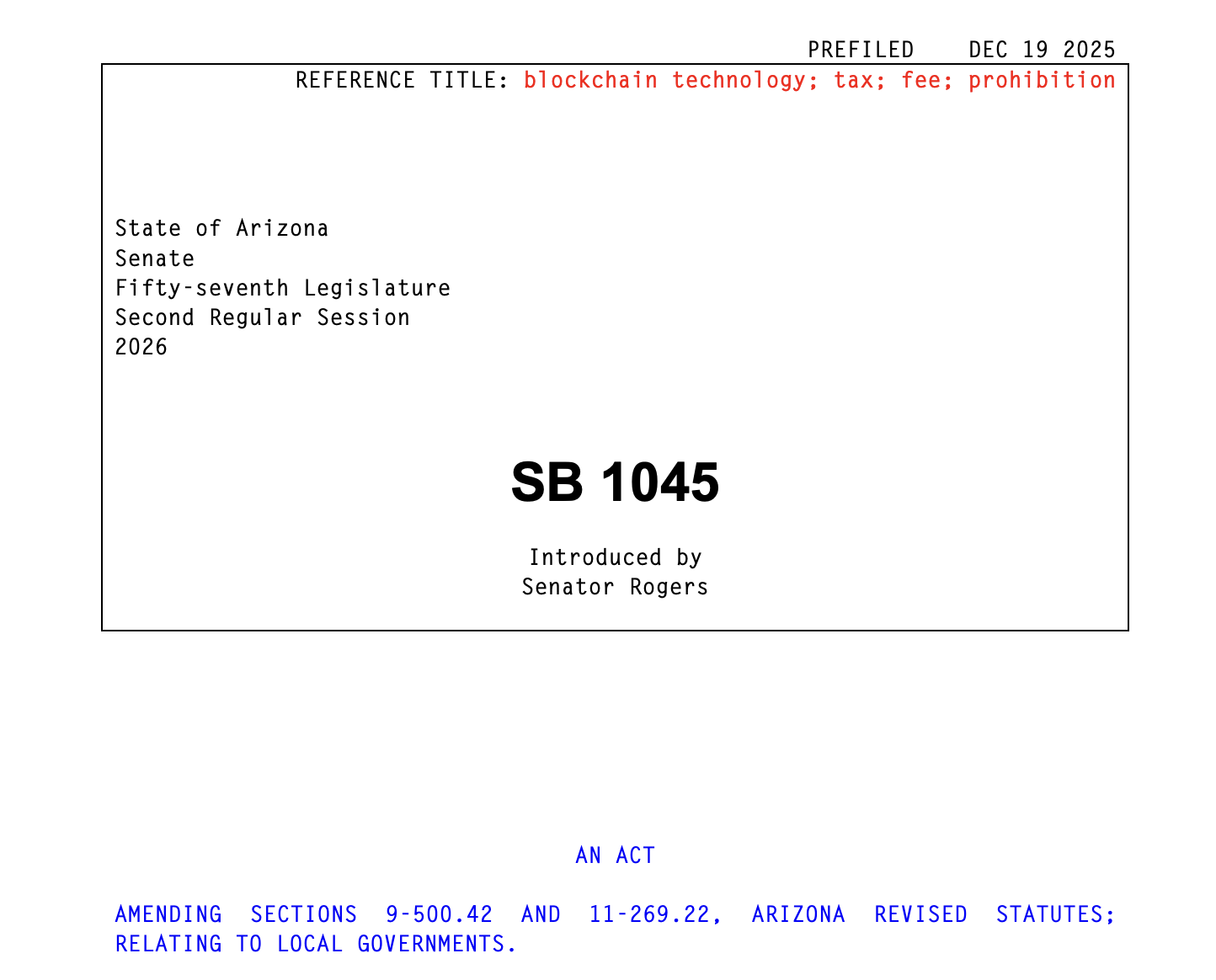
Bill barring cities or towns from taxing blockchain node activity: Source: Arizona legislature

Arizona is one of the few US states that has a law on the books allowing the government to claim ownership of digital assets that have been abandoned for at least three years. The law was part of efforts by crypto advocates to establish a digital asset reserve in Arizona, but there are other proposals to give the state more authority to invest in cryptocurrencies like Bitcoin (BTC).

Related: New Hampshire governor signs crypto reserve bill into law

Rogers was one of the co-sponsors of a Bitcoin reserve bill vetoed by Arizona Governor Katie Hobbs in May. The senator condemned the move and said she would refile the bill during the next session. Cointelegraph reached out to Rogers for comment but had not received a response at the time of publication.

US states adopt crypto reserve bills, different digital asset policies

Arizona remains one of the few US states with a law establishing a digital asset reserve, along with New Hampshire and Texas. Although some lawmakers in other states have been attempting to gather support for similar bills, there are also many suggesting a different approach to digital asset taxation.

For example, Ohio’s House of Representatives passed a bill that could exempt crypto transactions under $200 from the state’s capital gain taxes. The legislation does not appear to have advanced since June.

New York Assemblymember Phil Steck proposed adding a 0.2% excise tax on “digital asset transactions, including the sale or transfer of digital assets” for the state’s residents. The bill was referred to the ways and means committee and did not appear to have advanced since August.

At the federal level, Wyoming Senator Cynthia Lummis submitted a draft bill in July proposing a de minimis exemption for digital asset transactions and capital gains of $300 or less. Lummis announced on Friday that she would retire from the US Senate in January 2027.

Magazine: When privacy and AML laws conflict: Crypto projects’ impossible choice

İlgili Sorular

QWhat are the three legislative actions proposed by Arizona state Senator Wendy Rogers regarding digital assets?

ASenator Wendy Rogers proposed two bills and one resolution: SB 1044 to exempt virtual currency from taxation, SB 1045 to bar counties, cities, and towns from taxing or fining blockchain node operators, and SCR 1003 to amend the state's constitution to clarify property tax rules for digital assets.

QWhich of Senator Rogers' proposals would require a vote by Arizona voters in the 2026 general election?

AThe crypto tax bill (SB 1044) and the resolution to amend the state constitution (SCR 1003) would require a vote by Arizona voters in the November 2026 general election.

QWhat does SB 1045 specifically prohibit local governments in Arizona from doing?

ASB 1045 prohibits cities, towns, and counties in Arizona from imposing a tax or fee on any person running a node on blockchain technology.

QWhich other US states have laws establishing a digital asset reserve, similar to Arizona?

ANew Hampshire and Texas are the other US states that have laws establishing a digital asset reserve, similar to Arizona.

QWhat federal-level proposal did Wyoming Senator Cynthia Lummis make regarding digital asset transactions in July?

AIn July, Wyoming Senator Cynthia Lummis submitted a draft bill proposing a de minimis exemption for digital asset transactions and capital gains of $300 or less at the federal level.

İlgili Okumalar

Google and Amazon Simultaneously Invest Heavily in a Competitor: The Most Absurd Business Logic of the AI Era Is Becoming Reality

In a span of four days, Amazon announced an additional $25 billion investment, and Google pledged up to $40 billion—both direct competitors pouring over $65 billion into the same AI startup, Anthropic. Rather than a typical venture capital move, this signals the latest escalation in the cloud wars. The core of the deal is not equity but compute pre-orders: Anthropic must spend the majority of these funds on AWS and Google Cloud services and chips, effectively locking in massive future compute consumption. This reflects a shift in cloud market dynamics—enterprises now choose cloud providers based on which hosts the best AI models, not just price or stability. With OpenAI deeply tied to Microsoft, Anthropic’s Claude has become the only viable strategic asset for Google and Amazon to remain competitive. Anthropic’s annualized revenue has surged to $30 billion, and it is expanding into verticals like biotech, positioning itself as a cross-industry AI infrastructure layer. However, this funding comes with constraints: Anthropic’s independence is challenged as it balances two rival investors, its safety-first narrative faces pressure from regulatory scrutiny, and its path to IPO introduces new financial pressures. Globally, this accelerates a "tri-polar" closed-loop structure in AI infrastructure, with Microsoft-OpenAI, Google-Anthropic, and Amazon-Anthropic forming exclusive model-cloud alliances. In contrast, China’s landscape differs—investments like Alibaba and Tencent backing open-source model firm DeepSeek reflect a more decoupled approach, though closed-source models from major cloud providers still dominate. The $65 billion bet is ultimately about securing a seat at the table in an AI-defined future—where missing the model layer means losing the cloud war.

marsbit2 saat önce

Google and Amazon Simultaneously Invest Heavily in a Competitor: The Most Absurd Business Logic of the AI Era Is Becoming Reality

marsbit2 saat önce

Computing Power Constrained, Why Did DeepSeek-V4 Open Source?

DeepSeek-V4 has been released as a preview open-source model, featuring 1 million tokens of context length as a baseline capability—previously a premium feature locked behind enterprise paywalls by major overseas AI firms. The official announcement, however, openly acknowledges computational constraints, particularly limited service throughput for the high-end DeepSeek-V4-Pro version due to restricted high-end computing power. Rather than competing on pure scale, DeepSeek adopts a pragmatic approach that balances algorithmic innovation with hardware realities in China’s AI ecosystem. The V4-Pro model uses a highly sparse architecture with 1.6T total parameters but only activates 49B during inference. It performs strongly in agentic coding, knowledge-intensive tasks, and STEM reasoning, competing closely with top-tier closed models like Gemini Pro 3.1 and Claude Opus 4.6 in certain scenarios. A key strategic product is the Flash edition, with 284B total parameters but only 13B activated—making it cost-effective and accessible for mid- and low-tier hardware, including domestic AI chips from Huawei (Ascend), Cambricon, and Hygon. This design supports broader adoption across developers and SMEs while stimulating China's domestic semiconductor ecosystem. Despite facing talent outflow and intense competition in user traffic—with rivals like Doubao and Qianwen leading in monthly active users—DeepSeek has maintained technical momentum. The release also comes amid reports of a new funding round targeting a valuation exceeding $10 billion, potentially setting a new record in China’s LLM sector. Ultimately, DeepSeek-V4 represents a shift toward open yet realistic infrastructure development in the constrained compute landscape of Chinese AI, emphasizing engineering efficiency and domestic hardware compatibility over pure model scale.

marsbit3 saat önce

Computing Power Constrained, Why Did DeepSeek-V4 Open Source?

marsbit3 saat önce

İşlemler

Spot
Futures
活动图片