Arizona AG Alerts Seniors on ATM Scams: How LiquidChain ($LIQUID) Solves Security

bitcoinist2026-02-03 tarihinde yayınlandı2026-02-03 tarihinde güncellendi

Özet

Arizona Attorney General Kris Mayes has issued a warning about a rise in cryptocurrency ATM scams targeting seniors, where fraudsters pose as officials and trick victims into depositing cash into Bitcoin kiosks. These scams exploit the irreversible nature of blockchain transactions and the complexity of current crypto infrastructure. LiquidChain ($LIQUID) is presented as a solution through its Layer 3 protocol, which unifies liquidity across Bitcoin, Ethereum, and Solana into a single execution environment. By eliminating the need for complex bridging and wrapped assets, it reduces transaction steps and potential points of failure. The platform aims to enhance security and usability, offering simplified cross-chain interactions and verifiable settlement. Its architecture is designed to lower fraud risks by streamlining user experience and providing a more transparent, secure DeFi environment.

The warnings from Arizona are becoming increasingly urgent.

Attorney General Kris Mayes issued a stark alert regarding a surge in cryptocurrency ATM scams targeting older adults, a predatory trend that exploits the irreversible nature of blockchain transactions.

According to the AG’s Office, scammers are posing as government officials or tech support agents. They then direct victims to deposit cash into physical Bitcoin kiosks under the guise of ‘protecting’ their savings.

It exposes a critical vulnerability in the current crypto on-ramp infrastructure: the lack of safety guardrails for non-technical users. Once cash is fed into a kiosk and converted to crypto in a scammer’s wallet, the funds are effectively gone.

The technological barrier to entry, combined with high-pressure social engineering, creates a perfect storm for fraud. While state regulators launch reporting tools and public awareness campaigns, the deeper issue lies in the complexity of the current blockchain landscape.

When users are forced to navigate confusing interfaces and fragmented networks, security risks compound. The solution might not just be better education, but better underlying infrastructure that simplifies execution.

That’s the precise operational gap LiquidChain ($LIQUID) aims to fill by rethinking how liquidity moves across the blockchain ecosystem.

Fragmented Liquidity Creates Vectors For Exploitation

The scams plaguing Arizona seniors often rely on the opacity of moving funds between different silos. Frankly, the current DeFi landscape is a mess. Liquidity is fragmented across Bitcoin, Ethereum, and Solana. Jumping between these chains usually requires complex bridging, wrapped assets, and multiple transaction steps.

Each step introduces friction and a potential point of failure where malicious actors can confuse users.

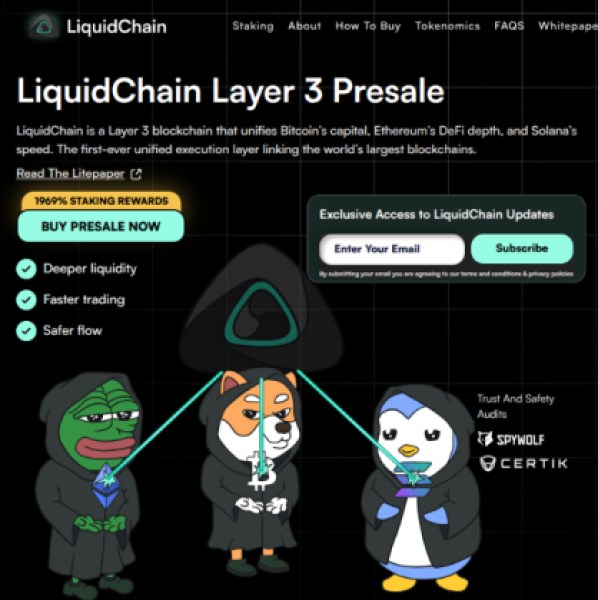
LiquidChain ($LIQUID) tackles this fundamental flaw by functioning as a Layer 3 (L3) infrastructure that fuses Bitcoin, Ethereum, and Solana liquidity into a single execution environment. By creating a Unified Liquidity Layer, the protocol eliminates the need for risky wrapped assets or convoluted bridge transfers.
Source: LiquidChain

For a user or developer, this means Single-Step Execution. The data suggests that reducing the number of ‘hops’ a transaction must take drastically lowers the surface area for errors.

The project’s ‘Deploy-Once Architecture’ allows developers to build applications accessing users and liquidity from all three major chains simultaneously. Instead of a disjointed system where funds can easily disappear into the ether of a complex bridge, LiquidChain offers a cohesive environment.

This consolidation is critical. By streamlining the user flow, the protocol removes the technical obfuscation that scammers often hide behind.

EXPLORE THE LIQUIDCHAIN ECOSYSTEM.

LiquidChain L3 Protocol Enhances Verifiable Settlement

Beyond simplification, the core security proposition of LiquidChain lies in its status as a Layer 3 protocol. Layer 1s (like Bitcoin) provide security, and Layer 2s handle scaling. But L3s? That’s where the magic happens, application-specific layers where custom logic and verifiable settlement occur.

The project utilizes a Cross-Chain VM (Virtual Machine) designed to handle the intricacies of multi-chain settlement without forcing the user to manage distinct wallets for every network.

This infrastructure is powered by the $LIQUID token, which serves as the primary transaction fuel for the network. Unlike legacy systems, where value transfer is opaque, the LiquidChain model emphasizes verifiable settlement.

For institutional participants (and savvy retail traders), this transparency is non-negotiable. The protocol also introduces Liquidity Staking, incentivizing users to secure the network while earning rewards, creating a deeper economic alignment between network security and user participation.

We’re seeing a clear shift in the market away from ‘wild west’ infrastructure toward compliant, transparent execution layers.

With Developer Grants available to encourage secure application building, the ecosystem is positioning itself as a hub for the next generation of safe, cross-chain DeFi. If you’re watching the infrastructure thesis, $LIQUID represents a bet on the convergence of major chains into a safer, more usable whole.

VISIT THE OFFICIAL LIQUIDCHAIN ($LIQUID) PRESALE SITE.

This article is for informational purposes only and does not constitute financial advice. Cryptocurrency investments, including presales and new protocols like LiquidChain, carry significant market risk and volatility. Always conduct independent research.


İlgili Sorular

QWhat is the main warning issued by Arizona Attorney General Kris Mayes regarding cryptocurrency?

AArizona Attorney General Kris Mayes issued a warning about a surge in cryptocurrency ATM scams targeting older adults, where scammers pose as government officials or tech support to trick victims into depositing cash into Bitcoin kiosks.

QHow does LiquidChain ($LIQUID) aim to address security vulnerabilities in the current crypto infrastructure?

ALiquidChain ($LIQUID) addresses security vulnerabilities by functioning as a Layer 3 infrastructure that unifies liquidity from Bitcoin, Ethereum, and Solana into a single execution environment, eliminating the need for risky wrapped assets or complex bridge transfers and reducing points of failure.

QWhat is the 'Deploy-Once Architecture' mentioned in the context of LiquidChain?

AThe 'Deploy-Once Architecture' allows developers to build applications that can access users and liquidity from Bitcoin, Ethereum, and Solana simultaneously, creating a cohesive environment instead of a fragmented system.

QWhat role does the $LIQUID token play in the LiquidChain ecosystem?

AThe $LIQUID token serves as the primary transaction fuel for the LiquidChain network, powering its cross-chain virtual machine and enabling verifiable settlement, while also supporting liquidity staking to incentivize network security.

QHow does LiquidChain's approach reduce the risk of scams like those targeting seniors in Arizona?

ALiquidChain reduces scam risks by streamlining user flow through single-step execution and a unified liquidity layer, which removes technical obfuscation and complex transaction steps that scammers often exploit to confuse users.

İlgili Okumalar

Claude Code Introduces Dynamic Workflows: Enabling AI to Form Teams and Collaborate

Claude Code introduces dynamic workflows, enabling AI to coordinate teams of specialized agents for complex tasks. This transforms Claude from a code assistant into a programmable workbench. Workflows address key limitations of single-agent systems: agentic laziness (premature task completion), self-preferential bias (favoring own outputs), and goal drift (losing sight of original objectives). The system allows Claude to dynamically create execution frameworks using JavaScript. It can split tasks, dispatch parallel agents for isolated work (e.g., in separate worktrees), implement adversarial validation, run tournaments, and synthesize results. This multi-agent approach is valuable for tasks requiring deep research, factual verification, code migration, root cause analysis, large-scale triage, and qualitative sorting. Key patterns include: classify-and-route, fan-out-and-synthesize, adversarial verification, generate-and-filter, tournaments, and loop-until-done. While token usage is higher, workflows excel where tasks resemble programming—needing problem decomposition, isolated context, hypothesis testing, and handling many details. They extend Claude Code's utility beyond technical work to areas like business plan review, resume screening, and naming brainstorm. The feature is not a universal solution but points to a future where AI tool competitiveness depends on organizing reliable, reusable, and auditable execution flows for complex goals.

marsbit12 dk önce

Claude Code Introduces Dynamic Workflows: Enabling AI to Form Teams and Collaborate

marsbit12 dk önce

Hyperliquid, Wall Street's 24/7 Trading Convenience Store

Hyperliquid: The 24/7 Trading "Convenience Store" for Wall Street Hyperliquid, a decentralized cryptocurrency exchange, has become a go-to platform for Wall Street traders seeking to trade around the clock, especially during traditional market closures. Founded by Jeff Yan, a former quantitative trader, after the FTX collapse, the platform emphasizes user self-custody of assets. It offers a wide range of perpetual contracts—leveraged derivatives with no expiry—on assets from Bitcoin and crude oil to the S&P 500 and even pre-IPO companies like SpaceX. A notable example involves a hedge fund trader who capitalized on geopolitical news over a weekend, securing a 243% return on oil derivatives before markets reopened. The platform, run by just 11 employees, generated approximately $800 million in revenue last year, and its native token HYPE has seen significant growth. Its rise highlights the merging of traditional finance and crypto. While U.S. users are currently restricted, recent CFTC rule changes could open access. The platform is known for its transparency, having processed $10 billion in liquidations during a market crash while competitors faltered. Regulators warn of the high risks and complexity of perpetual contracts for retail investors. Key to its appeal is a strong community culture, direct engagement with founders, and a simple interface. Despite rules against VPN use, it attracts global users with its permissionless approach. Hyperliquid plans to expand into prediction markets and options, aiming to eventually host all financial activity.

marsbit13 dk önce

Hyperliquid, Wall Street's 24/7 Trading Convenience Store

marsbit13 dk önce

Who Funds the Agents?

**Summary: Who Funds AI Agents?** OpenAI recently shut down a feature allowing AI agents to shop for users, highlighting the challenge of creating a secure and regulated environment for agent-driven transactions. While payment infrastructure exists, a crucial governance layer—defining spending limits, fraud detection, tax handling, and return policies—is largely missing. The potential is enormous: AI agents already processed $73M across 176M transactions last year, with McKinsey forecasting this could grow to $3-5T in global consumer commerce by 2030. The core competition isn't just about processing payments, which can be very cheap (especially with crypto-based settlement), but about controlling the rules that govern agent spending. Key players like Stripe and Coinbase are racing to dominate this governance layer. Stripe's acquisition of wallet provider Privy allows it to set spending policies, identity checks, and human-in-the-loop approvals directly at the wallet level. Similarly, Coinbase's stack, including its x402 protocol and AgentKit, embeds governance rules. This vertical integration across settlement, wallet, and governance layers is becoming the dominant strategy. Control over the governance layer is where significant future value lies. If agents handle trillions in transactions, even a small fee for managing compliance, fraud prevention, and policy enforcement could generate billions in annual revenue. The companies that successfully integrate across the payment stack will capture value from idle agent balances, transaction fees, and governance services, positioning themselves as the foundational banks of the AI agent economy.

marsbit40 dk önce

Who Funds the Agents?

marsbit40 dk önce

İşlemler

Spot
Futures
活动图片