Arbitrum Pretends to Be the Hacker, 'Steals' Back the Money Lost by KelpDAO

marsbit2026-04-21 tarihinde yayınlandı2026-04-21 tarihinde güncellendi

Özet

Title: Arbitrum Poses as Hacker to Recover Stolen Funds from KelpDAO Last week, KelpDAO suffered a hack resulting in nearly $300 million in losses, marking the largest DeFi security incident this year. Approximately 30,765 ETH (worth over $70 million) remained on an Arbitrum address controlled by the attacker. In an unprecedented move, Arbitrum’s Security Council utilized its emergency authority to upgrade the Inbox bridge contract, adding a function that allowed them to impersonate the hacker’s address and initiate a transfer without access to its private key. The council’s action, approved by 9 of its 12 members, moved the stolen ETH to a frozen address in a single transaction before reverting the contract to its original state. The operation was coordinated with law enforcement, which attributed the attack to North Korea’s Lazarus Group. Community reactions are divided: some praise the recovery of funds, while others question the centralization of power, as the council can upgrade core contracts without governance votes. However, such emergency mechanisms are common among major L2s. Despite the partial recovery, over $292 million was stolen in total, with more than $100 million in bad debt on Aave and remaining funds scattered across other chains. The incident highlights escalating security challenges in DeFi, with state-sponsored hackers employing advanced tactics and L2s responding with elevated countermeasures.

Author: Deep Tide TechFlow

Last week, KelpDAO was hacked for nearly $300 million, making it the largest negative security incident in DeFi so far this year.

The stolen ETH is now scattered across multiple chains, with approximately 30,765 ETH remaining in an address on the Arbitrum chain, worth over $70 million.

Just when everyone thought the story was over, a sequel emerged today.

According to on-chain security firm PeckShield, the funds in the hacker's address on the Arbitrum chain were transferred out a few hours ago. Strangely, the funds were moved to a bizarre address that appears to be almost all zeros: 0x00000...
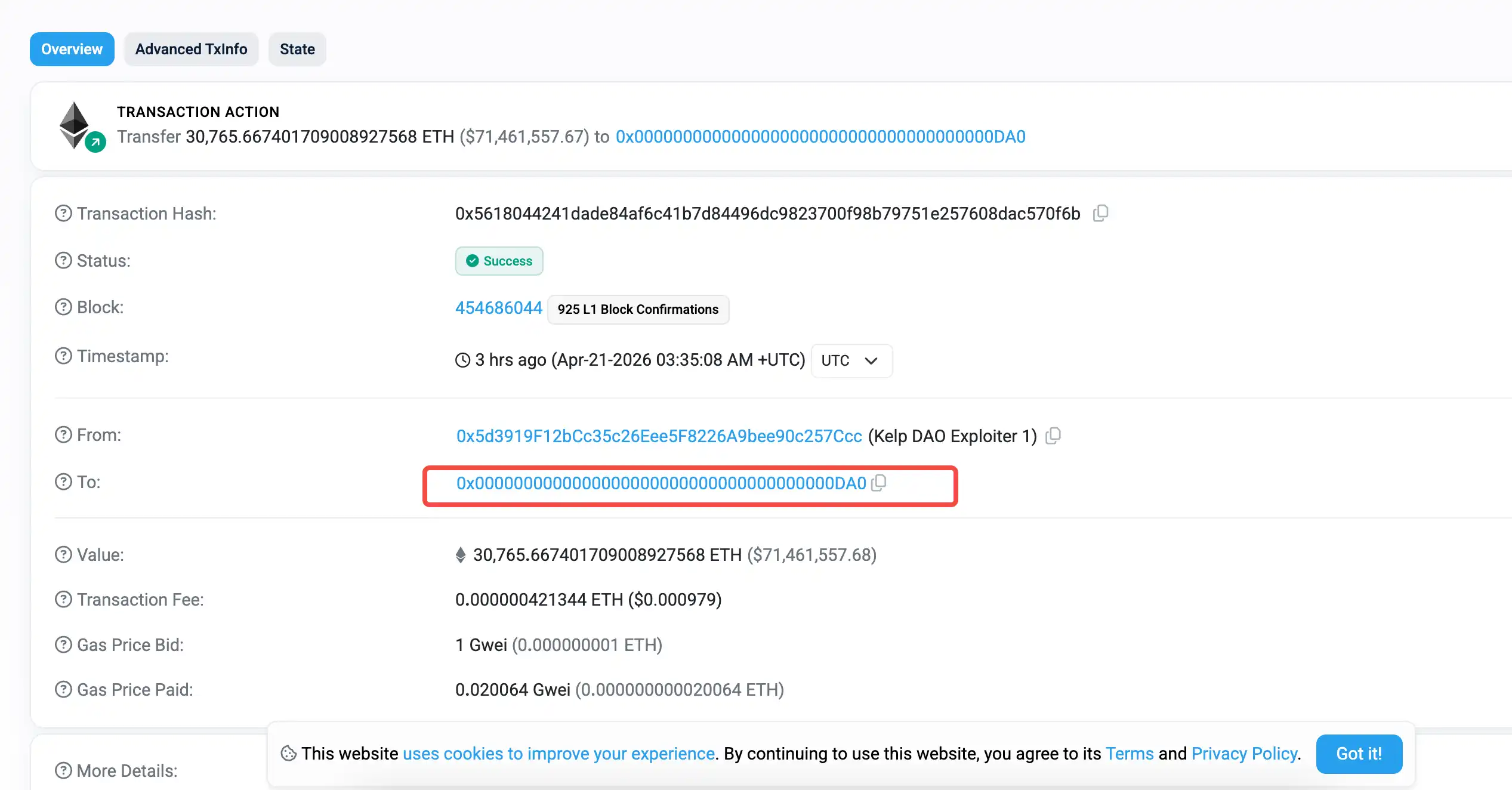
Everyone was speculating: Did the hacker burn the funds by sending them to a black hole address? Or did they have a change of heart or get recruited?

Neither.

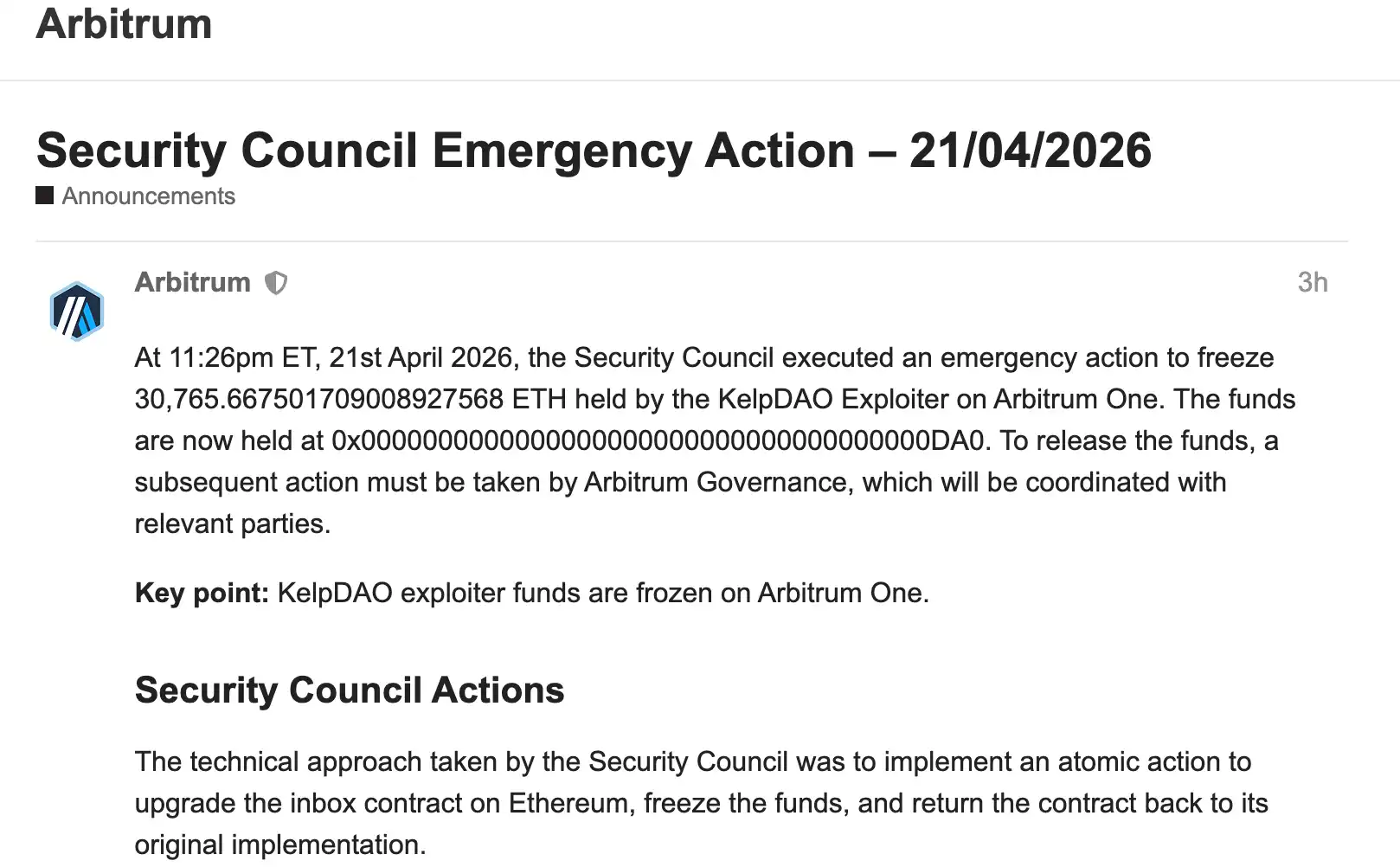
A few hours ago, the Arbitrum official forum posted an emergency action announcement explaining the situation. The hacker's funds were transferred by the Arbitrum Security Council.

However, the remarkable part is that without knowing the private key of the hacker's address, the Arbitrum Council neither froze the funds nor had the authority to transfer them. Instead, they directly issued a transfer instruction "in the name of the hacker."

The hacker was unaware, the private key was not leaked, and the on-chain records made it look like the hacker had performed the operation themselves.
The principle behind this operation is that all cross-chain messages between Arbitrum and Ethereum must pass through a bridge contract called Inbox. The Security Council used its emergency authority to temporarily upgrade this contract, adding a new function:

It allows sending cross-chain transactions in the name of any wallet address, without needing that wallet's private key.

They then used this function to forge a message, with the sender field filled as the hacker's wallet, and the content being "Transfer all my ETH to the frozen address." The Arbitrum chain received it and executed it as usual, resulting in the bizarre scene captured in the on-chain transfer screenshot above.

After transferring the hacker's funds, the contract was immediately downgraded back to its original version. The upgrade, forgery, transfer, and restoration were all completed within a single Ethereum transaction. Other users and applications were completely unaffected.

This operation is unprecedented in Arbitrum's history.

According to the forum announcement, the Security Council first confirmed the hacker's identity with law enforcement, pointing to North Korea's Lazarus Group, the most active state-level hacker organization in the DeFi space this year. The council conducted a technical assessment to ensure it would not affect other users before taking action.

Since the hacker was in the wrong first, this move carries a bit of a "don't blame us for not playing by the rules" sentiment. As for the subsequent handling of the frozen ETH, it will go through Arbitrum's DAO governance vote and be coordinated with law enforcement.

Recovering over $70 million in stolen funds is undoubtedly a good thing. But it's worth noting the prerequisite for achieving this: 9 out of the 12 members of the Security Council can sign to bypass all governance votes and upgrade any core on-chain contract with zero delay.

Praising the Outcome, Worrying about the Capability?

Currently, the community's reaction is divided.

Some think Arbitrum did a great job, protecting assets at a critical moment, which actually adds a bit of confidence in L2. Others ask a very direct question: If 9 people can sign to move any asset in anyone's name, can this still be called decentralization?

In my opinion, the two sides are actually talking about different things.

The former is talking about the result, the latter is talking about the capability. The result of this incident is certainly good—over $70 million in stolen funds was recovered. But the capability demonstrated by Arbitrum this time—to modify contract functions via multi-sig—is neutral in itself; what it is used for in the future, whether it can be used, and how it is used, all actually depend on the council's governance.

However, for most people using Arbitrum, this discussion might be less relevant than another fact. Arbitrum is not special; currently, almost all mainstream L2s retain similar emergency upgrade permissions.

The chain you are using most likely also has a similar Security Council with similar capabilities. This is not a unique choice by Arbitrum; it's almost a universal design for L2s at this stage.

Looking at it from another angle, this offensive and defensive battle actually reveals a bigger picture.

The attacker is North Korea's Lazarus Group, attributed to at least 18 DeFi attacks since the beginning of this year. Just three weeks ago, they stole $285 million from Drift Protocol using a completely different method.

On one side, state-level hackers are constantly upgrading their attack methods; on the other, L2s are starting to use underlying permissions to fight back. The security war in DeFi is entering a new stage, moving beyond "post-incident freezes, on-chain shouting, and praying for white hats to intervene."

In extraordinary times, they created a master key to open the hacker's address, and melted the key after use. Just judging by this incident alone, having the capability to respond to hacker attacks is not a bad thing.

And if we must elevate this to a philosophical discussion about "this is not decentralized at all," then there are many more things to talk about. The crypto industry has no shortage of centralized operations. This time, at least, it was handling a negative incident and solving a problem, not creating one.

Looking back more pragmatically, KelpDAO was robbed of $292 million, and only over $70 million was recovered—less than a quarter of the total. The remaining ETH is still scattered on other chains. Over $100 million in bad debt on Aave remains unresolved, and it's still unknown how much rsETH holders will get back.

Even though Arbitrum invoked god-like permissions, this battle is clearly far from over.

İlgili Sorular

QWhat was the approximate value of the ETH stolen from KelpDAO that remained on the Arbitrum chain?

AOver $70 million worth of ETH, specifically 30,765 ETH, remained on the Arbitrum chain.

QHow did the Arbitrum Security Council manage to move the hacker's funds without the private key?

AThe Security Council used its emergency powers to temporarily upgrade the Inbox bridge contract, adding a new function that allowed them to forge a cross-chain message that appeared to be from the hacker's address, instructing the transfer of all ETH to a frozen address.

QWhich hacker organization was identified as being responsible for the attack on KelpDAO?

AThe attack was attributed to the North Korean state-backed hacker group, Lazarus Group.

QWhat is a major concern raised by the community regarding the Arbitrum Security Council's action?

AA major concern is that the action demonstrates a lack of decentralization, as 9 out of 12 council members can sign to upgrade any core contract and move any assets without a governance vote.

QWhat percentage of the total stolen funds from KelpDAO was recovered through this action on Arbitrum?

ALess than a quarter of the total stolen funds were recovered. The action recovered roughly $70 million of the total $292 million stolen.

İlgili Okumalar

The Value Distribution of Stablecoins

**Summary: The Value Distribution of Stablecoins** The article argues that stablecoins are evolving from mere trading tools into broader channels for dollar access. It divides the stablecoin ecosystem into four layers to analyze how value is distributed: 1. **Issuance Layer:** Mints stablecoins, holds reserve assets, and captures the spread between reserve yield and user costs (e.g., Tether, Circle). This layer currently earns the largest profit margin. 2. **Infrastructure Layer:** Connects stablecoins to the traditional financial system, handling fiat on/off-ramps, banking integration, compliance (KYC/AML), and asset management (e.g., Bridge, BVNK). This is the "unglamorous" but critical work, building the essential bridges between crypto and real-world finance. 3. **Acquiring/Distribution Layer:** Integrates stablecoins into merchant systems, manages payment flows, and provides enterprise financial software (e.g., Stripe, Coinbase). They act as the access point for businesses. 4. **Application Layer:** The end-users and businesses that ultimately use stablecoins for payments, settlements, or as a store of value. They benefit from convenience but have little pricing power. The core thesis is that while the issuance layer currently dominates profits, the often-overlooked **infrastructure layer holds significant long-term potential**. The real challenge and barrier to mass adoption is not the on-chain transfer of stablecoins (which is simple), but the complex "last mile" integration into existing business workflows, banking systems, and regulatory frameworks across different countries. Companies in this layer are currently in a "land grab" phase, investing heavily to build networks, secure bank partnerships, and establish compliance pathways. While their position is currently pressured by the profitable issuers above and distribution platforms below, the article suggests that if stablecoins become a default financial rail for businesses, the infrastructure providers who have done the hard work of integration will ultimately gain strong pricing power and become entrenched, essential players.

marsbit5 saat önce

The Value Distribution of Stablecoins

marsbit5 saat önce

The Value Distribution of Stablecoins

The Value Distribution of Stablecoins The article argues that stablecoins are evolving from a mere trading tool into a broad "dollar channel." It analyzes the industry's value chain through four layers: 1. **Issuance Layer (e.g., Tether, Circle):** The top layer that mints stablecoins, holds reserve assets, and captures the thickest interest rate spread. 2. **Infrastructure Layer (e.g., Bridge, BVNK):** Connects stablecoins to the traditional financial system, handling critical but complex "dirty work" like fiat on/off-ramps, banking integration, compliance (KYC/AML), and cross-border settlement. 3. **Acquiring/Distribution Layer (e.g., Stripe, Coinbase):** Embeds stablecoins into merchant systems, manages payment flows, and integrates with enterprise software. 4. **Application Layer:** End-users and businesses that ultimately use stablecoins for payments, settlement, or storing value. The author posits that while the issuance layer currently captures the most profit, the most overlooked and potentially critical layer is infrastructure. The core challenge for stablecoin adoption isn't the on-chain transfer (which is simple), but bridging the gap between blockchain and the real-world financial system. This involves solving practical problems for businesses: fiat conversion, reconciliation, tax handling, and user onboarding. Infrastructure companies are currently in a difficult "land-grab" phase—building networks, securing banking relationships, and achieving compliance country-by-country. They face pressure from both the profitable issuance layer above and distribution platforms below. However, the author suggests this layer is building a crucial moat. Once stablecoins become a default business rail, the infrastructure players who have done the hard work of integration may gain significant, durable value and pricing power.

链捕手5 saat önce

The Value Distribution of Stablecoins

链捕手5 saat önce

İşlemler

Spot
Futures
活动图片