Aptos introduces post-quantum signatures before they’re urgently needed

cointelegraph2025-12-18 tarihinde yayınlandı2025-12-18 tarihinde güncellendi

Özet

Aptos is advancing a proposal to introduce post-quantum digital signatures as an optional security upgrade, addressing growing concerns that future quantum computers could eventually break current cryptographic systems. The Aptos Improvement Proposal AIP-137 would integrate the SLH-DSA (FIPS 205) signature scheme at the account level, making Aptos one of the first major blockchains to natively support quantum-resistant accounts. Existing accounts would remain unchanged, and adoption would be opt-in. This move reflects broader industry attention to quantum risks, with other networks like Solana also testing quantum-resistant solutions. While some in the crypto space, including Bitcoin pioneers, view the quantum threat as distant or overhyped, Aptos and others are taking proactive steps to prepare for a post-quantum era.

Blockchain network Aptos is moving toward a post-quantum signature option, reflecting growing concern that advances in quantum computing are no longer purely theoretical and could eventually affect how blockchain networks secure accounts and transactions.

On Thursday, Aptos outlined a proposal to introduce post-quantum signatures, addressing the network’s reliance on digital signatures for ownership, transaction authorization and overall security.

While existing cryptographic schemes remain secure against classical computers, researchers warn that sufficiently powerful quantum machines could one day forge them, potentially compromising account security retroactively.

“Quantum computing is not a distant spectre anymore,” Aptos Labs wrote in a post on X, pointing to early discussions around quantum scaling by IBM and growing regulatory momentum, including the publication of post-quantum cryptography standards by the US National Institute of Standards and Technology (NIST).

“This matters for networks like Aptos because Cryptographically Relevant Quantum Computers (CRQCs) can make today’s signature schemes forgeable, possibly breaking security models,” the post said.

In response, developers have proposed AIP-137, an Aptos Improvement Proposal authored by cryptographers at Aptos Labs, which would add support for a post-quantum signature scheme at the account level.
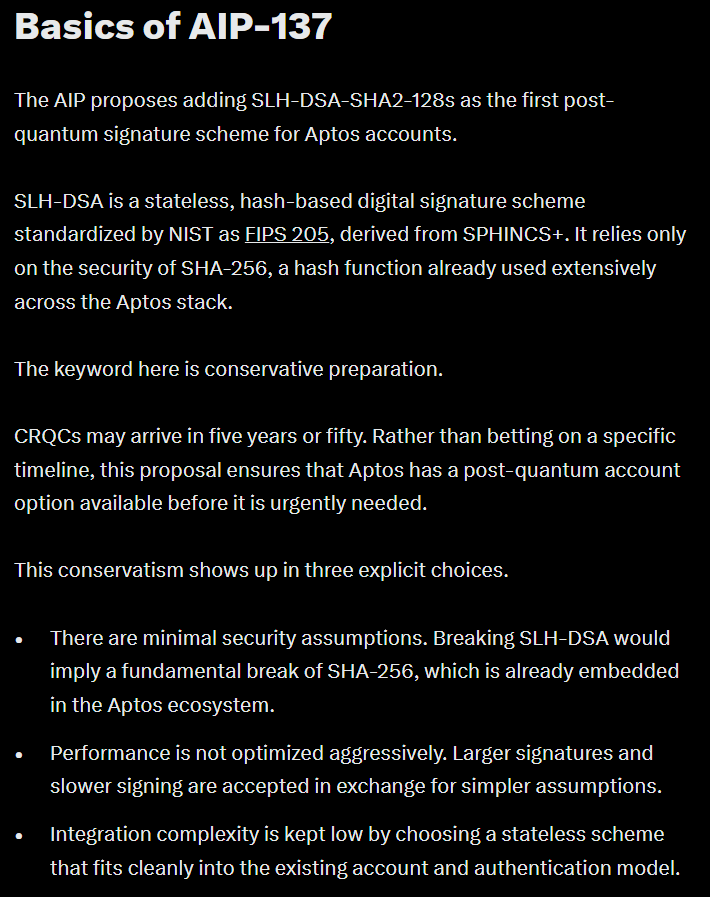
Source: Aptos Labs

If approved through governance, AIP-137 would introduce SLH-DSA, a hash-based digital signature scheme standardized as FIPS 205, as an optional account signature type. The change would make Aptos one of the earliest production blockchains to natively support post-quantum accounts.

However, existing accounts would remain unaffected. Post-quantum accounts would be opt-in only, allowing users to adopt selectively.

Aptos is one of the larger layer-1 proof-of-stake blockchains, designed primarily to support decentralized applications. Earlier this year, its head of ecosystem, Ash Pampati, told Cointelegraph that consumer-focused applications were gaining traction on the network, particularly those blending elements of Web2 and Web3.

As Cointelegraph previously reported, Aptos has also emerged as a venue for tokenized real-world assets, with asset managers including Franklin Templeton and BlackRock deploying products on the network.

Related: Google announces quantum advantage, 13,000 times faster than supercomputers

The race against quantum

While many in the crypto industry argue that quantum threats to blockchains, particularly Bitcoin, remain years away, networks are increasingly taking preparatory steps, with Aptos far from alone in doing so.

Earlier this month, Solana tested quantum-resistant transactions on a dedicated testnet, an experiment aimed at evaluating how post-quantum signature schemes could be integrated into its transaction model without disrupting existing accounts.

Within the Bitcoin community, a smaller but vocal group of developers, researchers and fund managers has also begun pushing for faster progress on quantum-resistant cryptography.

Some have rallied around BIP-360, a proposed Bitcoin Improvement Proposal that would introduce quantum-resistant signature options. However, the idea remains in its early stages and is subject to debate.
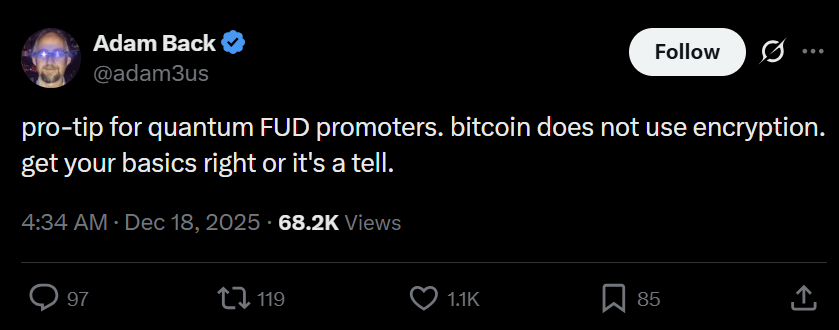
Source: Adam Back

Others, including early Bitcoin figure Adam Back, have dismissed near-term quantum concerns as a form of fear, uncertainty and doubt, or FUD, arguing that Bitcoin does not rely on encryption for its core security model. Instead, Bitcoin uses digital signature schemes and cryptographic hash functions, which are not imminently threatened by practical quantum computers.

Related: Are quantum computers stealing Bitcoin? Inside Josh Mandell’s claim and the pushback


İlgili Sorular

QWhat is the main reason Aptos is introducing post-quantum signatures?

AAptos is introducing post-quantum signatures due to growing concern that advances in quantum computing could eventually compromise the network's security by making today's digital signature schemes forgeable.

QWhat specific proposal has Aptos Labs put forward for post-quantum signatures?

AAptos Labs has proposed AIP-137, which would add support for the SLH-DSA (FIPS 205) hash-based digital signature scheme as an optional account signature type.

QWill existing Aptos accounts be automatically upgraded to post-quantum security?

ANo, existing accounts will remain unaffected. The post-quantum account option will be opt-in only, allowing users to adopt it selectively.

QBesides Aptos, which other blockchain network has recently tested quantum-resistant technology?

ASolana tested quantum-resistant transactions on a dedicated testnet earlier this month to evaluate integration of post-quantum signature schemes.

QWhat is the name of the proposed Bitcoin Improvement Proposal for quantum resistance mentioned in the article?

AThe proposed Bitcoin Improvement Proposal for quantum-resistant signature options is BIP-360.

İlgili Okumalar

When AI Begins to Audit the World: From Claude Discovering the ZEC Vulnerability, Watching the Encryption Industry Enter the 'Recursive Security Era'

**When AI Audits the World: From Claude's Discovery of a ZEC Vulnerability, Viewing the Crypto Industry Entering a "Recursive Security Era"** This article examines a pivotal shift in the blockchain security landscape, triggered by the convergence of two events: Anthropic's research on AI's "Recursive Self-Improvement" and Claude Opus 4.8's discovery of a critical vulnerability in Zcash's code. Traditionally, crypto security has relied on human experts and automated tools for periodic audits. However, the article argues AI is transitioning from a mere tool to an active participant in understanding and analyzing complex systems. Claude's ability to identify a subtle flaw in Zcash's zero-knowledge proof system demonstrates AI's potential to dramatically lower the cost and time required for risk discovery. This goes beyond finding a single bug; it signals a change in the very mechanism of how vulnerabilities are found. The core thesis introduces the concept of "Recursive Security," drawing a parallel to Anthropic's "Recursive Self-Improvement." Just as AI can accelerate its own development through feedback loops, security systems are evolving towards a continuous cycle of analysis, risk identification, remediation, and re-analysis. Security is becoming a persistent, evolving capability integrated into a system's lifecycle, rather than a one-time pre-launch audit. This shift is particularly urgent for the crypto industry, where system complexity from Layer-2 networks, modular architectures, and ZK-proofs is growing faster than human analysis capacity. AI excels at the pattern recognition and contextual understanding needed to navigate this complexity. Importantly, the article cautions that AI augments both defenders and potential attackers, accelerating the entire threat landscape. The future competitive advantage may not lie in having zero vulnerabilities, but in having the fastest risk discovery, validation, and response capabilities. The Claude-Zcash incident is thus an early signal of an era where AI-driven, recursive security systems become essential for managing risk in an increasingly complex digital world.

marsbit1 saat önce

When AI Begins to Audit the World: From Claude Discovering the ZEC Vulnerability, Watching the Encryption Industry Enter the 'Recursive Security Era'

marsbit1 saat önce

From MSTR to STRC+: Where Is the Limit of the Strategy Universe?

From MSTR to STRC+: The Evolution and Limits of the Strategy Universe This article examines the transformation of Strategy (formerly MicroStrategy) from a simple "Bitcoin treasury" company into a complex financial engineering firm building a BTC-backed credit system. **Core Thesis:** Strategy's true significance lies not just in its massive BTC holdings (~844k BTC), but in its attempt to transform this static reserve into a multi-layered credit curve within traditional capital markets and, subsequently, into on-chain yield infrastructure. **The MSTR Flywheel:** The initial model was a reflexive loop: BTC price rises → MSTR stock rises → company raises capital (debt/equity) at a premium → buys more BTC → increases per-share BTC exposure → MSTR premium grows. This "amplified Bitcoin" equity (MSTR) thrives on bullish momentum but is vulnerable to tightening premiums and rising funding costs. **Building the Credit Curve:** Strategy's innovation is slicing its single BTC balance sheet into different risk/return profiles via specialized securities: * **MSTR:** High-volatility equity layer absorbing full BTC upside/downside. * **STRC:** Key product. A perpetual preferred stock designed as "short duration high yield credit," offering ~11.5% floating monthly dividends. It attracts fixed-income investors seeking yield without direct BTC exposure, funding Strategy's operations. * **STRD/STRK/STRF:** Other preferred/share classes with varying durations, conversion rights, and fixed dividends. **Risks of the STRC Model:** STRC's high yield is not risk-free. Its stability depends on: 1) Sufficient BTC asset coverage, 2) Strategy's continued ability to pay dividends, and 3) Market faith in the MSTR/STRC funding flywheel. Stress points include deep BTC price declines eroding the asset buffer, rising dividend costs if STRC trades below par, and a broken flywheel if MSTR's premium (mNAV) falls persistently. **On-Chain Expansion: STRC+:** Projects like **Saturn** and **Apyx** aim to package STRC's (and other DAT preferred stock) cash flows into on-chain stablecoin yield (e.g., sUSDat, apyUSD). They offer DeFi a new yield source distinct from trading fees or incentives—cash dividends from traditional securities. However, this introduces compounded risks: off-chain custody, issuer credit risk, BTC volatility, and protocol execution risk. **Conclusion: The Ultimate Boundary** Strategy's endgame is not infinite BTC accumulation. It is the market's long-term acceptance of a new credit system where BTC serves as collateral for tradable securities whose cash flows can power on-chain financial applications. Its "universe" expands if this BTC-native credit curve gains legitimacy, but contracts if these instruments are repriced purely as high-risk, yield-bearing credit assets without stablecoin mythology.

marsbit1 saat önce

From MSTR to STRC+: Where Is the Limit of the Strategy Universe?

marsbit1 saat önce

İşlemler

Spot
Futures

Popüler Makaleler

BILL Nasıl Satın Alınır

HTX.com’a hoş geldiniz! Billions Network (BILL) satın alma işlemlerini basit ve kullanışlı bir hâle getirdik. Adım adım açıkladığımız rehberimizi takip ederek kripto yolculuğunuza başlayın. 1. Adım: HTX Hesabınızı OluşturunHTX'te ücretsiz bir hesap açmak için e-posta adresinizi veya telefon numaranızı kullanın. Sorunsuzca kaydolun ve tüm özelliklerin kilidini açın. Hesabımı Aç2. Adım: Kripto Satın Al Bölümüne Gidin ve Ödeme Yönteminizi SeçinKredi/Banka Kartı: Visa veya Mastercard'ınızı kullanarak anında Billions Network (BILL) satın alın.Bakiye: Sorunsuz bir şekilde işlem yapmak için HTX hesap bakiyenizdeki fonları kullanın.Üçüncü Taraflar: Kullanımı kolaylaştırmak için Google Pay ve Apple Pay gibi popüler ödeme yöntemlerini ekledik.P2P: HTX'teki diğer kullanıcılarla doğrudan işlem yapın.Borsa Dışı (OTC): Yatırımcılar için kişiye özel hizmetler ve rekabetçi döviz kurları sunuyoruz.3. Adım: Billions Network (BILL) Varlıklarınızı SaklayınBillions Network (BILL) satın aldıktan sonra HTX hesabınızda saklayın. Alternatif olarak, blok zinciri transferi yoluyla başka bir yere gönderebilir veya diğer kripto para birimlerini takas etmek için kullanabilirsiniz.4. Adım: Billions Network (BILL) Varlıklarınızla İşlem YapınHTX'in spot piyasasında Billions Network (BILL) ile kolayca işlemler yapın.Hesabınıza erişin, işlem çiftinizi seçin, işlemlerinizi gerçekleştirin ve gerçek zamanlı olarak izleyin. Hem yeni başlayanlar hem de deneyimli yatırımcılar için kullanıcı dostu bir deneyim sunuyoruz.

255 Toplam GörüntülenmeYayınlanma 2026.05.07Güncellenme 2026.06.02

BILL Nasıl Satın Alınır

ATWO Nedir

I. Proje TanıtımıArena Two, hayranların gerçek zamanlı etkinlik sonuçlarında aktif, tokenleştirilmiş bir rol oynamasına olanak tanıyan merkeziyetsiz bir etkileşimli platformdur. Hayranları pasif izleyicilere indirgeyen geleneksel yayıncılık modellerinin aksine, Arena Two, hayranların doğrudan gerçek zamanlı oy kullanmalarını ve sahadaki sonuçları etkilemelerini sağlamak için blok zinciri teknolojisini kullanır.II. Token BilgileriToken adı: ATWO(Arena Two)III. İlgili BağlantılarWeb sitesi:https://arenatwo.com/Keşif araçları:https://basescan.org/token/0x499D35eBE6cEe9B2Ac35Fd003fcBbeeB9CFc7B32Twitter:https://x.com/arenatwoXNot: Proje tanıtımı, resmi proje ekibi tarafından yayınlanan veya sağlanan materyallerden gelmektedir ve yalnızca referans amaçlıdır, yatırım tavsiyesi niteliği taşımaz. HTX, ortaya çıkan doğrudan veya dolaylı kayıplardan sorumluluk kabul etmez.

236 Toplam GörüntülenmeYayınlanma 2026.05.18Güncellenme 2026.06.02

ATWO Nedir

ATWO Nasıl Satın Alınır

HTX.com’a hoş geldiniz! Arena Two (ATWO) satın alma işlemlerini basit ve kullanışlı bir hâle getirdik. Adım adım açıkladığımız rehberimizi takip ederek kripto yolculuğunuza başlayın. 1. Adım: HTX Hesabınızı OluşturunHTX'te ücretsiz bir hesap açmak için e-posta adresinizi veya telefon numaranızı kullanın. Sorunsuzca kaydolun ve tüm özelliklerin kilidini açın. Hesabımı Aç2. Adım: Kripto Satın Al Bölümüne Gidin ve Ödeme Yönteminizi SeçinKredi/Banka Kartı: Visa veya Mastercard'ınızı kullanarak anında Arena Two (ATWO) satın alın.Bakiye: Sorunsuz bir şekilde işlem yapmak için HTX hesap bakiyenizdeki fonları kullanın.Üçüncü Taraflar: Kullanımı kolaylaştırmak için Google Pay ve Apple Pay gibi popüler ödeme yöntemlerini ekledik.P2P: HTX'teki diğer kullanıcılarla doğrudan işlem yapın.Borsa Dışı (OTC): Yatırımcılar için kişiye özel hizmetler ve rekabetçi döviz kurları sunuyoruz.3. Adım: Arena Two (ATWO) Varlıklarınızı SaklayınArena Two (ATWO) satın aldıktan sonra HTX hesabınızda saklayın. Alternatif olarak, blok zinciri transferi yoluyla başka bir yere gönderebilir veya diğer kripto para birimlerini takas etmek için kullanabilirsiniz.4. Adım: Arena Two (ATWO) Varlıklarınızla İşlem YapınHTX'in spot piyasasında Arena Two (ATWO) ile kolayca işlemler yapın.Hesabınıza erişin, işlem çiftinizi seçin, işlemlerinizi gerçekleştirin ve gerçek zamanlı olarak izleyin. Hem yeni başlayanlar hem de deneyimli yatırımcılar için kullanıcı dostu bir deneyim sunuyoruz.

162 Toplam GörüntülenmeYayınlanma 2026.05.18Güncellenme 2026.06.02

ATWO Nasıl Satın Alınır

Tartışmalar

HTX Topluluğuna hoş geldiniz. Burada, en son platform gelişmeleri hakkında bilgi sahibi olabilir ve profesyonel piyasa görüşlerine erişebilirsiniz. Kullanıcıların A (A) fiyatı hakkındaki görüşleri aşağıda sunulmaktadır.

活动图片