Anthropic Issues DMCA Takedown Notices, Massively Removes 8,100 Source Code Repositories

marsbit2026-04-01 tarihinde yayınlandı2026-04-01 tarihinde güncellendi

Özet

AI giant Anthropic has issued multiple DMCA takedown notices to GitHub in response to a major source code leak. The company is targeting illegally hosted repositories containing the code for Claude Code. As a result, GitHub has removed the main repository along with over 8,100 forked repositories, marking one of the largest code copyright clean-up operations in the AI industry. Contrary to initial reports of employee error, an internal investigation revealed the leak was caused by a bug in an internal packaging tool. This bug mistakenly included sensitive files and full TypeScript source code, which should have remained private, into a production build. While this finding shifts blame from employee misconduct, it highlights a critical security flaw in Anthropic's automated workflow. Despite the takedown, the code had already been downloaded by thousands of developers within 48 hours and widely shared on platforms like Telegram, cloud storage, and private Git servers, making complete eradication nearly impossible. The leaked code, which includes implementation logic and internal model fine-tuning instructions, continues to be actively analyzed by developers.

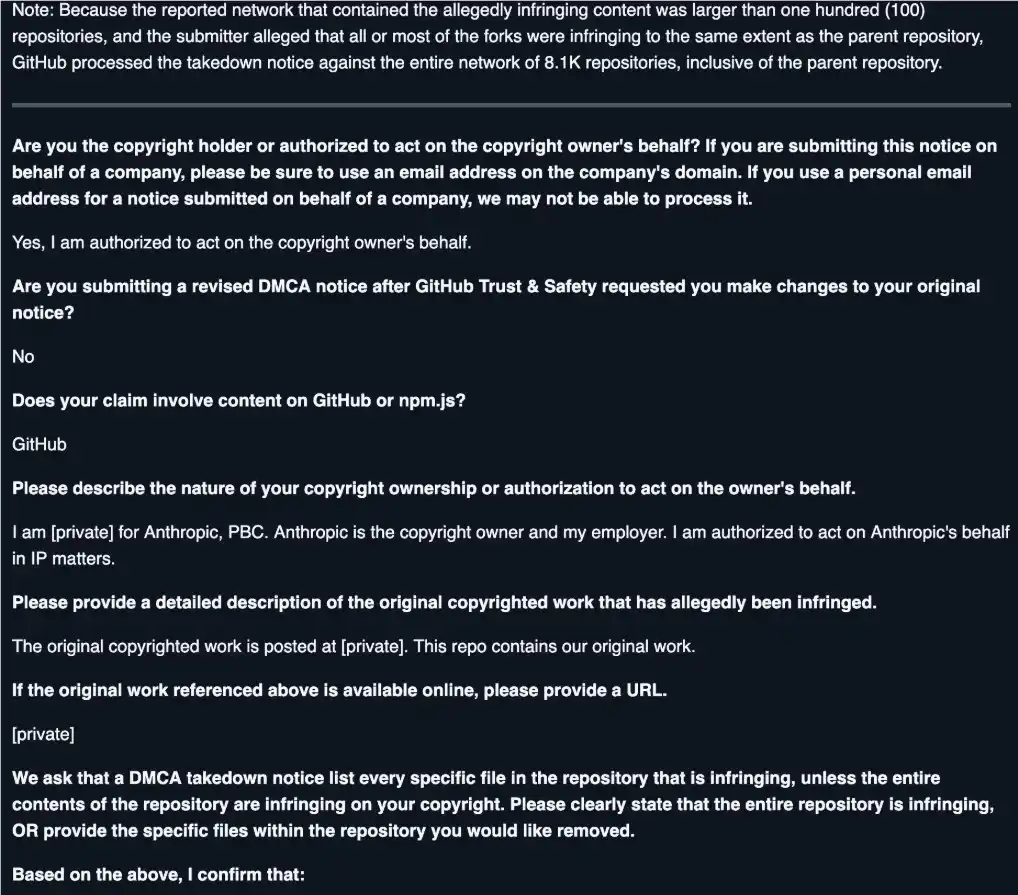
In response to the recent source code leak incident, AI giant Anthropic has officially launched a legal counterattack. According to the latest news, the company has submitted multiple DMCA (Digital Millennium Copyright Act) takedown notices to GitHub, demanding the removal of all illegally hosted Claude Code source code repositories on the platform.

As a result, GitHub adopted a "wholesale" approach, not only deleting the reported main repository but also simultaneously taking down over 8,100 related forked repositories. This marks one of the largest code copyright cleanup operations in the AI industry in recent years.
Leak Cause Reversed: Not "Human Error," but a Tool BUG

Public opinion previously widely believed the leak was due to employee operational error, but the latest investigation report reveals that the real culprit may be an underlying BUG in a certain packaging tool used internally by Anthropic.

This BUG caused the system to mistakenly include sensitive files and complete TypeScript source code, which should have remained private, when building the production environment package. The exposure of this technical detail somewhat alleviates external doubts about the professional competence of Anthropic employees but also reveals serious security vulnerabilities in their automated workflow.

Although GitHub cooperated by taking down 8,100 repositories, it is nearly impossible to completely erase this data, as the source code has been downloaded, cloned, and disseminated by tens of thousands of developers worldwide over the past 48 hours, spreading to Telegram, cloud storage, and private Git platforms.

Currently, a large number of developers within the community are conducting "archaeological" research on this code. The leaked source code not only reveals the implementation logic of Claude Code but also contains a wealth of internal instructions regarding model behavior fine-tuning.


İlgili Sorular

QWhat legal action did Anthropic take in response to the source code leak?

AAnthropic submitted multiple DMCA (Digital Millennium Copyright Act) takedown notices to GitHub to remove illegally hosted Claude Code source code repositories.

QHow many repositories were affected by GitHub's takedown in response to Anthropic's DMCA notices?

AGitHub took down over 8,100 related fork repositories in addition to the main reported repository.

QWhat was the actual cause of the source code leak, according to the latest investigation?

AThe leak was caused by a bug in an internal packaging tool used by Anthropic, which mistakenly included sensitive files and full TypeScript source code that should have remained private when building the production environment package.

QWhy is it nearly impossible to completely remove the leaked source code from circulation?

AIt is nearly impossible because the source code was downloaded, cloned, and spread by tens of thousands of developers worldwide within 48 hours, and it has been disseminated to platforms like Telegram, cloud storage, and private Git platforms.

QWhat does the leaked source code reveal about Claude Code?

AThe leaked source code reveals the implementation logic of Claude Code and contains a large number of internal instructions related to model behavior fine-tuning.

İlgili Okumalar

Now the Greatest Regret Is to My Family: Crypto Experts Took a Stumble in the Stock Market

Summary: This article examines the significant losses recently suffered by cryptocurrency traders and influencers who ventured into the stock market, specifically by heavily investing in AI-related and semiconductor storage stocks. The narrative centers on the dramatic reversal in the Korean and US equity markets in late July, with stocks like SK Hynix and related leveraged ETFs experiencing historic plunges, erasing massive gains. The analysis highlights several key factors behind the "flip." Traders, accustomed to crypto's high volatility and frustrated by a stagnant market, chased the apparent momentum in AI-themed equities. Many made fatal mistakes: applying high-leverage strategies common in crypto (e.g., 2x ETFs, on-chain perpetual contracts) to stocks, and failing to understand the distinct rules of different stock markets (like Korean pre-market trading). This led to widespread liquidations, especially when a thin Korean pre-market trade triggered a cascading flash crash on a decentralized exchange. Post-crash reflections from prominent figures reveal deep regret and self-criticism. They acknowledge misjudging their expertise, overestimating their edge against sophisticated institutional players, and the dangers of leverage. The article concludes that while such setbacks are part of trading, surviving long-term requires recognizing one's limitations and the inherent risks of cross-market strategies.

marsbit49 dk önce

Now the Greatest Regret Is to My Family: Crypto Experts Took a Stumble in the Stock Market

marsbit49 dk önce

US Senate Makes Important Amendments to "Conflict of Interest" Section of Cryptocurrency Bill

The U.S. Senate has taken a key step regarding the CLARITY Act, which could shape the future of the U.S. crypto market. On July 29, Senators Tom Tillis and Ruben Gallego finalized amendments to the bill's "conflict of interest" rules, one of its most contentious aspects. The bipartisan bill aims to tighten restrictions on high-level federal officials' ties to digital assets. The new text, crafted as an alternative to a White House-endorsed ethics code, is expected to impose stricter rules limiting officials' ability to issue or directly participate in digital asset projects. However, with Congress entering an August recess and the revised text not yet reviewed by much of the Senate, the bill's timeline is uncertain. Senate Majority Leader John Thune indicated a procedural vote could occur between July 29 and August 1 but expressed doubt the full bill could pass before the break. The House-approved CLARITY Act, passed in July 2025, has been under Senate negotiation for over a year. Key goals of the CLARITY Act include clarifying jurisdictional boundaries between the SEC and CFTC, setting rules for digital commodity spot markets, and addressing topics like stablecoin yields, DeFi, and illicit financing. The stablecoin yield provisions could significantly impact U.S.-based DeFi protocols, exchanges, and issuers, affecting their global competitiveness. The outcome is being closely watched by both the U.S. and global digital asset markets.

cryptonews.ru1 saat önce

US Senate Makes Important Amendments to "Conflict of Interest" Section of Cryptocurrency Bill

cryptonews.ru1 saat önce

Pavel Durov Designated as a Terrorist in Russia. What Does This Mean for Telegram Users?

Pavel Durov, the founder of Telegram, has been added to Russia's list of terrorists and extremists by Rosfinmonitoring, as published on July 30. The entry includes his name and date of birth. The designation follows an announcement by the Russian Federal Security Service (FSB) on July 29, which charged Durov with aiding terrorist activity. The FSB alleges that a Telegram dating bot named "DaiVinchik" was used to recruit 46 individuals for attacks on police and arson, orchestrated by Ukrainian special services. The FSB also accuses Telegram's administration of failing to remove channels and bots used by Ukrainian intelligence and extremist groups. Durov is reportedly subject to an international arrest warrant. Inclusion on the Rosfinmonitoring list leads to significant restrictions: the freezing of Durov's bank accounts and assets, severe limitations on financial transactions, and a ban on election participation, media interaction, and event organization. Transfers to his accounts may be considered terrorism financing. For ordinary Russian Telegram users, purchasing Telegram Premium is not classified as financing terrorism, according to an IT expert. General use of the messenger—messaging, managing channels—does not automatically make a user a participant in extremist activity. There has been no official decision to ban Telegram itself. It is noted that French authorities are also investigating Durov over allegations of inadequate measures against criminal activity on the platform and insufficient cooperation with law enforcement. Durov denies all charges.

cryptonews.ru1 saat önce

Pavel Durov Designated as a Terrorist in Russia. What Does This Mean for Telegram Users?

cryptonews.ru1 saat önce

İşlemler

Spot
活动图片