Anthropic Employees Leave to Start a Business, Valued at $1 Billion, Also Focused on 'Recursive Self-Improvement'

marsbit2026-06-26 tarihinde yayınlandı2026-06-26 tarihinde güncellendi

Özet

Former Anthropic employees Behnam Neyshabur and Harsh Mehta have founded a startup named Mirendil, securing $200 million in seed funding at a $1 billion valuation from investors including Andreessen Horowitz, Kleiner Perkins, and NVIDIA. The company, staffed by researchers from Anthropic, xAI, Google DeepMind, and OpenAI, aims to accelerate scientific discovery by focusing on "recursive self-improvement" for AI. Their vision, described as "AI for AI for Science," is to build a platform enabling research labs in fields like medicine and materials science to develop and iteratively improve their own specialized AI models, rather than relying on general-purpose models from large tech firms. Neyshabur argues this approach, involving AI that can optimize its own code under human supervision, is the fastest path to AI-accelerated science. The founders believe a market opportunity exists because major AI companies, while increasingly using AI to advance their own research, restrict external developers from using their models to train competing products. Mirendil plans to release its first models soon to gather early user feedback, with the goal of empowering thousands of labs to tackle critical scientific challenges.

Employees leaving Anthropic to start a business, securing $200 million in funding right from the start.

Recently, two prominent figures who left Anthropic — Behnam Neyshabur and Harsh Mehta — announced their entrepreneurial venture, founding a startup named Mirendil. Its vision is similar to Tian Yuandong's previously announced startup project, both aiming to create AI capable of self-evolution to accelerate human scientific progress. The technical approach is 'recursive self-improvement'.
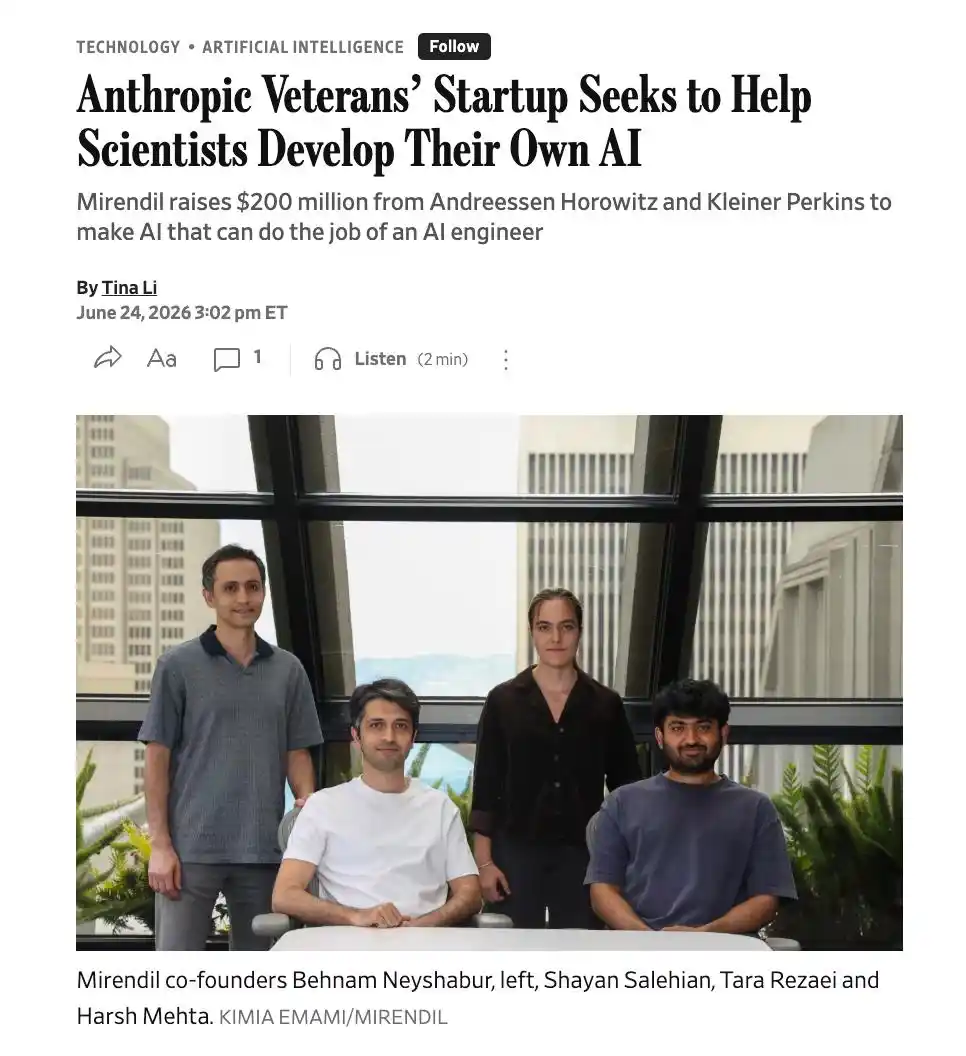
The company's founding team consists of 20 researchers and engineers from cutting-edge institutions like Anthropic, xAI, Google DeepMind, and OpenAI. They came together driven by a passion for science and a commitment to building technology that propels scientific advancement. The company name 'Mirendil' comes from 'The Lord of the Rings,' meaning 'Jewel-friend' in Elvish.

They raised $200 million in seed funding from venture capital firms Andreessen Horowitz, Kleiner Perkins, and NVIDIA. Post-funding, the company's valuation reached $1 billion, making it one of the AI startups with a notably high seed-round valuation in recent years.

Origin: An Unfamiliar Email,

A Seven-Year 'Partnership'

The founders' story begins in 2019.

At that time, Mehta was a regular researcher at Google, while Neyshabur had just joined Google and was already gaining some renown in academic circles for his in-depth research into the fundamental question of 'why AI models work' — as Mehta himself put it, 'he was already a bit of a star in the field.' Mehta mustered the courage to send him an unfamiliar email, and thus their connection began.

They were both passionate about 'using AI to accelerate scientific research' early on, but at the time, limited by model capabilities, this idea remained in the realm of imagination. It wasn't until late 2024 that both joined Anthropic, and in December 2025, shortly after the release of Claude Opus 4.5, they chose to leave to start their own company.

The release of Claude Opus 4.5 significantly enhanced AI Agents' ability to handle complex tasks. Perhaps it was this breakthrough that convinced them the timing was ripe.

Mission: Not 'AI for Science',

But 'AI for AI for Science'

Mirendil's positioning sounds a bit convoluted, but Neyshabur clarified it in one sentence: 'What we do is have AI help scientists build their own AI, rather than just directly using AI to assist science.'

In other words, their goal is to build a tool platform that allows research teams in various vertical fields like medicine and materials science to independently train and iterate their own specialized AI models — without relying on general-purpose models provided by major tech companies. An example they give is: helping researchers build a model to predict Alzheimer's disease risk.

This involves a more controversial technical path — Recursive Self-Improvement, which involves AI continuously optimizing its own code and capabilities. Neyshabur directly stated that this is the shortest path to 'AI-accelerated science,' while also believing it can be advanced safely under human supervision. 'I don't accept the argument that it can't be done; it's just a very difficult problem.'

Competition: Major Companies' Moats,

Precisely Mirendil's Opportunity

The logic behind Mirendil's ability to secure this funding is also quite clear.

Currently, major AI companies, including Anthropic, are increasingly using AI to accelerate their own research. According to Anthropic's disclosure, as of May this year, over 80% of its internal code was already written by Claude. However, at the same time, these major companies explicitly restrict external developers from using their models to train competitive products in their user agreements.

This 'for internal use only, not for lending' strategy, in the view of a16z investor Matt Bornstein, is just a normal reaction from major companies as 'rational economic actors.' But precisely because of this, a structural gap has emerged in the market, necessitating an independent company to take on this task.
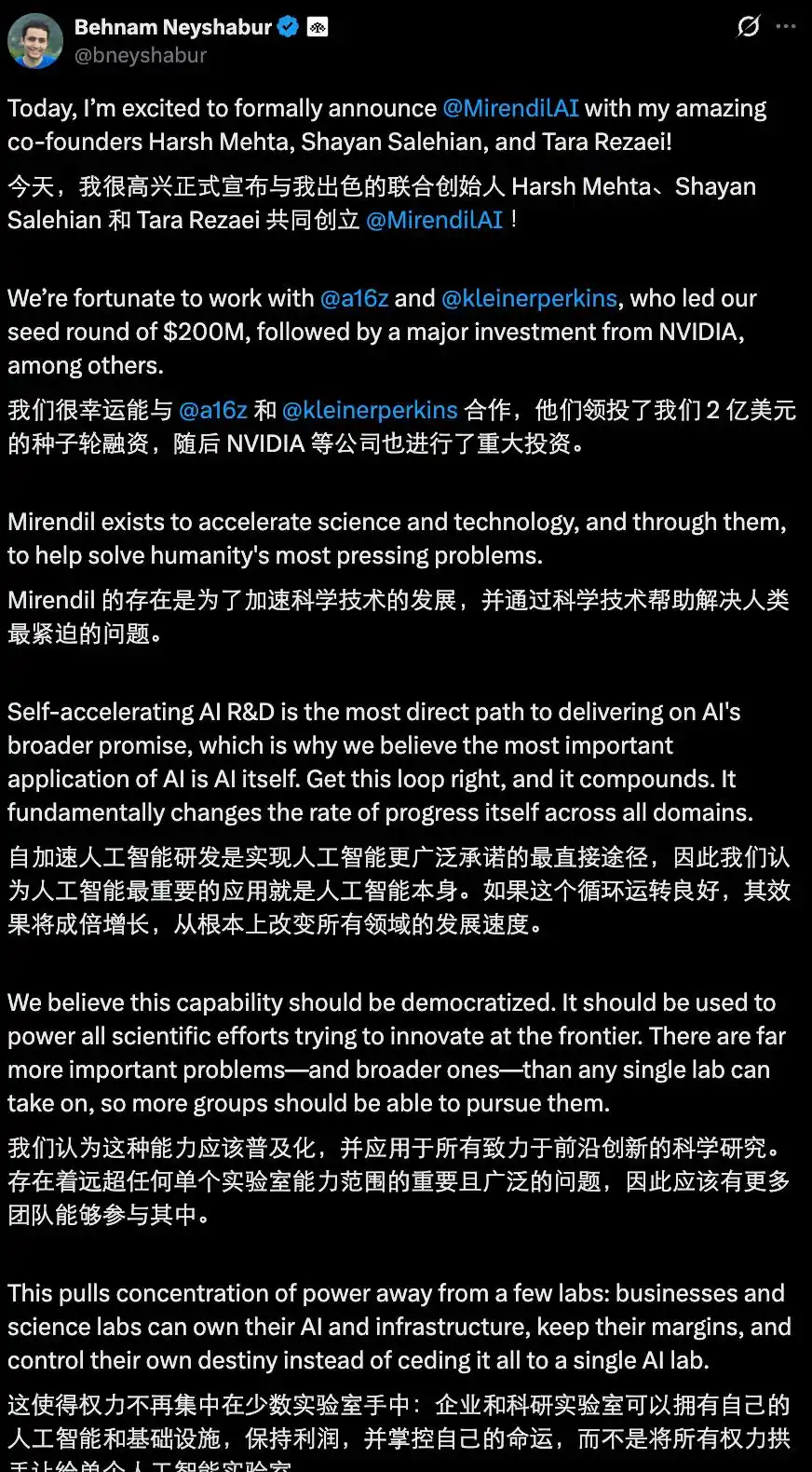
In addition to the two co-founders, Mirendil's core team includes Shayan Salehian, who was an early member at Musk's xAI, and Tara Rezaei, a graduate of MIT. The company currently has about 20 technical staff, with offices located in downtown San Francisco.

In the coming months, Mirendil plans to release its first model and product, gathering early feedback from users. Neyshabur's vision for this is: 'We hope that in the future, there will be thousands of labs in the world, each tackling the most important problems of our time. We want to be the force that empowers them.'

Reference Links:

https://x.com/bneyshabur/status/2069860934148079800

https://www.wsj.com/tech/ai/anthropic-veterans-startup-seeks-to-help-scientists-develop-their-own-ai-09e2f3e5?mod=author_content_page_1_pos_1

This article is from the WeChat public account 'Almost Human', author: Almost Human Editorial Department

İlgili Sorular

QWhat is the name of the startup founded by former Anthropic employees, and what is its valuation?

AThe startup is named Mirendil, and its valuation is $1 billion after a $200 million seed funding round.

QWhat is the core technical vision or goal of the startup Mirendil?

AMirendil's core vision is to achieve 'recursive self-improvement' in AI, aiming to build AI that can self-evolve to accelerate scientific progress, specifically by creating tools for scientists to develop their own specialized AI models.

QHow do the founders of Mirendil view their approach compared to 'AI for Science'?

AThe founders describe their approach as 'AI for AI for Science'. They aim to create tools that enable scientists to build and iterate their own AI models, rather than just using existing AI to directly assist in scientific research.

QAccording to the article, why did the founders decide it was the right time to start this venture?

AThe founders believe the time is right because of significant advancements in AI capabilities, specifically mentioning the release of Claude Opus 4.5, which greatly enhanced AI agents' ability to handle complex tasks, making their vision more feasible.

QWhat market opportunity does the article identify for Mirendil, based on the strategies of major AI companies?

AThe article identifies a structural gap because major AI companies like Anthropic primarily use their AI to accelerate their own internal research and restrict external developers from using their models to train competitive products. This creates an opportunity for an independent company like Mirendil to provide such capabilities to the broader scientific community.

İlgili Okumalar

A 380% Soar, Shenzhen’s 100-Billion-Yuan IPO Rings the Bell

HKC Holdings, a major Chinese display panel manufacturer, has successfully listed on the Shenzhen Stock Exchange's main board. The company's shares surged over 380% on its debut, pushing its market capitalization to around 350 billion yuan (formerly reaching 500 billion yuan). Founded by Wang Zhiyong in Shenzhen's Huaqiangbei electronics market nearly three decades ago, HKC evolved from assembling monitors to becoming a global top-tier supplier of semiconductor display panels for TVs, monitors, and smartphones. The IPO marks a significant milestone for HKC and its backers. The company's growth into the capital-intensive panel manufacturing sector was supported through partnerships with state-owned capital from regions like Chongqing, Mianyang, and Chuzhou. Its shareholder list also includes BOE Technology's investment arm. In recent years, HKC reported strong financials, with core panel business contributing over 70% of revenue and clients including Samsung, TCL, and Xiaomi. This listing is seen as part of a broader trend in Shenzhen's evolving tech landscape. Beyond established giants, the city is nurturing clusters of leading companies in specialized sectors like robotics—exemplified by the "Shenzhen Robot Valley"—and storage chips, where a group of firms dubbed the "Storage Five Tigers" has achieved a combined trillion-yuan market valuation. Shenzhen's strategic focus on emerging industries such as AI terminals, low-altitude economy, and humanoid robotics aims to build new industrial depth and foster the next generation of tech champions.

marsbit9 dk önce

A 380% Soar, Shenzhen’s 100-Billion-Yuan IPO Rings the Bell

marsbit9 dk önce

Domestic First Explosion-Proof Certification, World's First Fueling Brain Solution: How Did They Secure Two 'Firsts'?

China's embodied AI sector is booming, with over ¥37 billion in funding this year. The focus has shifted decisively to real-world application, particularly in hazardous, repetitive tasks humans should avoid. A key, often prohibitive, barrier to entry for robots in environments like gas stations and oil fields is obtaining explosion-proof certification, requiring meticulous hardware and circuit design from the ground up. The article explores three main application areas. At gas stations, the challenge lies in executing a long, precise sequence of actions (opening caps, handling the fuel nozzle) with millimeter accuracy across diverse car models. For facility inspections, robots need sustained autonomous patrols combined with real-time anomaly detection and response. Port scenarios introduce the complexity of multi-robot coordination. Addressing the core challenge of long-horizon tasks, the piece highlights a technical breakthrough: a "world model"-driven approach. This enables predictive planning, allowing the AI to visualize the desired end-state (e.g., nozzle returned, cap closed) and work backward to synthesize intermediate visual frames. This "imagination" of the task trajectory, as implemented in the H-GAR architecture, guides action generation, significantly reducing cumulative error in multi-step operations. The three-step H-GAR process involves generating a coarse action draft, synthesizing target-conditioned observation frames, and then refining actions based on visual context and a memory of past successful motions. The conclusion emphasizes that success in specialized, safety-critical fields requires long-term commitment and deep integration of the "embodied brain" (AI) with a purpose-built, certified physical "body." Mastering this brain-body-data闭环 (closed-loop) is positioned as a crucial competitive advantage for commercialization.

marsbit57 dk önce

Domestic First Explosion-Proof Certification, World's First Fueling Brain Solution: How Did They Secure Two 'Firsts'?

marsbit57 dk önce

Bitcoin Bear Market Triggers Crypto Layoffs, Yet Fuels Industry's Most Aggressive M&A Wave Ever

A prolonged Bitcoin downturn is forcing crypto companies to lay off employees and automate operations, but has simultaneously triggered the industry's most aggressive wave of mergers and acquisitions (M&A). In the first half of 2026, crypto M&A deal value reached $93.7 billion, 26 times higher than the same period last year. This activity is primarily driven by traditional financial institutions—banks, payment processors, and asset managers—who are acquiring compliant crypto infrastructure like custody solutions, payment rails, and regulatory licenses instead of building them internally. Examples include Mastercard's acquisition of stablecoin firm BVNK and Franklin Templeton's launch of a dedicated crypto division via acquisition. This consolidation contrasts sharply with a shrinking crypto labor market, where active job openings have plummeted. Companies like Coinbase are restructuring to become "AI-native," leading to a sharp increase in roles requiring AI skills, while engineering and compliance positions now dominate hiring. Financially pressured crypto firms, such as Messari which was acquired at a fraction of its prior valuation, are becoming prime targets. Capital remains available but is highly selective, flowing overwhelmingly into businesses that bridge digital assets with traditional finance, such as tokenization platforms and regulated trading venues. The trend indicates a market where capital is rewarding compliant, utility-focused infrastructure while weaker models consolidate or downsize.

marsbit58 dk önce

Bitcoin Bear Market Triggers Crypto Layoffs, Yet Fuels Industry's Most Aggressive M&A Wave Ever

marsbit58 dk önce

İşlemler

Spot
Futures
活动图片