Ant Digital Tech Proposes New Architecture for Agent Economy, Covering Four Layers: Identity, Payment, Risk Control, and Compliance

marsbit2026-04-20 tarihinde yayınlandı2026-04-20 tarihinde güncellendi

Özet

Ant Digital Technologies (Ant Digital) has introduced a new architectural framework for the agentic economy, named the "4R Full-Stack Architecture," at the Hong Kong Web3 Festival. The framework is designed to address four core challenges in AI agent operations: identity, payment, risk control, and compliance. The four layers include: - **Agentic Runtime**, featuring DTClaw with the CARLI security model to enforce behavioral constraints and ensure controllability and auditability; - **Payment Rails**, which provide on-chain payment channels supporting smart decision-making, verifiable credentials, instant settlement, and cross-chain asset transfers; - **Agent Registry**, leveraging DIDs and the ERC-8004 standard to assign verifiable on-chain identities to agents; - **Root Infrastructure**, built on Jovay Layer2 and ZKVM technology to enable high-speed micro-payments and trusted off-chain computation with on-chain verification. According to CTO Yan Ying, the architecture aims to resolve fundamental gaps in the current agent economy—such as execution vulnerabilities, identity issues, payment barriers, and trust deficits—by redesigning underlying infrastructure rather than applying superficial fixes. The initiative builds on Ant Digital’s extensive experience in financial-grade security, privacy computing, and blockchain.

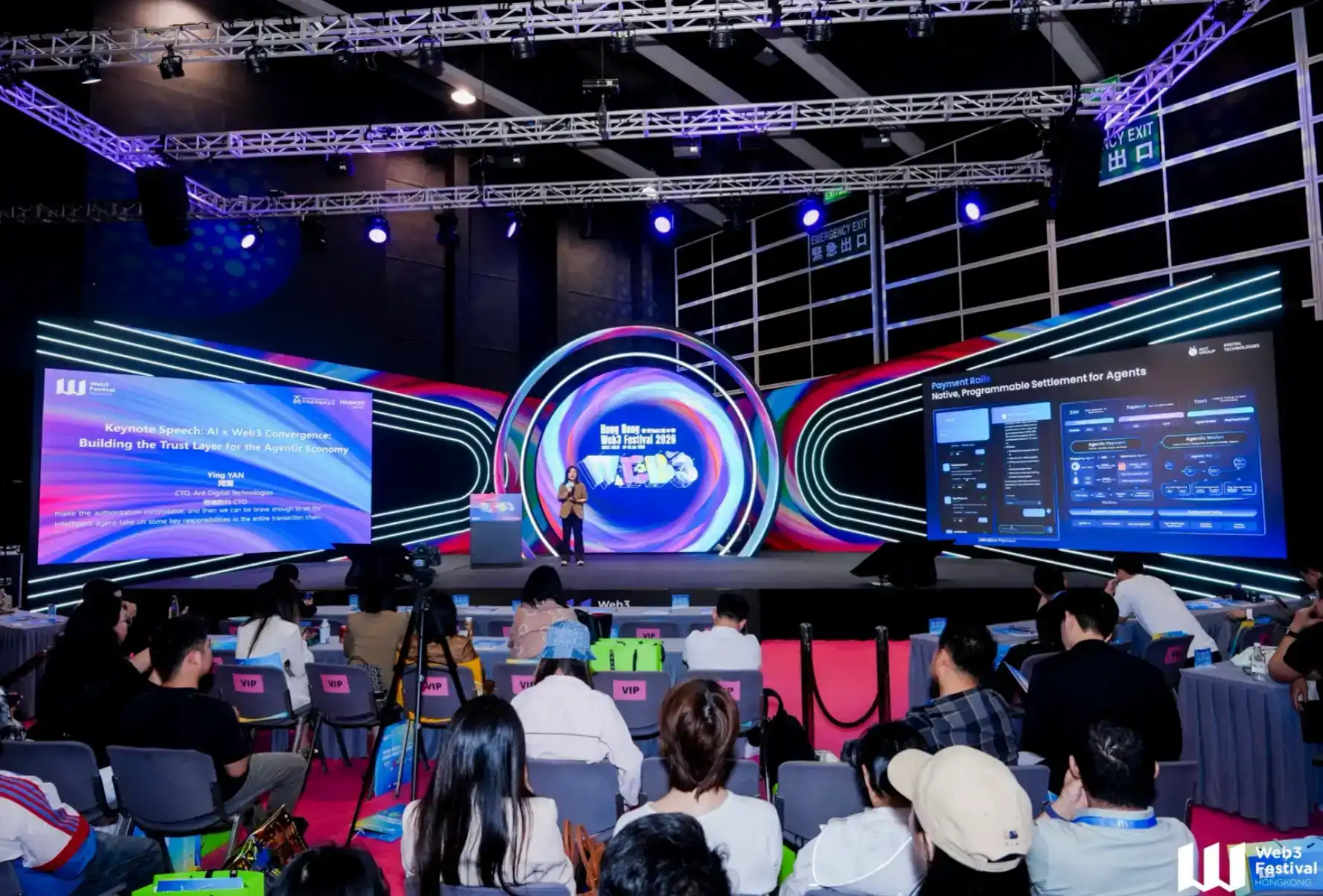
On April 20, Ant Digital Tech introduced the "4R Full-Stack" architecture concept for the agent economy at the Hong Kong Web3 Festival, encompassing four layers: Agentic Runtime, Payment Rails, Agent Registry, and Root Infrastructure. This framework aims to provide AI agents with a technical infrastructure covering identity, payment, risk control, and compliance.

Ant Digital Tech CTO Yan Ying pointed out in her speech that the current foundation of the agent economy suffers from "four gaps": execution failures due to prompt logic vulnerabilities, responsibility vacuums caused by AI's lack of credible identity, transaction barriers from payment gateways designed for humans, and collaboration risks arising from a lack of trust between unfamiliar agents. "These cannot be resolved by simply patching software; they require a redesign from the underlying infrastructure level," she said.

According to Yan Ying, the core product of the Agentic Runtime layer is DTClaw, which incorporates the CARLI security model to enforce constraints on agent behavior at the execution level. It supports multi-model compatibility and financial-grade compliance standards, aiming to make every AI operation controllable, auditable, and recoverable.

The Payment Rails layer builds native on-chain payment channels, integrating agent intelligent decision-making with verifiable credential chain technology. This ensures precise payment intent recognition and full-link security control while achieving transparency and immutability in the transaction process. For high-frequency micro-transaction scenarios, the platform constructs a native instant settlement network that supports cross-chain, multi-asset seamless flow, and intelligent routing, significantly improving capital turnover efficiency. Additionally, by providing a standardized development toolchain and a seamless wallet integration experience, the solution greatly reduces development barriers and user costs, forming a payment closed-loop that balances financial-grade security and an optimal user experience.
The Agent Registry layer issues on-chain identities for each agent based on DID (Decentralized Identity) and the ERC-8004 standard, ensuring that every collaboration between agents is documented. The Root Infrastructure layer serves as the architectural foundation, utilizing Jovay Layer2 to achieve 120-millisecond confirmation times to support AI micro-payments, and combining ZKVM technology to enable off-chain computation and on-chain verification, addressing the trust issues in AI economy computing power. Yan Ying stated, "The Root Infrastructure uses blockchain and privacy computing technologies to provide agents with an immutable contract execution environment. Even two unfamiliar AIs can establish trust based on code and conduct transactions with confidence."

Currently, AI is evolving from the era of Chat and Action to the era of the agent economy. Yan Ying believes that the qualitative change in the third stage lies not in AI becoming smarter, but in it beginning to possess assets and transaction rights. She noted that over the past decade, Ant Digital Tech has accumulated extensive engineering practices in financial-grade security, privacy computing, blockchain, and compliance systems, and the 4R architecture is built upon this foundation with全新研发和设计 (entirely new research and design).


İlgili Sorular

QWhat is the '4R Full-Stack' architecture proposed by Ant Digital Tech, and what are its four layers?

AThe '4R Full-Stack' architecture is a framework for the agentic economy proposed by Ant Digital Tech. Its four layers are: Agentic Runtime, Payment Rails, Agent Registry, and Root Infrastructure.

QAccording to Ant Digital Tech's CTO, what are the 'four fractures' in the current foundation of the agentic economy?

AThe 'four fractures' are: 1) Execution loss of control due to prompt logic vulnerabilities, 2) A responsibility vacuum caused by AI's lack of a trusted identity, 3) Transaction barriers from payment gateways designed for humans, and 4) Collaboration risks from a lack of trust between unfamiliar agents.

QWhat is the core product in the Agentic Runtime layer and what is its primary function?

AThe core product in the Agentic Runtime layer is DTClaw. Its primary function is to enforce mandatory constraints on agent behavior at the execution level, making every AI operation controllable, auditable, and recoverable.

QHow does the Payment Rails layer facilitate transactions for AI agents?

AThe Payment Rails layer builds native on-chain payment channels that integrate agent intelligent decision-making with verifiable credential chain technology. It ensures precise payment intent recognition, full-link security, transparency. It also features an instant settlement network for high-frequency micro-transactions, supporting cross-chain, multi-asset flow and smart routing.

QWhat technologies are used in the Root Infrastructure layer to support the agentic economy?

AThe Root Infrastructure layer utilizes Jovay Layer2 to achieve 120-millisecond confirmation times to support AI micro-payments, and combines ZKVM technology to enable off-chain computation with on-chain verification, solving the trust problem in AI economy computing power.

İlgili Okumalar

Bitcoin Withdrawals Continue: 8 Years of Storage in a Coldcard Cold Wallet Ended in Zero

Coldcard Hardware Wallet Hacked: Losses Mount Due to Vulnerable Seed Generation A critical vulnerability in Coldcard hardware wallets has led to a continued wave of fund thefts. According to Galaxy Research, the total stolen has reached 1,367.05 BTC (approx. $88.6 million) from 4,585 addresses, a significant increase from the initial 594.5 BTC reported on July 30, 2026. Most of the stolen funds remain on the attackers' addresses. The issue is not with the current firmware, which Coinkite has updated, but with seed phrases generated on vulnerable devices between March 2021 and the release of fixed firmware versions. Due to a programmer error, devices switched from using a hardware random number generator to the software-based Yasmarang generator, which was initialized with publicly accessible data like the chip's serial number. This made the seed phrases predictable through offline brute-force attacks, meaning wallets remain at risk until funds are moved to a new wallet generated with the patched firmware. Affected devices include Mk2/Mk3 with firmware 4.0.1–4.1.9 (and up to 5.0.3), Mk4/Mk5 up to version 5.6.0, and Q models up to 1.5.0Q. The only exceptions are seeds created with a high-entropy method like at least 50 independent dice rolls or a strong unique BIP-39 passphrase. All other owners must generate a new seed on the fixed firmware and transfer their assets. A case highlighting the human impact involves a 39-year-old long-term investor who lost 2 BTC (approx. $130,000) in minutes. He had accumulated the Bitcoin over eight years through physical labor, viewing it as a financial lifeline and a retirement plan in a country suffering from hyperinflation. His story underscores that even conservative "buy and hold in cold storage" strategies can be compromised by such underlying technical flaws. From a technical perspective, this incident echoes historical failures where weak random number generators undermined cryptographic security, challenging the assumption that offline storage is automatically foolproof.

cryptonews.ru54 dk önce

Bitcoin Withdrawals Continue: 8 Years of Storage in a Coldcard Cold Wallet Ended in Zero

cryptonews.ru54 dk önce

İşlemler

Spot
活动图片




