Another Big Scandal in the Crypto World? AI Doomsday Theory... What Are KOLs Talking About?

比推2026-02-24 tarihinde yayınlandı2026-02-24 tarihinde güncellendi

Özet

Based on the provided content, here is an English summary: The article discusses trending topics among crypto KOLs on social media platform X. The main points include: 1. **Crypto "Strict Father" Action:** Speculation about an imminent major regulatory crackdown on insider trading, with a list of targets allegedly locked in and set to be revealed on the 26th. Multiple embedded images suggest this is a major point of discussion. 2. **Bit Mining Company Sells Bitcoin:** The mining company Bitdeer, with a market cap of $1.9 billion, has drawn controversy for selling off its entire Bitcoin holdings. 3. **AI and Financial Crisis Debate:** A significant online debate questions whether AI will trigger a financial crisis by 2028. The discussion includes concerns about AI's current unreliability for critical tasks, its high cost compared to human labor, and its potential to cause massive unemployment and economic disruption. Opinions vary on the likelihood of an extreme crisis versus a scenario of long-term economic stagnation and inequality. Links are provided to read the full discussions. 4. **Private Equity Mogul Comments on Justin Sun:** Well-known Chinese private equity investor Dan Bin made comments about Tron founder Justin Sun. Replies to this note Sun's controversial reputation but acknowledge the foresight of his past investment ideas, and praise Dan Bin for adapting to new market trends like AI. The article is a roundup of community discussions and explicitly states ...

Dear readers, Wishing you great success as you start work~

What have the KOLs in the crypto circle been talking about in the past 24 hours?

Note: The following content is compiled from the X platform and represents personal opinions. It does not represent the stance of this platform and should not be considered investment advice.

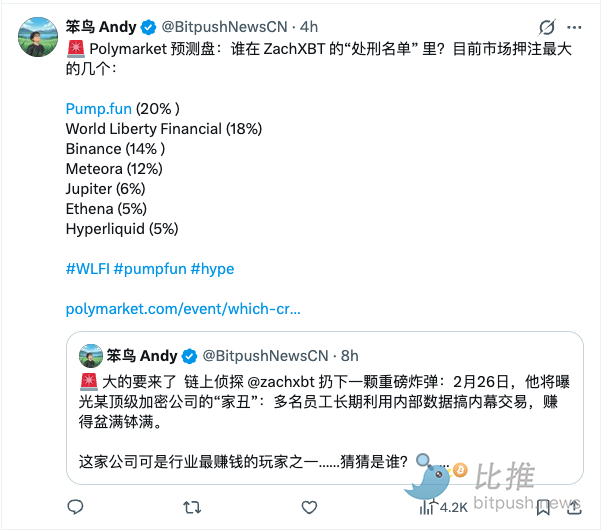
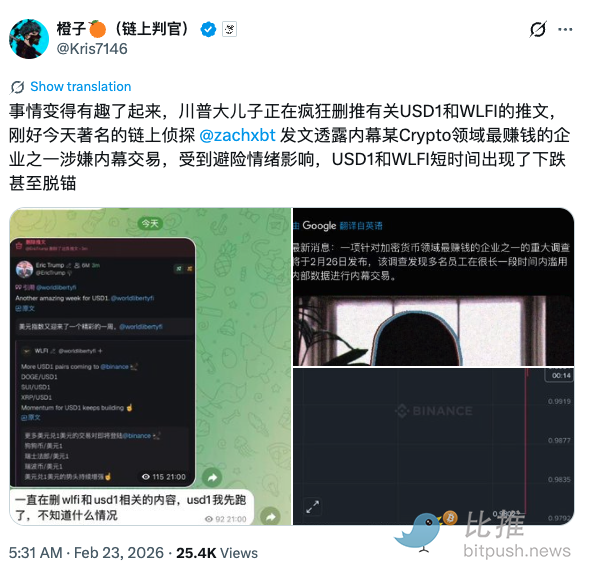
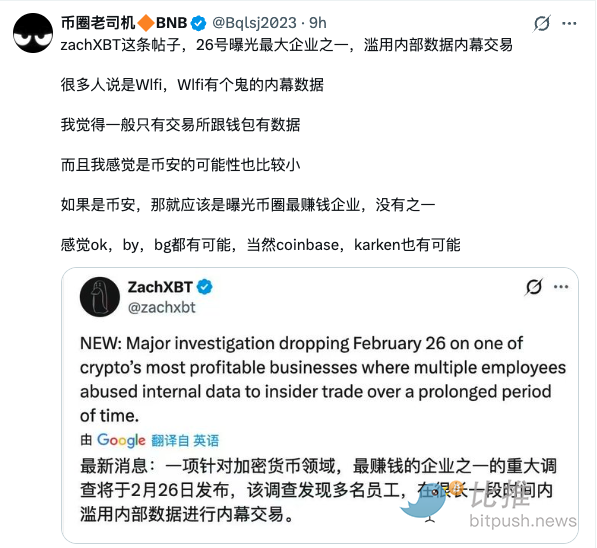
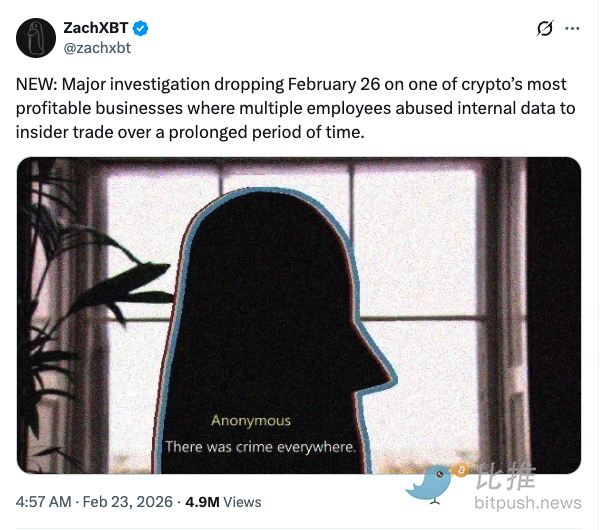
Crypto "Strict Father" is about to take action: Insider trading list locked in, to be revealed on the 26th!

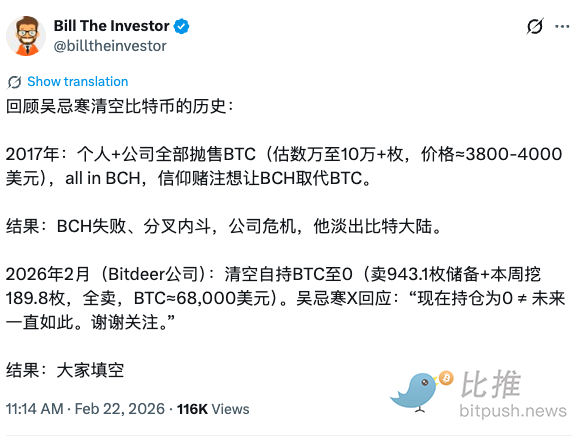
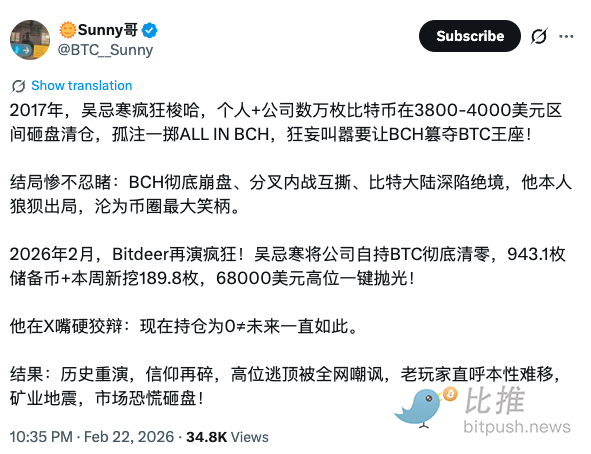
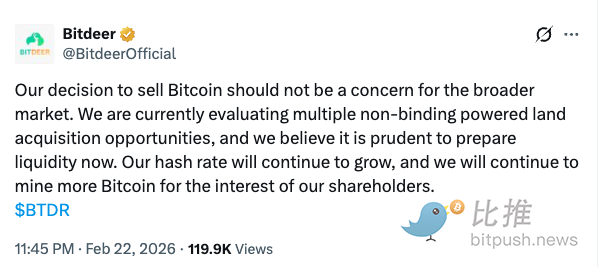
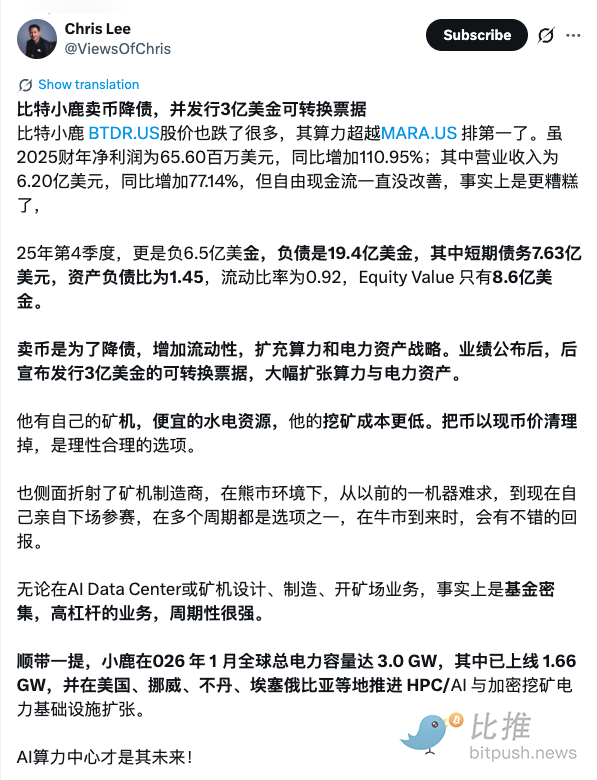
Mining company Bitdeer with a market cap of $1.9 billion liquidates Bitcoin, sparking controversy
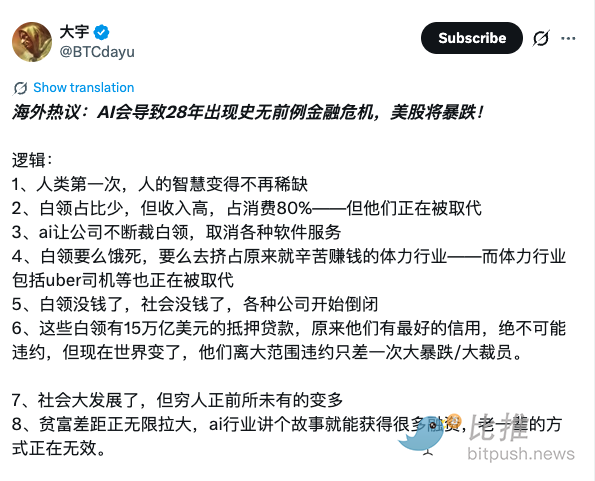
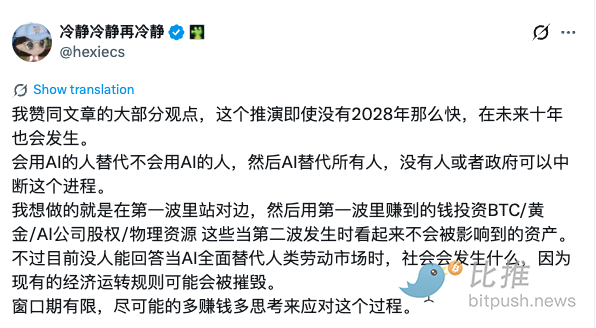
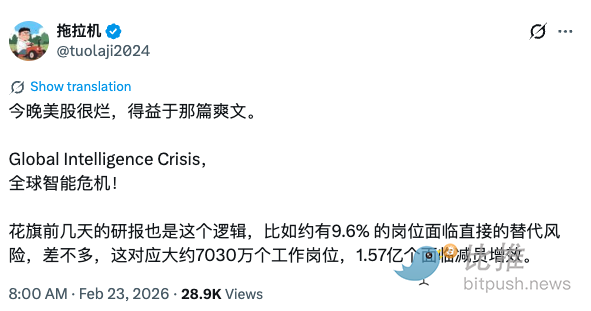
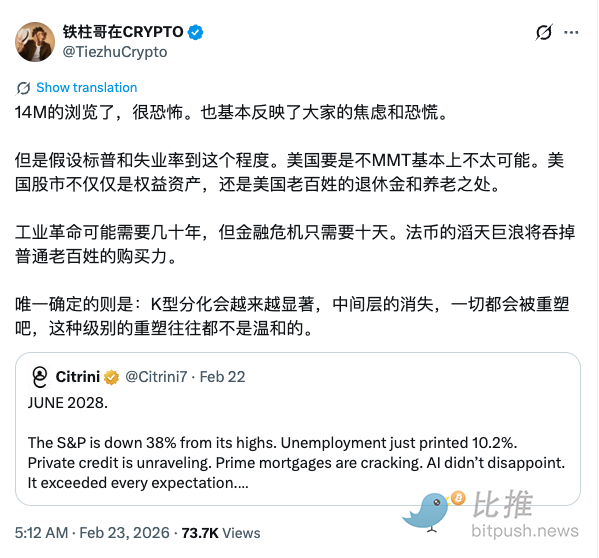
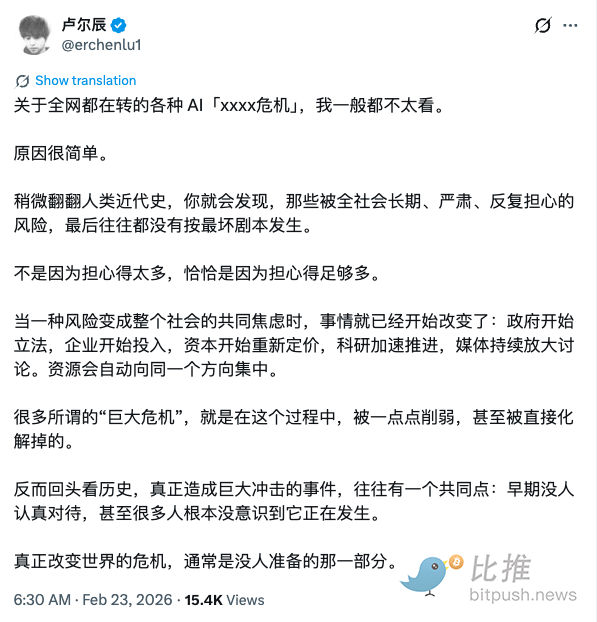
Hot topic overseas: Will AI trigger a financial crisis in 2028?

Click to read the full article:

https://www.bitpush.news/articles/7613842;

<极>https://www.bitpush.news/articles/7613859


Popular replies:

The first point about SaaS dying by mid-2026 is unreliable. Currently, AI accuracy is only 95% to 99%, and this is an inherent characteristic of GenAI. Which company is willing to bear this inaccuracy in mission-critical business? Would you dare use software generated by Vibe Code for tax filing? Would you dare use software generated by Vibe Code for building construction?;

For now, humans are cheaper than tokens. Try running a few tasks with lobsters; even simple ones like checking flight tickets are more expensive than humans;

First inflation, then deflation, but there is still a long period in between, depending on when AI productivity is realized and the race of capital expenditure;

AI will definitely bring huge unemployment and distribution crises, and may even trigger a severe recession. However, the most extreme scenario of an "unprecedented financial crisis + a sharp drop in US stocks" has a low probability of occurring in 2028 (20–30%?). What is more likely is "Japan-style long-term stagnation + class solidification + coexistence of inflation and asset bubbles;";

Since AI can raise a large amount of money just by telling a story, why don't these people switch to the AI industry?;

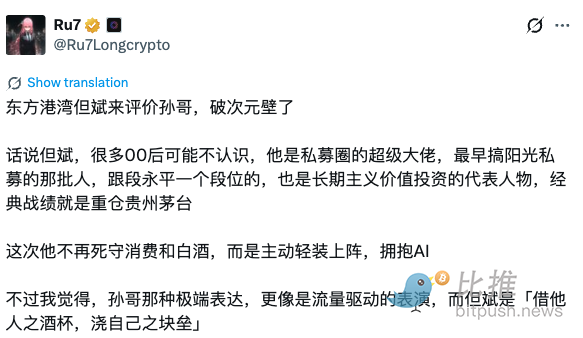
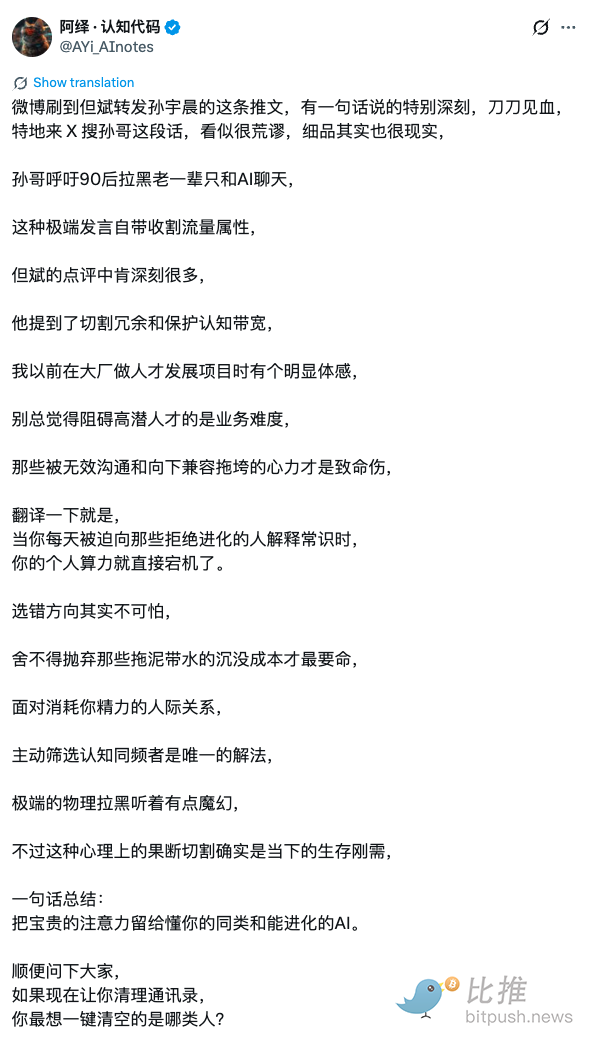
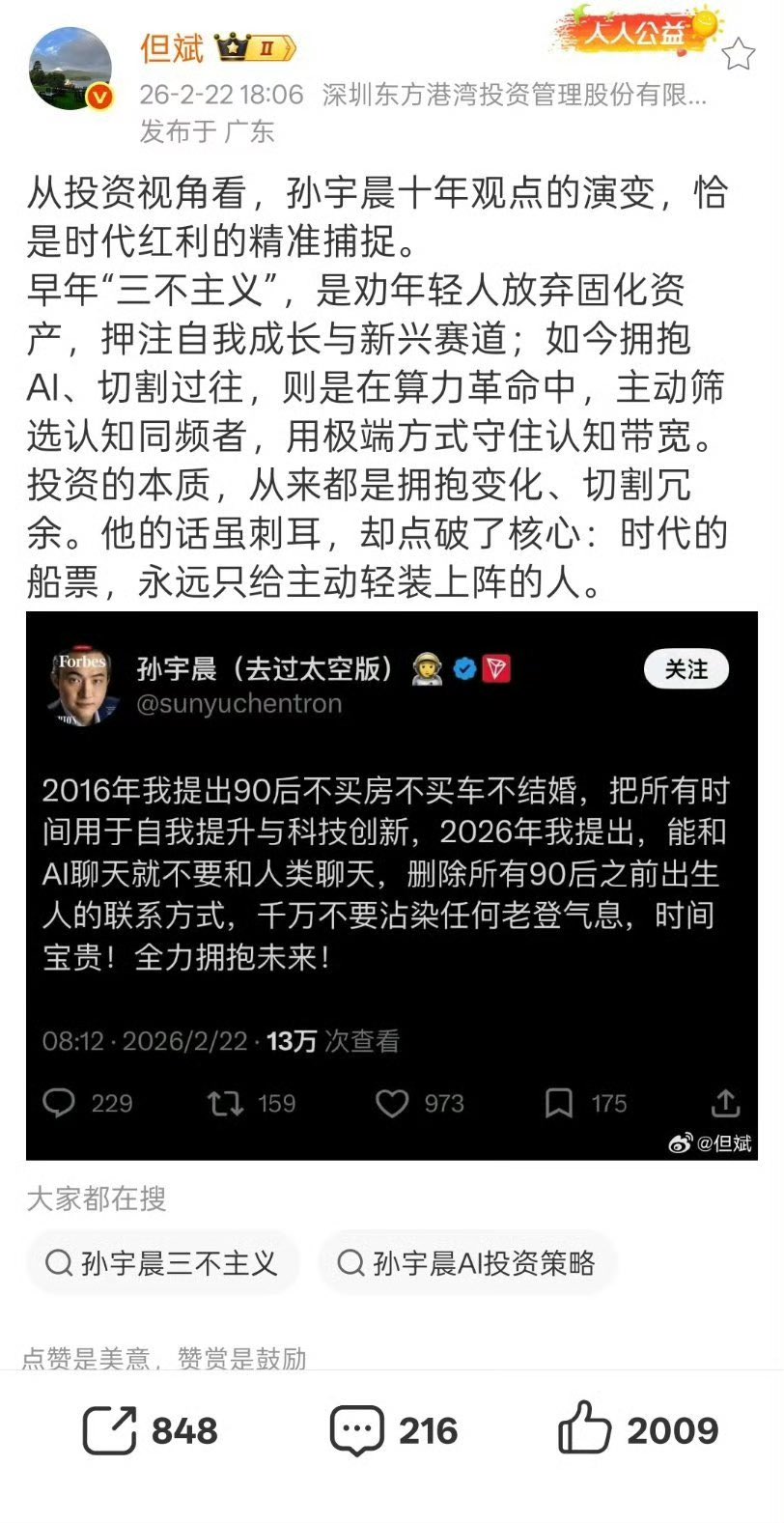
Private equity big shot Dan Bin comments on Brother Sun
Popular replies:

You can doubt Brother Sun's character, but you can't doubt the foresight of his investment philosophy. I remember listening to Brother Sun's podcast on喜马拉雅 in 2018, and many of the things he talked about have now come true;

Dan Bin is quite famous. His shift to investing in AI shows that he is also keeping up with new market trends;

Learning from the younger generation, I admire Dan Bin's breadth of vision and open-mindedness;


Twitter:https://twitter.com/BitpushNewsCN

Bitpush TG discussion group:https://t.me/BitPushCommunity

Bitpush TG subscription: https://t.me/bitpush

Original article link:https://www.bitpush.news/articles/7613895

İlgili Sorular

QWhat major cryptocurrency mining company sold off all its Bitcoin holdings, causing controversy?

ABitdeer, a mining company with a market capitalization of $1.9 billion, sold off all its Bitcoin holdings, sparking debate.

QAccording to the article, what potential global crisis is AI predicted to trigger by 2028?

AAI is predicted to potentially trigger an unprecedented financial crisis and a stock market crash by 2028, according to discussions among KOLs.

QWhat is the date mentioned for the revelation of a list related to insider trading in the crypto circle?

AThe list related to insider trading is scheduled to be unveiled on the 26th.

QWhich well-known private equity investor commented on 'Brother Sun' (Sun Yuchen) in the article?

ADan Bin, a prominent private equity investor, commented on 'Brother Sun' (Sun Yuchen).

QWhat is a key criticism mentioned in the popular replies regarding the current use of Generative AI (GenAI) in business?

AA key criticism is that GenAI's current accuracy is only 95-99%, and this inherent unreliability makes companies unwilling to use it for mission-critical tasks, as people are currently cheaper than AI tokens for many operations.


İlgili Okumalar

Gensyn AI: Don't Let AI Repeat the Mistakes of the Internet

In recent months, the rapid growth of the AI industry has attracted significant talent from the crypto sector. A persistent question among researchers intersecting both fields is whether blockchain can become a foundational part of AI infrastructure. While many previous AI and Crypto projects focused on application layers (like AI Agents, on-chain reasoning, data markets, and compute rentals), few achieved viable commercial models. Gensyn differentiates itself by targeting the most critical and expensive layer of AI: model training. Gensyn aims to organize globally distributed GPU resources into an open AI training network. Developers can submit training tasks, nodes provide computational power, and the network verifies results while distributing incentives. The core issue addressed is not decentralization for its own sake, but the increasing centralization of compute power among tech giants. In the era of large models, access to GPUs (like the H100) has become a decisive bottleneck, dictating the pace of AI development. Major AI companies are heavily dependent on large cloud providers for compute resources. Gensyn's approach is significant for several reasons: 1) It operates at the core infrastructure layer (model training), the most resource-intensive and technically demanding part of the AI value chain. 2) It proposes a more open, collaborative model for compute, potentially increasing resource utilization by dynamically pooling idle GPUs, similar to early cloud computing logic. 3) Its technical moat lies in solving complex challenges like verifying training results, ensuring node honesty, and maintaining reliability in a distributed environment—making it more of a deep-tech infrastructure company. 4) It targets a validated, high-growth market with genuine demand, rather than pursuing blockchain integration without purpose. Ultimately, the boundaries between Crypto and AI are blurring. AI requires global resource coordination, incentive mechanisms, and collaborative systems—areas where crypto-native solutions excel. Gensyn represents a step toward making advanced training capabilities more accessible and collaborative, moving beyond a niche controlled by a few giants. If successful, it could evolve into a fundamental piece of AI infrastructure, where the most enduring value in the AI era is often created.

marsbit11 saat önce

Gensyn AI: Don't Let AI Repeat the Mistakes of the Internet

marsbit11 saat önce

Why is China's AI Developing So Fast? The Answer Lies Inside the Labs

A US researcher's visit to China's top AI labs reveals distinct cultural and organizational factors driving China's rapid AI development. While talent, data, and compute are similar to the West, Chinese labs excel through a pragmatic, execution-focused culture: less emphasis on individual stardom and conceptual debate, and more on teamwork, engineering optimization, and mastering the full tech stack. A key advantage is the integration of young students and researchers who approach model-building with fresh perspectives and low ego, prioritizing collective progress over personal credit. This contrasts with the US culture of self-promotion and "star scientist" narratives. Chinese labs also exhibit a strong "build, don't buy" mentality, preferring to develop core capabilities—like data pipelines and environments—in-house rather than relying on external services. The ecosystem feels more collaborative than tribal, with mutual respect among labs. While government support exists, its scale is unclear, and technical decisions appear driven by labs, not state mandates. Chinese companies across sectors, from platforms to consumer tech, are building their own foundational models to control their tech destiny, reflecting a broader cultural drive for technological sovereignty. Demand for AI is emerging, with spending patterns potentially mirroring cloud infrastructure more than traditional SaaS. Despite challenges like a less mature data industry and GPU shortages, Chinese labs are propelled by vast talent, rapid iteration, and deep integration with the open-source community. The competition is evolving beyond a pure model race into a contest of organizational execution, developer ecosystems, and industrial pragmatism.

marsbit13 saat önce

Why is China's AI Developing So Fast? The Answer Lies Inside the Labs

marsbit13 saat önce

3 Years, 5 Times: The Rebirth of a Century-Old Glass Factory

Corning, a 175-year-old glass company, is experiencing a dramatic revival as a key player in AI infrastructure, driven by surging demand for high-performance optical fiber in data centers. AI data centers require vastly more fiber than traditional ones—5 to 10 times as much per rack—to handle high-speed data transmission between GPUs. This structural demand shift, coupled with supply constraints from the lengthy expansion cycle for fiber preforms, has created a significant supply-demand gap. Nvidia has invested in Corning, along with Lumentum and Coherent, in a $4.5 billion total commitment to secure the optical supply chain for AI. Corning's competitive edge lies in its expertise in producing ultra-low-loss, high-density, and bend-resistant specialty fiber, which is critical for 800G+ and future 1.6T data rates. Its deep involvement in co-packaged optics (CPO) with partners like Nvidia further solidifies its position. While not the largest fiber manufacturer globally, Corning's revenue from enterprise/data center clients now exceeds 40% of its optical communications sales, and it has secured multi-year supply agreements with major hyperscalers including Meta and Nvidia. Financially, Corning's optical communications revenue has surged, doubling from $1.3 billion in 2023 to over $3 billion in 2025. Its stock price has risen nearly 6-fold since late 2023. Key future catalysts include the rollout of Nvidia's CPO products and the scale of undisclosed customer agreements. However, risks include high current valuations and potential disruption from next-generation technologies like hollow-core fiber. The company's long-term bet on light over electricity, maintained even through the telecom bubble crash, is now being validated by the AI boom.

marsbit13 saat önce

3 Years, 5 Times: The Rebirth of a Century-Old Glass Factory

marsbit13 saat önce

İşlemler

Spot
Futures
活动图片