Analyzing Noise's New Beta Version: How to 'Trade Hype' On-Chain?

marsbit2026-04-13 tarihinde yayınlandı2026-04-13 tarihinde güncellendi

Özet

Noise, a "relevance prediction market," has launched its Beta version, allowing users to trade on the perceived importance of events and cultural trends. The platform generates a "Relevance Index" by algorithmically analyzing data from social platforms like X, Reddit, and YouTube, as well as prediction markets such as Polymarket. Users can speculate on whether the热度 of a topic will rise or fall, using up to 5x leverage. Transactions in Beta are conducted with credits purchased via fiat or crypto (USDC on Ethereum/Solana), though cash-out functionality is not yet available. Founded by a young team from USC and backed by Paradigm, Noise aims to move beyond traditional prediction markets by quantifying and trading cultural relevance rather than just event outcomes. Potential use cases include hedging marketing campaigns or investment strategies. The platform plans to launch on Base with real-money trading in the coming months.

On April 1, 2026, Beijing time, the "hype prediction market" Noise launched its Beta version, officially opening for trading. Users are required to pay $5 to trade on the Beta version DApp to prevent malicious activities.

Noise announced in January of this year that it had raised $7.1 million in a seed round led by Paradigm, with participation from Figment Capital, Anagram, GSR, and JPEG Trading. KaitoAI, a representative of the attention economy previously cut off from X's API, also participated in the investment.

The term "trading hype" has always referred to deliberately creating topics and sparking attention through various means to increase the exposure and discussion of an event. However, Noise quantifies hype into numbers, allowing users to trade the rise and fall of these numbers. In Noise's own words, prediction markets focus on "whether something will happen," while Noise focuses on "how important something is right now."

Hype Index Trading Platform

Noise's mechanism is actually quite simple to explain: Through Noise's algorithm, a hype index for a specific event or cultural symbol is generated. Users can predict whether the hype will rise or fall in the future and perform long or short operations.

Only two things need clarification: first, how to trade; second, how this index is calculated.

Perhaps because it is in the testing phase, trading on the Noise platform does not directly use fiat currency or cryptocurrency. Instead, users need to purchase "credits" on the platform and use these credits for trading.

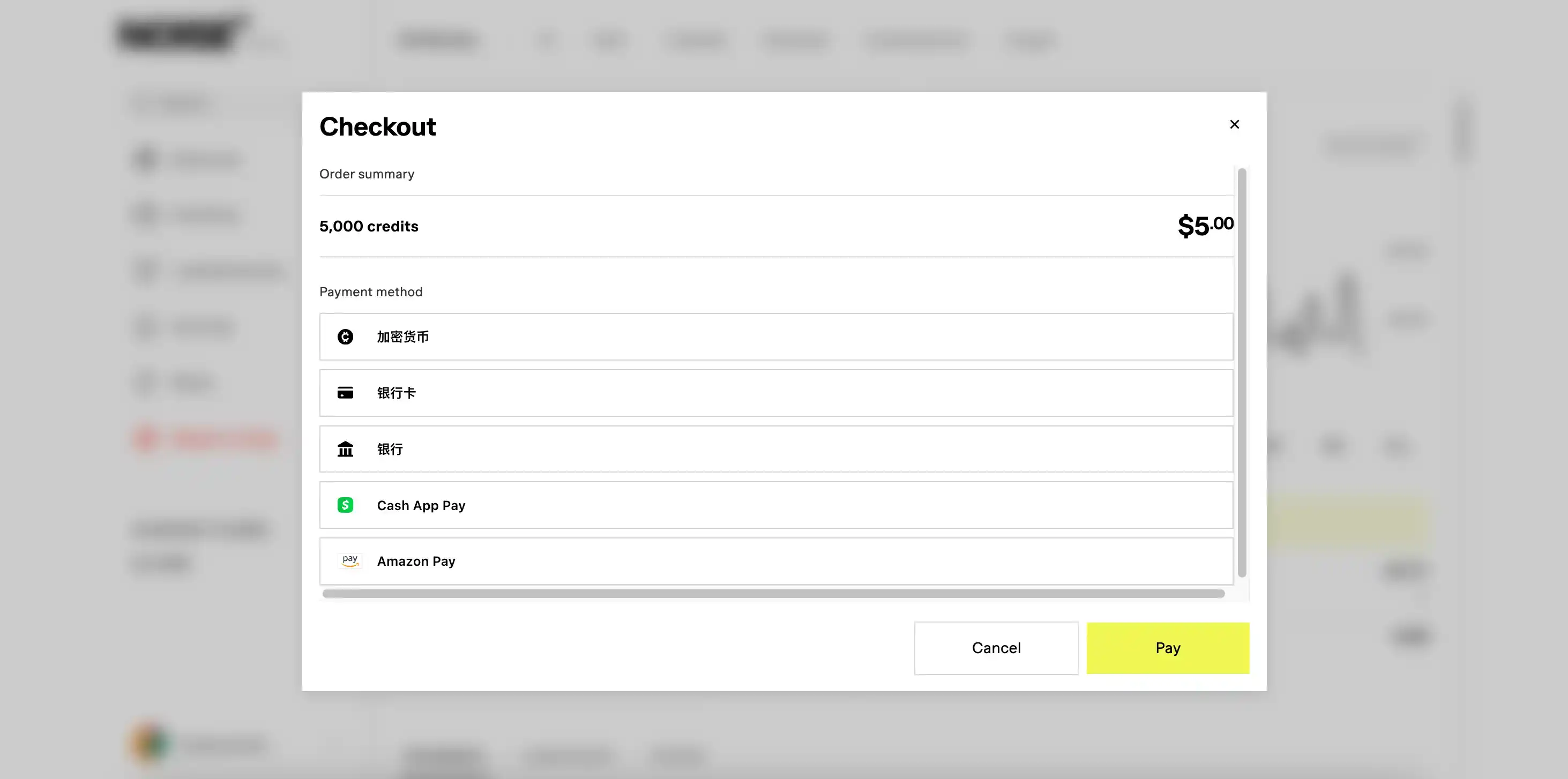
Fiat purchases are supported through banking channels, Cash App, and Amazon Pay. For cryptocurrency channels, transfers need to be made via MetaMask and Phantom, currently supporting USDC on Ethereum and Solana. The author did not find an entry to exchange credits back to fiat or stablecoins, possibly because the Beta version is only testing the trading engine and does not yet have a settlement function.

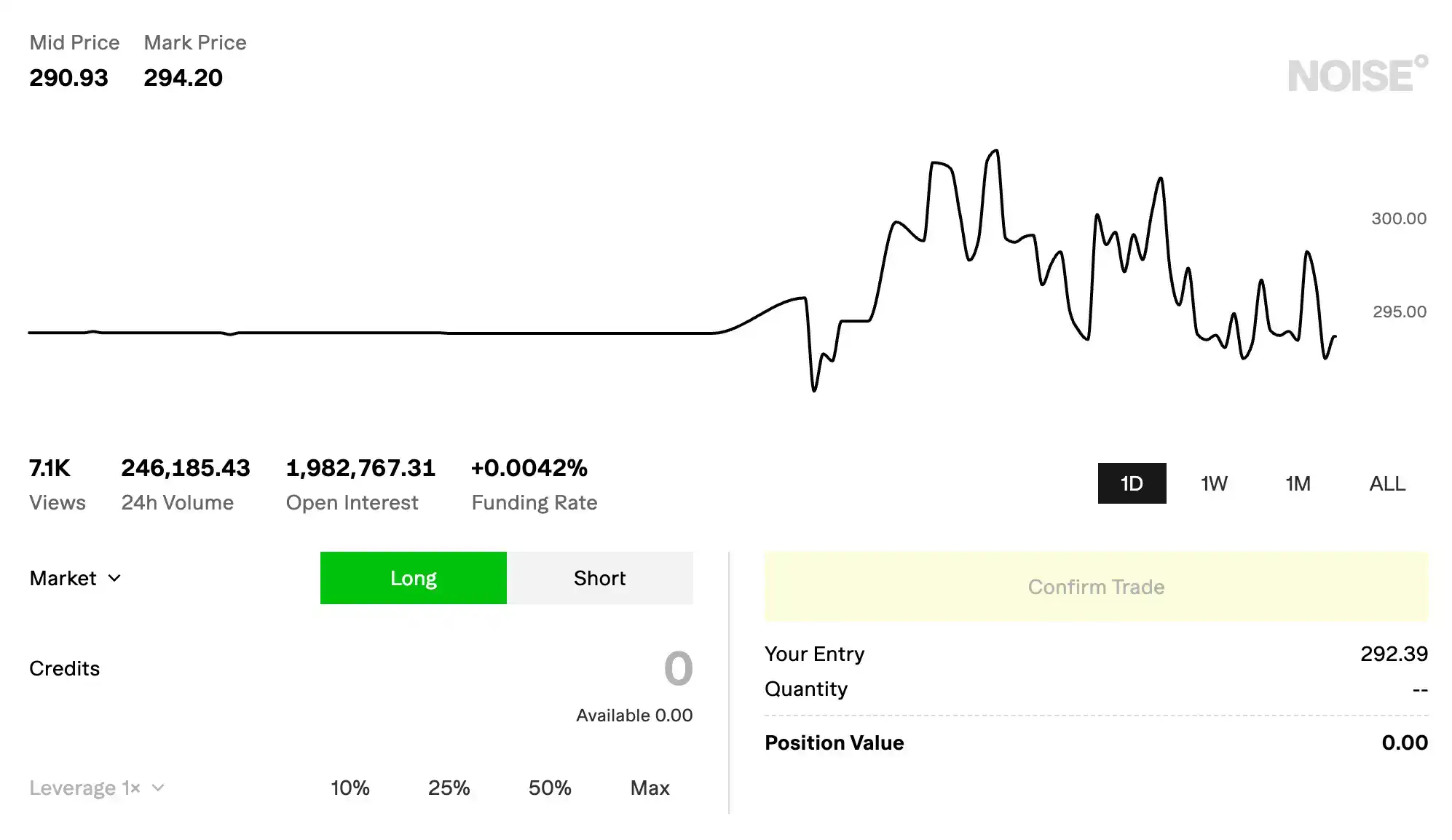
Taking "crude oil," a recent market focus with high attention, as an example, you can choose leverage from 1x to 5x for long or short trading. Currently, this market is one of the hottest in the Noise Beta version, but its 24-hour trading volume is only over 200,000, with an open interest value of about 2 million, which translates to less than $20 million in USD.

Although not displayed on the front end, Noise also uses an order book model. Unlike prediction markets, Noise's trading market is more like cryptocurrency perpetual contracts. The index provided by the oracle is the "mark price," and the market automatically adjusts the balance between the market price and the mark price through funding rates.
As for the hype index we are trading, Noise calls it the "Relevance Index." Data calculation is based on two sources: content and signals.

In terms of content, Noise tracks interactions, post counts, and unique author counts related to topics on platforms including X, Reddit, YouTube, Instagram, Substack, and RSS news feeds. Signals come from trading volume and market counts of related topics on Polymarket and Kalshi.

The smoothed values (to prevent short-term noise effects) of all sources and indicators are aggregated into a comprehensive value through weighting, which is the index users trade. However, Noise has not fully disclosed the specific algorithm, most likely to prevent someone from exploiting the algorithm's mechanism to artificially inflate the hype of an event or weaken the hype of a hot event with a large amount of irrelevant information.

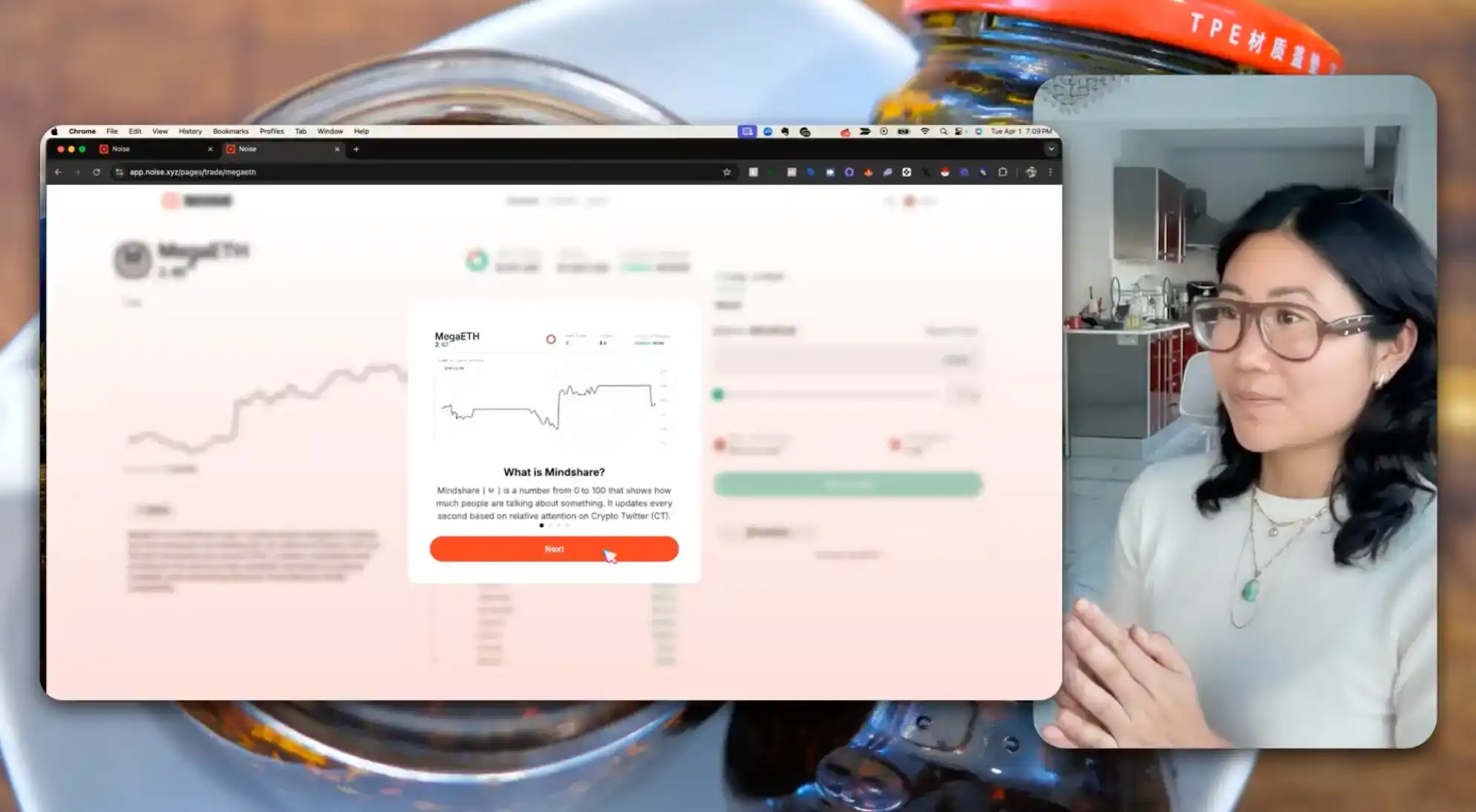
Interestingly, the author found a testnet experience video of Noise on YouTube from a year ago. In April 2025, Noise's index was still a "Mindshare" data between 0 and 100. Even in February of this year, Forbes' report on prediction markets still used this term.
The Founder Who Just Graduated from University

Noise's core founding team consists of three people, all from the University of Southern California: 22-year-old Luca Cordova Stuart, 26-year-old David Zhou, and 24-year-old Gabriel Perez Carafa.

Among them, Gabriel Perez Carafa had no work experience before Noise. Luca Cordova Stuart had an internship in BD at LayerZero Labs, and almost no public information can be found about David Zhou.

None of Noise's three co-founders have particularly impressive backgrounds, similar to Kalshi in its early days. The difference is, although Forbes categorizes Noise as a prediction market, these three young people do not agree. They wrote in the blog post announcing the Beta version launch, "You may have seen people compare Noise to prediction markets. We understand the reason for this comparison, but we do not agree with it. Speculation is just one of many factors. Our goal is to build a platform that helps people understand and spread deeper stories about modern culture, lifestyle, politics, and technological changes."

From multiple articles published in the past, Noise has always wanted to express: eliminate noise and gain true insight. Prediction markets provide the probability of an event happening, backed by real money. What Noise wants to discuss is "whether it is necessary to discuss whether this event will happen."

Besides Speculation, What Are the Application Scenarios?

Trading markets inevitably involve speculation, which is undeniable. The key is what practical use cases Noise has beyond speculation.

Previously, Kalshi's co-founder Lara shared at a conference that recently, there have been many multi-million dollar orders on Kalshi's inflation prediction market, and the source of these orders is large companies using them to hedge against potential wage increases due to a rebound in inflation. Noise provides a similar scenario here: companies can use a portion of their marketing budget to short the topics they plan to market, thereby hedging against the failure of marketing strategies.

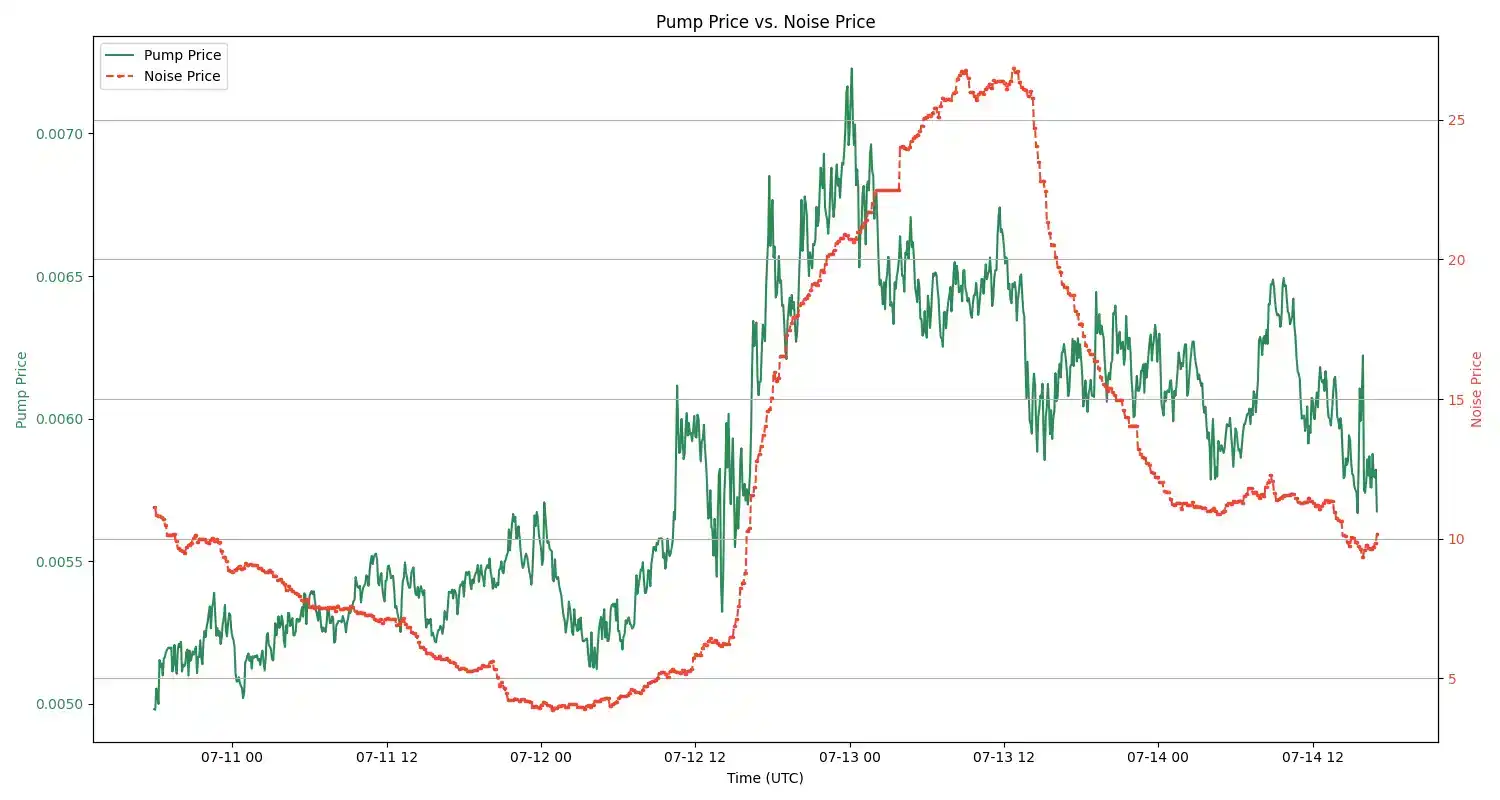
Additionally, "hype" has unique uses in trading such as cryptocurrencies and stocks. In Noise's market regarding the hype of the PUMP topic, the peak hype coincided with the rebound high point after PUMP's first wave of decline. For investors who believe in "buy when no one is interested, sell when everyone is talking," Noise's related markets might be a good reference and hedging channel.
Noise plans to launch its mainnet on Base in the coming months, at which time the platform will be open to everyone and support real money trading. From the author's perspective, Noise's idea is indeed relatively novel and has real application scenarios. However, like prediction markets over a decade ago, trading "hype" and "trends" might still be slightly ahead of its time. But at least in the recent market dominated by stablecoins and payment applications, Noise is a target for airdrop farming.


İlgili Sorular

QWhat is Noise and what does its Beta version allow users to do?

ANoise is a 'relevance prediction market' that launched its Beta version, allowing users to trade on the rise and fall of a 'Relevance Index' for various events or cultural symbols. Users can take long or short positions using leverage.

QHow does Noise generate the 'Relevance Index' that users trade on?

AThe 'Relevance Index' is calculated based on content (interactions, post counts, unique authors from platforms like X, Reddit, YouTube, etc.) and signals (trading volume and market count from prediction markets like Polymarket and Kalshi). These are weighted and smoothed to create a composite value.

QWhat is the purpose of using 'credits' for trading on the Noise Beta platform?

AIn the Beta version, users must purchase 'credits' with fiat currency or cryptocurrency to trade. This is primarily a measure to prevent malicious behavior and test the trading engine, as the platform does not yet support cashing out credits for real money.

QWho are the founders of Noise and what is their background?

ANoise was founded by three graduates from the University of Southern California: 22-year-old Luca Cordova Stuart, 26-year-old David Zhou, and 24-year-old Gabriel Perez Carafa. They have limited prior professional experience, with Stuart having a BD internship at LayerZero Labs.

QWhat are some potential real-world use cases for Noise beyond speculation?

ABeyond speculation, Noise can be used by companies to hedge marketing campaigns by shorting the topic they are promoting, thus hedging against campaign failure. It can also serve as a reference or hedging tool for investors in crypto or stocks by providing a measure of public interest or 'hype' around an asset.

İlgili Okumalar

Anthropic Cries Wolf: Is the AGI Threat Real, or Just an IPO Story?

Anthropic has published an article titled "When AI builds itself," discussing the emerging concept of "recursive self-improvement," where AI begins to actively participate in designing, training, testing, and optimizing its own subsequent versions. The company presents internal data showing that by May 2026, over 80% of code merged into its codebase was written by Claude, its AI model. Claude's capabilities have expanded to handling complex, open-ended engineering tasks, achieving a 76% success rate in such areas, and even contributing to research processes, such as optimizing code performance and conducting AI safety experiments. Anthropic outlines an evolution from human-driven development to AI-assisted workflows, culminating in the current stage where AI agents can autonomously write, run, and delegate code. The company cautions that the path toward a "closed loop," where AI continuously improves itself, is becoming visible. It calls for coordinated global mechanisms to potentially slow or pause frontier AI development to allow safety research and societal structures to catch up. However, the timing of this warning coincides with Anthropic's preparations for an IPO, framing the narrative not just as a safety concern but also as a demonstration of Claude's advanced capabilities and its integral role in accelerating Anthropic's own R&D—creating a potential "flywheel" effect for competitive advantage. This contrasts with OpenAI's recent, more policy-oriented discussion of the same risks, highlighting the competitive dynamics in the AI industry as companies position themselves in both the technological and regulatory landscape.

marsbit22 dk önce

Anthropic Cries Wolf: Is the AGI Threat Real, or Just an IPO Story?

marsbit22 dk önce

BIT Research: ETF Purchases Have Slowed, Strategy (MicroStrategy) Has Slowed, What Else Can Drive Bitcoin's Rise?

Market Refocus on Inflation and Rate Expectations Weighs on Bitcoin Currently, the market is in a phase of macro-repricing dominated by inflation and interest rate expectations. Bitcoin, which previously benefited from easy liquidity and low inflation, is seeing its core bullish drivers weaken. These drivers were market expectations for interest rate cuts and strong inflows from Bitcoin ETFs and institutions like MicroStrategy (referred to as "Strategy" in the text). The logic has shifted. Recent high inflation data (e.g., CPI hitting 3.8% in a May 2026 report) has caused the market to sharply reduce its rate cut expectations for 2025 and even price in potential hikes. This is a key constraint for Bitcoin, as it lacks cash flows and is highly sensitive to rate expectations. Concurrently, institutional capital flows have slowed significantly. Following the hot CPI data, Bitcoin ETFs saw accelerated outflows, with around $4.3 billion leaving over a period. MicroStrategy's ability to keep adding substantial Bitcoin to its balance sheet is also diminishing. Together, ETF and MicroStrategy holdings total roughly $110 billion, but their momentum as growth engines is cooling. In summary, Bitcoin's current pressure stems not from its own fundamentals but from a changing macro environment. As long as inflation stays elevated, Bitcoin is likely to remain in a consolidating phase. However, historically, inflation eventually peaks. Once it recedes and rate cut expectations rebuild, institutional capital could return, potentially fueling a new and more robust recovery phase for Bitcoin.

marsbit30 dk önce

BIT Research: ETF Purchases Have Slowed, Strategy (MicroStrategy) Has Slowed, What Else Can Drive Bitcoin's Rise?

marsbit30 dk önce

Earning 1000 Trillion in Half a Year, 'Pocketing' 20 Million per Capita: This Round of Wealth Creation in the Korean Stock Market is Unprecedented in Scale

The South Korean stock market is experiencing an unprecedented wealth surge in 2026, with household equity and fund asset values soaring by over 1,000 trillion KRW (~$730bn) year-to-date. This translates to an average per capita wealth increase of roughly 20 million KRW, fueled by a historic 109% rally in the KOSPI index. The boom is driven by three converging forces: an AI-driven semiconductor supercycle boosting giants like Samsung and SK Hynix; the government's "Value-Up" market reforms addressing long-standing corporate governance issues; and aggressive real estate regulations that have locked capital within financial markets, preventing profits from flowing back into property. This has triggered a wealth effect, boosting high-end consumption significantly. However, the gains are highly concentrated. The two semiconductor behemoths account for over half the index's value, but retail investors own relatively low stakes in them, systematically missing the biggest rallies. Wealth and consumption benefits are skewed towards luxury goods and imported cars, bypassing mainstream retail. Further risks stem from excessive leverage, with high trading volume in leveraged ETFs, and a market sentiment heavily reliant on the AI sector's fortunes and speculative rumors. While this cycle marks a potential shift from real estate to equities as a primary wealth generator for Koreans, its sustainability, amid structural imbalances and leverage, remains a critical test.

marsbit35 dk önce

Earning 1000 Trillion in Half a Year, 'Pocketing' 20 Million per Capita: This Round of Wealth Creation in the Korean Stock Market is Unprecedented in Scale

marsbit35 dk önce

Behind ZEC's Over 30% Plunge: An 'Unlimited Minting' Vulnerability with No Way to Prove if It Was Ever Exploited

A critical vulnerability was discovered in Zcash's Orchard privacy pool, allowing for the theoretical creation of undetectable counterfeit ZEC. Researcher Taylor Hornby found the flaw on May 29th, 2024, within the Orchard circuit's cryptographic constraints, which could let an attacker bypass asset conservation rules. Although a rapid emergency fix was deployed within days via a coordinated soft and hard fork, a core uncertainty remains: due to Orchard's privacy features, it is impossible to cryptographically prove whether this "unlimited mint" flaw was exploited in the nearly four years since the pool's 2022 launch. This uncertainty, rather than the patched flaw itself, triggered a market panic, causing ZEC's price to drop over 30%. While the Zcash Foundation stated no evidence of exploitation was found, independent entity Shielded Labs emphasized the impossibility of definitively proving no counterfeit ZEC was ever created. The incident highlights the unique trust challenge in privacy systems. To address this, developers are proposing a new network upgrade with enhanced auditing to allow verifiable proof of supply integrity. Notably, the researcher utilized the newly released AI model Claude Opus 4.8 as a tool during the security review, signaling the growing role of advanced AI in uncovering complex cryptographic vulnerabilities.

marsbit37 dk önce

Behind ZEC's Over 30% Plunge: An 'Unlimited Minting' Vulnerability with No Way to Prove if It Was Ever Exploited

marsbit37 dk önce

İşlemler

Spot
Futures

Popüler Makaleler

HYPE Nasıl Satın Alınır

HTX.com’a hoş geldiniz! Hyperliquid (HYPE) satın alma işlemlerini basit ve kullanışlı bir hâle getirdik. Adım adım açıkladığımız rehberimizi takip ederek kripto yolculuğunuza başlayın. 1. Adım: HTX Hesabınızı OluşturunHTX'te ücretsiz bir hesap açmak için e-posta adresinizi veya telefon numaranızı kullanın. Sorunsuzca kaydolun ve tüm özelliklerin kilidini açın. Hesabımı Aç2. Adım: Kripto Satın Al Bölümüne Gidin ve Ödeme Yönteminizi SeçinKredi/Banka Kartı: Visa veya Mastercard'ınızı kullanarak anında Hyperliquid (HYPE) satın alın.Bakiye: Sorunsuz bir şekilde işlem yapmak için HTX hesap bakiyenizdeki fonları kullanın.Üçüncü Taraflar: Kullanımı kolaylaştırmak için Google Pay ve Apple Pay gibi popüler ödeme yöntemlerini ekledik.P2P: HTX'teki diğer kullanıcılarla doğrudan işlem yapın.Borsa Dışı (OTC): Yatırımcılar için kişiye özel hizmetler ve rekabetçi döviz kurları sunuyoruz.3. Adım: Hyperliquid (HYPE) Varlıklarınızı SaklayınHyperliquid (HYPE) satın aldıktan sonra HTX hesabınızda saklayın. Alternatif olarak, blok zinciri transferi yoluyla başka bir yere gönderebilir veya diğer kripto para birimlerini takas etmek için kullanabilirsiniz.4. Adım: Hyperliquid (HYPE) Varlıklarınızla İşlem YapınHTX'in spot piyasasında Hyperliquid (HYPE) ile kolayca işlemler yapın.Hesabınıza erişin, işlem çiftinizi seçin, işlemlerinizi gerçekleştirin ve gerçek zamanlı olarak izleyin. Hem yeni başlayanlar hem de deneyimli yatırımcılar için kullanıcı dostu bir deneyim sunuyoruz.

271 Toplam GörüntülenmeYayınlanma 2024.12.11Güncellenme 2026.06.02

HYPE Nasıl Satın Alınır

Tartışmalar

HTX Topluluğuna hoş geldiniz. Burada, en son platform gelişmeleri hakkında bilgi sahibi olabilir ve profesyonel piyasa görüşlerine erişebilirsiniz. Kullanıcıların HYPE (HYPE) fiyatı hakkındaki görüşleri aşağıda sunulmaktadır.

活动图片