Analyzing if AAVE could target $92 after breaking KEY support

ambcrypto2026-03-29 tarihinde yayınlandı2026-03-29 tarihinde güncellendi

Özet

AAVE breached the $100 support level amid a broader market decline, falling to a three-week low of $96 and trading at $97 at press time, down 7.7% daily. The market cap dropped by over $200 million. The altcoin fell below its short-term moving averages, reflecting strong bearish pressure. Market participants turned bearish, with the Bulls vs. Bears indicator turning negative after over a month of positivity. Exchange data showed a net inflow of tokens, indicating selling dominance, and the Exchange Supply Ratio hit a monthly high of 0.137. The RSI dropped to 34, nearing oversold conditions, suggesting continued seller control. If bearish momentum persists, AAVE could decline toward $92. A rebound would require reclaiming $100 and key moving averages at $107 and $110; otherwise, the downtrend may continue.

Aave [AAVE] breached the $100 support level amid a broader market slip and fell to a three-week low of $96. In fact, at press time, AAVE traded at $97, down 7.7% on the daily charts, while the market cap fell by over $200 million.

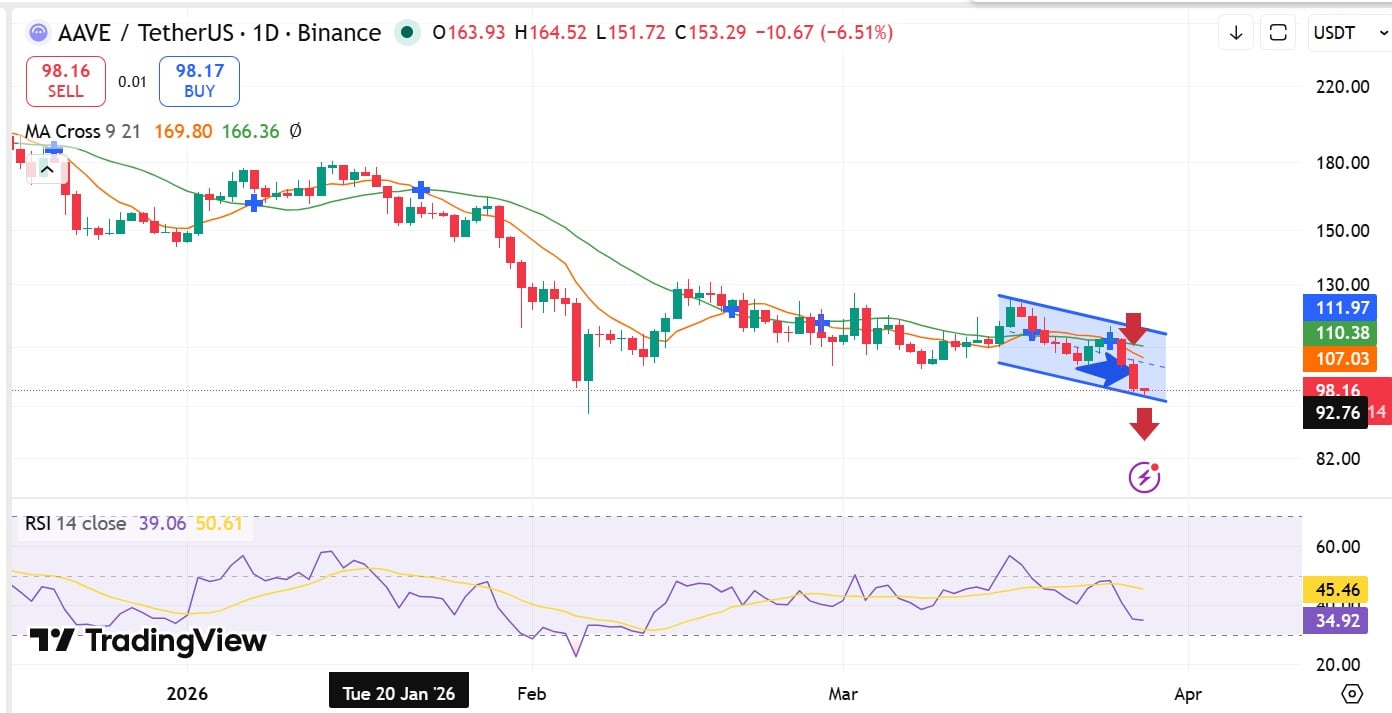
In doing so, the altcoin fell below its short-term Moving Averages (MA), the 9- and 21-day MAs, reflecting strong downside pressure.

AAVE drops below $100

As the crypto market retraced, AAVE market participants turned bearish and began exiting the market aggressively, thereby strengthening downside momentum.

In fact, the Bulls vs. Bears indicator turned negative after being positive for more than a month. When this metric turns negative, it suggests that sellers have dominated the market and displaced buyers.
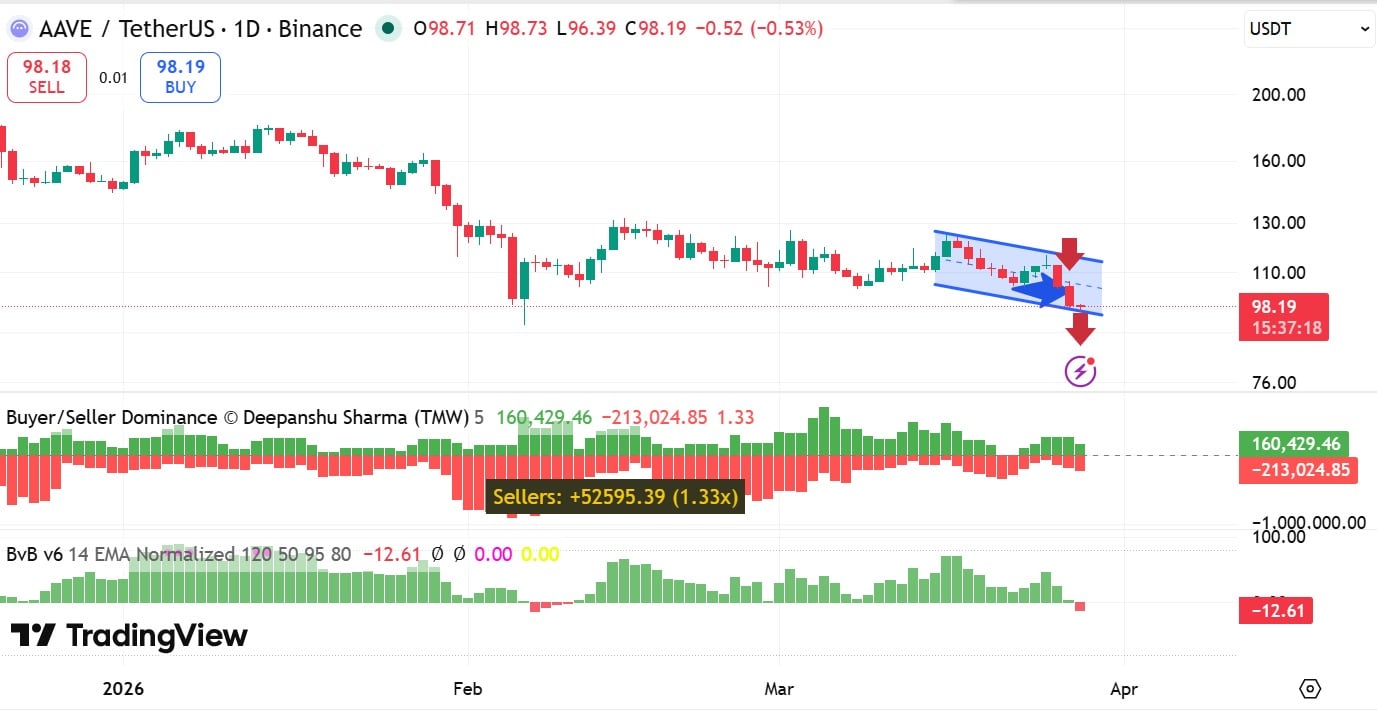
Source: TradingView

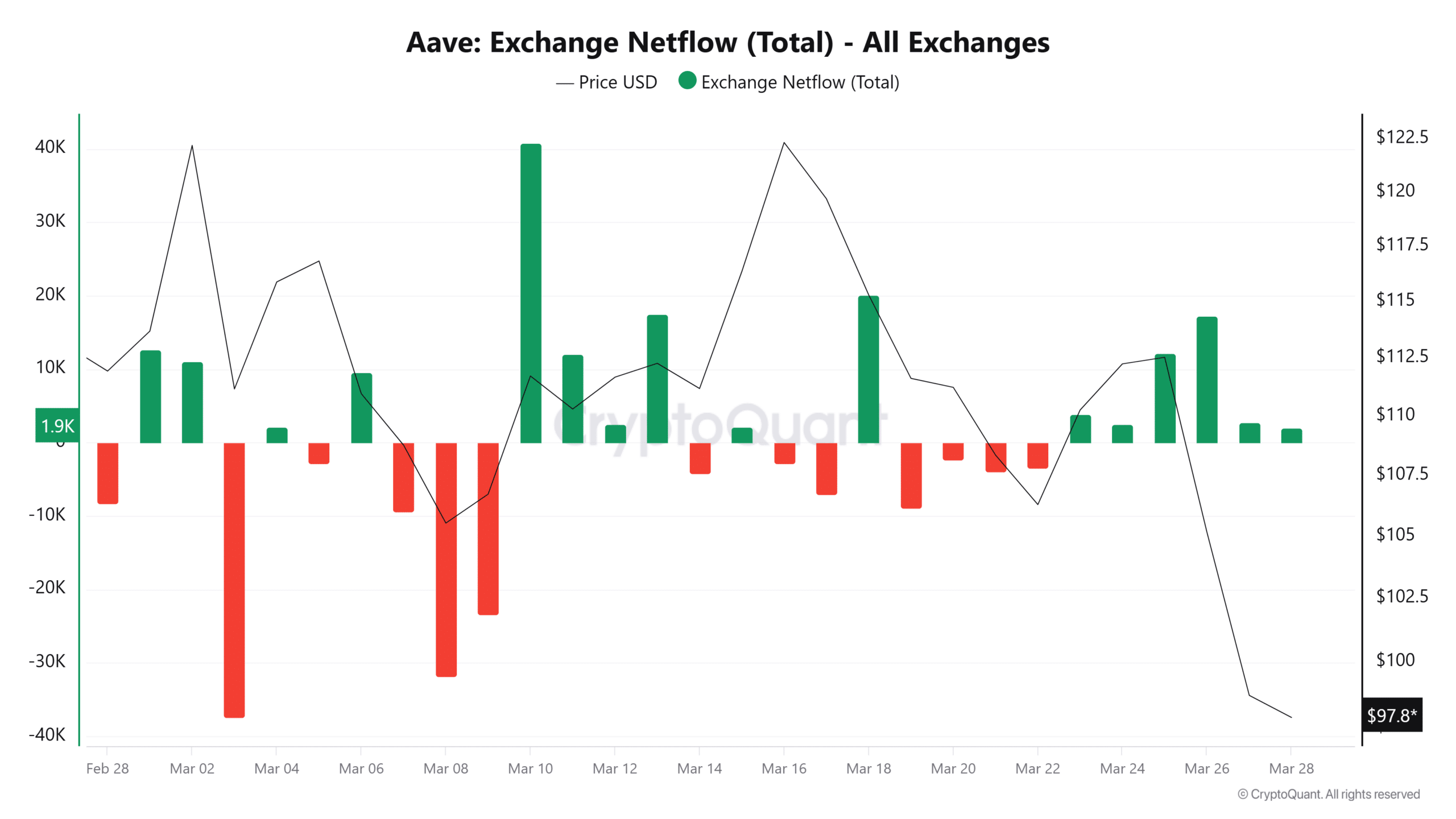
Furthermore, exchange activities echoed this seller dominance. According to CryptoQuant data, 79k AAVE tokens flowed into exchanges, compared to 74k flowing out.
Source: CryptoQuant

Thus, the altcoin’s Netflow extended its hold within the positive zone for the sixth day, suggesting that sellers have had a strong dominance over the market.

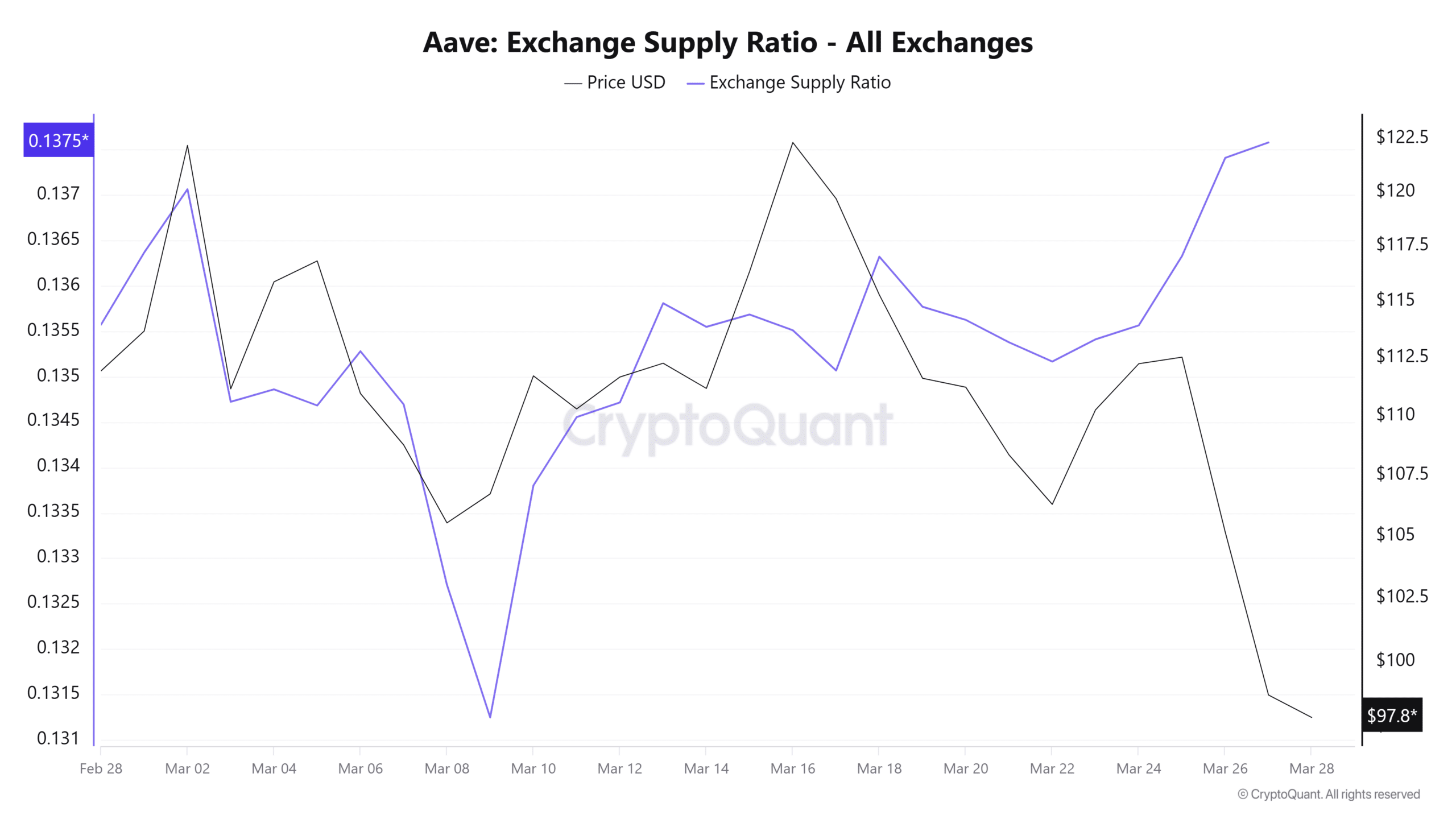
As a result, the altcoin’s Exchange Supply Ratio jumped to a monthly high of 0.137 as of writing, indicating increased selling activity. Often, such a jump in ESR reduces scarcity, thus increasing the supply available for immediate sale.
Source: CryptoQuant

Such a setup on exchanges has preceded strong downward momentum for the asset, leading to lower prices.

What momentum indicators suggest

AAVE has experienced strong downward momentum and breached a key support level, with sellers significantly outpacing buyers. Since then, the altcoin’s Relative Strength Index (RSI) dropped deeper into bearish territory, falling to 34 at press time.

With RSI nearing oversold territory, this suggests sellers’ control of the market, while buyers have largely stepped back. Traditionally, such market conditions have strengthened downward momentum, typically resulting in lower prices.
Source: TradingView

Therefore, if sellers continue to overrun the market with little resistance, AAVE is likely to slide towards $92 before attempting another leg up.

However, if the market cools down and bulls reclaim $100, the altcoin could set the ground for a rebound. But for a significant trend reversal, bulls need to flip $100 and reclaim the 9- and 21-day MAs at $107 and $110, respectively.

Failure to do so will see the altcoin enter an extended bearish streak, with a likelihood of staying below $100.


Final Summary

  • Aave dropped 7.7%, breaching $100 and dropping to a three-week low of $96.
  • AAVE faced intense selling pressure, with bears outpacing bulls, strengthening downside risk.

İlgili Sorular

QWhat key support level did AAVE breach, and what was its price at the time of writing?

AAAVE breached the $100 support level and was trading at $97 at the time of writing.

QWhat does the Bulls vs. Bears indicator turning negative suggest about the AAVE market?

AIt suggests that sellers have dominated the market and displaced buyers, indicating strong bearish sentiment.

QAccording to the data, how did the Netflow and Exchange Supply Ratio (ESR) metrics reflect selling pressure?

AThe Netflow was positive for the sixth day, and the Exchange Supply Ratio jumped to a monthly high of 0.137, both indicating increased selling activity and dominance by sellers.

QWhat does the RSI value of 34 at press time imply for AAVE's price momentum?

AAn RSI of 34 suggests that the market is nearing oversold territory, with sellers in control and strong downward momentum, which could lead to lower prices.

QWhat are the two potential price scenarios for AAVE mentioned in the article?

AIf sellers continue to dominate, AAVE could slide towards $92. If bulls reclaim $100, it could set the stage for a rebound, but a significant reversal requires flipping $100 and reclaiming the 9- and 21-day MAs at $107 and $110.

İlgili Okumalar

In Jinjiang, Fujian, a Storage Super Unicorn Lies Quiet

In Fujian's Jinjiang, a city known for sportswear, lies a quiet semiconductor giant: Fujian Jinhua Integrated Circuit Co. (JHICC). Once a promising domestic DRAM manufacturer alongside Yangtze Memory and ChangXin Memory Technologies (CXMT), its journey was derailed in 2018 when the U.S. placed it on an Entity List and filed criminal charges for alleged trade secret theft. This halted production for years. A turning point came in February 2024 when a U.S. federal court found JHICC not guilty. However, it had lost crucial time. While CXMT soared to become a top-valued A-share company in 2024, JHICC, with an estimated valuation of 80 billion RMB, was just restarting. Its current output is primarily customized DDR4 chips, not the advanced DDR5/HBM demanded for AI, but it still benefits from the broader memory chip upcycle. JHICC's story is tied to Chen Zhengkun, a veteran engineer who left Micron to lead the venture. Founded in 2016 with state-backed funding, JHICC partnered with Taiwan's UMC to develop DRAM technology. Rapid progress was cut short by the U.S. actions, which Micron initiated, partly due to its heavy reliance on the Chinese market. Post-sanctions, Chen's team worked to rebuild the production line with reduced reliance on U.S. technology. According to its records, JHICC achieved small-scale production and revenue growth under immense pressure. It now focuses on the stable "niche" DRAM market (e.g., TVs, routers) with a monthly capacity of ~40,000 wafers, aiming for 60,000 by 2026. It holds over 1,000 patents but remains on the Entity List. For Jinjiang, investing in JHICC was a bold industrial leap. The local government provided unwavering financial and logistical support during the crisis, helping the company survive. JHICC has become the anchor for a growing local semiconductor cluster. Though its scale lags behind domestic peers, JHICC's persistence symbolizes a hard-won foothold in a global market long dominated by Samsung, SK Hynix, and Micron. Having missed one boom, it seeks a place in the new AI-driven memory supercycle.

marsbit1 saat önce

In Jinjiang, Fujian, a Storage Super Unicorn Lies Quiet

marsbit1 saat önce

İşlemler

Spot
活动图片





