Analyst Reveals Bitcoin Strategy With 250% Potential Upside — Key Entry Levels Identified

bitcoinist2026-03-09 tarihinde yayınlandı2026-03-09 tarihinde güncellendi

Özet

A popular crypto analyst, Ali Martinez, has outlined a Bitcoin buy-and-hold strategy with a potential upside of over 250%. The plan is based on the Cumulative Value Days Destroyed (CVDD) indicator, an on-chain metric used to identify long-term support and resistance levels. The analysis suggests that Bitcoin's price could bottom out around the CVDD line at approximately $49,330, which has historically acted as a cycle bottom and a prime accumulation zone. From this entry point, the strategy identifies two key profit-taking levels: $178,478 (the CVDD 3.618x line) and $273,158 (the Alpha CVDD line). A move from the suggested entry to the first target would represent a gain of over 260%. At the time of writing, Bitcoin price is approximately $67,350, down over 1% in the past 24 hours.

A popular crypto analyst on the social media platform X has shared a buy-and-hold strategy for Bitcoin, which could potentially yield over 250% gain in the near future.

BTC Price To Bottom Out Around $49,000?

In a recent post on the X platform, market pundit Ali Martinez put forward an exciting trade plan for Bitcoin, the world’s largest cryptocurrency by market capitalization. This strategy revolves around the CVDD (Cumulative Value Days Destroyed) Channel.

CVDD is an on-chain technical indicator based on the volume of aged capital being sent into the market. This on-chain metric is typically used in highlighting zones of long-term support or resistance based on the movement of long-held coins.

The Cumulative Value Days Destroyed line, which is typically the lowest line in the channel, signals a phase of severe undervaluation. The channel extensions (the resistance bands, which are usually the targets during bull markets) are then created by applying Fibonacci multiples to the base CVDD line.

From a historical perspective, the Bitcoin price has never dropped below the CVDD line (the base line of the channel), marking it as a relevant indicator for identifying cycle bottoms. Hence, the line is often considered a primary accumulation zone, where investors often bet on a price reversal.
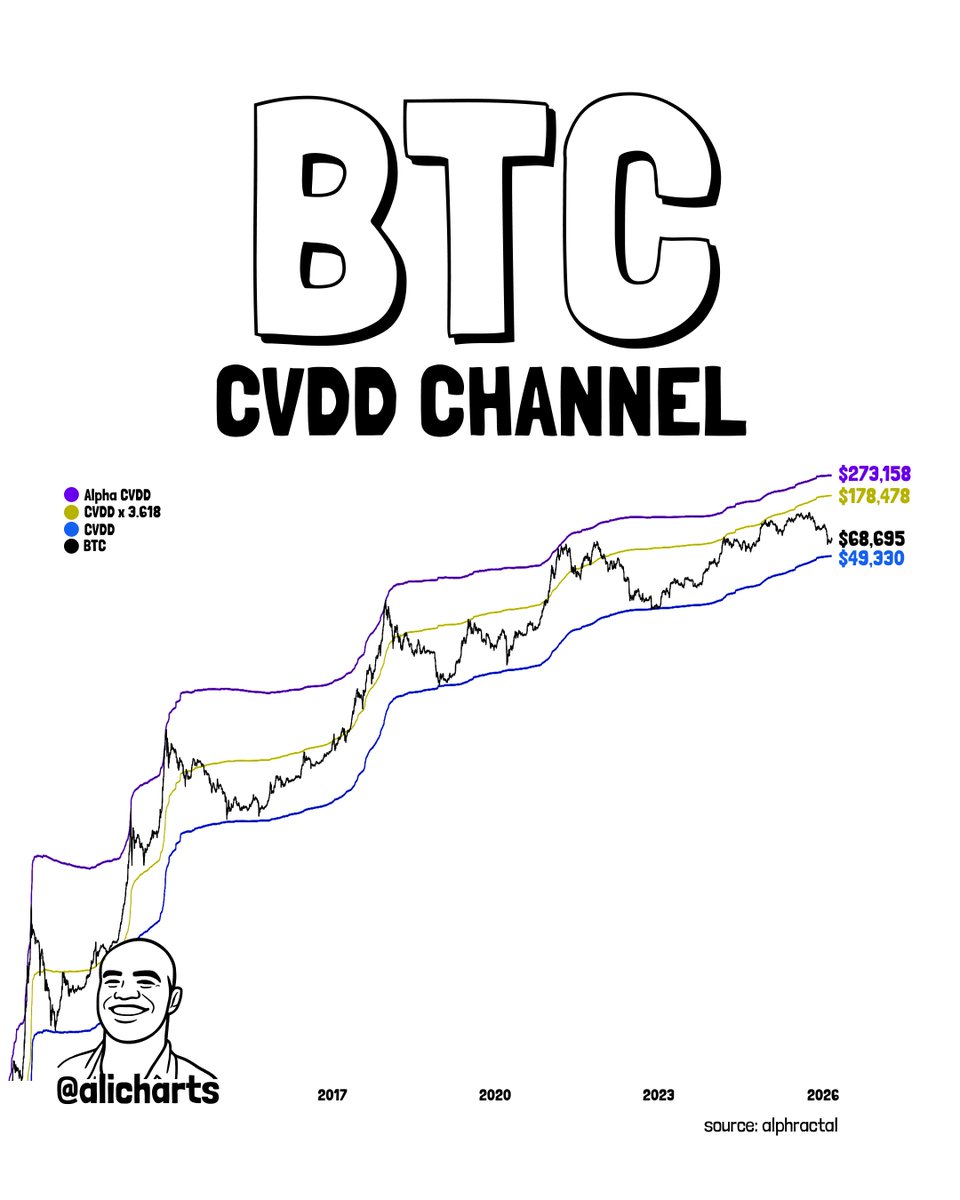
Source: @ali_charts on X

As shown in the highlighted chart, this CVDD line (blue) is currently around $49,330, representing the potential Bitcoin bottom in this bearish phase. According to Martinez, this price point also represents the perfect spot to take a position in the flagship cryptocurrency.

Next, the market analyst says to take profit from this trade at the resistance levels around $178,478 or $273,158. These $178,478 and $273,158 resistance levels are the CVDD 3.618x and Alpha CVDD lines, respectively, of the channel, and they represent potential cycle tops for the Bitcoin price.

If the price of BTC indeed soars from $49,330 to at least the $178,478 top, that would represent an over 260% rally in one cycle. Meanwhile, it would take a further 53% upside movement from $178,478 toward the next resistance level.

Bitcoin Price Overview

As of this writing, the price of BTC stands at around $67,350, reflecting a more than 1% decline in the past 24 hours. According to data from CoinGecko, the premier cryptocurrency is barely up by 1% kn the weekly timeframe.

The price of BTC on the daily timeframe | Source: BTCUSDT chart on TradingView


İlgili Sorular

QWhat is the CVDD indicator and how is it used in the Bitcoin strategy mentioned?

ACVDD (Cumulative Value Days Destroyed) is an on-chain technical indicator based on the volume of aged capital being sent into the market. It is used to highlight zones of long-term support or resistance based on the movement of long-held coins. In this strategy, the CVDD line (approximately $49,330) is identified as a potential cycle bottom and accumulation zone, while its Fibonacci multiples ($178,478 and $273,158) represent potential cycle tops for taking profits.

QAccording to Ali Martinez, what are the key entry and profit-taking levels for Bitcoin in this strategy?

AThe key entry level is near $49,330, which is the CVDD line and potential bottom. The profit-taking levels are between $178,478 (CVDD 3.618x) and $273,158 (Alpha CVDD line), representing potential cycle tops.

QWhat potential percentage gain does this strategy offer if Bitcoin reaches the first profit target?

AIf Bitcoin rises from the entry point of $49,330 to the first profit target of $178,478, it would represent a gain of over 260%.

QWhat is the current price of Bitcoin and its recent performance as mentioned in the article?

AAs of the writing of the article, the price is around $67,350, reflecting a more than 1% decline in the past 24 hours and a barely 1% increase on the weekly timeframe.

QWhy is the CVDD line considered a significant indicator for identifying cycle bottoms in Bitcoin?

AFrom a historical perspective, the Bitcoin price has never dropped below the CVDD line, marking it as a relevant indicator for identifying cycle bottoms. It is often considered a primary accumulation zone where investors bet on a price reversal.

İlgili Okumalar

Stuck Polymarket: The Real Test After Riding the Traffic Boom Has Arrived

Polymarket, a leading prediction market platform, is facing significant technical challenges as its growth outpaces its current infrastructure on Polygon. Users are experiencing laggy transactions, unresponsive orders, and delayed confirmations, severely impacting the trading experience. In response, DeFi Engineering VP Josh Stevens outlined a comprehensive engineering overhaul. The plan includes reducing on-chain data delays, fixing order cancellation issues, rebuilding the central limit order book (CLOB), improving website performance, and developing a unified SDK and API. A major revelation was the ongoing "chain migration," indicating a potential move away from Polygon. The core issue is that Polymarket has evolved from a simple prediction market into a high-frequency trading platform, making Polygon's limitations—such as block space, gas fees, and block time—a ceiling for further growth. The migration is not just a simple chain switch but a fundamental rebuild of its trading system to support more complex products like perpetual contracts (Perps). This announcement has sparked competition among chains like Solana, Sui, and Algorand, all vying to host Polymarket. For Polygon, losing this key application, which contributes significantly to its gas fee revenue, would be a major setback. The real test for Polymarket is no longer attracting users but proving it can provide a stable, reliable trading environment that retains them.

Odaily星球日报19 dk önce

Stuck Polymarket: The Real Test After Riding the Traffic Boom Has Arrived

Odaily星球日报19 dk önce

Lowering Expectations for BTC's Next Bull Market

The author, Alex Xu, explains his decision to significantly reduce his Bitcoin holdings (from full to ~30% of his portfolio) during the current bull cycle, citing a lowered long-term outlook for BTC's price appreciation in the next cycle. He outlines six key reasons for this reduced expectation: 1. **Diminished Growth Drivers:** The narrative of exponential user adoption has largely played out with institutional ETF adoption. The next major growth phase—adoption by sovereign national reserves or central banks—seems unlikely in the near future. 2. **Personal Opportunity Cost:** More attractive investment opportunities have emerged in other assets, such as undervalued companies. 3. **Industry-Wide Contraction:** The broader crypto industry is struggling, with most Web3 business models (SocialFi, GameFi, DePIN) failing. This overall萧条 (depression) reduces the fundamental demand and consensus for Bitcoin. 4. **Strain on Major Buyer:** MicroStrategy, a major corporate buyer of BTC, faces rising financing expenses for its debt, which could slow its purchasing rate and create significant marginal pressure on the market. 5. **Increased Competition from Gold:** The emergence of "tokenized gold" has closed the functional gap (portability, divisibility) between physical gold and Bitcoin, offering a strong competitor in the non-sovereign store-of-value space. 6. **Security Budget Concerns:** The block reward halving continues to exacerbate the long-standing issue of funding Bitcoin's network security, with new fee source explorations like Ordinals and L2s largely failing. The author's decision to hold a significant (though reduced) position reflects a cautious, not bearish, outlook. He remains open to increasing his exposure if the fundamental reasons for his skepticism change or if new positive catalysts emerge.

marsbit58 dk önce

Lowering Expectations for BTC's Next Bull Market

marsbit58 dk önce

Can Iran 'Control' the Strait of Hormuz?

Iran has announced a comprehensive plan to assert control over the strategic Strait of Hormuz, a critical global oil shipping chokepoint. The proposed measures include requiring all vessels to obtain Iranian permission for passage, imposing fees for security, environmental protection, and navigation management—preferably paid in Iranian rials—and absolutely banning Israeli ships. Vessels from countries deemed hostile by Iran’s top security bodies may also be barred. Analysts suggest Iran’s motives are multifaceted: increasing pressure on the U.S. and Israel by leveraging control over oil transit to influence global prices and inflation; creating a new revenue stream, potentially exceeding $7.7 billion annually, to counter Western sanctions and support postwar reconstruction; and using transit permissions as bargaining chips in future negotiations, notably with the U.S. However, the plan faces significant practical and diplomatic challenges. Enforcing comprehensive interception and fee collection in the busy waterway, patrolled by international military forces, would be difficult. The U.S. has already countering with a blockade of Iranian ports and threats to intercept any ship paying fees, potentially strangling Iran’s oil exports and fee revenue. Broad international opposition, led by European and Gulf states, and legal controversies further complicate implementation. The proposal may ultimately serve more as a negotiating tactic than a feasible policy, with its execution remaining highly uncertain.

marsbit2 saat önce

Can Iran 'Control' the Strait of Hormuz?

marsbit2 saat önce

İşlemler

Spot
Futures
活动图片




