Analyst Predicts The ‘Biggest Altcoin Season Ever’, Reveals The Real Drivers

bitcoinist2026-05-28 tarihinde yayınlandı2026-05-28 tarihinde güncellendi

Özet

Crypto analyst Fergani predicts the biggest altcoin season ever will occur within the next six months, driven by AI. He cites the Others/BTC chart, indicating altcoins have strong support and are poised for significant gains against Bitcoin. While some AI coins like TAO and NEAR have rallied recently, the overall altcoin season index remains low at 31, far from the 75 threshold indicating a true season. Another analyst, Ryker, forecasts the season will start in June and last about six months, similar to past cycles, leading to major pumps for various altcoins. Despite current market sluggishness, exchange volume for altcoins is increasing, suggesting some investors are quietly accumulating.

Crypto analyst Fergani has predicted that the biggest altcoin season will happen this year. The analyst also revealed the catalyst that will drive this bullish momentum for altcoins, as he noted that this could be the latest real run for these crypto assets.

Analyst Predicts This Year Will Be The Biggest Altcoin Season Ever

In an X post, Fergani stated that this year will be the biggest altcoin season ever and suggested it would happen within the next six months. He cited the Others/BTC chart, which shows that these altcoins have formed a strong support at their current levels and are ready to record significant gains against Bitcoin.

The analyst also alluded to AI as what will drive the altcoin season, although he didn’t explain why or how that would happen. He added that this might be the last real altcoin run before the game changes forever. It is worth noting that some AI coins, such as TAO, NEAR, and VVV, have recorded significant gains over the past few weeks.
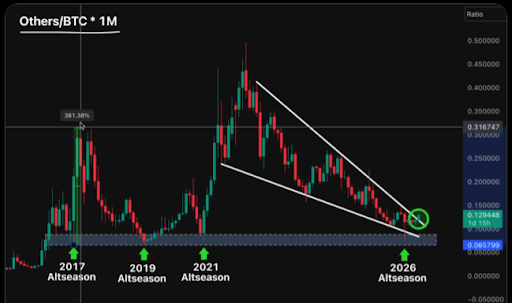
Source: Chart from Fergani on X

Crypto analyst CW recently pointed out that exchange volume for altcoins, excluding the top 5 cryptos by market cap, is increasing and that trading is increasingly concentrated in altcoins amid this sluggish situation. He added that some investors are quietly accumulating altcoins, while some people are negative about the altcoin season.

Despite the recent gains in some altcoins, it is worth noting that it is still far from being altcoin season. BlockchainCenter data shows that the altcoin season index is currently at 31, signaling that it is still Bitcoin season. The index needs to reach 75 for it to be altcoin season. Over the last 90 days, only 15 of the top 50 coins by market cap have outperformed BTC. For it to be altcoin season, 75% of these coins need to have outperformed the leading crypto over this period.

Altcoin Season To Start In June

Crypto analyst Ryker predicted that the next altcoin season will take place from June to January 2027. This came as he noted that the season usually lasts about six months and occurs when all altcoins are undervalued. The analyst cited the 2017 and 2021 bull cycles, when the market pumped strongly, leading many coins like XRP, ETH, SOL, and LUNA to see 10x gains.

Ryker noted that it has been up to 4 years since the last altcoin season and advised market participants not to miss the one about to begin and last for 6 months. He also alluded to the OTHERS/BTC chart, which showed that these altcoins are about to break out against Bitcoin. In another X post, the analyst noted that the gains recorded by coins such as ZEC, HYPE, NEAR, and ONDO are just the beginning of altcoin season and that it will lead to pumps for other coins.

Total market cap excluding BTC at $966.99 BILLION on the 1D chart | Source: TOTAL2 on Tradingview.com

İlgili Sorular

QWhat does crypto analyst Fergani predict about the upcoming altcoin season?

AFergani predicts that this year will see the biggest altcoin season ever, and he suggests it will happen within the next six months.

QAccording to the article, what is one key factor that will drive this altcoin season?

AFergani alludes to Artificial Intelligence (AI) as a key driver for the upcoming altcoin season, noting that some AI coins have already seen significant gains.

QWhat data point does Fergani cite to support his bullish prediction for altcoins?

AHe cites the Others/BTC chart, which shows that altcoins have formed a strong support at current levels and are ready to record significant gains against Bitcoin.

QWhat does the BlockchainCenter altcoin season index currently indicate, and what is the threshold for an 'altcoin season'?

AThe index is currently at 31, which signals it is still Bitcoin season. For it to be considered an altcoin season, the index needs to reach 75.

QWhen does crypto analyst Ryker predict the next altcoin season will take place, and how long does he expect it to last?

ARyker predicts the next altcoin season will take place from June to January 2027, and he expects it to last about six months.

İlgili Okumalar

CPU, Quietly Returning to the Center of the AI Computing Power Stage

Over the past three years, AI computing power narratives have been dominated by GPUs. However, starting in 2026, this story began to shift. While training large models remains GPU-intensive, the rapid growth of inference and AI agent workloads, which require high levels of task orchestration, concurrency, and data flow management, has highlighted a renewed critical role for CPUs. These are tasks GPUs are not designed to handle. Intel's recent launch of the Xeon 6+ processor, built on its Intel 18A process and featuring up to 288 efficiency cores (E-cores), exemplifies this strategic pivot. It is positioned not as a mere companion to GPUs but as the essential "control plane" for AI infrastructure, optimized for high-density, energy-efficient, and high-throughput workloads characteristic of AI agents and inference. This "CPU resurgence" is not about CPUs outperforming GPUs in raw computation. It reflects a systemic bottleneck: as AI scales from training single models to deploying countless intelligent agents, the demand for coordination and data handling surges. Major cloud providers are also developing their own high-density ARM-based server CPUs for similar workloads. However, Intel's success with this strategy faces significant challenges. Competition includes NVIDIA's integrated CPU-GPU solutions, the expanding adoption of cloud vendors' in-house ARM CPUs, and the crucial market test of Intel's 18A manufacturing process against rivals like TSMC's N2. In conclusion, CPUs are indeed reclaiming a central, though redefined, role in AI compute—managing the complex orchestration that enables massive-scale AI deployment. While the trend is clear, which company will ultimately lead this CPU resurgence remains an open question to be decided in the data centers of 2027 and beyond.

marsbit14 dk önce

CPU, Quietly Returning to the Center of the AI Computing Power Stage

marsbit14 dk önce

After Collaborating with 35+ DeFi Projects, Pink Brains Discovers the New 2026 KOL Marketing Rules

After collaborating with over 35 leading DeFi projects on marketing over three years, Pink Brains identifies a key shift for effective marketing in 2026: prioritizing the user journey over traditional campaign tactics. The most effective marketing mirrors how users actually behave—starting with discovery on social platforms like X (formerly Twitter), followed by data-driven verification on sites like DefiLlama, and finally, participation with small test funds. Success hinges on genuine, verifiable mechanisms, not just marketing hype. Current user interest centers on several key themes: new DeFi trends (RWA, perps, crypto x AI), meaningful airdrops requiring real contributions, real yield from protocol revenue, and tokens with value capture mechanisms directly tied to product usage. Case studies like Hyperliquid's HYPE (with its aggressive buyback program) and Venice's VVV (linking demand to AI compute) exemplify how strong tokenomics foster user retention. New trading venues like prediction markets, collectibles platforms, and GambleFi are also gaining traction, driven by verifiable activity. The article outlines common mistakes in DeFi KOL marketing, such as using creators unfamiliar with the product, generic messaging, or relying on a few top-tier KOLs. Instead, effective strategies align with different KOL types—educators, content creators, airdrop hunters, and niche experts—for various stages of the user journey. Ultimately, long-term user retention depends on a combination of a genuinely useful product, responsive support, community-aligned tokenomics, and strategic community building. The core takeaway is that sustainable growth stems from products whose value is validated by data and real-world utility, not just promotional efforts.

marsbit32 dk önce

After Collaborating with 35+ DeFi Projects, Pink Brains Discovers the New 2026 KOL Marketing Rules

marsbit32 dk önce

İşlemler

Spot
Futures
活动图片





