Analyst Predicts Bitcoin Price Crash To $15,000 Using Gold Chart

bitcoinist2025-12-09 tarihinde yayınlandı2025-12-09 tarihinde güncellendi

Özet

Analyst The Great Martis predicts a significant Bitcoin price crash to as low as $15,000, using the performance of gold as a key indicator. This forecast follows Bitcoin's recent drop below $100,000, with the analyst suggesting an inverse relationship between the two assets. As gold reaches new all-time highs, driven by Federal Reserve interventions and speculation, Martis expects it could rise to the $12,000 range. Consequently, Bitcoin may face a severe bear market, potentially declining over 70% from current levels and nearly 90% from its $126,000 peak. In 2025, gold has surged 55%, while Bitcoin has fallen 30% from its October high, reinforcing gold's status as a safer investment amid Bitcoin's volatility.

Following the Bitcoin price crash below $100,000 back in November, different bearish predictions have begun to make the rounds in the crypto community. For some, this crash signifies the end of the bull market, ushering in the dreaded bear market. While some of the predictions have been conservative, putting the pioneer cryptocurrency somewhere around $50,000 at the bottom, one analyst in particular has predicted a deeper crash, and this was done using the gold chart.

Why A Crash Could Be Coming For The Bitcoin Price

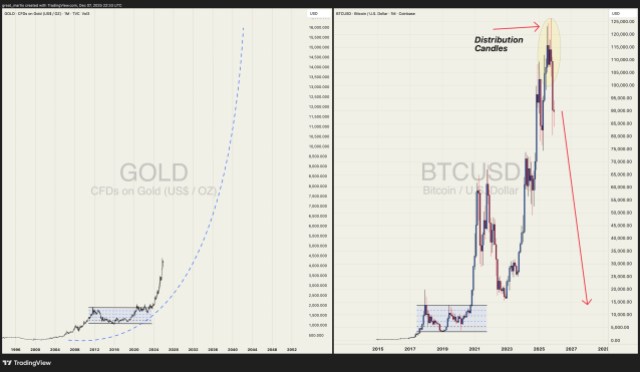
Crypto analyst The Great Martis took to X (formerly Twitter) to share their prediction of where the Bitcoin price is headed next. The chart shows a possible decline that could send Bitcoin moving below $20,000, before eventually reaching a bottom at around $15,000. Although this is not out of the ordinary for analysts to predict such crashes, the reason why Mathis believes this is possible is what is interesting.

The crypto analyst points out that the gold performance, which has seen the asset hitting new all-time highs this year, was being driven by speculation. Martis explains that the Fed’s intervention is something that will continue to drive the price of gold higher, and this could, in turn, continue to push down the Bitcoin price.

Furthermore, the analyst expects that the gold price will rise into the $12,000 territory, putting it in the same region that the Bitcoin price was in back in 2021. The interesting thing to note about Bitcoin in 2021 is that this was the year that the digital asset went on one of its most explosive rallies so far.
Source: X

If Bitcoin continues to perform inversely to gold, then a rise to 5-digits for gold would mean a bearish market for Bitcoin. A crash to $15,000 would translate to a more than 70% decrease in price from the current level, and an almost 90% decline from its $126,000 all-time high.

So far, this year, gold has been the better performer of the two when compared side-by-side. For context, the gold price is already up over 55% in the year 2025; meanwhile, the Bitcoin price suffered a major 30% drop in price after hitting $126,000 back in October.

While both of these assets continue to lead in their respective sectors, gold continues to remain the standard for what investors consider a “safe” investment compared to Bitcoin, which is known for its wild price fluctuations.


BTC retraces weekend gains | Source: BTCUSD on Tradingview.com

İlgili Okumalar

Mars Morning Post | After Fed Rate Cut, US Dollar Records Worst Single-Day Performance Since September; Trump: Rate Cut Too Small, Could Have Been Doubled

Mars News, Dec 11 — Following the Fed’s decision to cut interest rates by 25 basis points, the US dollar recorded its worst single-day performance since September, with the dollar index falling 0.4%. Fed Chair Powell emphasized labor market risks and downplayed inflation concerns, contributing to the decline. President Trump criticized the move, calling the cut “too small” and suggesting it should have been doubled. In other developments, Stripe acquired the team behind crypto wallet Valora to expand its stablecoin services. The CFTC launched an innovation council with members including Polymarket, Kraken, and Gemini. GameStop reported a $9.4 million decrease in its Bitcoin holdings in Q3. Elon Musk hinted at a potential SpaceX IPO, while Michael Saylor argued that limiting passive Bitcoin investment would be counterproductive. A new wallet accumulated 1,200 BTC, and the crypto fear and greed index rose to 29, a one-month high. Meanwhile, the Norwegian central bank announced it sees no current need for a CBDC, citing an already efficient payment system. Paxful agreed to plead guilty to U.S. charges and will pay $7.5 million in fines. a16z Crypto opened its first office in Seoul. Analysts noted the Fed’s dovish tone, projecting 100 basis points in rate cuts next year, though internal divisions remain. Powell stated that further rate hikes are not the base case, and the focus is on whether to hold or cut rates.

marsbit8 dk önce

Mars Morning Post | After Fed Rate Cut, US Dollar Records Worst Single-Day Performance Since September; Trump: Rate Cut Too Small, Could Have Been Doubled

marsbit8 dk önce

A Brief History of the Encrypted Future: Seven Major Trends Reshaping the Industry Narrative in 2026

"Crypto Future: 7 Trends Reshaping the Industry Narrative in 2026" This article outlines seven key trends expected to define the crypto industry in 2026. First, **Appchains** will see a major breakthrough, as applications built on custom, purpose-specific blockchains optimized for unique user experiences and cultures will flourish, enabled by modular infrastructure. Second, **prediction markets** will continue to innovate, with success hinging on solutions that reduce spreads, increase open interest, and capture specific categories of volume. Third, **Agentic Curators** will emerge, using AI agents (LLMs with tools) to manage DeFi risk and strategies through reasoning, not just fixed algorithms, competing directly with human managers. Fourth, **short-form video** will become the dominant traffic and commerce gateway, with platforms blurring the lines between content and payment. Crypto is essential for enabling microtransactions and tracking complex revenue sharing. Fifth, **new AI Scaling Laws** will be driven by blockchain, as decentralized training and inference networks move from testing to production, offering verifiable, confidential computation and challenging centralized AI development. Sixth, **RWA (Real World Assets)** will achieve real-world adoption at scale. Tokenization will expand beyond stablecoins to assets like commodities, credit, and equities, upgrading global capital markets through on-chain transparency and DeFi composability. Finally, an **Agent-driven product renaissance** will begin, shifting the internet's core from apps we use to agents we converse with. These AI agents will manage complex on-chain tasks, filter information, and execute strategies, reducing friction and unlocking a new era of user empowerment.

Odaily星球日报12 dk önce

A Brief History of the Encrypted Future: Seven Major Trends Reshaping the Industry Narrative in 2026

Odaily星球日报12 dk önce

Shorting the Dip, Buying the Rally? FOMC Outcome Reveals the Truth Behind Bitcoin (BTC) Price Trends

Based on historical data from 2025, Bitcoin's (BTC) price action around FOMC meetings reveals a distinct pattern: the market often prices in macroeconomic expectations in advance, leading to a "buy the rumor, sell the news" dynamic. Despite the actual policy decisions, BTC typically experiences selling pressure post-announcement, even during rate-cut cycles. Key findings show that BTC declined after most FOMC events in 2025, with the sharpest seven-day drops (-6.9% and -8%) occurring after the two 25-basis-point rate cuts in September and October. In contrast, meetings with unchanged rates resulted in mixed performance, ranging from +6.92% to -4.58%. This counterintuitive reaction is attributed to structural market dynamics rather than macroeconomic fundamentals. Before FOMC meetings, especially in July, September, and October, significant capital inflows and leveraged long positions were observed, leading to reduced spot liquidity. This over-leveraging often meant that any "hawkish" momentum was already priced in, leaving the market vulnerable to a sell-off once the actual decision was announced. Analysts note that FOMC events act more as market reset points than directional catalysts. When policy outcomes are highly anticipated, pre-meeting volatility compresses, and post-announcement volatility expands, creating predictable short-term dislocations. The data suggests that traders should prepare for heightened volatility, with potential retests of key support levels, such as $88,000, following the typical post-FOMC decline.

cointelegraph_中文31 dk önce

Shorting the Dip, Buying the Rally? FOMC Outcome Reveals the Truth Behind Bitcoin (BTC) Price Trends

cointelegraph_中文31 dk önce

İşlemler

Spot
Futures
活动图片