Analyst Assesses Bitcoin's Prospects After Investor Selling Wave

cryptonews.ru2026-08-03 tarihinde yayınlandı2026-08-03 tarihinde güncellendi

Özet

The beginning of August saw Bitcoin under significant selling pressure, with retail investors offloading around 32,000 BTC at a loss over several days, according to Bitbanker analyst Andrey Poroshin. He noted that while short-term investors are selling emotionally, long-term holders are accumulating, potentially laying the groundwork for the next upward cycle. The crypto market's focus this week is on key U.S. macroeconomic data, including the ISM Manufacturing PMI and the Non-Farm Payrolls report. Strong data could indicate economic resilience but might also reduce expectations for a near-term Federal Reserve rate cut, acting as a headwind for risk assets like Bitcoin. Poroshin stated Bitcoin's fundamental backdrop remains mixed, pressured by high U.S. interest rates and retail sales. The cryptocurrency is currently trading below the estimated $73,000–$75,000 production cost for most U.S. miners, a rare situation that historically attracts long-term buyers. Technically, sellers maintain control. The analyst's base case for the near term is a decline towards the $60,000–$61,500 range, a strong demand zone from which a technical rebound could form. Separately, a Russian deputy finance minister announced that unqualified investors in Russia will soon be permitted to legally purchase Bitcoin, Ethereum, and major stablecoins, with an annual limit of 300,000 rubles per intermediary.

The beginning of August turned out to be a period of noticeable pressure from sellers for Bitcoin. Within a few days, retail investors sold approximately 32,000 BTC, realizing losses. This was announced on August 3rd to "Izvestia" by financial analyst at Bitbanker, Andrey Poroshin.

"While private investors are exiting the market amid emotional selling, long-term participants are gradually accumulating the supply. Historically, such periods do not always become an immediate signal for growth, but it is precisely in these phases that the foundation for the next upward cycle is often formed," the expert noted.

One of the main factors for the crypto market this week will be American macroeconomic statistics. On Monday, investors are awaiting the publication of the US ISM Manufacturing PMI business activity index. If the indicator turns out to be above 50 points, this will indicate the resilience of the industrial sector of the American economy. However, strong data could simultaneously reduce the likelihood of an imminent easing of Federal Reserve (Fed) policy, which would become a restraining factor for risky assets, including Bitcoin.

Another important event, added the expert, will be Friday's publication of the Non-Farm Payrolls employment report. This data traditionally influences market expectations regarding the Fed's further decisions and can cause increased volatility.

According to Poroshin, the fundamental situation surrounding Bitcoin remains ambiguous. The asset is under pressure from the high cost of money in the US and selling by a portion of retail investors. At the same time, the cryptocurrency is trading below the production cost for most American miners, which is estimated in the range of $73,000–$75,000.

Historically, a prolonged stay of BTC below the production cost level is rare and gradually attracts long-term buyers, the analyst noted. From a technical point of view, the situation remains difficult for now: sellers maintain the initiative, and buyers have not been able to regain control of the market.

For the coming days, the expert considers the base scenario to be a decline in Bitcoin to the $60,000–$61.5 thousand area, where a strong demand zone is located. A technical rebound is possible from this level, in his opinion.

Deputy Finance Minister Ivan Chebeskov on June 16th stated that unqualified investors in Russia will soon be able to legally buy Bitcoin, Ethereum, and popular stablecoins. Furthermore, the deputy minister clarified that a limit of 300,000 rubles per year through one intermediary has been proposed for "non-qualified" investors.

end-content

İlgili Sorular

QWhat did the financial analyst Andrey Poroshin say about Bitcoin's price movement in early August?

AHe stated that early August was a period of significant selling pressure, with retail investors selling approximately 32,000 BTC to realize losses. He noted that while retail investors are exiting the market due to emotional selling, long-term participants are gradually accumulating the supply, often forming the foundation for the next upward cycle.

QWhat are the key macroeconomic factors expected to impact the cryptocurrency market this week according to the article?

AThe key factors are the release of the US ISM Manufacturing PMI index and the Non-Farm Payrolls report. A strong ISM PMI (above 50) could reduce expectations for a near-term Federal Reserve policy easing, which is a restraining factor for risk assets like Bitcoin. The Non-Farm Payrolls data also significantly influences market expectations for Fed decisions and can cause increased volatility.

QWhat is the fundamental situation surrounding Bitcoin as described by analyst Andrey Poroshin?

AThe fundamental situation is ambiguous. Pressure on the asset comes from the high cost of money in the US and selling by some retail investors. Meanwhile, Bitcoin is trading below the production cost for most American miners, estimated to be in the range of $73,000-$75,000.

QWhat is the analyst's base scenario for Bitcoin's price movement in the coming days?

AThe base scenario for the coming days is a decline in Bitcoin to the area of $60,000-$61,500, where a strong demand zone is located. From this level, he believes a technical rebound is possible.

QWhat recent regulatory development in Russia regarding cryptocurrency was mentioned in the article?

ADeputy Finance Minister Ivan Chebeskov announced on June 16th that unqualified investors in Russia will soon be able to legally buy Bitcoin, Ether, and popular stablecoins. Furthermore, he clarified that a limit of 300,000 rubles per year through one intermediary has been proposed for 'non-qualified' investors.

İlgili Okumalar

Company Managing $2.8 Billion in Bitcoin Makes Optimistic Statement About BTC!

Dylan LeClair, CFO of MetaPlanet, commented on the recent sharp sell-offs in crypto markets and growing criticism towards Bitcoin-holding companies. He compared the current pessimism to the 2022 crash, suggesting price corrections and liquidations have set the stage for Bitcoin's next growth phase. LeClair acknowledged that the recent BTC price drop created negative perceptions of corporate balance sheet holdings but called this a cyclical phenomenon. He referenced similar criticism faced by MicroStrategy in 2021/22, noting that while such companies can underperform BTC during downturns due to leveraged structures, the long-term trend reverses. He argued that for Bitcoin to reach a multi-trillion-dollar asset class, integration with traditional capital markets is essential, and retail "cold storage" alone is insufficient. Addressing criticism from some Bitcoin purists, LeClair defended the use of equities and debt instruments as necessary bridges to attract institutional capital with varying risk tolerances. LeClair suggested the market may have bottomed, citing institutional funds rotating from Bitcoin-related assets into AI stocks at the end of Q2, creating artificial selling pressure. He downplayed exaggerated fears like quantum computing threats, predicting that once sellers are exhausted, Bitcoin will surge sharply without significant news catalysts.

cryptonews.ru36 dk önce

Company Managing $2.8 Billion in Bitcoin Makes Optimistic Statement About BTC!

cryptonews.ru36 dk önce

Capital is Moving from Cryptocurrency Speculation to Tokenized RWA Assets

In 2026, tokenized real-world assets (RWA) became one of the fastest-growing areas in crypto. Investors, weary of market volatility, are shifting capital from speculative crypto trading towards assets offering stable yield. These include tokenized government bonds (e.g., T-bills), private credit, real estate income, commodities, and money market funds. Data shows a clear preference for transparent, regulated products. Deposits into RWA protocols more than tripled year-on-year, reaching $7.4 billion in Q2, while spot trading activity surged 220%. The total on-chain value of tokenized RWAs exceeded $30 billion in 2026, more than doubling from the previous year, and approached $38 billion by August. RWA acts as a bridge between traditional finance and blockchain, not a replacement. It allows banks and asset managers to launch regulated products on public blockchains, while DeFi users gain access to previously unavailable real-world assets. Blockchain provides 24/7 settlements, transparency, programmability, and lower fees, while traditional finance contributes capital, regulation, and proven products. Tokenized private credit remains the largest RWA category (over $7 billion on-chain), benefiting from blockchain's cost reduction and transparency. Treasury bills are the fastest-growing institutional segment, driven by higher interest rates. Tokenized commodities, especially gold, are expanding, combining asset safety with blockchain trading ease. Real estate, though smaller, is also growing steadily. Tokenization is increasingly viewed as core financial infrastructure.

cryptonews.ru56 dk önce

Capital is Moving from Cryptocurrency Speculation to Tokenized RWA Assets

cryptonews.ru56 dk önce

Lone Bitcoin Miner Defies All Odds, Hits $200,000 Jackpot with Block Reward

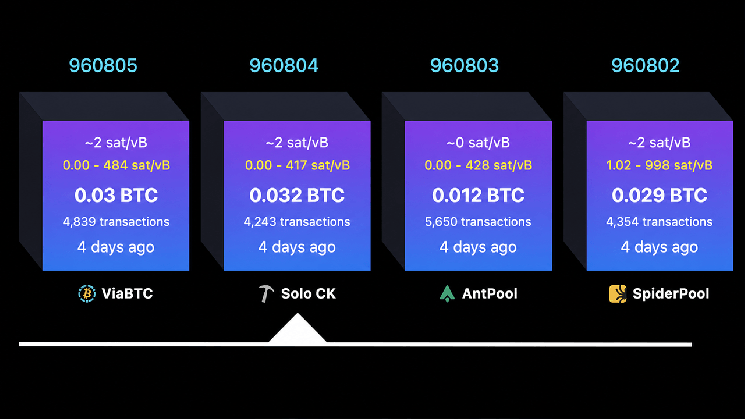
A solo Bitcoin miner, contrary to all predictions, won a $200,000 jackpot as a block reward. The payment went to an address linked to CKPool, a solo-mining service. This was the 317th solo block found by the pool. The reward consisted of the 3.125 BTC fixed subsidy and about 0.032 BTC in transaction fees from 4,243 transactions. CKPool operator Dr -ck (Con Kolivas) confirmed the win, noting the miner's hashrate was "extremely volatile, presumably rented," peaking at 100 PH/s. This represented about 0.011% of Bitcoin's total network hashrate. At that level, a miner could statistically expect to find a block roughly every 64 days, far more likely than for a typical small home setup. Solo mining differs from pool mining, where rewards are shared based on contributed work. In solo mining, a miner gets nothing unless they personally find a block, but then receives the entire reward. CKPool charges a ~2% fee on blocks found. Dr -ck noted the hashrate pattern suggested rented computing power, a practice making solo wins more accessible. He also highlighted this was the first mainnet block mined after integrating Stratum V2 code into ckpool, though the block itself was found using the older Stratum V1 protocol. Against a backdrop of mining concentration in large industrial pools, such solo finds remain rare but demonstrate that anyone with sufficient hashrate can claim a full reward without corporate or government permission. The block subsidy will remain 3.125 BTC until the next halving around April 2028. The miner's identity remains unknown, as is typical. Bitcoin's mining difficulty is due for an adjustment, and network hashrate has declined from late 2025 peaks, partly due to competition for power and hardware from AI data centers.

cryptonews.ru57 dk önce

Lone Bitcoin Miner Defies All Odds, Hits $200,000 Jackpot with Block Reward

cryptonews.ru57 dk önce

Blackrock Leads with $305 Million Inflow into Bitcoin and Ether ETFs

Money continued to flow rapidly into the largest cryptocurrency ETFs. Bitcoin and Ethereum ETFs collectively attracted over $305 million in inflows, with BlackRock again leading the charge, marking the third consecutive session of strong institutional demand. The broader market picture was mixed. Hyperliquid ($HYPE) ETFs finally saw renewed buying interest, while XRP ($XRP) ETFs faced outflows, and Solana-based products remained stagnant. In a strong session, Bitcoin ETFs recorded a net inflow of $244.42 million across five funds. BlackRock's IBIT dominated with $196.83 million, followed by ARK 21Shares' ARKB at $37.63 million and Fidelity's FBTC at $11.28 million. Vaneck's HODL was the sole fund to see an outflow (-$14.67 million), barely impacting the category's overall positive trend. Total trading volume reached $1.58 billion. Ethereum ETFs also continued their positive run, attracting $60.86 million. BlackRock's ETHA led with $50.34 million. The staking-oriented ETHB and Fidelity's FETH followed. No Ethereum ETF saw outflows. Among smaller tokens, Hyperliquid ETFs saw a minor but notable inflow of ~$966,690, potentially signaling easing selling pressure. Conversely, XRP ETFs experienced a $3.58 million outflow. Solana ETFs saw no net activity. The session solidified Bitcoin and Ethereum as the focal point for institutional capital, with BlackRock as the dominant source of demand, while activity in altcoin ETFs remained volatile.

cryptonews.ru58 dk önce

Blackrock Leads with $305 Million Inflow into Bitcoin and Ether ETFs

cryptonews.ru58 dk önce

İşlemler

Spot
活动图片