An 80s-Born from Tianjin, Set to Become the First Human on a Journey to Mars

Odaily星球日报2026-05-22 tarihinde yayınlandı2026-05-22 tarihinde güncellendi

Özet

Chun Wang, an 80s-born native of Tianjin, is set to become the first person to journey to Mars. SpaceX recently announced that Wang, co-founder of F2Pool and commander of the Fram2 mission, will travel on Starship for a historic two-year deep-space mission to fly by Mars (without landing) and return to Earth. Prior to this, he will also participate in a week-long commercial crewed mission around the Moon. Wang's passion for exploration began in childhood. After university, he embarked on extensive travels, eventually visiting every province in China by train and earning the nickname "Thousand High-Speed Rail Man." His interest in technology led him to programming and, in 2011, to Bitcoin. He purchased his first bitcoin at $8.70 and later co-founded F2Pool, one of the world's largest mining pools, in 2013. The success of his cryptocurrency ventures provided the wealth that later funded his ambitious projects. Having reached both the South and North Poles, Wang sought new frontiers. Inspired by SpaceX's advancements, he conceived and funded the private Fram2 mission in 2025. As mission commander, he led an all-civilian, non-American crew on a unique polar orbit flight aboard a Crew Dragon spacecraft, conducting scientific experiments and capturing unprecedented views of Earth's poles. Now, his journey continues toward the ultimate destination. From his current location on the remote Bouvet Island near Antarctica, Wang prepares for the next steps: a lunar flyby and humanity's...

Original | Odaily Planet Daily(@OdailyChina)

Author | Azuma(@azuma_eth)
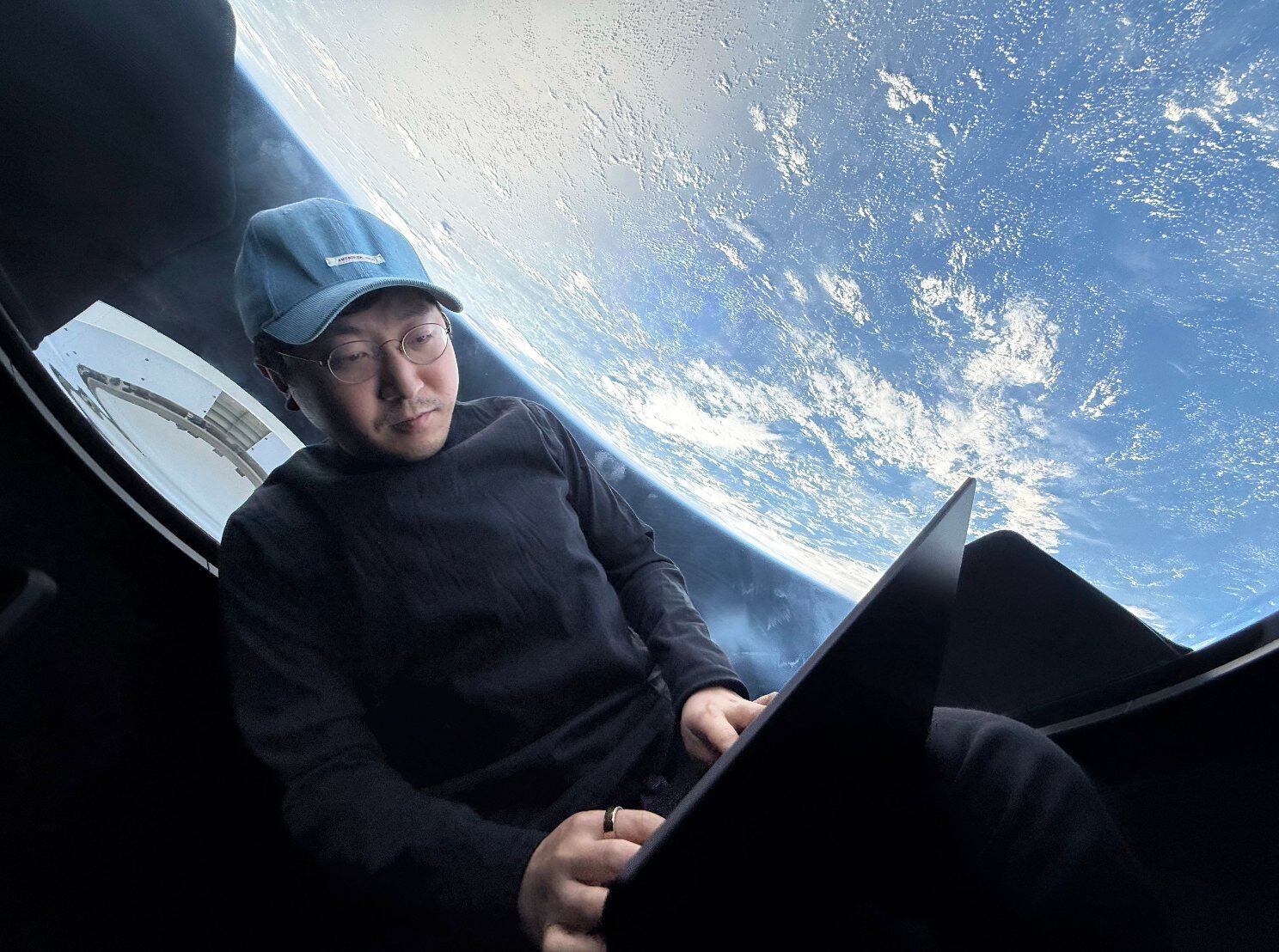
Humanity is finally embarking on its journey to Mars, and the central figure about to undertake this historic aerospace mission is someone from Tianjin.

On the morning of May 22, Beijing Time, SpaceX, which is gearing up for an IPO, dropped a major announcement — Chun Wang, co-founder of F2Pool and Mission Commander of Fram2, will board the Starship to execute the first batch of manned interplanetary Mars flight missions! The mission is planned as a two-year deep space flight, exiting the Earth-Moon system, passing by Mars (without landing), and finally returning to Earth.

Prior to this mission, Chun Wang, along with Dennis Tito and Akiko Tito, will participate in Starship's first commercial manned lunar flyby mission, expected to last about a week, with a flyby approximately 200 km from the lunar surface.
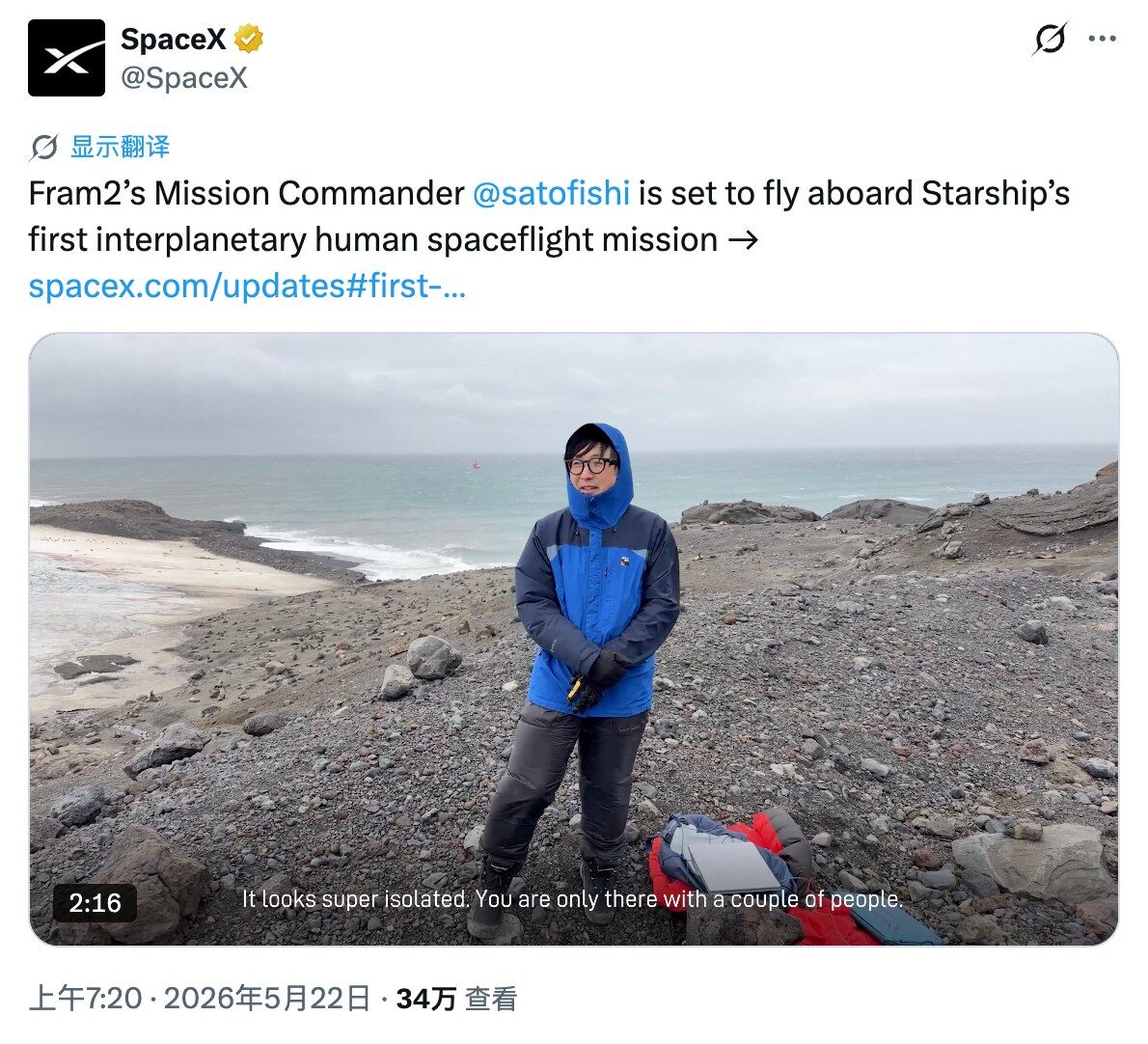
The Travel Maniac from Tianjin

On March 31, 2025, on the eve of the Fram2 mission launch, Chun Wang gave an interview to the aerospace professional media "Spaceflight Now," revealing many previously unknown stories from his upbringing.

Chun Wang was born in 1982 in Tianjin, China, and was raised by his grandparents. Until he left for university in 2000, he had hardly ever ventured beyond his hometown.

However, from a very young age, Chun Wang developed a strong interest in travel, always fantasizing about exploring the world: "In 1987, when I was 5 years old, my grandfather brought home a world map he found during a walk. That map instantly became my favorite toy and ignited my curiosity. What truly caught my eye was the vast blank area at the bottom of the map — the polar regions. From that moment on, I was deeply captivated by the mystery and excitement of these distant and unknown lands."

After university, Chun Wang first worked for a Norwegian software company in Beijing. It was then that his travel mileage truly began to skyrocket — to save money, he often slept on his French colleague's sofa or directly in the office, commuting back home about 120 kilometers away on weekends.

Chun Wang mentioned: "Despite having a full-time job, I traveled over 75,900 kilometers by train during weekends in the year 2007 alone. In total, I spent two full months that year inside train compartments, heading straight to the railway station after work on Fridays and not returning to the company until Monday morning."

Over the next four years, Chun Wang further expanded his travel footprint. By train, he visited every province in China.

In 2010, Chun Wang embarked on his first trip abroad — Nepal followed by India. That trip took him to the southernmost tip of the Indian subcontinent. He boarded what was then India's longest-running, non-stop train — the 16317 Himsagar Express, traveling all the way from Kanyakumari to Kashmir and continuing his journey in the country.

That journey ultimately cost him about $1,000, which was all the savings he had at the time.

"During those years, I was obsessed with infrastructure and transportation, especially railways. I meticulously recorded every train journey down to the minute or even second and posted these records on online forums and message boards. Someone once gave me the nickname 'Thousand-HSR-Man,' because I was counting my high-speed rail rides at the time, aiming for the goal of 1,000 trips."

Chun Wang revealed that as of March 20, 2025, he had taken 854 high-speed rail trips, but the number of his commercial airline flights was already extremely close to 1,000.

Wealth, Capability, and Resource Accumulation, Rooted in Cryptocurrency

Apart from travel, Chun Wang also displayed a keen interest in various emerging technologies.

At the age of 7, Chun Wang first heard about computers, but it wasn't until he graduated from elementary school at 13 that he owned his first computer, a 486SX running MS-DOS 5.0.

Chun Wang mentioned: "Besides playing games, I also used it to write many interesting programs. One of the earliest was a gravity simulator that visually demonstrated the motion of planets in the solar system... At school, I participated in various programming competitions, including the International Olympiad in Informatics (IOI) and the ACM-ICPC (International Collegiate Programming Contest). Due to my outstanding performance in these competitions, I was directly admitted to university without taking the National College Entrance Examination (Gaokao)."

In 2011, Chun Wang first heard about Bitcoin through the tech website Solidot, and on May 28 of that year, he bought his first Bitcoin at $8.7 each.
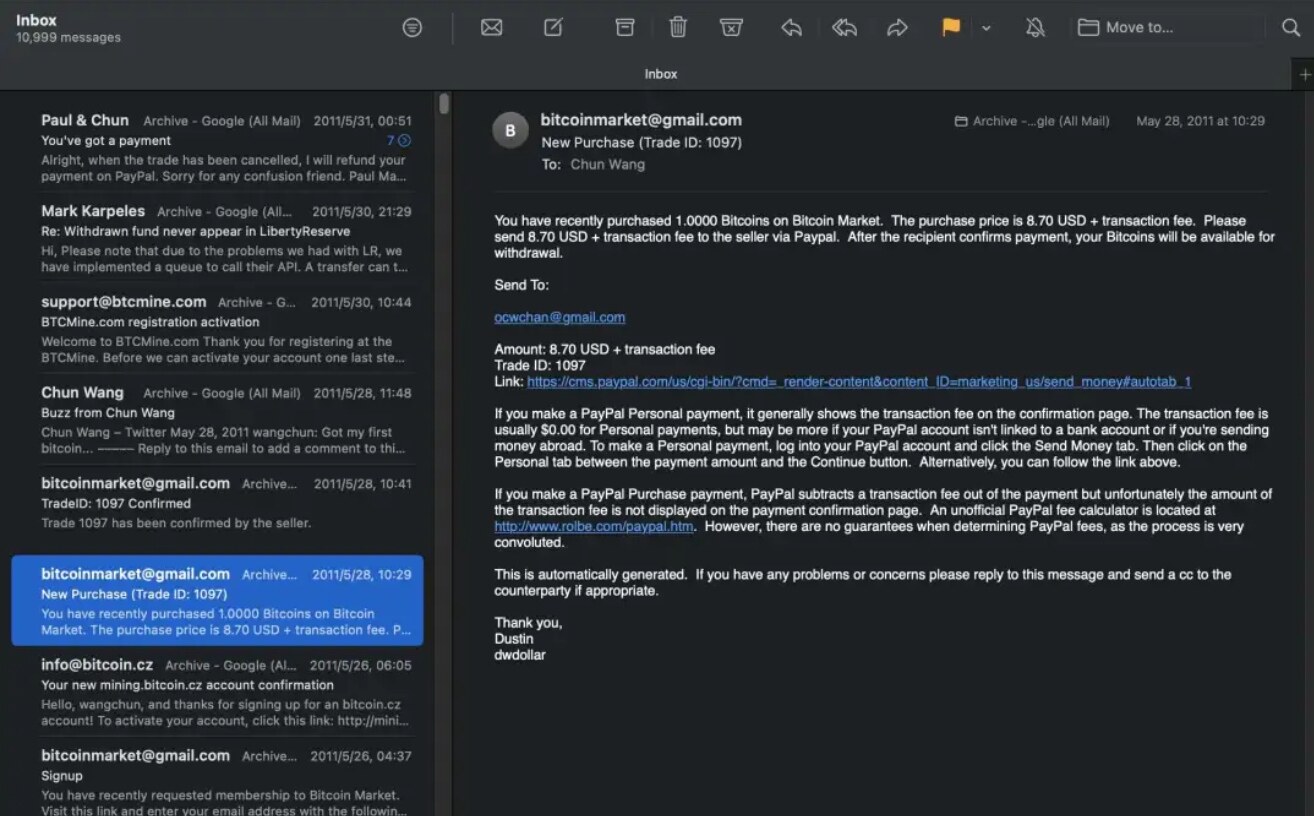
Simultaneously, as a tech enthusiast, Chun Wang began trying to assemble his own mining rigs to mine Bitcoin.

The initial story wasn't smooth sailing. Chun Wang first collaborated with Wu Gang, the later founder of Bixin, renting a few residential rooms and building a relatively crude mining farm with several dozen rigs. The startup capital was even borrowed from his father... Yet, despite this, Chun Wang managed to mine 7,700 Bitcoins over two years, spending 4,000 on electricity, trading 660 for an iPhone (which was later stolen at the St. Petersburg subway station), and liquidating the rest at $17 each in early 2023...

The turning point came in 2013. In April of that year, he co-founded F2Pool (known in the cryptocurrency community as 'Fish Pool') in Wenzhou with Mao Shixing, nicknamed 'Shenyu.' The more introverted Chun Wang handled backend coding, while the more extroverted Shenyu managed operations. This was China's first Bitcoin mining pool, which later developed into one of the world's largest comprehensive mining pools.

In 2018, Chun Wang founded his second company, Stake.fish, in Thailand, a staking service provider specializing in PoS networks, offering comprehensive node staking services for networks like Ethereum, Cosmos, and Polygon.

The success of F2Pool and Stake.fish, coupled with the soaring price of cryptocurrencies, accumulated immense personal wealth for Chun Wang — in 2025, Chun Wang revealed that over the past decade or so, F2Pool had mined over 1.3 million Bitcoins.

A Space Dreamer

The rapid growth in wealth allowed Chun Wang to realize his childhood dream of traveling to the polar regions. In December 2021, Chun Wang successfully reached the South Pole; in July 2023, he reached the North Pole.

But after fulfilling these dreams, Chun Wang found that it still wasn't enough... His entire life had been a journey, continuously moving towards unknown horizons.

  • 2006: He traveled west to the Kazakhstan border at 82° East longitude;
  • 2011: He went to the southernmost tip of India, reaching 8° North latitude;
  • 2012: He took the Trans-Siberian Railway to Europe, reaching St. Petersburg at 60° North, 30° East;
  • 2013: He traveled to the Kamchatka Peninsula, reaching 160° East longitude;
  • 2016: He visited the United States for the first time;
  • December 2021: He successfully reached the South Pole;
  • July 2023: He successfully reached the North Pole...

But now, there are no further endpoints left on Earth. Where else could one go?

Chun Wang soon found the answer: "Since SpaceX began recovering Falcon 9 first-stage rockets, the commercial aerospace industry has been advancing at an incredible pace. I once again see something completely new and exciting unfolding, a feeling just like when I first heard about computers or discovered Bitcoin."

Chun Wang's choice was to fly into space. In 2023, Chun Wang proposed an extremely bold idea to SpaceX — he wished to privately and fully fund a SpaceX Crew Dragon mission to fly over a polar orbit passing both the Earth's North and South Poles.

Chun Wang's idea was that since humans entered space in 1961, because most rocket launches are concentrated near the equator or at mid-latitudes, the International Space Station (ISS) and almost all previous manned spacecraft (except for Apollo missions that passed by from a distance) have been unable to fly over the Earth's poles. In other words, for nearly 60 years of manned spaceflight history in low Earth orbit, the Earth's polar ice caps have been a visual and scientific blank. Therefore, Chun Wang hoped to take a never-before-taken polar retrograde orbit (Polar Orbit) at a 90-degree inclination, directly crossing and overlooking the Earth's poles.

Chun Wang named the mission "Fram2," in homage to the legendary polar research vessel "Fram," which carried Norwegian explorers to the Arctic and Antarctic in history.

On April 1, 2025, a Falcon 9 rocket carrying the Crew Dragon "Resilience" lifted off on time from LC-39A at the Kennedy Space Center in Florida. Chun Wang, as the Mission Commander, led the all-civilian, fully non-American crew he personally selected (including a Norwegian filmmaker, a German robotics engineer, and an Australian Arctic explorer) and officially embarked on their space journey.
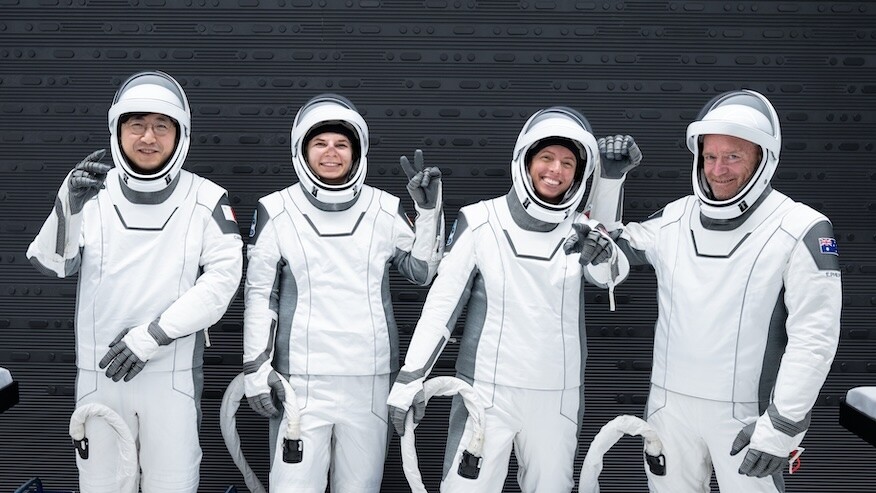
In a 90-degree polar orbit with an apogee of 413 km and a perigee of 202 km, the spacecraft orbited the Earth every 93 minutes, taking only 46 minutes to fly from the North Pole to the South Pole. During the three-and-a-half-day flight mission, Chun Wang and the crew completed a significant amount of extremely hardcore scientific research and visual capture — including close observation of the rare, high-latitude atmospheric phenomenon STEVE (Strong Thermal Emission Velocity Enhancement); capturing the first-ever space X-ray image in microgravity; and humanity's first attempt to grow fungal organisms in microgravity...

One noteworthy detail is that before the mission began, Chun Wang's friend Bao Er Ye (宝二爷) revealed online that Chun Wang had not made any backups of his Bitcoin private keys. He had stated that if anything happened to him during the mission, his Bitcoin holdings would be permanently destroyed.

Flying to Mars

Chun Wang's aerospace dreams did not end with the successful conclusion of Fram2 but continued to evolve further.

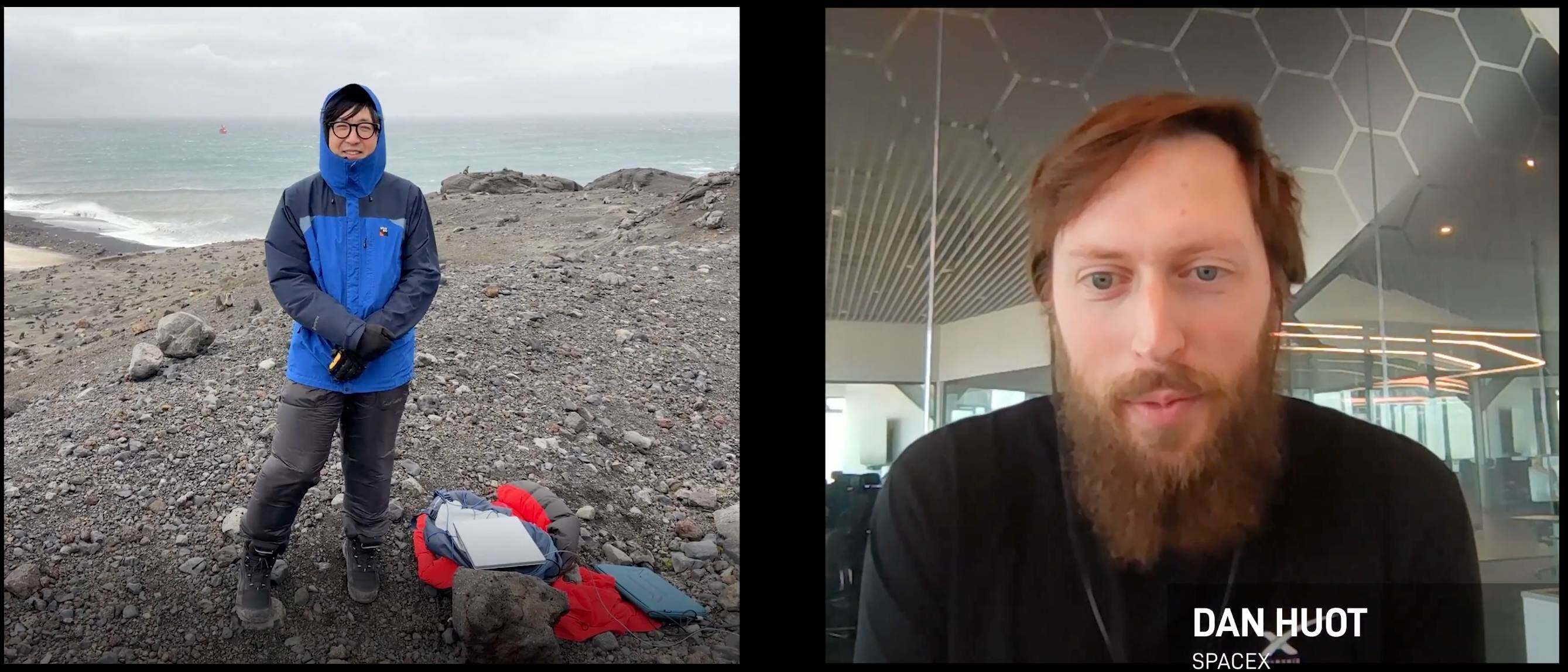
Returning to the story at the beginning, just before SpaceX tested the launch of its latest-generation Starship, SpaceX officially announced during a livestream two subsequent space plans for Chun Wang — a week-long manned lunar flyby mission, and the first-ever two-year-long manned interplanetary Mars flight mission in human history.

During SpaceX's live connection with Chun Wang, he was standing in the fierce winds on Bouvet Island at 54°26′ South, 3°24′ East. The island is located in the South Atlantic Ocean, near Antarctica, is an overseas territory of Norway (Norwegian Antarctic Territory), and lies outside the land claims frozen by the Antarctic Treaty.
On Chun Wang's personal X profile, he detailed his travel progress. As of the time of writing, the current status is: "60% of territories visited on 1 celestial body (150 / 249), to be continued..."


İlgili Sorular

QWho is Chun Wang, and what significant achievement is he about to accomplish according to the article?

AChun Wang is an 80s-born entrepreneur from Tianjin, China, co-founder of F2Pool and Stake.fish. According to the article, he is about to become the first person to undertake a manned interplanetary mission to Mars, flying by Mars (without landing) on SpaceX's Starship for a two-year mission.

QHow did Chun Wang accumulate the wealth and resources that enabled his space ambitions?

AChun Wang accumulated his wealth primarily through cryptocurrency. He co-founded F2Pool, one of the world's largest mining pools, which has mined over 1.3 million Bitcoins. He also founded the staking service provider Stake.fish. The success of these ventures, coupled with the rise in cryptocurrency value, provided him with significant personal wealth.

QWhat was the name and primary objective of Chun Wang's first private space mission with SpaceX?

AHis first private space mission was named 'Fram2'. Its primary objective was to fly a Crew Dragon spacecraft on a polar orbit (90-degree inclination), allowing it to pass directly over and visually survey Earth's North and South Poles—areas previously unseen by crewed spacecraft in low-Earth orbit.

QWhat personal characteristic, evident from his youth, is cited as a driving force behind Chun Wang's extensive travels and eventual space ventures?

AFrom a very young age, Chun Wang exhibited an intense fascination with travel and exploration. After his grandfather brought home a world map when he was five, he became deeply curious about remote and unknown places, particularly the polar regions. This lifelong passion for pushing geographical and experiential boundaries ultimately led him to space exploration.

QBefore the planned Mars mission, what other upcoming SpaceX mission is Chun Wang scheduled to participate in?

ABefore the Mars mission, Chun Wang is scheduled to participate in SpaceX's first commercial crewed circumlunar flight mission. He will join Dennis Tito and Akiko Tito on a week-long journey that will include a flyby approximately 200 km from the lunar surface.

İlgili Okumalar

After Three Consecutive Quarters of Decline, Can the Crypto Market Find a Window for Stabilization in Q3?

The cryptocurrency market has just concluded its worst-performing quarter since 2022, with total capitalization dropping 12.6% to $2.1 trillion. All core metrics indicate capital is leaving the sector, not just rotating within it. Bitcoin fell 14.2% and Ethereum dropped 25.4% in Q2, breaking their previous correlation with US tech stocks. A key driver is the reversal in US spot Bitcoin ETF flows, which saw a net outflow of approximately $4.67 billion in Q2, including a record monthly outflow near $4.5 billion in June. While recent data suggests long-term holders are accumulating again, sustained ETF outflows mean continued selling pressure. Market focus is now singularly on the Federal Reserve. The upcoming July FOMC meeting is seen as the most critical event for Q3. A dovish signal could support Bitcoin reclaiming a $68,000-$84,000 range, while a hawkish stance might establish a new trading band around $50,000-$56,000. Additionally, regulatory uncertainty persists, with the progress of the crucial *CLARITY Act* stalling in the Senate, reducing its perceived 2026 passage probability to 40-45%. Despite the broad downturn, a few sectors showed growth. Prediction markets saw nominal volume surge 48.7% year-over-year to $113.8 billion, and tokenized collectibles transaction volume rose 143% quarterly to $1.4 billion. The Real-World Asset (RWA) tokenization sector also continued steady growth, now representing ~$28.1 billion in on-chain value. The market's foundation for an extreme crash appears limited, with Bitcoin price hovering near its 200-week moving average. However, the trading paradigm has shifted from narrative-driven speculation to decisions based on price action, policy developments, and interest rate expectations, making a broad sentiment-driven rally unlikely in the near term.

marsbit7 saat önce

After Three Consecutive Quarters of Decline, Can the Crypto Market Find a Window for Stabilization in Q3?

marsbit7 saat önce

BIT Trading Moment: BTC Still Suppressed by Weekly 200 EMA, Rejection May Restart Decline; Storage and Semiconductors that Surged Last Night Begin Falling in Evening Trading

**Crypto & Stock Market Wrap: Bitcoin Tests Resistance, Stocks Retreat After AI Surge** Bitcoin consolidates around $66,000, facing key resistance near $68,000—an area seen as a major psychological and technical hurdle where previous rallies have failed. Analysts note the cryptocurrency is caught between its 200-week moving average (~$63,333) and 200-week EMA (~$68,328). A clear break above $68k is needed to signal a stronger bullish trend, while a rejection could lead to a retest of $63k support. Market sentiment remains cautious, with low futures open interest pointing to a low-liquidity rebound rather than a full bull market. Bitcoin spot ETFs saw another $203 million inflow. US stock futures pointed lower after a strong Tuesday session led by a massive rebound in semiconductors and memory stocks. The rally was fueled by renewed optimism about AI-driven hardware demand, with Micron, SanDisk, and SK Hynix surging. However, those gains reversed in pre-market trading. Super Micro Computer (SMCI) soared over 20% after hours on strong guidance and a record backlog. Other standouts included Rocket Lab and nuclear energy plays Oklo and X-Energy. Rising oil prices (Brent above $91) and climbing Treasury yields (10-year near 4.64%), however, are reigniting inflation concerns and acting as a headwind for equities. In Asia, markets were mixed. South Korea's KOSPI pared early gains to close slightly higher as semiconductor stocks like SK Hynix gave back initial surges. Japan's Nikkei edged lower as the yen hit a fresh 38-year low against the dollar, raising fears of potential market intervention. Key events to watch include the Samsung Galaxy launch, AMD's AI event, and a slew of major tech earnings from Alphabet, Tesla, and IBM after the close on Wednesday, followed by the ECB meeting and Intel's earnings on Thursday.

marsbit7 saat önce

BIT Trading Moment: BTC Still Suppressed by Weekly 200 EMA, Rejection May Restart Decline; Storage and Semiconductors that Surged Last Night Begin Falling in Evening Trading

marsbit7 saat önce

Former CFTC Chairman, Circle President Tarbert: Preaching Long-Termism While Cashing Out $30 Million Himself

Former CFTC Chairman and Circle President Heath Tarbert has consistently advocated for a long-term vision in public, urging patience from investors as Circle’s stock price has fallen significantly from its peak. However, it has been revealed that since Circle’s IPO, Tarbert has continuously sold his CRCL shares through pre-arranged trading plans, cashing out approximately $30 million, without making any public market purchases. This contrast between his public messaging and personal actions has drawn criticism. Tarbert joined Circle in July 2023 as Chief Legal Officer, leveraging his regulatory experience to help guide the company through its IPO and expansion. Despite promoting stablecoins as long-term infrastructure, he established a 10b5-1 trading plan just before Circle went public, leading to substantial stock sales over the following year. In March 2026, he initiated another plan to sell more shares. His career trajectory highlights a pattern of moving between high-level regulatory roles and influential positions in the financial sector. After resigning as CFTC Chairman in early 2021, he joined Citadel Securities as Chief Legal Officer just 27 days later, during a period of intense regulatory scrutiny for the firm. He later joined Circle, aiding its efforts to navigate regulatory challenges for its public listing. While Tarbert's expertise in policy and compliance is valuable to companies like Circle, his actions—advocating long-term confidence while personally divesting—raise questions about the alignment between his public statements and his private financial decisions, leaving investors who followed his advice to bear the market risks.

marsbit8 saat önce

Former CFTC Chairman, Circle President Tarbert: Preaching Long-Termism While Cashing Out $30 Million Himself

marsbit8 saat önce

Gate Research Institute: The 'Wall Street-ization' Wave of Crypto Financial Products – Competition or Integration?

The article titled "Gate Research Institute: Are Crypto Financial Products Sparking a 'Wall Street' Wave—Competition or Convergence?" explores the evolving relationship between the crypto ecosystem and traditional finance (TradFi). The piece begins by reflecting on Bitcoin's original 2009 vision of decentralization, disintermediation, and moving away from banks. It then contrasts this with the 2024 landscape, where key crypto assets like Bitcoin are increasingly held through Wall Street products like ETFs issued by giants like BlackRock. The article questions whether this signifies that TradFi is systematically taking over the rights to issue, price, custody, and distribute crypto financial assets. The core argument is that this is not a zero-sum takeover but rather a bidirectional convergence where each side addresses the other's weaknesses. Crypto offers 24/7 global markets, programmable settlement, and open access but lacks compliant channels, institutional-grade custody, deep fiat liquidity, and mainstream distribution. TradFi possesses these but is constrained by legacy systems, limited operating hours, and slow settlement. Two primary convergence paths are highlighted: * **Path A (CEX to TradFi):** Exemplified by Gate, which has progressed from offering tokenized stocks and CFDs to providing direct, real stock trading (US, Hong Kong, South Korea) within its platform, using USDT. * **Path B (TradFi to Crypto):** Exemplified by Robinhood, which has integrated crypto trading, acquired exchanges like Bitstamp, and is moving traditional assets like stocks onto the blockchain via tokenization and its own Layer 2. Both paths are ultimately competing to become the next-generation, unified financial account—a "super account" where users can seamlessly trade cryptocurrencies, stocks, ETFs, RWA (Real World Assets), and tokenized treasury products in one interface. The growth of RWA and tokenized treasuries (e.g., BlackRock's BUIDL) is presented as the asset-layer fusion, providing stable, yield-bearing assets on-chain and acting as a bridge between the two worlds. In conclusion, the "Wall Street-ization" of crypto is framed as a mutual transformation. Decentralized ideals persist in the protocol layer, while at the application layer, a more efficient, global, and accessible unified capital market is emerging from this convergence. The future competition lies not between crypto exchanges and stockbrokers, but between platforms vying to offer the most comprehensive asset coverage, liquidity, and user experience within a single account.

marsbit8 saat önce

Gate Research Institute: The 'Wall Street-ization' Wave of Crypto Financial Products – Competition or Integration?

marsbit8 saat önce

İşlemler

Spot
活动图片




