Original | Odaily Planet Daily (@OdailyChina)
Author | Ethan(@ethanzhang_web3)

The "lobster fever" has spread to crypto exchanges, becoming the most intriguing scene in the OpenClaw craze. In recent days, OKX, Binance, Gate, and Bitget have almost simultaneously pushed Skills, MCP, CLI, Agent Hub, and Wallet Skill into the spotlight.
This time, the exchanges are not just chasing a trend; they are repackaging the capabilities embedded in their apps, web pages, and APIs into an interface layer that Agents can read, call, and execute. In the past, they competed on liquidity, fees, and listing speed; now they are starting to fight for a more front-end position: when users hand over research, screening, and pre-order preparation to Agents, which platform will be the first to be called.
This is the truly critical aspect of this round of changes.
First, let's see what these platforms have been updating in recent days
The pace of updates in this round has been very密集 (dense).
OKX's actions actually unfolded in two steps. On March 3rd, Odaily cited official news stating that OKX OnchainOS had opened AI-related capabilities, allowing Agents to execute on-chain transactions, gain market insights, perform address analysis, and make on-chain payments through AI Skills, MCP, and Open API. According to the OnchainOS official documentation, this system already covers core capabilities like wallets, trading, market data, and payments, with documentation claiming coverage of 130+ major public chains and aggregation of 500+ DEX routes on the trading side. By March 10th, the OKX Agent Trade Kit took another step forward, pushing the okx-trade-mcp and okx-trade-cli access paths, along with 4 plug-and-play Skills, to the forefront. What's truly noteworthy is not the 'AI Trading' label, but the detailed explanation: AI can complete spot, perpetual, and conditional order operations through a single MCP interface; keys are only stored in local configuration, and signing is done locally; if an API Key lacks trading permissions, the corresponding order placement tool simply won't be registered in the toolbox. The official scale given is 82 tools, 7 modules, and they also highlighted live options markets and simulation mode. Looking at OnchainOS and Agent Trade Kit together, OKX's move in this round is clearly not just about creating a trading assistant, but about aligning both on-chain capabilities and trading capabilities with Agent infrastructure.
Binance's节奏 (rhythm/pace) was earlier, and it pushed forward continuously. On March 3rd, the first batch of 7 AI Agent Skills was released, followed by the Skills Hub bringing these capabilities to the foreground, publicly listing modules like crypto-market-rank, meme-rush, query-address-info, query-token-audit, query-token-info, spot, and trading-signal. The next day, MPC Wallet and DeFi Wealth Management were disclosed to be in the audit stage; by March 12th, 4 new AI Agent Skills expanded capabilities directly into Alpha market data, USDⓈ-M futures trading, margin trading, and asset management. This means Binance's line is no longer just the initial 7 informational Skills, but has rapidly extended from an information entry point to derivatives, leverage, and account management. The most interesting sentence on the page isn't the feature introduction, but that all Skills undergo review before going live. This indicates Binance wants to capture not just the traffic entry point, but also the ability distribution rules of the Agent era.
Gate's updates were more like a rapid succession. On March 5th, Blue Lobster was released first, lowering the threshold for ordinary users to experience GateClaw; on March 7th, DEX MCP went live; on March 10th, CEX MCP followed, by which point Gate had connected both on-chain and centralized trading capabilities to the Agent scenario. Then, on March 11th alone, it successively launched the Skills Hub, the new Blue Lobster, Gate CLI, Blue Lobster operation guide, and an update of 20 AI Agent Skills. In other words, Gate isn't just putting up a 'Gate for AI' page; it laid out the experience entry points, DEX/CEX MCP, CLI, Skills Hub, and Agent Skill layers within a few days. Looking back at the architecture of Gate for AI—application layer, capability layer, protocol layer, infrastructure layer, and the 5 core modules of Exchange, DEX, Wallet, News, Info—it becomes clearer: it aims not to be a single-point tool, but to package CEX, DEX, wallet, news, and on-chain data together into a set of Agent infrastructure.
Bitget's actions have also formed a complete line.最早 (Earliest) on February 27th, the Bitget Wallet Skill beta was released, focusing on allowing large models and automated tools to access on-chain data and trading infrastructure using natural language, with trades still requiring user signature confirmation; subsequently, on March 2nd, Bitget Wallet initiated exploration of Agent scenario capabilities and launched the Skills beta, bringing the Wallet line fully to the forefront. By March 9th, the Bitget Agent Hub received a major upgrade, connecting the Skills and CLI modules to form a complete calling system with the MCP and API launched last month. The official口径 (wording/statement) was 9 major modules, 58 tools, 3-minute接入 (access/integration) with OpenClaw; on the same day, Bitget Wallet announced integration with Paydify, bringing consumer payment scenarios into the Agent ecosystem; then on March 12th, Bitget Wallet MCP was opened for user testing, further pushing on-chain wallet capabilities towards a callable interface layer. Looking further, the March monthly report presented another set of numbers: a net inflow of approximately $205.95 million in February, ranking third among global CEXs, and BTC reserves rising to 36,700 coins. Stringing these actions together, Bitget is clearly not just temporarily riding the lobster wave; it is integrating Wallet, payment, Agent Hub, MCP, and other capabilities into its infrastructure narrative amidst platform growth, capital inflow, and brand expansion.
Laying out the timeline of these past few days reveals a clear change: This wave is no longer just exchanges collectively issuing a round of AI press releases; it's several leading platforms starting to successively repackage capabilities like market data, addresses, audits, wallets, order placement, and risk control—previously scattered across pages and APIs—into modules that Agents can call.
In a nutshell, the difference is: Previously, most products just made AI better at talking; this round, leading exchanges are starting to make AI actually able to call things.
The industry hasn't been silent on AI trading in the past year. Copy trading, signal bots, strategy generation, research report abstracts—all have been discussed. The problem was, those products often just added a smarter front end to the existing trading process. AI analyzed on one side, trading executed on the other, and users still had to switch pages, copy parameters, and click confirm in between. Essentially, they were still helping you look, not connecting the systems for you.
This round is different. It's no longer satisfied with keeping research and suggestions in the dialog box; it's starting to move towards system calls, permission boundaries, and execution chains. Precisely because of this, what exchanges are releasing now is not just an enhanced dialogue layer, but they are beginning to touch real system interfaces.
Comparing the几家 (several/few) platforms, the gap is no longer about "having or not," but "how far they've gone"
Based on the author's hands-on experience, if you really put the four into a table, spot trading and conditional orders are no longer scarce capabilities. The差距 (gap) mainly lies deeper. (Relevant Agent tutorials are attached at the end of the article; here we only share the author's experience.)
Start with the most basic spot scenario. Buying some ETH while placing take-profit and stop-loss orders—this action can already be handled by three platforms. Binance's Spot Skill supports OCO, OKX's spot module can handle take-profit/stop-loss, and Bitget's spot conditional orders are also out. At this stage, the difference isn't in the ability to do it, but in who integrates more smoothly and whose Agent understands intent more accurately.
Futures start to拉开层次 (create stratification/differentiate the layers). OKX and Bitget can already directly receive instructions for opening positions, stop-loss, take-profit, etc. Binance did not put futures upfront in its first batch of Skills phase, so that version felt more like a research and spot execution entry point. Although it later added USDⓈ-M futures, margin, and asset management, judging from the current publicly visible product completeness, the smoothest parts are still the information layer and standardized spot scenarios.
Looking further, Bitget's boundaries are more open. Modules like copy trading, wealth management, and account management have been publicly displayed. Trader screening, automatically开启 (opening/initiating) copy trading, wealth management product query and subscription—these are no longer just slogans. OKX and Binance haven't yet placed these parts at the same depth. So Bitget gives a more direct impression: It's not just making a few more Agent tools; it's moving the entire trading environment into the dialog box.
Binance also has its own strengths. In several public user guides, the chain of address query, hot token analysis, token audit, and spot trading is the smoothest among them. Especially in the pre-order layer, capabilities like wallet address insights, token security audits, and market rankings are very suitable for Agents to handle first. However, its boundaries are also clear; for example, wallet queries currently only support BSC, Base, and Solana chains. Many capabilities first establish the entry point before gradually adding depth.
OKX seems to focus its efforts more on the execution layer. By putting spot, perpetuals, conditional orders, options, local signing, and simulation environment together, it's clearly prioritizing solving a more difficult problem: After the Agent真正碰到 (truly encounters) the order system, how are permissions managed, risk control maintained, simulations run? OKX明显想得更靠前 (obviously is thinking further ahead).
Gate is暂时还不好用几个单点场景去压别人 (not yet easy to pressure others with a few single-point scenarios). Compared to the previous three, its currently publicly visible third-party usage scenarios are relatively fewer, so it's hard to directly say it surpasses anyone in a specific trading action yet; but judging from the DEX/CEX MCP, CLI, Skills Hub, and 20 Agent Skills pushed out consecutively these days, Gate isn't just补一个功能 (adding a feature); it's laying a foundation. Short-term, it might not be the most powerful to use; medium-term, it aims to capture a more critical platform position. Beyond functionality, another intuitive feeling: In this wave, even the naming conventions of exchanges are becoming increasingly similar. While热度 (heat/hype) has risen,辨识度 (distinctiveness/recognition) hasn't fully kept up.
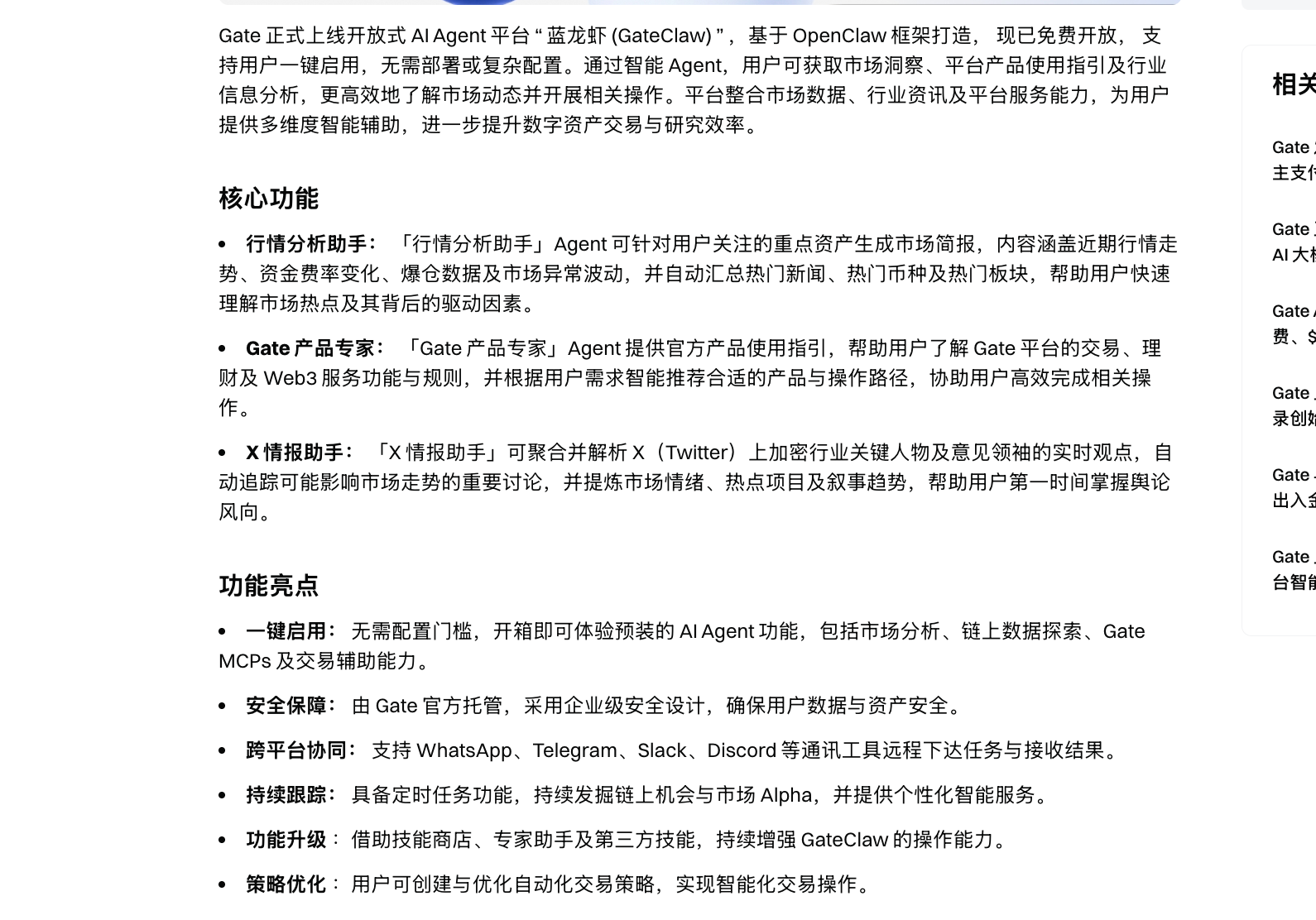
GateClaw Official Website
Using Bybit as a control (for comparison), the difference becomes more apparent. As of March 13, 2026, its most visible public action remains event-driven narratives like the 'AI vs. Human 1v1 Trading Competition,' which can drive traffic but is clearly not on the same product rhythm as the前面几家 (previous few) pushing Skills, MCP, CLI, and modular interfaces forward.
So, putting the几家 (several/few) together, the conclusion is already clear: Binance first captured the information and Skill distribution entry point, OKX is closest to the trading execution closed loop, Bitget currently has the deepest publicly revealed business depth, Gate is more like building a platform foundation, and Bybit remains at the activity and communication layer,暂时没进入 (has not yet entered) this round of真正的产品对打 (real product competition).
Why are exchanges the first to charge out?
This question is actually more important than who is more comprehensive now. Exchanges are the companies least likely to slow down on this matter.
Market data, depth, accounts, orders, wallets, risk control—these things are inherently the most mature, structured, and最适合被模块化 (most suitable for modularization) set of capabilities in an exchange's daily business. For large models, the difficulty has never been "understanding a human sentence," but whether there are reliable external systems to connect to after understanding. Exchanges恰恰手里全是这种现成系统 (precisely have their hands full of such ready-made systems).
A more practical layer is that exchanges fear losing the entry point more than other projects. In the past, users opened the App first, then looked at行情 (market conditions), then placed orders; later, users started entering through wallets,量化工具 (quantitative tools), Telegram groups, and链上看板 (on-chain dashboards). Now Agents have created a new layer of entry. Users in the future might not open the trading page first, but instead first say in Claude, OpenClaw, ChatGPT, or a terminal: "Help me see which coins moved the most today, and if the risk is controllable, give me a分批买入方案 (batch buying plan)." If the first touchpoint becomes a dialog box, exchanges that don't proactively make themselves the default capability layer called by Agents risk being relegated to mere liquidity backends.
The OpenClaw hype wave恰好 (coincidentally) pushed this matter forward. Previously, terms like Skills, MCP, and CLI were more developer-oriented; now exchanges, media, and KOLs can use them to tell stories. For exchanges, this isn't just about having a few new terms; it's about a new layer of distribution channels suddenly taking shape. Whoever enters first has the opportunity to secure a position before standards solidify. (Recommended reading: "Lobster Key 11 Questions: The Most Understandable OpenClaw Principle Breakdown" )
So exchanges in this round didn't suddenly fall in love with AI; they are judging one thing: if part of the users' first trading interface is no longer a candlestick chart but a dialog box in the future, would they be content to retreat to the background, merely being a liquidity provider that is compared and switched, or proactively step forward to become the financial base that Agents call first.
What we should truly be wary of in this wave is not exchanges doing AI, but the market又开始把接口升级讲成革命 (starting to talk about interface upgrades as a revolution again)
But now is also the easiest moment to casually overstate things, as if once exchanges deploy Skills and MCP, the next-generation trading entry point has already shifted from Apps to dialog boxes. Reaching this conclusion now is still too premature.
What truly runs smoothly today is mainly pre-trade actions like research, screening, alerts, and conditional judgments. When it comes to the execution layer, the problems remain: How are permissions granted? How are二次确认 (secondary confirmations) handled? How are failures rolled back? How are risk warnings expressed? Who bears the final responsibility (责任最后落谁头上)? Anyone who has seriously integrated with trading systems knows there are no shortcuts here. So what this round of competition looks at first is probably not fully automated trading. More realistically, whoever can first make the pre-order layer smoother is more likely to be called by default by Agents. Research, screening, news, alerts, pre-order preparation—these things sound less explosive but are most likely to become real usage first.
Precisely because of this, what's worth watching in this wave is not that exchanges are chasing another AI trend, but that they are starting to compete for the same new position: Who can first organize their trading capabilities into callable modules? Who can first design permissions and security to be sufficiently trustworthy? And who can first secure the default entry point within new interfaces like Claude, OpenClaw, and ChatGPT?
As for whether this争夺 (contest/competition) will ultimately reshape the industry landscape, it's too early to conclude. Interfaces can go live first, but trust won't grow overnight; pages can be compatible first, but user habits won't migrate immediately; products can promise闭环 (closed loops) first, but real usage must undergo rounds of trial and error.
But at least until today, one thing is already clear: When exchanges start seriously改造 (transforming/revamping) their interfaces, permissions, and capability modules, the industry should see not just another wave of AI hype, but a more concrete question emerging: After AI Agents gradually take over part of the pre-trade process, who will become the default-called crypto financial operating system?
Relevant Agent Tutorials
Binance AI Agent Skills Official Tutorial
OKX Agent Trade Kit: Building a BTC DCA System (Openclaw Combined Version)
Bitget GetClaw Official Minimalist Video Tutorial
Gate GateClaw Official Setup Tutorial