Amid Stock Market Highs, Bond and Oil Markets Are Still 'Casting Dissenting Votes'

marsbit2026-04-16 tarihinde yayınlandı2026-04-16 tarihinde güncellendi

Özet

The stock market has fully recovered its losses from the U.S.-Iran conflict, with the S&P 500 nearing all-time highs. However, bond and crude oil markets are signaling a different story. While equities are pricing in an optimistic scenario—low inflation, Fed rate cuts, contained costs, and conflict resolution—bond yields and oil prices suggest persistent inflation, limited Fed flexibility, and ongoing geopolitical risk. The 10-year Treasury yield has risen 30 basis points since the conflict began, reflecting inflation concerns rather than growth optimism. WTI crude is up 37%, indicating the market does not anticipate a near-term resolution to Middle East tensions. The 2-year yield, sensitive to Fed policy expectations, has increased 40 bps, challenging the narrative of imminent rate cuts. This divergence suggests the equity rally may be driven more by momentum than fundamentals. If upcoming inflation data exceeds expectations or geopolitical risks persist, stocks may need to correct downward to align with the realities reflected in bonds and oil. The author remains cautious, preferring to wait for clearer signals rather than chase a rally unsupported by key asset classes.

Original Title: The Bond Market Isn't Buying This Rally. Neither Am I.

Original Author: KURT S. ALTRICHTER, CRPS

Original Compilation: Peggy, BlockBeats

Editor's Note: As the stock market quickly recovers its wartime losses and approaches historical highs, a narrative that 'risks have been cleared' is once again taking dominance. However, this article reminds us that if we only look at the equity market, it is easy to misjudge the current real environment.

The signals from bonds and oil are inconsistent: rising interest rates and high oil prices point to sticky inflation, limited policy space for the Federal Reserve, and geopolitical conflicts that have not truly subsided. In contrast, the stock market is simultaneously pricing in low inflation, the restart of interest rate cuts, controllable costs, and conflict resolution—a highly idealized set of premises.

The author believes that this rally is driven more by momentum than fundamentals. Driven by trading behavior of 'fear of missing out,' prices can deviate from reality in the short term but must eventually return to the range determined by macroeconomic variables.

When divergences occur between different asset classes, the real risk often lies not in who is right or wrong, but in how this divergence is resolved. The current issue is not whether the market is optimistic, but whether this optimism has run ahead of the data.

Below is the original text:

"Rule Two: Excessive volatility in one direction often triggers excessive reversals in the opposite direction." — Bob Farrell

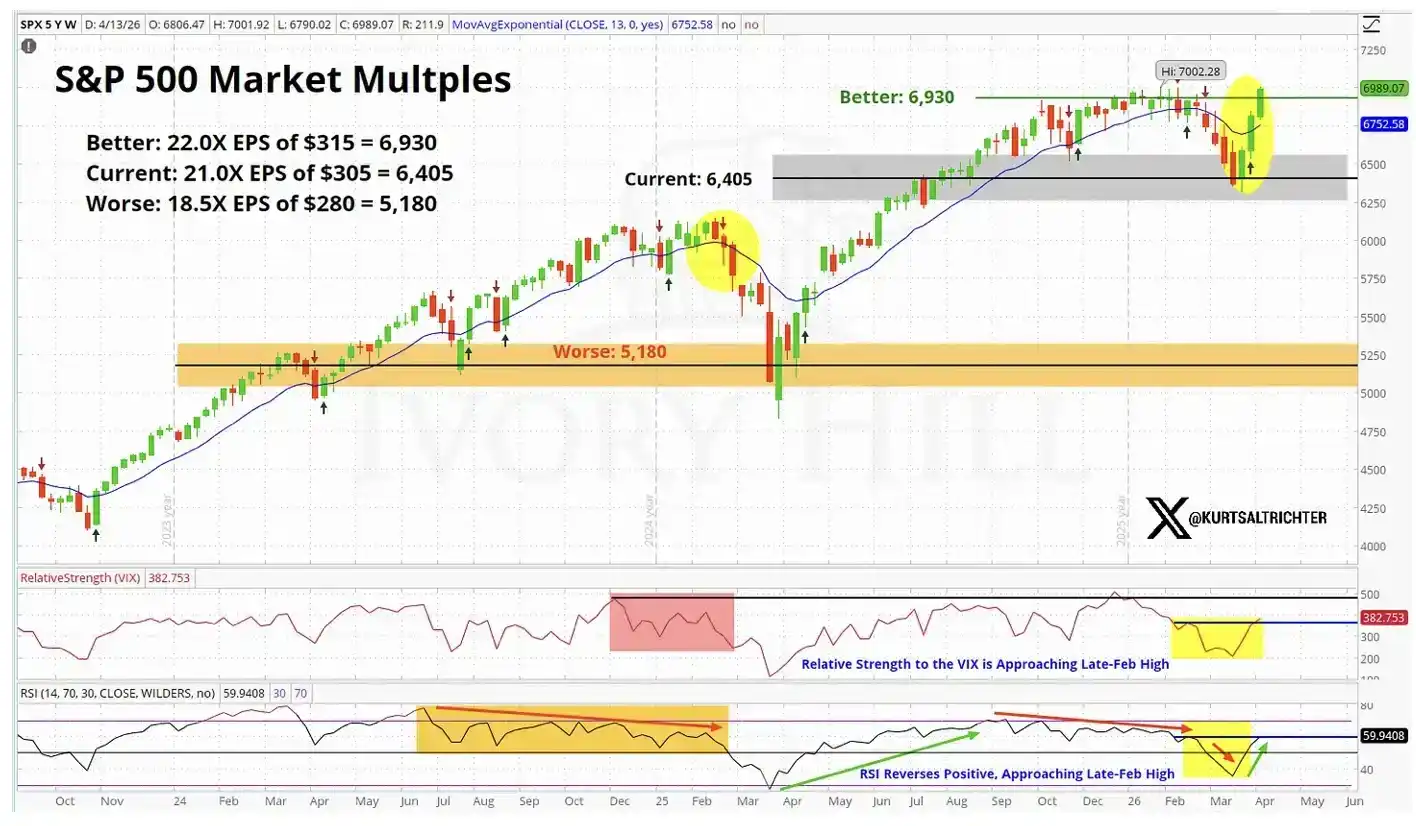
The S&P 500 has completely recovered all its losses during the U.S.-Iran conflict. As of yesterday, the index was 1% higher than on February 27 (the day before the first strike on Iran) and is only a step away from its historical high (less than 1%).

In just 10 trading days, the market has completed a full round trip.
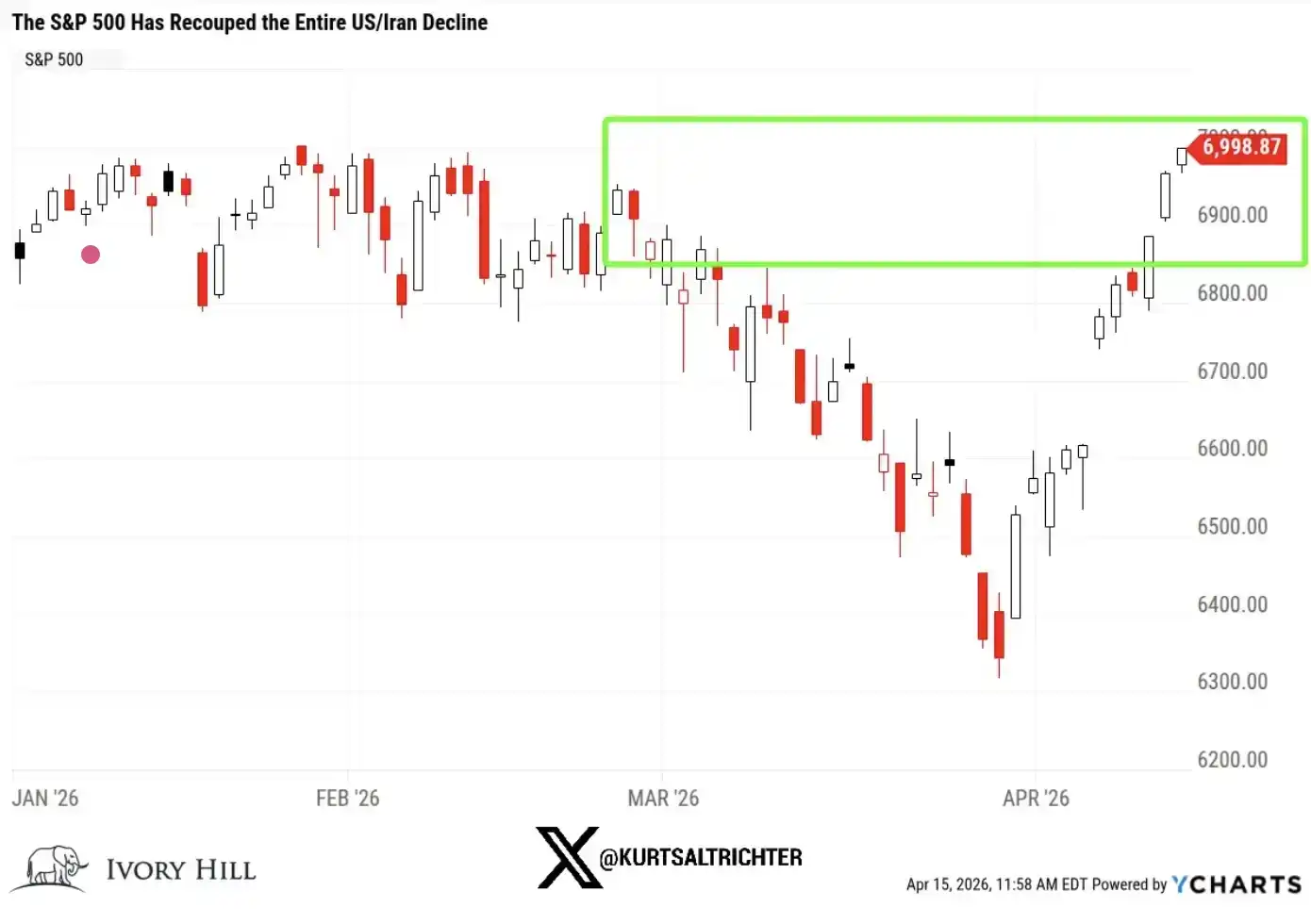
Let me be direct: if you only look at the stock market now, everything seems to be 'back to health.' War breaks out, the market falls, then quickly rebounds, everything returns to normal, and everyone moves on.

But if you broaden your perspective, this is not what is really happening.

The bond market has not confirmed this rally.

The oil market has not confirmed this rally either.

When the two most important global markets are telling a different story from the stock market, this is by no means a signal that can be ignored.

So, what is the stock market pricing in right now?

For the S&P 500 to stand above pre-war levels, the market essentially needs to believe in the following things simultaneously:

Current oil prices are not yet sufficient to substantially suppress consumption.

The Federal Reserve will ignore overheated inflation data and still choose to cut interest rates.

Higher raw material and transportation costs will not erode corporate profit margins.

The Middle East conflict will be sufficiently close to resolution within six months, no longer posing a risk.

Maybe things will indeed develop this way. I'm not saying it's impossible. But this is a rather aggressive set of premises, and the data released by the current bond and oil markets do not support these assumptions.

From a fundamental perspective, the stock market's pricing is already close to a 'perfect expectation.'
Let's look at more specific data

On February 27, the day before the war broke out, the closing levels of key indicators were as follows:

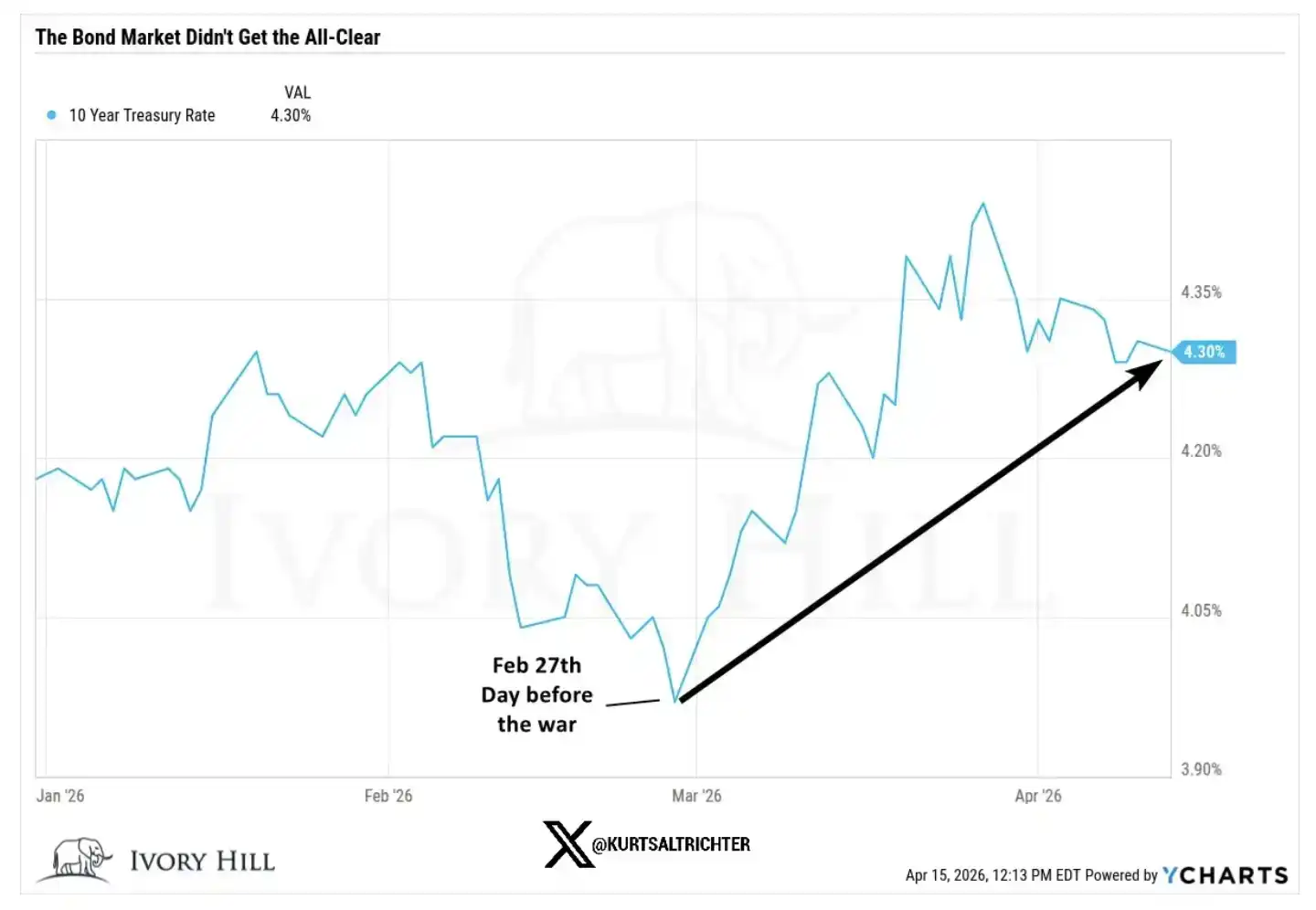
10-year U.S. Treasury yield: 3.95%, while yesterday it closed at 4.25%, up 30 basis points from pre-war levels.

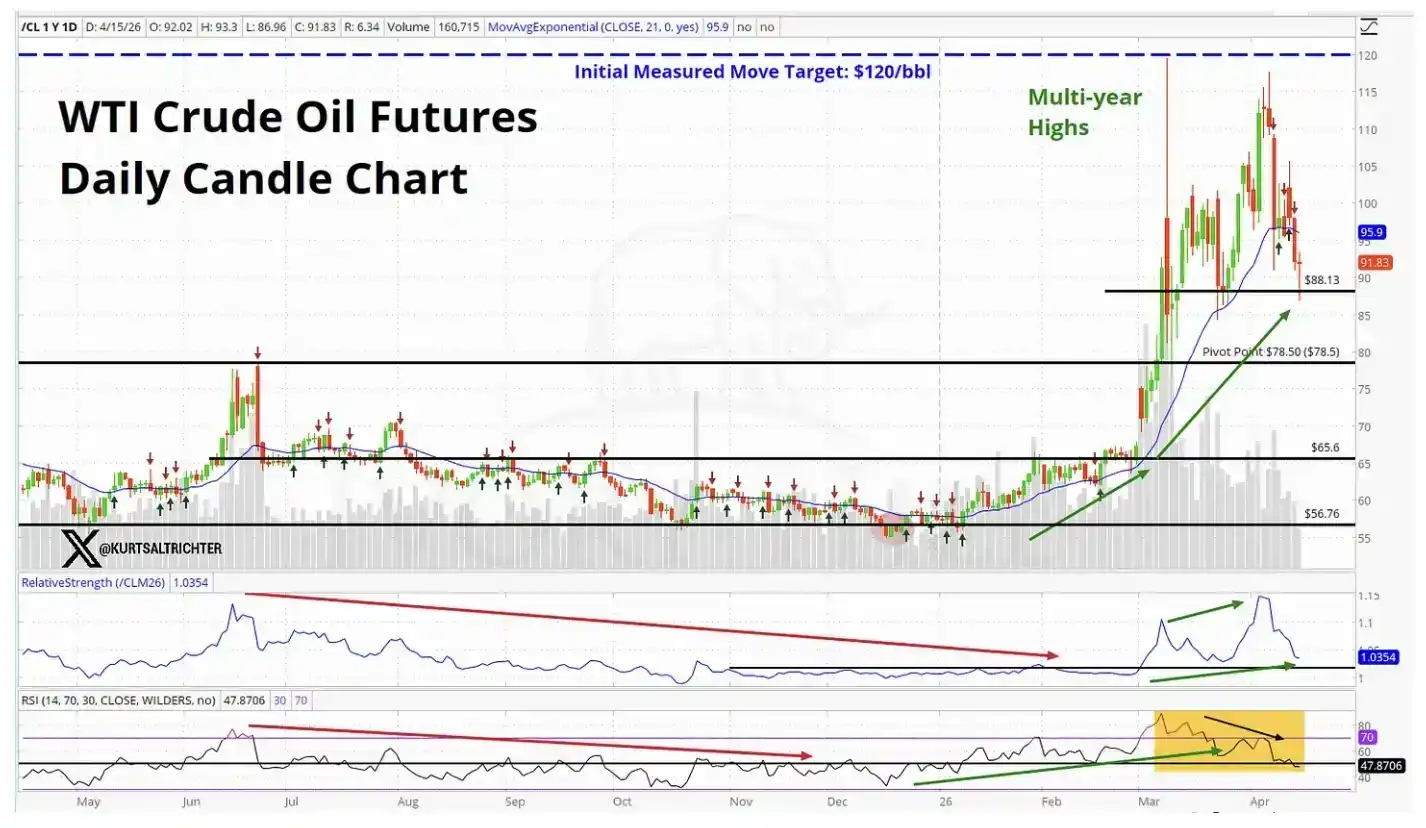
WTI crude oil: $67.02, currently about 37% higher than then.

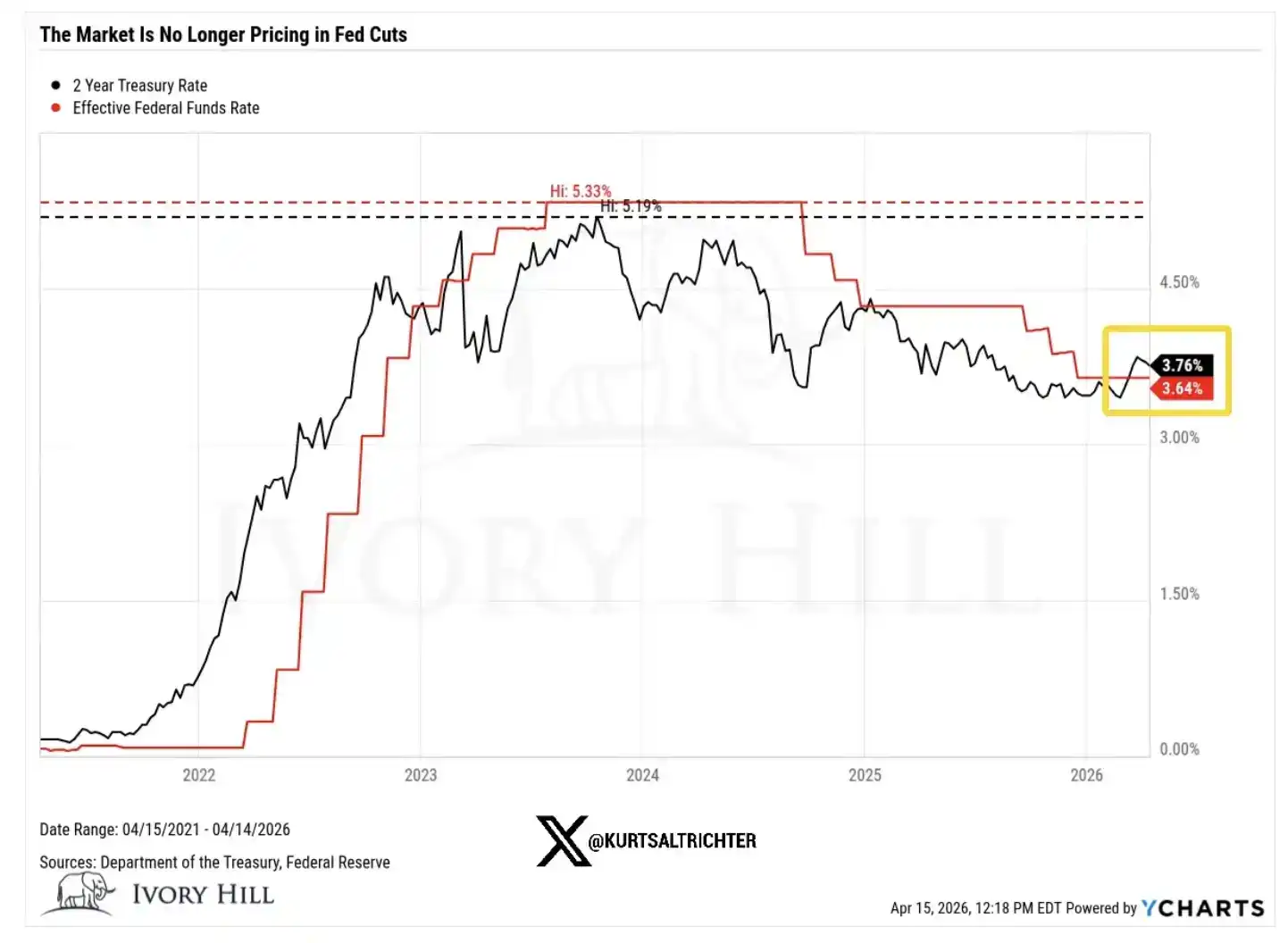
2-year U.S. Treasury yield: 3.38%, yesterday it closed at 3.75%, up nearly 40 basis points from pre-war levels.

Now, let's break down the implications behind these changes one by one.

The 30-basis-point rise in the 10-year yield after the war broke out is not because the bond market is more optimistic about economic growth. Current consumer sentiment is weakening, and confidence remains sluggish. This rise in interest rates is essentially the bond market 'quietly' pricing in inflation.

The signal it sends is clear: higher oil prices are transmitting to the overall price system, and the Federal Reserve's future policy space may not be as accommodative as the stock market assumes.
A 37% rise in oil prices over 6 weeks is not the performance one would expect if the market truly believed that a real, lasting agreement between the U.S. and Iran is imminent.

If traders were truly confident in a stable ceasefire agreement, oil prices should have long fallen back to the $70 range and continued to decline. But that is not the reality. Oil prices remain high, which means the oil market is not pricing in the same 'conflict resolution is imminent' expectation as the stock market.
And the 2-year U.S. Treasury yield is still 40 basis points higher than pre-war levels, which is itself a direct challenge to the narrative that 'the Federal Reserve is about to cut interest rates.'

The 2-year yield is the most sensitive indicator for observing interest rate expectations; it reflects the Federal Reserve's policy path more directly than any other asset. And now, the signal it sends is: the Federal Reserve's room for maneuver is smaller than the market imagines. This affects almost all the valuation logic supporting this stock market rally.
So, who is right?

The stock market might be right, I'm willing to admit that. If a substantive ceasefire agreement really emerges, bond yields could quickly fall back; once supply issues are credibly resolved, oil prices could also drop significantly. This is not the first time the stock market has led, with other markets 'catching up' or following later.

But there is another explanation that I think is currently underestimated.

A large part of this rally is not driven by fundamentals but by momentum. Traders' reluctance to short in an upward trend itself continuously pushes the market higher. Such buying can indeed sustain the trend longer than it should.

But it does not change the underlying logic.

And the underlying reality is: oil prices remain high, interest rates are still rising, and the Federal Reserve's room for interest rate cuts is more limited than what the bulls need.
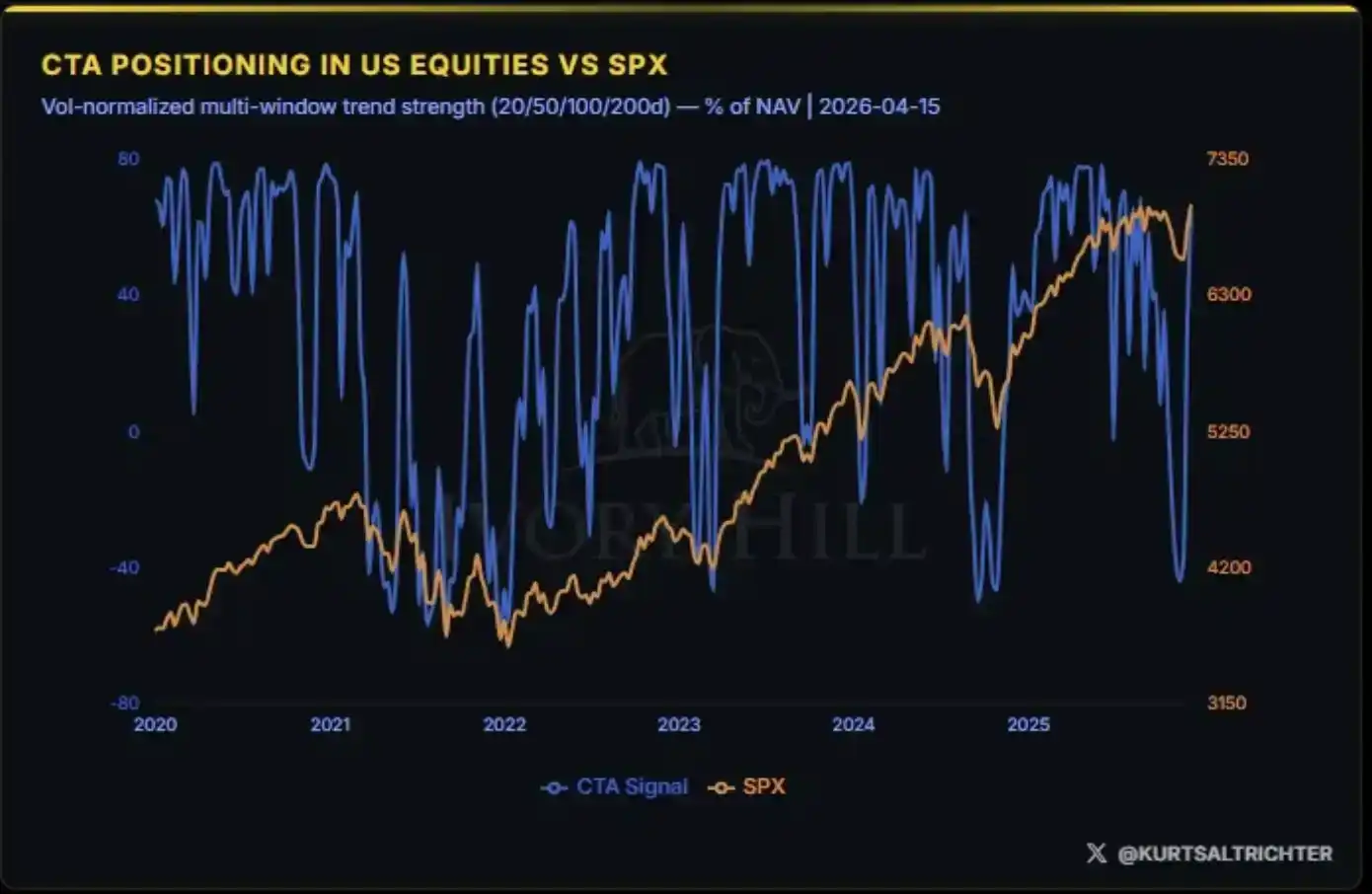
Rallies driven by fundamentals tend to be more sustainable; those driven by momentum are usually more fragile and shorter-lived. When you consider whether to add positions near historical highs, this difference is particularly critical. As the market valuation chart above shows, the current stock market is already pricing in a 'perfect scenario.'

My actual judgment

Over the past 10 days, the situation has indeed improved, I won't deny that. I'm not the type to be bearish for no reason.

But there is still a clear gap between the stock market's pricing and the reality reflected by bonds and oil, and this gap has not narrowed. I am closely watching this.

Currently, the stock market is at the most optimistic end of the range; bonds and oil are closer to the middle, reflecting a world where inflation still exists, the Federal Reserve's policy space is limited, and the conflict is not truly resolved.

This divergence will eventually be resolved, and there are only two paths:

Either a real ceasefire agreement is reached, oil prices fall back to around $70, the Federal Reserve gains clear room to cut rates, ultimately proving the stock market right;

Or none of this happens, and the stock market will fall back, moving closer to the levels currently reflected by bonds and oil.

And for now, bonds and oil show no signs of moving toward the stock market; it seems more like the stock market needs to move down to 'align' with them.

The next inflation data will be released on May 12. If my judgment is correct and CPI is above 3.5%, the narrative of rate cuts in 2026 will basically be over.

If you continue to add positions at this level, you are essentially betting that everything develops in the most ideal direction: the war ends smoothly, without interference from 'Trump's sudden remarks'; inflation remains controllable; the Federal Reserve cuts rates as planned; corporate profits hold steady. These four things must all happen simultaneously. If any one of them deviates significantly, the market's downward adjustment process is likely to be swift and severe.

In comparison, I prefer to remain patient rather than chase a rally that is 'quietly denied' by two key asset classes. If long-term signals point to buying, we will naturally gradually increase positions according to strategy.

And don't forget—the only certainty is that everything will eventually change.

Original link

İlgili Sorular

QWhat are the key signals from the bond and oil markets that contradict the stock market rally?

AThe 10-year Treasury yield has increased by 30 basis points since the pre-war period, indicating bond markets are pricing in persistent inflation rather than economic optimism. The 2-year Treasury yield is up 40 basis points, challenging the narrative of imminent Fed rate cuts. Oil prices have risen 37%, suggesting the market does not believe in a near-term resolution to Middle East conflicts, contrary to equity assumptions.

QAccording to the author, what underlying reality do bond and oil markets reflect compared to equities?

ABond and oil markets reflect a reality where inflation remains sticky, the Fed has limited policy flexibility, and geopolitical conflicts are unresolved. Equities, however, are pricing a 'perfect scenario' of low inflation, Fed rate cuts, controlled costs, and conflict resolution—a highly optimistic set of assumptions.

QWhat two paths could resolve the divergence between equity markets and bond/oil markets?

AEither a genuine ceasefire agreement is reached, causing oil prices to fall and the Fed to gain clear room for rate cuts (validating equities), or these conditions do not materialize, forcing equities to decline and align with the levels reflected in bond and oil markets.

QWhy does the author view the current stock rally as potentially fragile?

AThe rally is driven more by momentum and 'fear of missing out' (FOMO) trading behavior rather than fundamentals. Such momentum-driven gains are often short-lived and vulnerable to abrupt corrections if underlying macroeconomic variables—like inflation data or geopolitical events—disappoint.

QWhat critical data does the author highlight as a potential catalyst for market reassessment?

AThe next CPI data release on May 12th is highlighted. If CPI exceeds 3.5%, it would likely end the narrative of Fed rate cuts in 2026, forcing a reevaluation of equity valuations that rely on accommodative monetary policy.

İlgili Okumalar

Gensyn AI: Don't Let AI Repeat the Mistakes of the Internet

In recent months, the rapid growth of the AI industry has attracted significant talent from the crypto sector. A persistent question among researchers intersecting both fields is whether blockchain can become a foundational part of AI infrastructure. While many previous AI and Crypto projects focused on application layers (like AI Agents, on-chain reasoning, data markets, and compute rentals), few achieved viable commercial models. Gensyn differentiates itself by targeting the most critical and expensive layer of AI: model training. Gensyn aims to organize globally distributed GPU resources into an open AI training network. Developers can submit training tasks, nodes provide computational power, and the network verifies results while distributing incentives. The core issue addressed is not decentralization for its own sake, but the increasing centralization of compute power among tech giants. In the era of large models, access to GPUs (like the H100) has become a decisive bottleneck, dictating the pace of AI development. Major AI companies are heavily dependent on large cloud providers for compute resources. Gensyn's approach is significant for several reasons: 1) It operates at the core infrastructure layer (model training), the most resource-intensive and technically demanding part of the AI value chain. 2) It proposes a more open, collaborative model for compute, potentially increasing resource utilization by dynamically pooling idle GPUs, similar to early cloud computing logic. 3) Its technical moat lies in solving complex challenges like verifying training results, ensuring node honesty, and maintaining reliability in a distributed environment—making it more of a deep-tech infrastructure company. 4) It targets a validated, high-growth market with genuine demand, rather than pursuing blockchain integration without purpose. Ultimately, the boundaries between Crypto and AI are blurring. AI requires global resource coordination, incentive mechanisms, and collaborative systems—areas where crypto-native solutions excel. Gensyn represents a step toward making advanced training capabilities more accessible and collaborative, moving beyond a niche controlled by a few giants. If successful, it could evolve into a fundamental piece of AI infrastructure, where the most enduring value in the AI era is often created.

marsbit9 saat önce

Gensyn AI: Don't Let AI Repeat the Mistakes of the Internet

marsbit9 saat önce

Why is China's AI Developing So Fast? The Answer Lies Inside the Labs

A US researcher's visit to China's top AI labs reveals distinct cultural and organizational factors driving China's rapid AI development. While talent, data, and compute are similar to the West, Chinese labs excel through a pragmatic, execution-focused culture: less emphasis on individual stardom and conceptual debate, and more on teamwork, engineering optimization, and mastering the full tech stack. A key advantage is the integration of young students and researchers who approach model-building with fresh perspectives and low ego, prioritizing collective progress over personal credit. This contrasts with the US culture of self-promotion and "star scientist" narratives. Chinese labs also exhibit a strong "build, don't buy" mentality, preferring to develop core capabilities—like data pipelines and environments—in-house rather than relying on external services. The ecosystem feels more collaborative than tribal, with mutual respect among labs. While government support exists, its scale is unclear, and technical decisions appear driven by labs, not state mandates. Chinese companies across sectors, from platforms to consumer tech, are building their own foundational models to control their tech destiny, reflecting a broader cultural drive for technological sovereignty. Demand for AI is emerging, with spending patterns potentially mirroring cloud infrastructure more than traditional SaaS. Despite challenges like a less mature data industry and GPU shortages, Chinese labs are propelled by vast talent, rapid iteration, and deep integration with the open-source community. The competition is evolving beyond a pure model race into a contest of organizational execution, developer ecosystems, and industrial pragmatism.

marsbit11 saat önce

Why is China's AI Developing So Fast? The Answer Lies Inside the Labs

marsbit11 saat önce

3 Years, 5 Times: The Rebirth of a Century-Old Glass Factory

Corning, a 175-year-old glass company, is experiencing a dramatic revival as a key player in AI infrastructure, driven by surging demand for high-performance optical fiber in data centers. AI data centers require vastly more fiber than traditional ones—5 to 10 times as much per rack—to handle high-speed data transmission between GPUs. This structural demand shift, coupled with supply constraints from the lengthy expansion cycle for fiber preforms, has created a significant supply-demand gap. Nvidia has invested in Corning, along with Lumentum and Coherent, in a $4.5 billion total commitment to secure the optical supply chain for AI. Corning's competitive edge lies in its expertise in producing ultra-low-loss, high-density, and bend-resistant specialty fiber, which is critical for 800G+ and future 1.6T data rates. Its deep involvement in co-packaged optics (CPO) with partners like Nvidia further solidifies its position. While not the largest fiber manufacturer globally, Corning's revenue from enterprise/data center clients now exceeds 40% of its optical communications sales, and it has secured multi-year supply agreements with major hyperscalers including Meta and Nvidia. Financially, Corning's optical communications revenue has surged, doubling from $1.3 billion in 2023 to over $3 billion in 2025. Its stock price has risen nearly 6-fold since late 2023. Key future catalysts include the rollout of Nvidia's CPO products and the scale of undisclosed customer agreements. However, risks include high current valuations and potential disruption from next-generation technologies like hollow-core fiber. The company's long-term bet on light over electricity, maintained even through the telecom bubble crash, is now being validated by the AI boom.

marsbit11 saat önce

3 Years, 5 Times: The Rebirth of a Century-Old Glass Factory

marsbit11 saat önce

İşlemler

Spot
Futures
活动图片