Altcoins or metals? Here’s how investors are rotating amid rising risk

ambcrypto2026-03-28 tarihinde yayınlandı2026-03-28 tarihinde güncellendi

Özet

Amid rising macroeconomic volatility and declining risk appetite, investors are rotating capital away from Bitcoin, which faces selling pressure, and into select altcoins. Technical indicators show Bitcoin dominance encountering resistance at 60%, while the Altcoin Season Index has risen, suggesting accelerating altcoin rotation. However, the Bitcoin Risk Index mirrors 2022 patterns, indicating that altcoins remain highly vulnerable to BTC’s instability. If negative altcoin impulse exceeds 25%, broader corrective pressure may spread. Concurrently, investors are hedging risk by moving into hard assets like gold and silver, which have gained significantly. This deliberate shift into metals may continue to limit altcoin upside until Bitcoin stabilizes and overall risk conditions improve.

Several interconnected traits characterize the ongoing corrective phase.

As macroeconomic volatility increases, investors’ risk appetite tends to decline, prompting a re-evaluation of portfolio exposures. In response, many market participants rotate capital away from Bitcoin [BTC], which has been under selling pressure, and into select altcoins.

Notably, this behavior appears to be unfolding in the market right now.

From a technical perspective, Bitcoin dominance (BTC.D) has encountered clear resistance at the 60% level, forming the first red yearly candle in five years. Simultaneously, the Altcoin Season Index is up by 10 points this month, suggesting that altcoin rotation is beginning to accelerate under the surface.
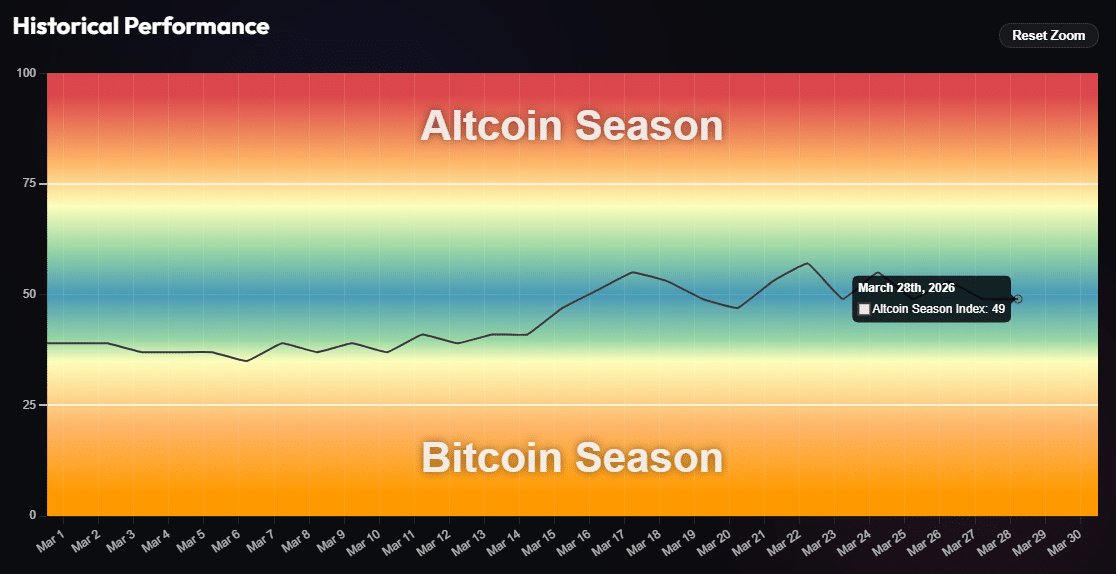
Source: Blockchaincenter

Naturally, the question arises – Is this corrective phase following the textbook rotational playbook?

Technical signals suggest it is, but the Bitcoin Risk Index has been mirroring 2022’s pattern. For context, when the Risk Index rises, BTC loses stability, and if negative altcoin impulse exceeds the 25% threshold, corrective pressure spreads “across” the broader altcoin market.

Currently, the market is nearing this critical threshold, meaning altcoins might be highly sensitive to changes in BTC stability and overall risk conditions. According to AMBCrypto, until the Risk Index declines and negative impulse subsides, altcoins are unlikely to gain significant traction. In this environment, short-term rallies may occur, but they are likely to be shallow and quickly reversed.

Investors bet on altcoins, but rising metals could restrict upside

Altcoins are currently trading under elevated risk, prompting investors to position carefully.

In other words, high altcoin risk, coupled with Bitcoin dominance hitting resistance, may be causing investors to rotate selectively, seeking short-term opportunities elsewhere. Such a dynamic keeps rallies muted and reinforces corrective pressure across the market until overall risk metrics ease.

Macro volatility further seemed to be compounding this dynamic at press time. The market has been increasingly pricing in stagflationary pressures, a scenario where economic growth slows down while inflation remains high. Stagflation reduces investors’ risk appetite and complicates portfolio allocation, prompting a careful balance between BTC, altcoins, and hard assets like gold and silver.
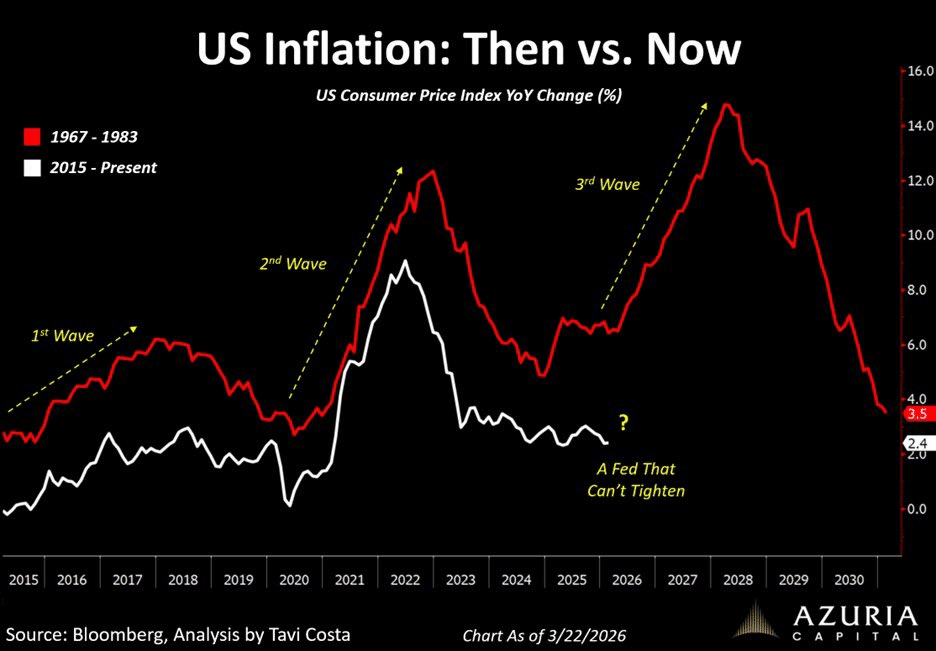
Source: Bloomberg

That said, investors appear to be moving ahead of the trend right now.

Technically, gold has decoupled from equities, extending gains to +4% over the day and climbing above $4,550/oz. Meanwhile, silver has jumped by +5%, surpassing $71/oz. Together, the two metals have added roughly $1.3 trillion in market capitalization.

The timing is telling. With Bitcoin breaking below $70K, BTC dominance capped at 60%, and altcoin rotations remaining selective amid a rising Risk Index, this move into hard assets looks deliberate. Investors might be hedging against broader market risk, which may continue to limit altcoin upside until BTC stabilizes and risk metrics improve.


Final Summary

  • BTC.D hitting 60% resistance and the Altcoin Season Index’s hike indicate selective rotation.
  • Rising gold and silver indicate deliberate hedging against macro and BTC risk, potentially limiting altcoin upside.


İlgili Sorular

QWhat are the key technical indicators suggesting a shift from Bitcoin to altcoins is occurring?

ABitcoin dominance (BTC.D) facing resistance at 60% and the Altcoin Season Index rising by 10 points this month indicate a selective rotation from Bitcoin into altcoins is beginning.

QAccording to the article, what is the critical threshold for altcoin market pressure, and what happens if it's exceeded?

AThe critical threshold is a negative altcoin impulse exceeding 25%. If this happens, corrective pressure spreads across the broader altcoin market.

QWhat macroeconomic scenario is the market pricing in, and how does it affect investor behavior?

AThe market is pricing in stagflationary pressures, where economic growth slows while inflation remains high. This reduces risk appetite and complicates portfolio allocation, causing investors to carefully balance between crypto and hard assets.

QWhat significant moves have gold and silver made, and what does this suggest about investor sentiment?

AGold gained +4% to climb above $4,550/oz and silver jumped +5% to surpass $71/oz, adding roughly $1.3 trillion in market cap. This suggests investors are deliberately hedging against broader market risk.

QWhy are altcoin rallies likely to be shallow and short-lived in the current environment?

AAltcoin rallies are likely shallow and quickly reversed because they are trading under elevated risk. Until the Bitcoin Risk Index declines and negative impulse subsides, altcoins are unlikely to gain significant traction.

İlgili Okumalar

The Largest IPO in History Ignites Heated Debate: Is SpaceX Worth $1.77 Trillion?

SpaceX's potential IPO is priced at $135 per share, aiming to raise $75 billion and valuing the company at approximately $1.77 trillion, which would make it the largest IPO in history. This valuation has sparked intense debate among investors. Bullish analysts, including major underwriters Goldman Sachs and Morgan Stanley, argue the valuation is justified by SpaceX's long-term potential. They see it not just as a rocket company but as a future leader in space infrastructure, with key growth drivers being Starlink satellite internet, low-cost rocket launches, and future AI-related ventures. They project revenues reaching hundreds of billions to trillions of dollars by 2030-2040. ARK Invest's model suggests a 2030 enterprise value could reach $2.5 trillion. Bearish analysts from independent research firms like Morningstar, PitchBook, and New Constructs contend the IPO price is excessively high, already pricing in unrealistic future growth. Using DCF and sum-of-the-parts models, they estimate fair value between $780 billion and $1.7 trillion, significantly below the IPO target. They highlight risks such as the speculative nature of AI projections, over-dependence on Elon Musk, high growth expectations, and corporate governance concerns. Trefis set a target price of just $79 per share. While both sides acknowledge SpaceX's unique position in commercial space, the core disagreement centers on whether the $135 share price offers a reasonable margin of safety or is overly optimistic. Despite the valuation controversy, reported strong demand for the IPO indicates significant market interest.

marsbit45 dk önce

The Largest IPO in History Ignites Heated Debate: Is SpaceX Worth $1.77 Trillion?

marsbit45 dk önce

After the Passage of the GENIUS Act and the CLARITY Act, What Is the Correct Architecture for On-Chain Yield?

The article discusses the evolution of on-chain credit, distinguishing three markets: overcollateralized crypto lending, unsecured lending (largely unsuccessful), and asset-backed credit (ABC). ABC, backed by identifiable real-world collateral with legal recourse, is identified as the fastest-growing category and the only one credibly addressing adverse selection—the core problem in credit where the riskiest borrowers self-select. Current growth in on-chain Real World Assets (RWAs), particularly tokenized private credit funds (e.g., Maple Finance, Centrifuge), is substantial but often merely "wraps" existing fund structures, inheriting their risks rather than solving adverse selection at the protocol level. The regulatory landscape is a key driver, with the US GENIUS Act (prohibiting stablecoin issuers from paying yield) and the proposed CLARITY Act (closing loopholes on indirect yield) set to redefine permissible yield-bearing products. This makes vaults (like ERC-4626) the critical architecture—they become the primary compliant vehicle for delivering yield, functioning as issuance, disclosure, distribution, and recovery mechanisms. The author's thesis is that the correct post-GENIUS/CLARITY architecture involves building ABC solutions where credit assessment, structure, and recovery are encoded directly into the smart contract vault layer, moving beyond mere tokenized fund wrappers to solve adverse selection fundamentally and ensure regulatory compliance.

Foresight News1 saat önce

After the Passage of the GENIUS Act and the CLARITY Act, What Is the Correct Architecture for On-Chain Yield?

Foresight News1 saat önce

TechFlow Intelligence Bureau: Anthropic's New Model Fable Sparks Controversy by Restricting Biosafety Research, US CPI Soars to 4.2%, a Three-Year High

**Summary of TechFlow Intelligence Report:** The newsletter covers several key tech and finance developments. In AI, Anthropic's new Fable model faced backlash for secretly limiting biomedical research capabilities and enforcing a 30-day data retention policy, prompting the company to promise more transparent adjustments. In a related story, Anthropic's founder revealed his departure from OpenAI was due to dishonesty from Sam Altman, not safety concerns. Meanwhile, OpenAI is considering significant price cuts to compete with Anthropic, potentially sparking a price war. In crypto/Web3, BlackRock filed a new amendment for a yield-generating Bitcoin ETF, while Bank of America's CEO warned that stablecoin yields could drain trillions from traditional banks. U.S. Senator Cynthia Lummis advocated for the U.S. to officially accumulate Bitcoin reserves. In hardware, Nvidia released the DiffusionGemma-2-6B image model optimized for efficient inference, and AMD promoted its unified memory architecture to challenge Nvidia's dominance. TSMC's CFO hinted at possible price increases due to soaring AI chip demand. A major legal ruling in Germany held Google legally responsible for inaccurate information generated by its AI Overviews feature. Google Chrome also moved to fully block ad-blocker workarounds like uBlock Origin. Macroeconomic headlines included U.S. CPI rising to 4.2% (a 3-year high) and Iran's complete closure of the Strait of Hormuz, raising oil price and inflation fears. South Korean markets saw continued volatility with massive foreign capital outflow. Other notable stories: Microsoft expanded its Copilot AI assistant "Mico" globally; a study found r/wallstreetbets users' stock picks outperformed Wall Street; a fully autonomous drone killed a human soldier for the first time, raising AI ethics concerns; and a Chinese hospital used brain-computer interface technology to help a blind person "see." The overarching theme connects debates over AI boundaries and responsibility (Anthropic's restrictions, Google's liability, lethal autonomous drones) with real-world economic and geopolitical turmoil (inflation, Strait of Hormuz closure, market instability), highlighting the tense interplay between technological advancement and global chaos.

marsbit1 saat önce

TechFlow Intelligence Bureau: Anthropic's New Model Fable Sparks Controversy by Restricting Biosafety Research, US CPI Soars to 4.2%, a Three-Year High

marsbit1 saat önce

Alibaba's Yet Another New Business Division: What Signal Does It Send?

Alibaba has established a new "Token Foundry" business unit, merging its Tongyi large model division and Future Life Lab. Led directly by Group CEO Wu Yongming, this marks the company's third significant AI organizational reshuffle in 2026, following the creation of the Alibaba Token Hub (ATH) and a Group Technology Committee. The move signals a strategic shift from consolidating AI resources to accelerating productization and commercialization. The "Token Foundry" name reflects Alibaba's ambition to become a foundational supplier in the AI era, focusing on model development and commercial application. Key teams, including those behind the high-performing HappyHorse video generation model, have been integrated into the new unit. Concurrently, Zhou Jingren, architect of the Qwen model series, has been appointed Group Chief Scientist to lead a new AI Future Research Institute, focusing on long-term technological breakthroughs like Agent capabilities. This restructuring creates a clear four-layer AI architecture within Alibaba: the research institute for frontier exploration, Token Foundry for core models and commercialization, MaaS for platform services, and business units like Qianwen (C端) and Wukong (B端) for end-user applications. The adjustments align with a global trend among tech giants like Google and Microsoft to centralize AI leadership under the CEO and deeply integrate research with business units. The urgency is driven by a narrowing competitive window. Alibaba has announced its AI business is now entering a commercialization phase, with AI-related revenue seeing triple-digit growth for eleven consecutive quarters. The company faces intense competition in the MaaS (Model-as-a-Service) sector from rivals like ByteDance and Tencent. The Token Foundry initiative represents Alibaba's effort to streamline execution and enhance competitiveness in this critical, fast-evolving landscape.

marsbit2 saat önce

Alibaba's Yet Another New Business Division: What Signal Does It Send?

marsbit2 saat önce

İşlemler

Spot
Futures
活动图片




