Summary
Alibaba's quarterly revenue grew by 9%, slightly exceeding market expectations. However, net profit fell by approximately 75% due to factors including AI investments. The stock price dropped nearly 5% at market open. As funds began re-evaluating the 45% growth rate of its cloud business and the prospects for AI commercialization, BABA's stock turned positive intraday and closed up about 1%. Market focus is shifting from short-term profits to the next phase of growth.
This earnings report from Alibaba took the market through a gamut of emotions.
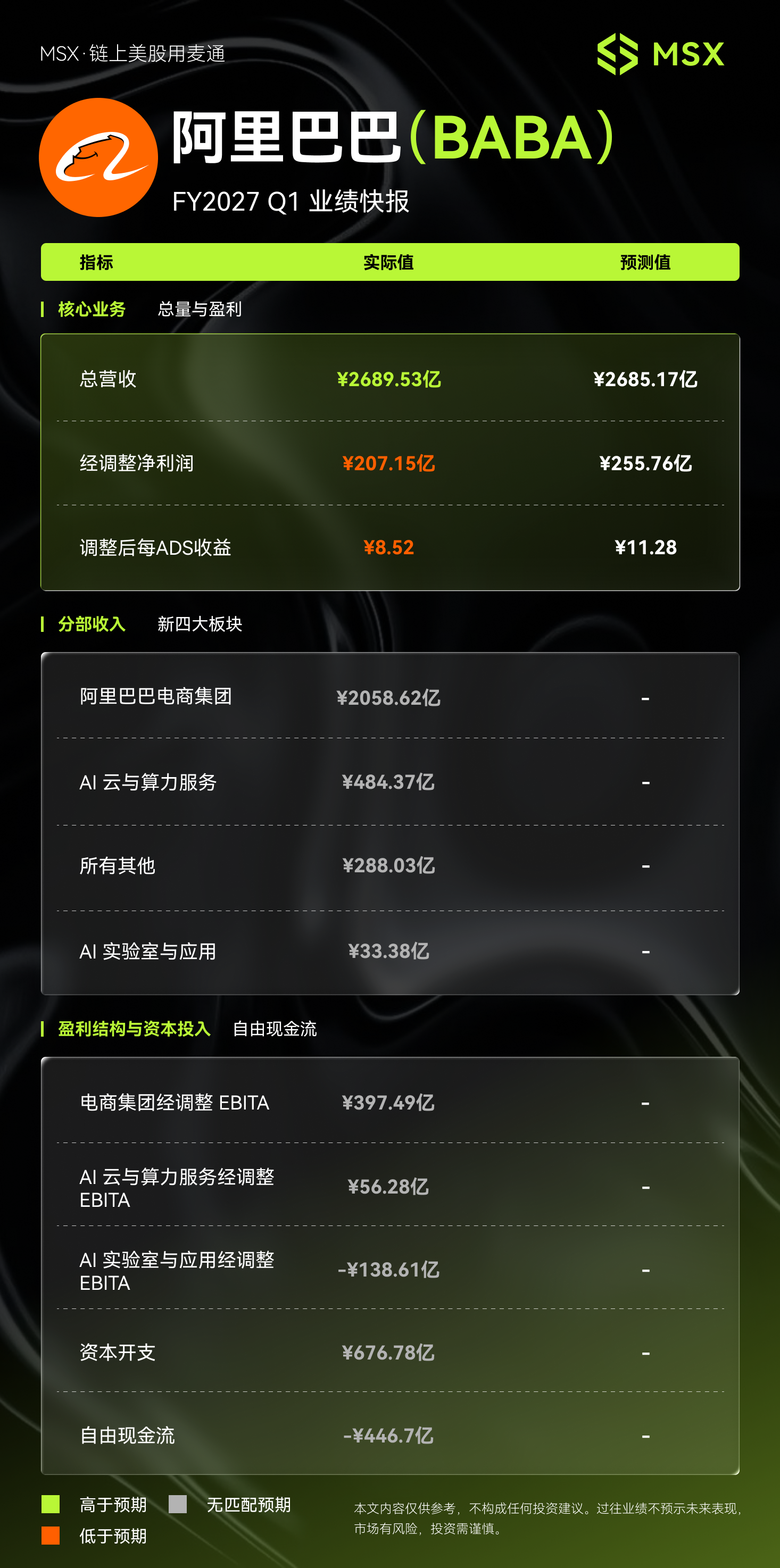
After the report was released, investors first noticed the profit pressure. Quarterly net profit fell about 75% year-on-year. Adjusted earnings per American Depositary Share were 8.52 yuan, below the market expectation of 10.53 yuan. BABA initially fell about 4.6% after the open, with clear selling pressure in both pre-market and early trading.
But the day's movement didn't end there. The stock price gradually recovered its losses, turned positive during the session, and ultimately closed up about 1%. This wasn't because the profit figures suddenly improved. Instead, the market began to reassess: is the profit Alibaba is sacrificing now merely filling holes in old businesses, or is it buying future growth?
Revenue Holds Steady as Growth Engines Shift Gears
For the quarter ending in June, Alibaba's revenue reached 268.95 billion yuan, a year-on-year increase of 9%, slightly exceeding the LSEG consensus estimate of 268.88 billion yuan. For a massive platform company of this scale, 9% growth is not explosive, but it indicates that core businesses are not decelerating.
More attention was paid to AI Cloud and Computing Services. This segment's revenue reached 48.44 billion yuan, a year-on-year increase of 45%. The annual recurring revenue for model-as-a-service has already exceeded 16 billion yuan. Alibaba is gradually transforming from an e-commerce platform into a comprehensive technology company that possesses both consumer touchpoints, cloud infrastructure, and large model capabilities. This is a key reason why funds were willing to re-enter the market after the initial decline.
Declining Profits: Spending Primarily on AI Infrastructure
Capital expenditure for the quarter reached 67.68 billion yuan, up 75% year-on-year. Alibaba previously announced plans to invest at least 380 billion yuan in cloud and AI infrastructure over the next three years, with about half already deployed. Servers, chips, data centers, and model training all require upfront investment, naturally putting pressure on profits and free cash flow.
What the market truly worries about is whether this spending will generate returns. Management's assessment is that, based on the current gross margin level, the capital expenditure on AI is expected to achieve a breakeven point within three years. Concurrently, Alibaba plans to expand the deployment of its in-house developed T-Head chips to reduce computing costs and improve long-term profit margins.
Therefore, this earnings report is not simply a story of "plummeting profits." In the short term, heavy investment has indeed depressed profitability. From a medium-term perspective, however, the 45% growth rate of cloud revenue, the continuously growing demand for AI, and the increasingly clear path to commercialization have allowed the market to see a second growth curve. BABA's intraday reversal from losses to gains precisely reflects the ongoing shift in valuation logic: investors are no longer just asking how much Alibaba earned this quarter, but also whether it can become a core platform for China's AI infrastructure.