Airdrops Won't Make You Rich, edgeX Doesn't Need a Community

marsbit2026-03-31 tarihinde yayınlandı2026-03-31 tarihinde güncellendi

Özet

The decentralized perpetual contract protocol edgeX, incubated by Amber Group and backed by Circle Ventures, faced massive community backlash following its token airdrop distribution. Despite earlier promises not to screen out Sybil accounts and to distribute tokens based on points earned through trading, users discovered significant inconsistencies in token allocation. Many users reported receiving vastly different token amounts for the same number of points—some obtained 11 tokens per point, while others received as few as 0.5. Further allegations emerged, including insider trading, with reports that low-point affiliated addresses received a quarter of the total airdrop. The project worsened the situation by disabling comments on its social media channels to suppress criticism. Influential figures like Bingwa accused edgeX of being a "setup" rather than a legitimate project, designed to manipulate and exploit users. The incident has eroded trust in airdrop mechanisms, highlighting the risks of "rule changes after the fact" and the lack of transparency. As a result, user activity on edgeX plummeted, with daily new deposits dropping from over 2,000 to under 50 shortly after the airdrop snapshot. The event raises broader concerns about the sustainability of airdrop-driven engagement in DeFi, suggesting that the era of "airdrop致富" (getting rich from airdrops) may be over.

Author: Gu Yu, ChainCatcher

Last week, the severe backlash from BackPack was still vivid in everyone's minds, and today, another decentralized perpetual contract trading protocol, edgeX, is facing a tidal wave of criticism.

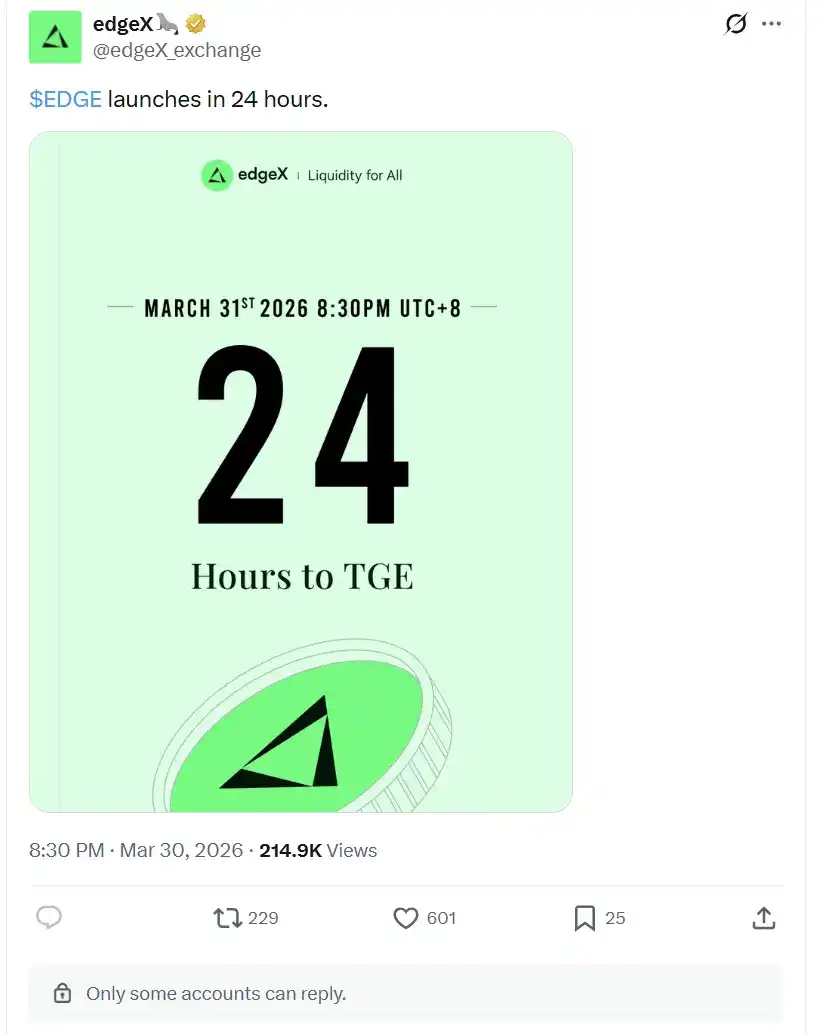
This morning, edgeX officially announced the website to check and claim the token airdrop, with plans to list on exchanges tonight. As a project incubated by Amber Group and strategically invested in by Circle Ventures this year, edgeX was once highly anticipated by airdrop hunters.

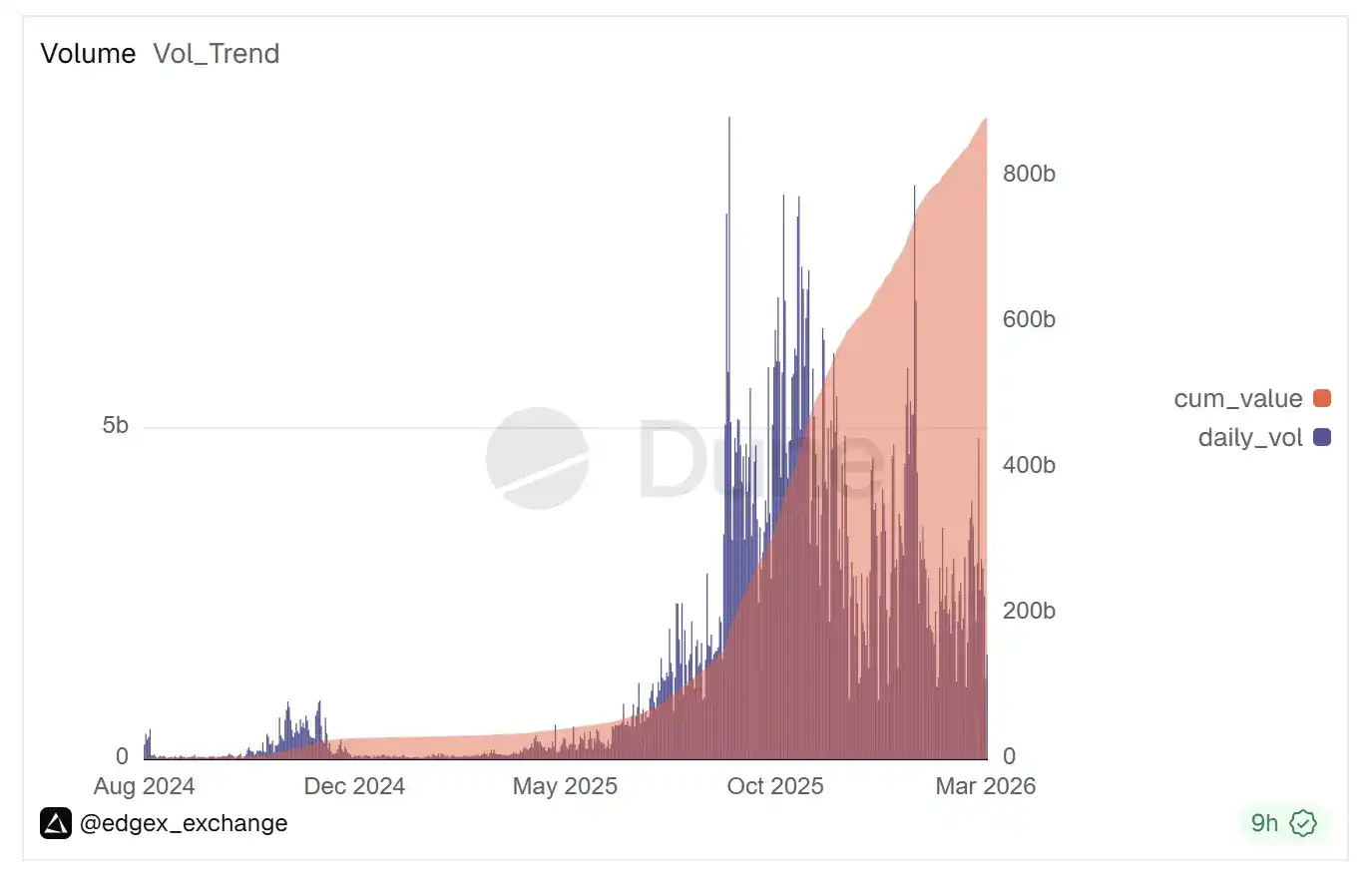
Since August 2025, edgeX's trading volume has entered a period of rapid growth. To date, it has accumulated over 470,000 user addresses, a total trading volume exceeding $87.7 billion, and a current Total Value Locked (TVL) of over $360 million. Furthermore, edgeX has generated over $180 million in fee revenue from these trades.
The edgeX team had previously promised the community that they would absolutely not screen for Sybil attacks—'if you have points, you get tokens'—which was a source of confidence for many edgeX users. However, what no one anticipated was that while edgeX indeed did not remove Sybil accounts this time, they manipulated the "points weighting" instead.

Based on community feedback, many users earned the same number of points through trading but received different amounts of airdropped tokens. Some users received 4 tokens per point on average, some only received 0.5 tokens per point, while others received 11 tokens per point. In response, the project team merely stated that points from different sources indeed had different weights.

Even calculating at the rate of 11 tokens per point, their current value is only about $5.5. In contrast, the secondary market price for edgeX points last year was $30-40, resulting in significant losses for secondary market buyers of these points.

What's worse, several KOLs, including He Bi, exposed that the edgeX project team engaged in a 'rat warehouse' situation (insider trading/preferential allocation), where multiple linked addresses with low points collectively received a quarter of the total airdropped tokens.

As community质疑声四起质疑 (questioning) grew louder, edgeX directly disabled comments on its X (formerly Twitter) account, attempting to suppress the spread of negative comments, but it was already too late.
"Why did they change rules arbitrarily, resulting in different rights for the same points? Why delete posts, kick people out, and suppress discussion? Because a project that from the very start intended to rely on wash trading to inflate data, hype valuations with stories, and coordinate with market maker groups for利益输送 (benefit transfer/insider profiteering) fundamentally cannot respect users, nor can it respect the community," said well-known KOL Ice Frog in an X post.

Ice Frog also stated that the most egregious aspect of edgeX is that it wasn't aimed at building a project from the beginning, but rather at setting up a scheme (a scam/plot), attempting to use manipulation and收割 (harvesting/exploitation) to destroy this industry.

Undoubtedly, this "post-rules" handling directly shatters the core premise of user trust in airdrop mechanisms—predictability. Once users cannot evaluate returns based on公开规则 (public rules), the so-called "points farming strategy" loses its博弈基础 (gaming foundation). One after another, large-scale "反向撸毛" (reverse airdrop/being rugged) and "作恶" (malicious acts) events continue to impact user confidence.

In fact, a significant portion of the trading volume and user activity on many yet-to-launch-token DeFi protocols comes from airdrop expectations. The seemingly massive community size and trading volume are built on this foundation. Once such projects complete their token launches and lose the appeal of potential收益 (returns/yields) for users, the false prosperity will quickly crumble. Once the expected returns from trading for airdrops are no longer certain or even become negative, the overall activity of the entire DeFi market could significantly decline.

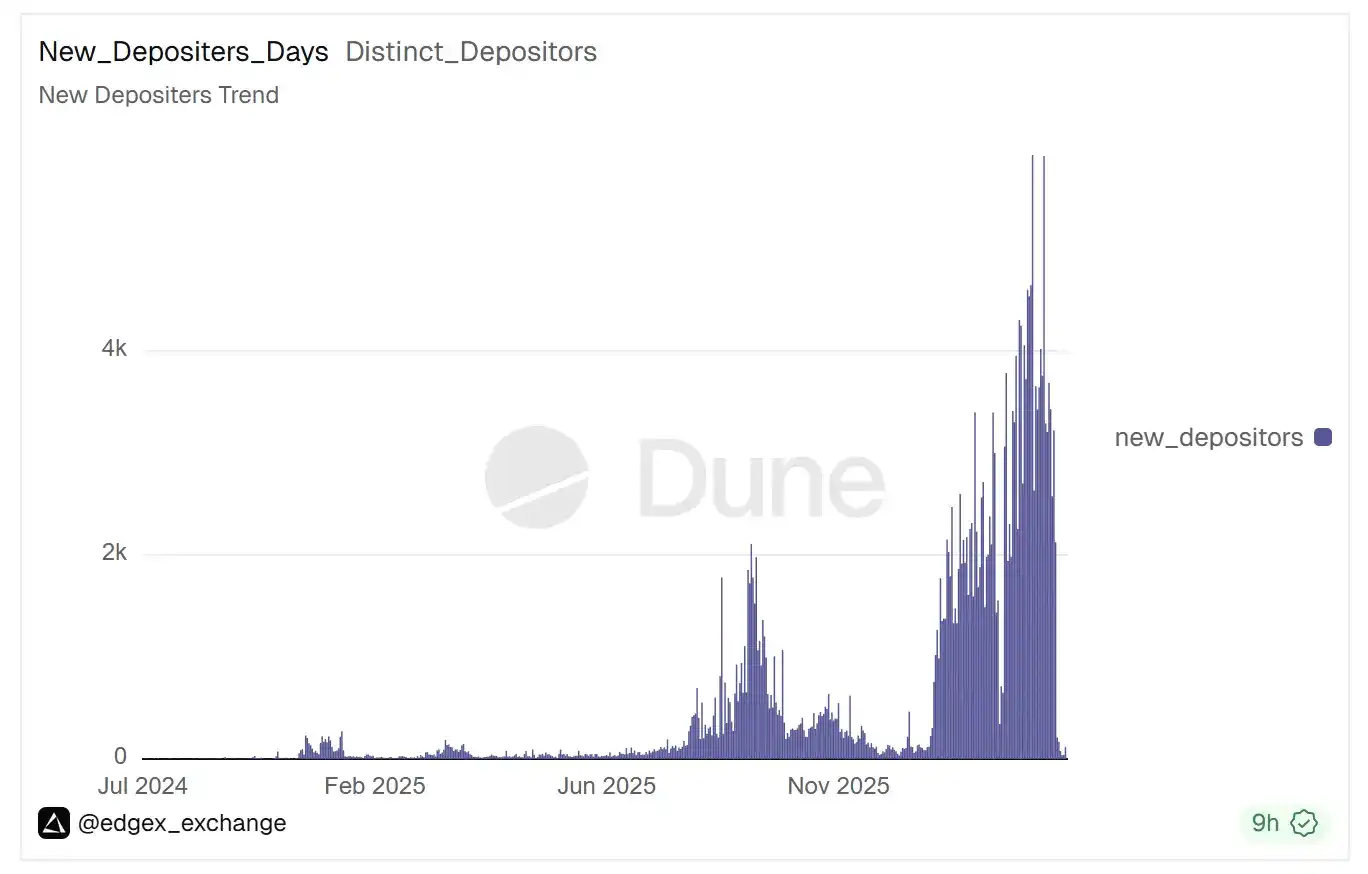
Taking edgeX as an example, in the days following the conclusion of the airdrop snapshot for this project, the number of new depositing users per day plummeted from over 2,000 to fewer than 50.
After the edgeX反向撸毛 (rug pull), what remains for the market is a series of question marks: How many people will continue to believe in "getting rich through airdrops"? As反向撸毛 (getting rugged) becomes the new normal and large numbers of airdrop hunters leave, will DeFi's trading activity and user stickiness continue to decrease?

When "反向撸毛" (reverse airdrops/rug pulls) evolve from isolated incidents into an industry consensus, the myth of getting rich through airdrops may have come to an end. For participants in the post-airdrop era, protecting the cash flow in hand might be more important than chasing those hard-to-verify "airdrop expectations."


İlgili Sorular

QWhat is the main controversy surrounding the edgeX airdrop distribution?

AThe main controversy is that edgeX applied different weights to user points without clear prior disclosure, resulting in unequal token distributions for users with the same number of points. Some users received 11 tokens per point while others received as low as 0.5, breaching expectations of fairness and transparency.

QHow did edgeX respond to the community's criticism regarding the airdrop?

AedgeX closed the comments section on its X (Twitter) account to suppress negative feedback and did not provide a transparent explanation for the unequal point weighting, only acknowledging that points from different sources had different weights.

QWhat allegations did KOLs like He Bi and Bing Wa make against edgeX?

AKOLs alleged that edgeX engaged in 'rat trading' (insider manipulation), where low-point affiliated addresses received a quarter of the total airdropped tokens, suggesting the project was designed to benefit insiders rather than the community.

QWhat impact did the airdrop snapshot have on edgeX's user activity?

AAfter the airdrop snapshot was completed, daily new depositing users on edgeX plummeted from over 2,000 to fewer than 50, indicating a collapse in user engagement once the airdrop incentive was removed.

QWhy does the article suggest that the edgeX incident could harm the broader DeFi ecosystem?

AThe incident undermines trust in airdrop predictability, which drives much of DeFi's trading volume and user activity. If users can no longer rely on fair rewards, engagement may decline, and the 'airdrop farming' economy could collapse.

İlgili Okumalar

Dialogue with Jia Hang | Looking Back at Two Decades of Chinese Payment Going Global

**Summary: A Conversation with Jia Hang on Two Decades of China's Payment Globalization** Jia Hang, a veteran with over twenty years in payments, reflects on China's attempts to build a global payment network through three key phases: UnionPay (card networks), Alipay+ (digital wallets), and now, stablecoins. His journey began at UnionPay International, aiming to establish China's card network abroad. While successful in following Chinese tourists ("where Chinese go, UnionPay goes"), it struggled to achieve true global scale. The core lesson: card networks like Visa/Mastercard's unassailable advantage isn't just technical standards, but their deeply entrenched **governance and profit-sharing models** that create powerful network effects. Competing as the "same species" is nearly impossible. At Ant Group, he led Alipay+, a strategy to bypass card networks by interconnecting local e-wallets worldwide. While innovative, it faced a similar ceiling. Mobile QR payments and card swipes were essentially **the same species competing for the same pie**, lacking a disruptive value proposition for users or a sustainable new incentive model to replace the card networks' established flywheel. Today, at Singapore's DCS, Jia focuses on stablecoin-based payments. He argues stablecoins represent a fundamental shift. They are not competing with Visa for consumer payments but challenging the **traditional banking and account system for value movement**. Products like "U Cards" (stablecoin-linked payment cards) are transitional, leveraging existing card networks for acceptance while building new rails. The real potential lies in stablecoins enabling seamless, low-cost global value transfer, potentially reorganizing the financial infrastructure around **accounts rather than cards**. Jia believes stablecoin adoption for local retail payments, cross-border transactions, and as high-yield savings vehicles is becoming irreversible. This could gradually reduce reliance on traditional fiat channels, especially in regions with weak currencies or capital controls. The quest for the "next global payment network" continues, now centered on whether stablecoins can successfully bridge Web2 and Web3, establish new governance, and create compelling user value beyond mere cost reduction.

marsbit8 dk önce

Dialogue with Jia Hang | Looking Back at Two Decades of Chinese Payment Going Global

marsbit8 dk önce

Circle's Stock Price Plunges 76%, Hong Kong Dollar Stablecoin Set to Launch Within Two Weeks

Circle's stock price has plunged approximately 76% from its 2023 peak, reflecting a major market revaluation. Despite this, Circle President Heath Tarbert emphasized the company's focus on long-term execution and its dominant position with USDC's $73 billion circulation across 34 blockchains. The competitive landscape is intensifying. A new consortium-backed stablecoin, Open USD, is attempting to challenge incumbents by sharing reserve yields with partners. More significantly, Visa's new stablecoin platform, initially supporting Open USD while also being compatible with USDC, could erode Circle's network effects. In response, Circle is expanding into real-world payments through partnerships like the one with Japan's JCB. Separately, Tether (USDT) faces a two-year compliance window under new U.S. regulations, requiring it to adjust its reserve composition away from assets like Bitcoin and loans towards cash and U.S. Treasuries. Meanwhile, in Hong Kong, Standard Chartered-backed fintech firm Dian Dian is poised to launch a licensed HKD-pegged stablecoin (HKDAP), moving the industry into a phase where the real test is integrating licensed stablecoins into actual payment flows and corporate treasury systems. The sharp decline in Circle's stock underscores a broader shift: the stablecoin market is moving from a winner-takes-all dynamic to a multi-player competitive arena where execution, compliance, and real-world utility are becoming paramount.

marsbit9 dk önce

Circle's Stock Price Plunges 76%, Hong Kong Dollar Stablecoin Set to Launch Within Two Weeks

marsbit9 dk önce

Amidst Capital's Encirclement, Decentralization is the Sole Defense for Public Blockchains

In a landscape dominated by power and profit motives, the author argues that decentralization is not merely one desirable feature among many in blockchain design—it is the singular, non-negotiable defense against corporate and capital capture. The article adopts a Machiavellian, realist perspective on human institutions, positing that businesses will inevitably attempt to co-opt any valuable network to protect their profits and dominance. While external attacks like 51% forks are often discussed, the greater existential risk is internal capture—the gradual erosion of a protocol’s neutrality by vested interests, as seen historically with platforms like Visa and Google. The piece critiques permissioned chains, highly centralized “permissionless” layer-1s, and layer-2s without sufficient decentralization (e.g., single sequencers) as inherently vulnerable. These compromised systems, promoted by established financial players, are framed as delaying tactics to stifle truly open networks that threaten existing high-fee, inefficient business models. Real-world examples, such as closed enterprise consortiums that exclude competitors, illustrate how such systems cement oligopolies rather than foster innovation. The author concludes that while decentralized protocols like Ethereum are imperfect and costly to operate, they represent the only viable long-term equilibrium. In a market where value naturally flows to the most secure and neutral settlement layer, only maximally decentralized public blockchains can resist being subsumed by capital and powerful incumbents.

Foresight News19 dk önce

Amidst Capital's Encirclement, Decentralization is the Sole Defense for Public Blockchains

Foresight News19 dk önce

Who Decides the Rules of Bitcoin? BIP-110 Ignites Governance Debate

Bitcoin's governance is once again at the center of a heated debate, this time ignited by BIP-110, the "Reduced Data Temporary Softfork." This proposal aims to curb non-monetary data (like inscriptions and Runes) by introducing seven new consensus-layer restrictions over a year, such as limiting new output scripts to 34 bytes and restoring the OP_RETURN cap to 83 bytes. The controversy stems from BIP-110's fundamental shift: it moves the battle against "spam" from node relay and miner policies to the consensus layer, rendering currently valid transactions invalid. Supporters, arguing that default policy governance has failed (highlighted by Bitcoin Core v30's relaxation of OP_RETURN limits), see this as necessary to protect node resources and Bitcoin's monetary focus. Opponents, led by figures like Michael Saylor and Adam Back, warn it dangerously centralizes governance. Saylor listed 110 reasons against it, criticizing its low 55% miner activation threshold and potential for chain splits. Back emphasized Bitcoin's "permissionless" ethos, arguing no single group should impose value judgments via consensus rules. Further complicating matters, technical critiques suggest BIP-110 may be technically circumventable, and a "BlockSlop" vulnerability in its upgrade path poses a consensus risk. The debate has drawn in diverse stakeholders: miners (with pools like Ocean signaling support and Foundry polling clients), node operators (like Bitcoin Knots), and new players like corporate treasury holder MicroStrategy (Saylor), whose market influence adds a novel dimension. Ultimately, BIP-110 acts as a governance stress test, exposing the unresolved question: who decides Bitcoin's rules? It pits the authority of miners, node operators, developers, and capital holders against each other, with each side claiming to defend Bitcoin's core principles of neutrality and security.

marsbit36 dk önce

Who Decides the Rules of Bitcoin? BIP-110 Ignites Governance Debate

marsbit36 dk önce

İşlemler

Spot
活动图片