Airdrops Won't Make You Rich, edgeX Doesn't Need a Community

marsbit2026-03-31 tarihinde yayınlandı2026-03-31 tarihinde güncellendi

Özet

The decentralized perpetual contract protocol edgeX, incubated by Amber Group and backed by Circle Ventures, faced massive community backlash following its token airdrop distribution. Despite earlier promises not to screen out Sybil accounts and to distribute tokens based on points earned through trading, users discovered significant inconsistencies in token allocation. Many users reported receiving vastly different token amounts for the same number of points—some obtained 11 tokens per point, while others received as few as 0.5. Further allegations emerged, including insider trading, with reports that low-point affiliated addresses received a quarter of the total airdrop. The project worsened the situation by disabling comments on its social media channels to suppress criticism. Influential figures like Bingwa accused edgeX of being a "setup" rather than a legitimate project, designed to manipulate and exploit users. The incident has eroded trust in airdrop mechanisms, highlighting the risks of "rule changes after the fact" and the lack of transparency. As a result, user activity on edgeX plummeted, with daily new deposits dropping from over 2,000 to under 50 shortly after the airdrop snapshot. The event raises broader concerns about the sustainability of airdrop-driven engagement in DeFi, suggesting that the era of "airdrop致富" (getting rich from airdrops) may be over.

Author: Gu Yu, ChainCatcher

Last week, the severe backlash from BackPack was still vivid in everyone's minds, and today, another decentralized perpetual contract trading protocol, edgeX, is facing a tidal wave of criticism.

This morning, edgeX officially announced the website to check and claim the token airdrop, with plans to list on exchanges tonight. As a project incubated by Amber Group and strategically invested in by Circle Ventures this year, edgeX was once highly anticipated by airdrop hunters.

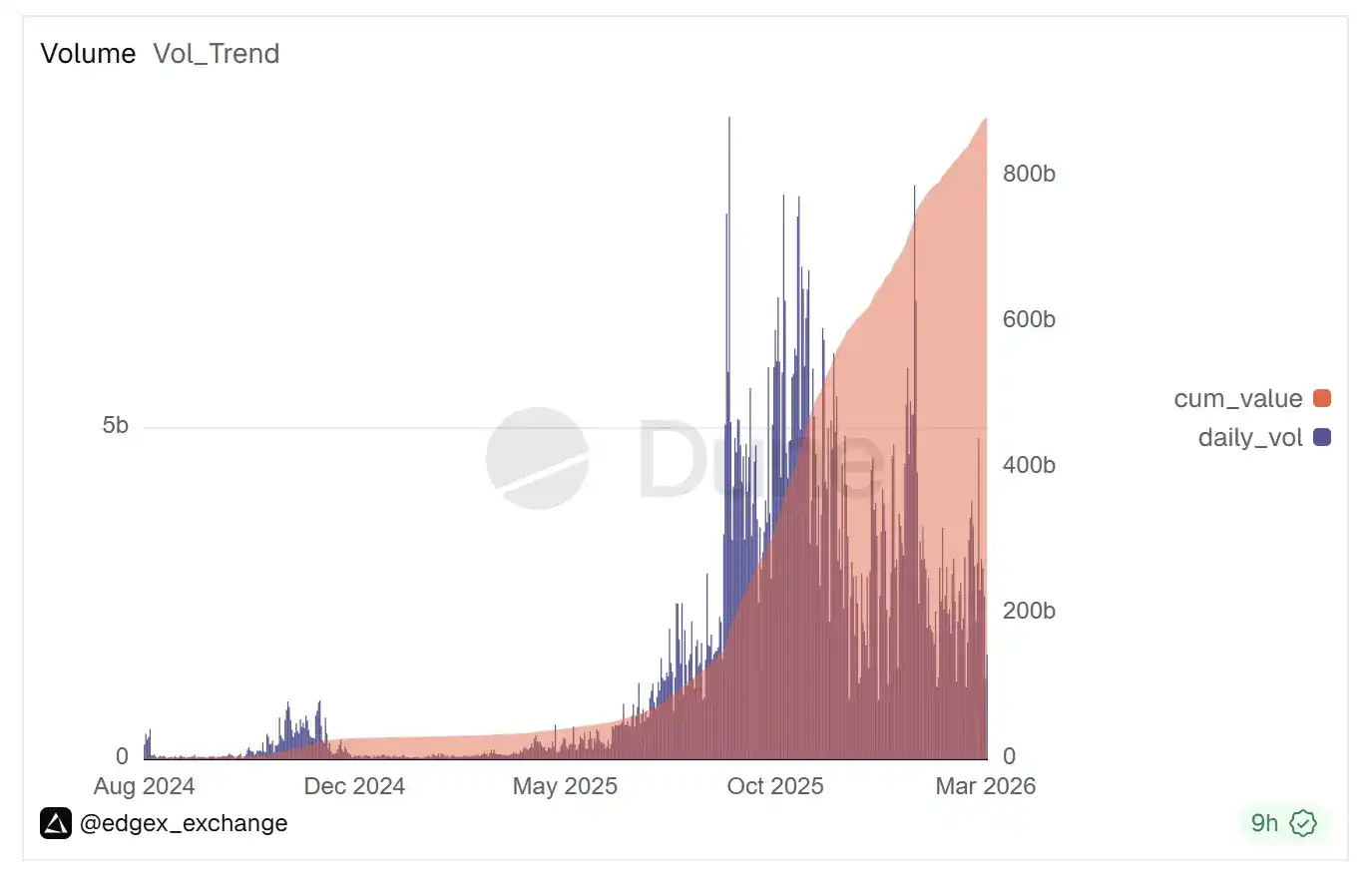
Since August 2025, edgeX's trading volume has entered a period of rapid growth. To date, it has accumulated over 470,000 user addresses, a total trading volume exceeding $87.7 billion, and a current Total Value Locked (TVL) of over $360 million. Furthermore, edgeX has generated over $180 million in fee revenue from these trades.
The edgeX team had previously promised the community that they would absolutely not screen for Sybil attacks—'if you have points, you get tokens'—which was a source of confidence for many edgeX users. However, what no one anticipated was that while edgeX indeed did not remove Sybil accounts this time, they manipulated the "points weighting" instead.

Based on community feedback, many users earned the same number of points through trading but received different amounts of airdropped tokens. Some users received 4 tokens per point on average, some only received 0.5 tokens per point, while others received 11 tokens per point. In response, the project team merely stated that points from different sources indeed had different weights.

Even calculating at the rate of 11 tokens per point, their current value is only about $5.5. In contrast, the secondary market price for edgeX points last year was $30-40, resulting in significant losses for secondary market buyers of these points.

What's worse, several KOLs, including He Bi, exposed that the edgeX project team engaged in a 'rat warehouse' situation (insider trading/preferential allocation), where multiple linked addresses with low points collectively received a quarter of the total airdropped tokens.

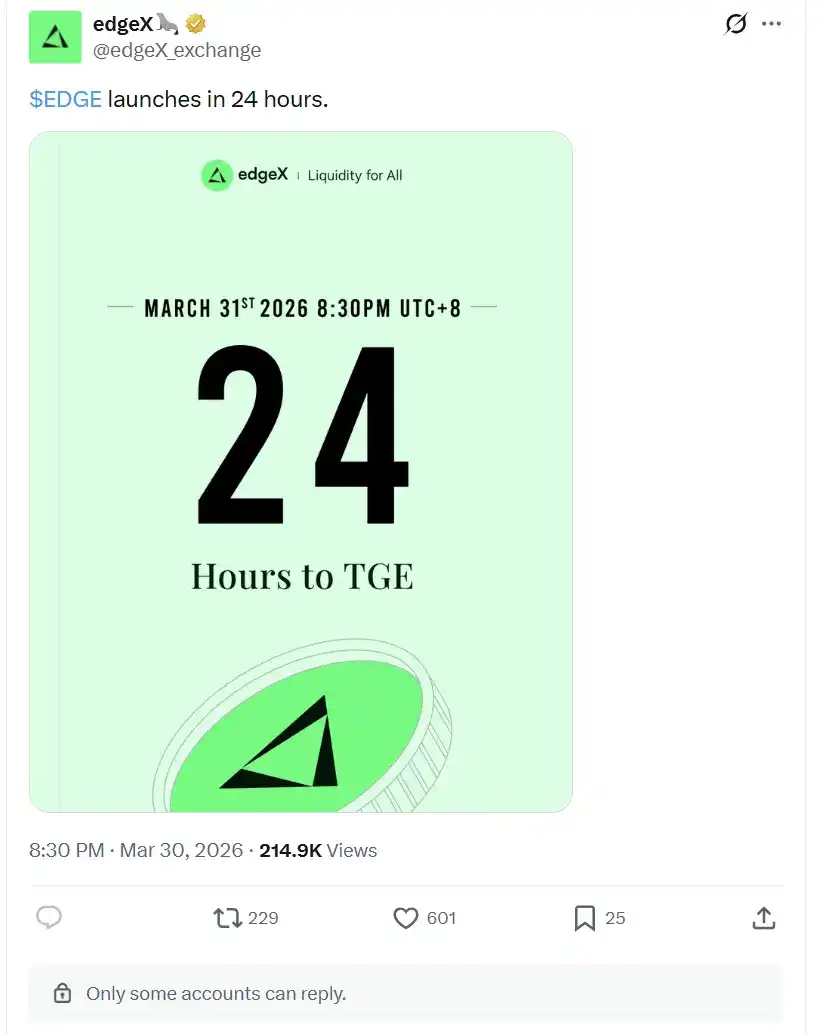
As community质疑声四起质疑 (questioning) grew louder, edgeX directly disabled comments on its X (formerly Twitter) account, attempting to suppress the spread of negative comments, but it was already too late.
"Why did they change rules arbitrarily, resulting in different rights for the same points? Why delete posts, kick people out, and suppress discussion? Because a project that from the very start intended to rely on wash trading to inflate data, hype valuations with stories, and coordinate with market maker groups for利益输送 (benefit transfer/insider profiteering) fundamentally cannot respect users, nor can it respect the community," said well-known KOL Ice Frog in an X post.

Ice Frog also stated that the most egregious aspect of edgeX is that it wasn't aimed at building a project from the beginning, but rather at setting up a scheme (a scam/plot), attempting to use manipulation and收割 (harvesting/exploitation) to destroy this industry.

Undoubtedly, this "post-rules" handling directly shatters the core premise of user trust in airdrop mechanisms—predictability. Once users cannot evaluate returns based on公开规则 (public rules), the so-called "points farming strategy" loses its博弈基础 (gaming foundation). One after another, large-scale "反向撸毛" (reverse airdrop/being rugged) and "作恶" (malicious acts) events continue to impact user confidence.

In fact, a significant portion of the trading volume and user activity on many yet-to-launch-token DeFi protocols comes from airdrop expectations. The seemingly massive community size and trading volume are built on this foundation. Once such projects complete their token launches and lose the appeal of potential收益 (returns/yields) for users, the false prosperity will quickly crumble. Once the expected returns from trading for airdrops are no longer certain or even become negative, the overall activity of the entire DeFi market could significantly decline.

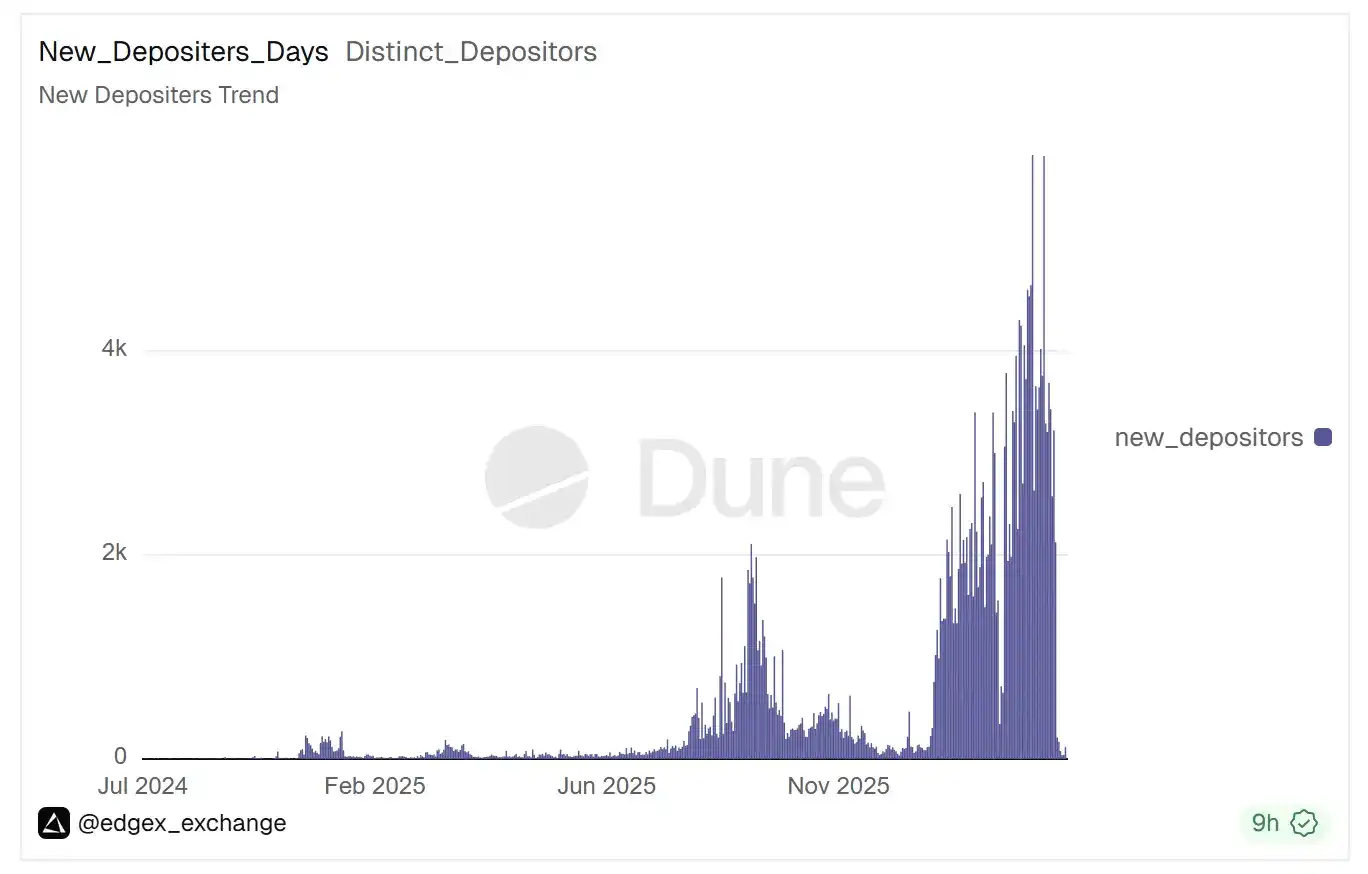
Taking edgeX as an example, in the days following the conclusion of the airdrop snapshot for this project, the number of new depositing users per day plummeted from over 2,000 to fewer than 50.
After the edgeX反向撸毛 (rug pull), what remains for the market is a series of question marks: How many people will continue to believe in "getting rich through airdrops"? As反向撸毛 (getting rugged) becomes the new normal and large numbers of airdrop hunters leave, will DeFi's trading activity and user stickiness continue to decrease?

When "反向撸毛" (reverse airdrops/rug pulls) evolve from isolated incidents into an industry consensus, the myth of getting rich through airdrops may have come to an end. For participants in the post-airdrop era, protecting the cash flow in hand might be more important than chasing those hard-to-verify "airdrop expectations."


İlgili Sorular

QWhat is the main controversy surrounding the edgeX airdrop distribution?

AThe main controversy is that edgeX applied different weights to user points without clear prior disclosure, resulting in unequal token distributions for users with the same number of points. Some users received 11 tokens per point while others received as low as 0.5, breaching expectations of fairness and transparency.

QHow did edgeX respond to the community's criticism regarding the airdrop?

AedgeX closed the comments section on its X (Twitter) account to suppress negative feedback and did not provide a transparent explanation for the unequal point weighting, only acknowledging that points from different sources had different weights.

QWhat allegations did KOLs like He Bi and Bing Wa make against edgeX?

AKOLs alleged that edgeX engaged in 'rat trading' (insider manipulation), where low-point affiliated addresses received a quarter of the total airdropped tokens, suggesting the project was designed to benefit insiders rather than the community.

QWhat impact did the airdrop snapshot have on edgeX's user activity?

AAfter the airdrop snapshot was completed, daily new depositing users on edgeX plummeted from over 2,000 to fewer than 50, indicating a collapse in user engagement once the airdrop incentive was removed.

QWhy does the article suggest that the edgeX incident could harm the broader DeFi ecosystem?

AThe incident undermines trust in airdrop predictability, which drives much of DeFi's trading volume and user activity. If users can no longer rely on fair rewards, engagement may decline, and the 'airdrop farming' economy could collapse.

İlgili Okumalar

a16z: From Companies to DAOs, DUNA May Become the Next Generation Organizational Form

This article, "From Companies to DAOs: How DUNA Could Become the Next Organizational Form," traces the 500-year evolution of business collaboration. It begins with medieval structures like the *commenda* and Florentine *compagnia*, which exposed partners to personal risk. The modern corporation, exemplified by the Dutch East India Company (VOC), was a revolutionary leap, enabling large-scale, capital-intensive ventures by offering limited liability and reducing coordination costs. However, corporations introduced new challenges like principal-agent problems and bureaucratic overhead. The piece argues that software and internet-native protocols are now reducing these traditional overheads. Decentralized Autonomous Organizations (DAOs) emerged as a new model for coordination without centralized management. Yet, DAOs face a significant legal vacuum: they lack legal recognition, leaving members exposed to unlimited personal liability, and their tokens are vulnerable to being classified as securities under unclear regulations (e.g., the Howey Test). This has forced projects into suboptimal workarounds like offshore foundations. The article identifies the Decentralized Unincorporated Nonprofit Association (DUNA) as a potential solution. Recently legalized in states like Wyoming, the DUNA provides a legal wrapper for decentralized networks. It grants key protections—legal personality, limited liability, and perpetual existence—to a group without imposing a traditional hierarchical management structure. This allows token-holder communities to govern, hold assets, and contract as a single legal entity, aligning with their decentralized nature. While DUNA doesn't solve all governance challenges or magically resolve securities law questions, it represents a crucial step. It fills the legal recognition gap, offering a native legal form for internet-scale, decentralized collaboration and extending the separation of personal risk from organizational venture into a new domain.

marsbit1 dk önce

a16z: From Companies to DAOs, DUNA May Become the Next Generation Organizational Form

marsbit1 dk önce

2026 Mid-Year Report On-Chain RWA: Tokenized Stock Market Cap Doubles in a Year, But 90% of Rights Are Hollow Shells

The 2026 Mid-Year Report on On-Chain RWA highlights a significant growth in tokenized stock market capitalization, which nearly doubled from $951 million in March to $1.89 billion by July. However, the report reveals a fundamental contradiction in this "layer 2.5" ecosystem: products with the strongest legal foundation (like regulated U.S. infrastructure) lack liquidity and distribution, while freely tradable offshored wrapper products often lack substantive ownership rights. The increase is driven largely by a few products (SECZ, FGRS, STRCx) and platforms (Ondo, xStocks, Securitize collectively hold over 85% share). While distributed value across networks like Ethereum, Solana, and BNB Chain has grown, the market remains fragmented. Products referencing the same underlying asset (e.g., Apple stock) are distinct legal liabilities with different intermediaries and jurisdictional rules, offering varying degrees of legal claim. The report cautions that headline numbers are misleading, as they reflect changes in distributed token value—driven by issuance, conversions, and price movements—not pure investor inflows. True "canonical shares" with legal ownership, wide wallet distribution, institutional liquidity, and independent on-chain price discovery do not yet exist at scale. Tokenized treasuries show stronger product-market fit, and ETFs may be easier to scale than single stocks. The core takeaway is a trade-off: legal certainty versus liquidity and composability.

marsbit51 dk önce

2026 Mid-Year Report On-Chain RWA: Tokenized Stock Market Cap Doubles in a Year, But 90% of Rights Are Hollow Shells

marsbit51 dk önce

Coldcard Hardware Wallet Hacked: 594 Bitcoin Withdrawn in 25 Minutes

The Coldcard hardware wallet has been compromised, with hackers stealing approximately 594.5 Bitcoin (~$40 million) from 500 addresses in just 25 minutes. The root cause was a critical software bug, undetected for five years, which disabled the device's secure chip for generating true random numbers. This led to the creation of private keys based on predictable data like the processor's serial number, drastically reducing cryptographic security. The attackers exploited this offline by brute-forcing possible seed phrases, finding active addresses on the public ledger, and signing transactions. Initially, Coinkite (Coldcard's maker) claimed only older models were at risk but later admitted all devices running the compromised firmware were vulnerable. CEO Rodolphe Novak (NVK) apologized but ruled out financial compensation for affected users. To secure funds, owners must urgently update their firmware to specific safe versions, generate a completely new seed phrase on the updated device, and transfer all assets to new addresses created with that new seed. While a BIP-39 passphrase can help, it does not replace this migration process. Other Coinkite products like TAPSIGNER were not affected. This incident underscores that even specialized hardware requires rigorous, independent code audits, especially for cryptographic functions. It parallels past failures, like a 2006 OpenSSL bug in Debian, and raises questions about whether automated code analysis can ever fully replace human scrutiny in critical security areas.

cryptonews.ru3 saat önce

Coldcard Hardware Wallet Hacked: 594 Bitcoin Withdrawn in 25 Minutes

cryptonews.ru3 saat önce

İşlemler

Spot
活动图片