Author: Jae, PANews
The final airdrop suspense of the year concluded last night (December 30). Perp DEX (decentralized perpetual contract exchange) Lighter announced the completion of its airdrop distribution, granting early participants a total of $675 million, bringing a glimmer of warmth to the chilly market at the end of 2025.
Although the winter market is somewhat bleak, competition in the Perp DEX arena for liquidity and trading experience is intensifying. The industry is witnessing the gradual replacement of early automated market makers (AMMs) by high-performance central limit order books (CLOBs). Lighter, built on zk-rollup, quickly stands out with its zero-fee strategy and customized ZK circuit technical approach, attempting to redefine the standard for on-chain derivatives trading.
Airdrops have always been hard to please everyone, and Lighter undoubtedly faces the same issues encountered by other airdrop projects: dissatisfaction with the airdrop and user retention in the post-airdrop era.
Polarized Reactions to Airdrop, Token Distribution Sparks Controversy
Lighter completed its TGE yesterday, and the protocol token LIT showed significant volatility in its early listing. In pre-market trading on several centralized exchanges, LIT once reached a high of $3.9. After the TGE officially began, the price briefly surged to $7.8 before falling back and stabilizing in the range of $2.6 to $3.
According to Bubblemaps monitoring, the total airdrop amount distributed to early participants on the first day of LIT's listing reached $675 million. Since the airdrop distribution began, approximately $30 million has flowed out of Lighter.
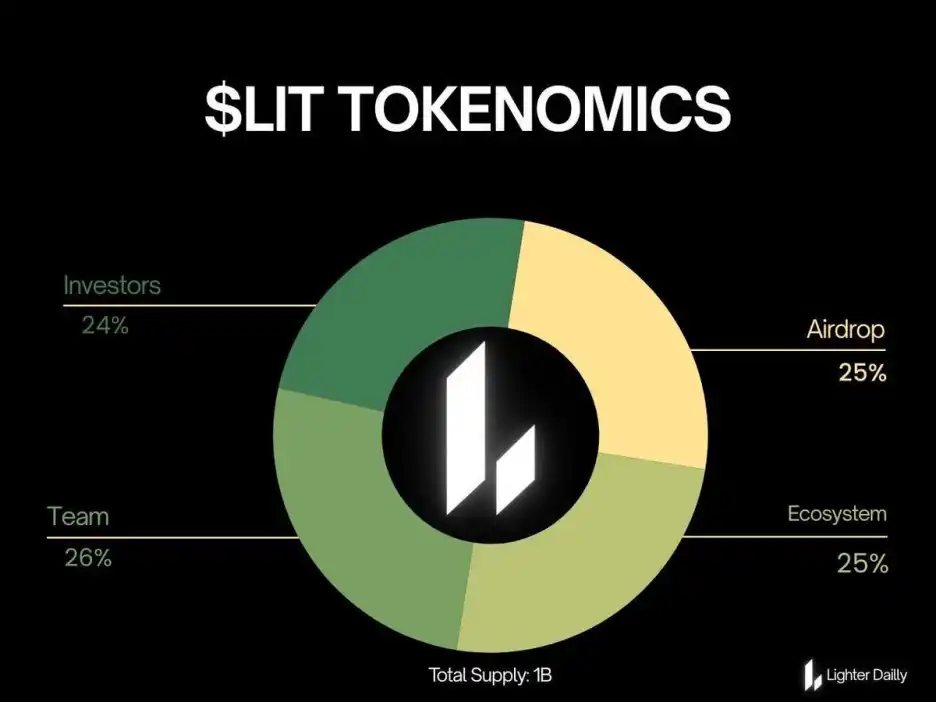
While Lighter's airdrop was relatively generous, community evaluations are polarized. Supporters believe that the initial airdrop accounted for 25% of the total supply, equivalent to approximately $690 million directly distributed to Season 1 and Season 2 points holders, with no lock-up restrictions, contrasting sharply with the lower token allocations at TGE for many other projects; opponents argue that the points conversion rate for Season 1 and Season 2 was about 20 to 28 LIT tokens per point. For some users with higher trading frequency, this is roughly equivalent to the fees they paid, failing to deliver the expected "big win"回报.
The biggest controversy surrounding this TGE lies in Lighter's tokenomics. The total token supply is 1 billion, with 50% allocated to the ecosystem and the other 50% to the team and investors, subject to a 3-year linear unlock. This plan has been criticized by the community as "team-dominated": although investor lock-ups are strict, the overall proportion is too high, potentially diluting community interests. The 25% unlocked airdrop tokens might create short-term selling pressure, while the 50% locked portion could lead to long-term potential selling pressure,不利于 the steady growth of LIT's market capitalization.
From a valuation perspective, Lighter's pricing directly benchmarks Hyperliquid and Aster. Although its trading volume once surpassed these two major rivals, the market still has doubts about the rationality of its valuation.
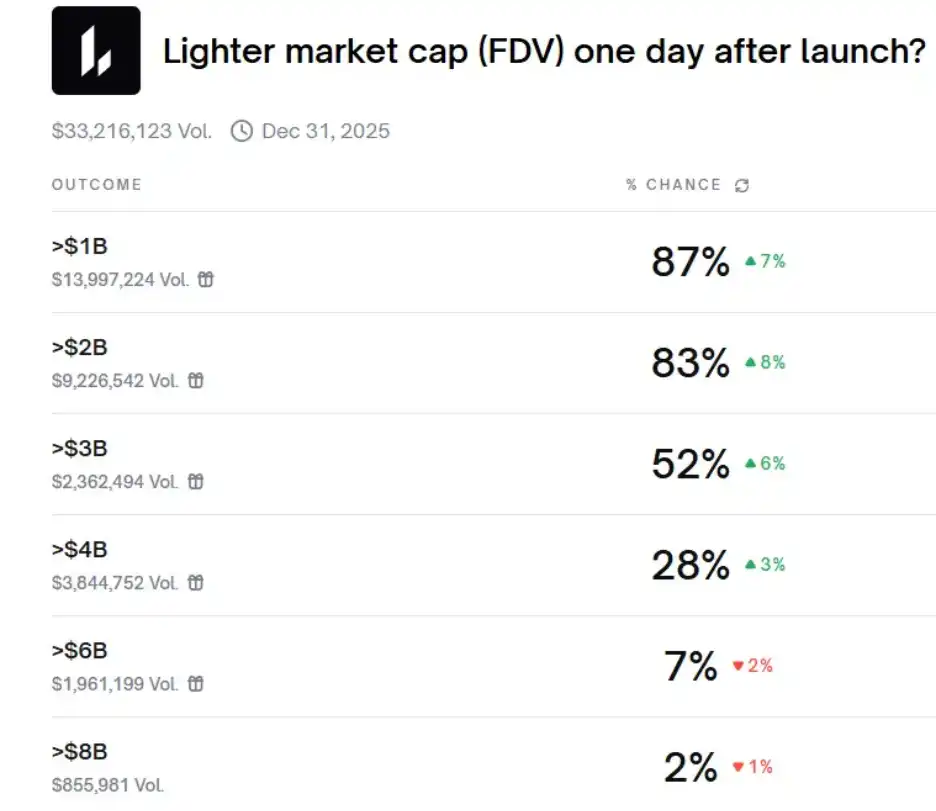
CoinGecko data shows that LIT's current market capitalization is approximately $680 million, with an FDV (fully diluted valuation) exceeding $2.7 billion. A week ago, Polymarket's prediction market showed an 83% probability that "Lighter's market cap will exceed $2 billion the day after listing".
Lighter CEO Vladimir Novakovski stated in a podcast interview: the token won't skyrocket immediately upon listing, realistic expectations are to start from a relatively healthy position. Andy, founder of The Rollup, also tweeted: if LIT's FDV is around $2 billion, he would choose to buy.
Overall, Lighter's TGE performance was largely in line with expectations but lacked surprises. Coupled with the overall market downturn, the community's overall response to the protocol has been muted.
Top-Tier Capital Bets on Harvard Prodigy Building Lighter
Lighter's story begins with its founder, Vladimir Novakovski, a mix of the typical "overachiever next door" and Wall Street elite. He entered Harvard at 16 and graduated early, later personally recruited by Ken Griffin, founder of the global market-making giant Citadel Securities. This experience in a top quantitative fund gave him deep insights into the microstructure of traditional financial markets and the essence of liquidity management.
However, this prodigy's ambition did not stop at Wall Street. He previously successfully founded Lunchclub, an AI social platform valued at over $100 million in Web2. In 2023, he敏锐地捕捉到 the gap in on-chain financial infrastructure, leading 80% of his team members to transition and All in Crypto, fully dedicating themselves to Lighter's development.
"We invested in Lighter, mostly because of Vladimir and his team's engineering capabilities." This statement by Joey Krug, partner at top Wall Street VC Founders Fund, reveals the underlying logic of the capital bet: on extremely complex technical tracks, top talent density is the main moat.
In November 2025, Lighter announced the completion of a $68 million funding round, with a post-money valuation reaching $1.5 billion.
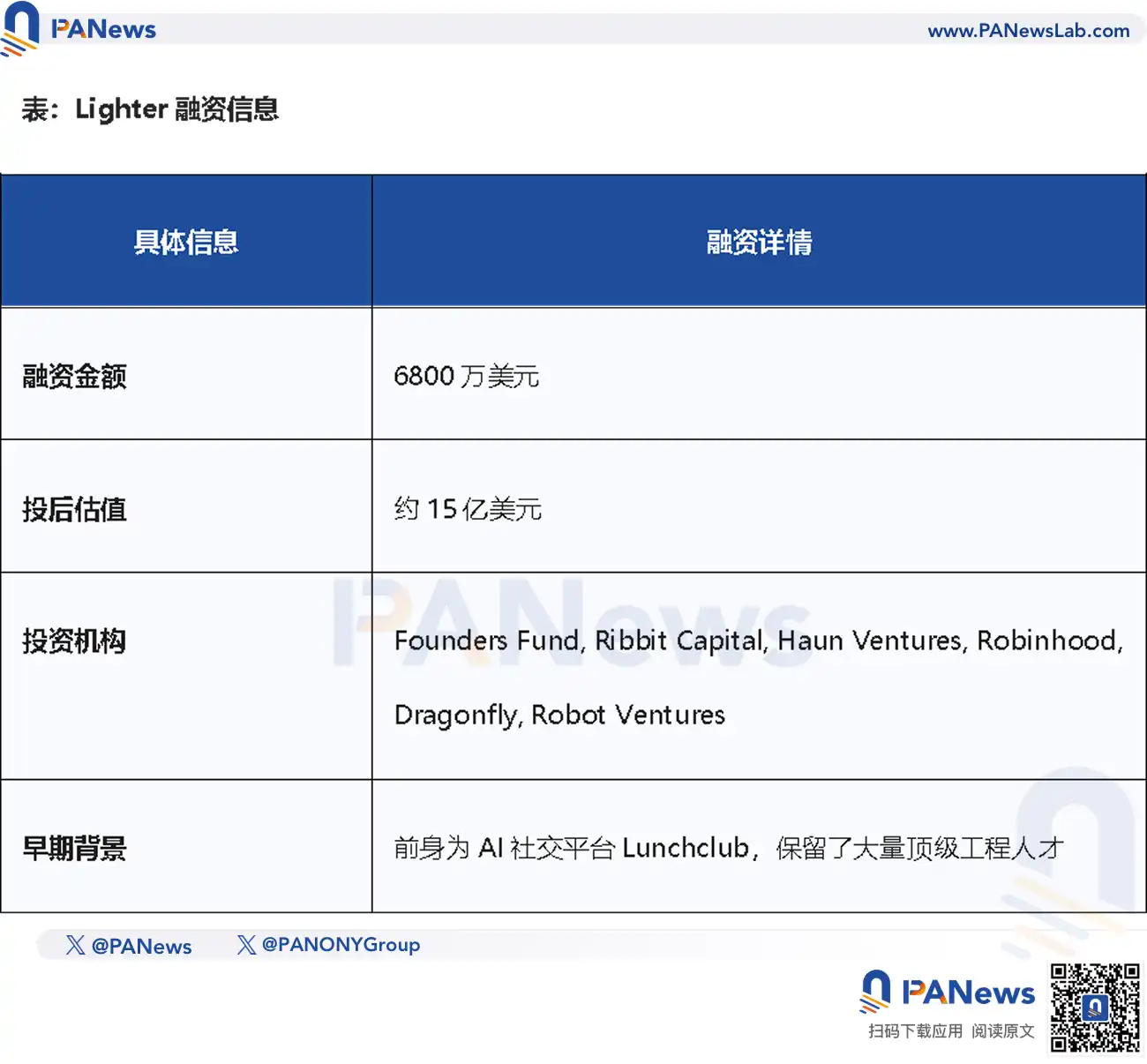
The participation of知名券商 Robinhood in this round perhaps signals an important trend: traditional financial giants are seeking Perp DEX infrastructure capable of truly handling institutional-grade trading volumes. This will not only bring funds to Lighter but also potentially导入 traditional financial institution user bases.
ZK Empowers Lighter to Achieve 15K+ TPS While Ensuring Verifiability
2025 is a watershed year for the Perp DEX赛道. Although early protocols like dYdX and GMX validated the feasibility of on-chain derivatives trading, they始终无法 match CEXs (centralized exchanges) in execution speed, slippage control, oracle latency, and liquidity depth. Lighter, however, achieves sub-second execution and higher capital efficiency by adopting a CLOB model and a high-performance Layer 2 architecture.
The core logic behind this evolution is verification equals trust. Lighter does not require users to trust the matching engine; instead, it uses customized ZK circuits to generate verifiable cryptographic proofs for every order match, every risk check, and every liquidation event. This architecture ensures that even if the sequencer attempts to act maliciously or is attacked, the underlying Ethereum mainnet contract can safeguard assets.
Lighter's technical moat is built on a seemingly contradictory combination: decentralized trust (ZK) and centralized efficiency (CLOB). Its architectural design pursues not only high performance but also transparency and non-custodianship, giving it a strong "Ethereum-native" attribute in its technical narrative.
Unlike many general-purpose ZK virtual machine protocols, Lighter chose a harder path: tailoring ZK circuits (zkLighter) specifically for trading logic. This allows the protocol to generate proofs with extremely high efficiency, achieving throughput of over 15,000 TPS (transactions per second) and soft finality below 10 milliseconds, sufficient to meet the demanding requirements of high-frequency traders.
It is worth mentioning that Lighter's underlying data structure uses a "hyper-tree" architecture to ensure that even under extremely high concurrency, the execution price of every order is the optimal available at that time.
To prevent extreme risks like sequencer offline or denial-of-service, Lighter also designed an "escape hatch" mode. Since all account balances and position data are published as Blob data on Ethereum, users can generate their own account value proofs based on the public data history and directly withdraw funds on the mainnet, without authorization from the sequencer. This mechanism also makes Lighter superior in terms of censorship resistance and asset sovereignty compared to Perp DEX protocols that build their own L1 consensus.
Zero-Fee Model Reshapes Protocol User Acquisition Logic
The reason Lighter has attracted such dense capital and user attention lies not only in its high performance and verifiability but also in its triple innovation in fee structure, capital efficiency, and liquidation logic.
In the context of Perp DEXs普遍 relying on trading fees for profit, Lighter dropped a bombshell on the market: "zero trading fees".
The protocol designed a clever dual-account model to balance商业可持续性.
-
Retail Account (Standard): No maker or taker fees for ordinary users. Although this introduces a slight delay of around 300ms, this cost saving is highly attractive for most non-high-frequency users.
-
Premium Account (Premium): Offers a zero-delay channel for institutions and high-frequency traders but charges very low fees (Maker 0.002%, Taker 0.02%).
Currently, Lighter's revenue mainly comes from premium account fees and liquidation fees, with daily revenue around $200,000,初步验证了其获客模式的可行性.
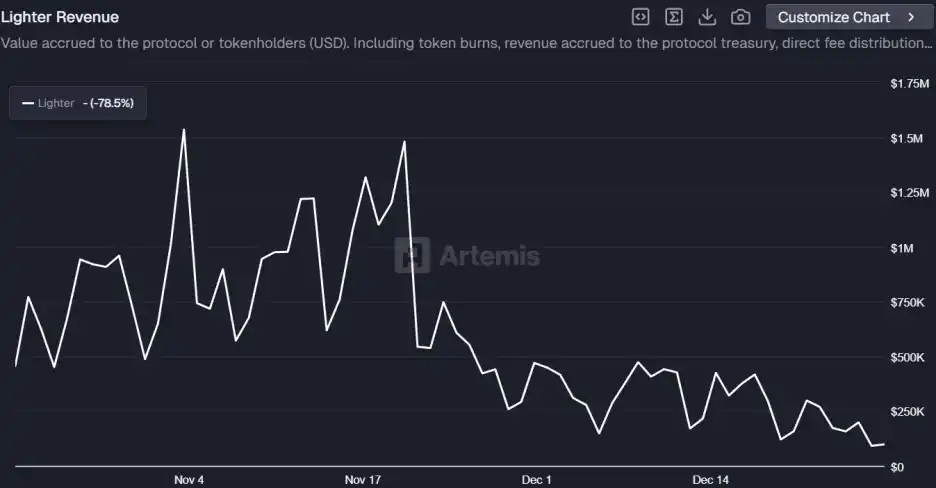
However, possibly due to the market downturn, Lighter's revenue level has declined slightly in the past week. With the airdrop expectation realized, the protocol's true revenue generation capability remains to be observed.
If the zero-fee is the hook for user acquisition, then the Universal Cross Margin (UCM) is the killer feature for retaining professional capital.
Traditional Perp DEXs typically require users to deposit stablecoins like USDC as margin, resulting in lower capital efficiency. Addressing this, Lighter introduced the UCM system, which allows traders to directly use yield-bearing assets stored on Ethereum L1 (such as stETH, LP tokens, or even Aave deposit positions) as collateral for L2 leveraged trading.
The cleverness of this design is that users' collateral assets do not need to be moved cross-chain; instead, they are mapped to L2 via ZK proofs. This means users can earn L1 staking yields while opening positions on L2.
If liquidation occurs, the system generates a cryptographic proof submitted to the L1 contract, automatically deducting the corresponding assets. This model of "assets stay put, credit extends" significantly improves capital efficiency, eliminating the difficult trade-off for users between yield assets and trading capital.
The liquidation mechanism has always been the most dispute-prone环节 in Perp DEXs. Lighter ensures liquidation behavior is fully verifiable through ZK circuits, reducing the probability of platform price manipulation (malicious wicking) or forced liquidation.
Additionally, Lighter has launched risk-tiered liquidity pools:
- LLP (Lighter Liquidity Provider): This is the main protocol pool, acting as the counterparty and liquidation executor. It not only profits from losing traders but also captures funding rates and liquidation fees. Currently, LLP's annualized yield remains around 30%.
- XLP (Experimental Liquidity Provider): An isolated pool specifically designed for experimental assets (like pre-listing tokens, RWA, and low-liquidity altcoins). XLP does not participate in forced liquidations, and its risk exposure is isolated from the main protocol, suitable for liquidity providers with higher risk appetite.
OI/Vol Ratio Lingers Around 0.2 Long-Term, Post-Airdrop Data May See Significant "Dehydration"
The rapidly advancing Lighter is not without its shadows.
The protocol's exaggerated OI/Vol (Open Interest/Volume) ratio has sparked widespread market skepticism. Although the ratio has recovered somewhat recently, Lighter maintained a ratio around 0.2 for a long time, meaning that on average, every $1 of open interest was traded back and forth about 5 times within 24 hours. This significantly deviates from a healthy organic holding pattern (OI/Vol < 0.33), showing明显的刷量特征 (obvious wash trading characteristics).
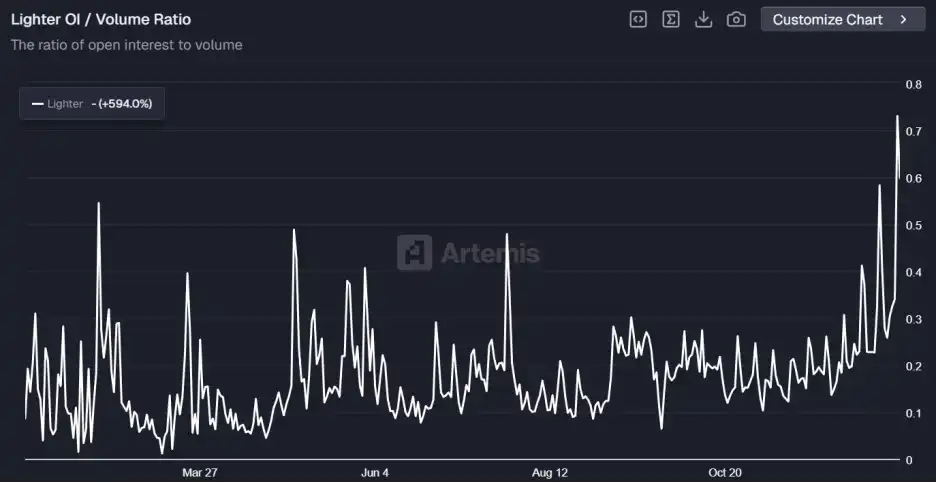
This phenomenon mainly stems from Lighter's aggressive points incentive program. Although the protocol defended against this by making invitation codes scarce and weighting holding duration, the TGE has concluded. The retention or departure of these high-frequency flows will also affect Lighter's true market share.
Frequent outages at Lighter also expose its insufficient system stability. On October 9, the protocol experienced a宕机事故 (downtime incident) lasting 4.5 hours. On December 30, Lighter again encountered issues with prover stagnation preventing users from正常提现 (withdrawing normally). For a derivatives platform handling billions of dollars, stability is the lifeline.
Lighter's emergence represents a new stage in the evolution of Perp DEXs: from decentralization to verifiable high performance. The protocol addresses the trust challenge through Ethereum mainnet security and ZK technology, and enters the Perp DEX battlefield with a zero-fee strategy.
However, competition in the Perp DEX赛道 is no longer just a technical contest but a comprehensive game of liquidity, community ecology, and product quality. Whether Lighter can grow from a technical dark horse into a top player in the赛道 depends on its ability to continuously attract and retain genuine trading demand in the post-airdrop era.