AI Intervenes in Public Opinion Formation, Prediction Markets Face a Stress Test

比推2025-12-15 tarihinde yayınlandı2025-12-15 tarihinde güncellendi

Özet

The article discusses the growing risk of AI-manipulated public opinion and its potential to distort prediction markets, particularly in political contexts like elections. It presents a hypothetical 2028 US presidential race scenario where suspicious trading activity causes a candidate's market odds to surge without clear justification, leading to accusations of manipulation and foreign interference. While historical evidence shows that manipulating liquid prediction markets is difficult and costly due to arbitrage, the author argues that the convergence of prediction markets, social media, and 24/7 news coverage amplifies the political impact of even failed manipulation attempts. Such events can erode trust and fuel conspiracy theories, regardless of their actual effect on election outcomes. The article acknowledges that prediction markets remain valuable in an AI-saturated information environment where traditional polls are increasingly vulnerable to AI-generated responses. However, it calls for improved governance: news outlets should prioritize reporting on liquid markets, platforms must enhance monitoring for manipulative trading, and regulators should enforce anti-manipulation rules and transparency requirements. If responsibly managed, prediction markets can complement traditional tools and support a healthier democratic ecosystem.

Author: Andy Hall, Professor at Stanford Graduate School of Business and Hoover Institution

Compiled by: Felix, PANews (This article has been abridged)

Original Title: When AI Learns to Fabricate Public Opinion, How Will Prediction Markets Cope with the Manipulation Test?


Imagine this scenario: It's October 2028, and Vance and Mark Cuban are neck and neck in the presidential election. Vance's support suddenly begins to surge on prediction markets. CNN, due to its partnership with Kalshi, provides round-the-clock coverage of prediction market prices.

Meanwhile, no one knows the initial reason for the price surge. Democrats insist the market is being "manipulated." They point to a large number of suspicious trades that shifted the market in favor of Vance without any new polls or other apparent reasons.

Simultaneously, The New York Times publishes a report stating that traders backed by the Saudi Arabian sovereign wealth fund have placed large bets on the election market, aiming to generate favorable coverage for Vance on CNN. Republicans, on the other hand, argue the prices are justified, pointing out there's no evidence the price surge affects the election outcome, and accuse Democrats of trying to suppress free speech and censor true information about the election. The truth remains difficult to ascertain.

This article will explain why such a scenario is highly likely in the coming years—despite the rarity of successful manipulation cases in prediction markets and the scant evidence that they influence voter behavior.

Attempts to manipulate these markets are inevitable, and when manipulation occurs, the political repercussions could far exceed the direct impact on election results. In an environment prone to interpreting any anomaly as a conspiracy, even a momentary distortion could trigger accusations of foreign interference, corruption, or elite collusion. Panic, blame, and a loss of trust might overshadow the actual impact of the initial action.

However, abandoning prediction markets would be a mistake. As traditional polls become more vulnerable in an AI-saturated environment—with extremely low response rates and pollsters struggling to distinguish AI responses from real human respondents—prediction markets offer a useful supplementary signal that aggregates dispersed information with real financial incentives.

The challenge lies in governance: building systems that preserve the informational value of prediction markets while reducing abuse. This might mean ensuring broadcasters focus on reporting more active markets that are harder to manipulate, encouraging platforms to monitor for signs of coordinated manipulation, and shifting the interpretation of market fluctuations to view them with humility rather than panic. If achieved, prediction markets can evolve into a more robust and transparent component of the political information ecosystem: one that helps the public understand elections rather than becoming a vector for distrust.

Lessons from History: Beware of Attempts to Manipulate Markets

"Now everyone is watching the betting markets. Their fluctuations are followed with fervent interest by the general electorate, who cannot personally gauge the direction of public sentiment and must blindly rely on the opinions of those betting hundreds of thousands of dollars on each election." — The Washington Post, November 5, 1905.

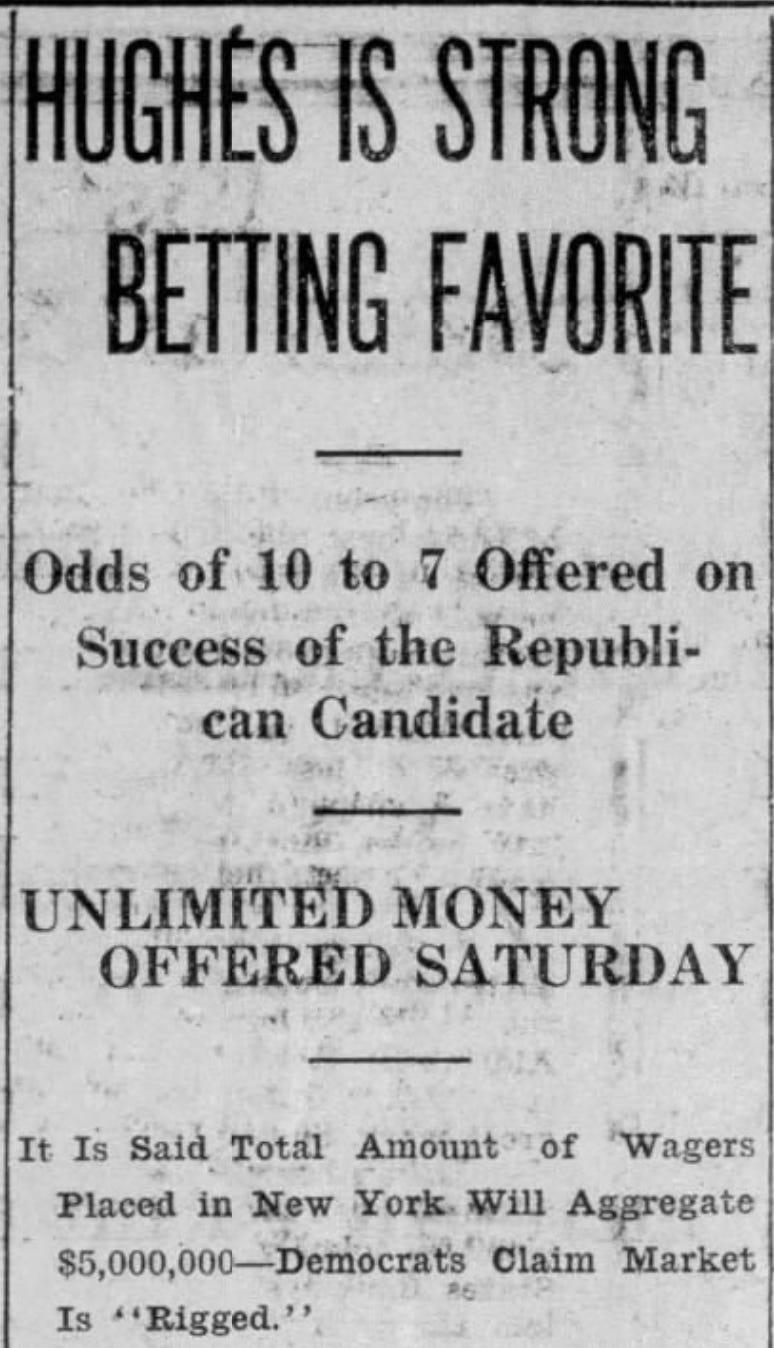
In the 1916 presidential election, Charles Evans Hughes led Woodrow Wilson in the New York betting markets. Notably, in the political landscape of that era, news media frequently reported on betting markets. Due to these reports, the shadow of market manipulation lingered. In 1916, Democrats, not wanting to be seen as trailing, claimed the betting markets were "rigged," and the media covered this.
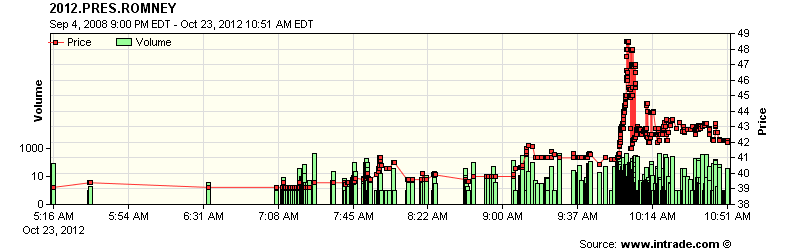
The potential threat of election manipulation has never disappeared. On the morning of October 23, 2012, during the campaign between Barack Obama and Mitt Romney, a trader placed a large buy order for Romney contracts on InTrade, causing his price to surge about 8 points, from just under 41 cents to nearly 49 cents—if the price were to be believed, this indicated an almost tied race. But the price quickly retraced, and the media paid little attention. The identity of the would-be manipulator was never confirmed.
However, sometimes you even see people openly articulate their logic for attempting to manipulate markets. A 2004 study documented a case of deliberate market manipulation during the 1999 Berlin state election. The authors cited a real email sent by a local party office urging members to place bets on the prediction market:

"The Tagesspiegel (one of Germany's largest newspapers) publishes a political stock market (PSM) daily, where the FDP is currently trading at 4.23%. You can view the PSM on the internet at http://berlin.wahlstreet.de. Many citizens do not see the PSM as a game but rather as the result of opinion polls. Therefore, it is important that the FDP's price can rise in the final days. Just like any exchange, the price level depends on demand. Please participate in the PSM and buy FDP contracts. In the end, we are all convinced of our party's success."

These concerns also emerged in 2024. On the eve of the election, The Wall Street Journal published an article questioning whether Trump's lead on Polymarket (which seemed to far exceed his poll numbers) was the result of undue influence: "Large bets on Trump aren't necessarily malicious. Some observers believe it might just be a big gambler firmly convinced Trump will win, looking to make a hefty profit. However, others believe these bets are an influence operation aimed at generating buzz for the former president on social media."

The scrutiny in 2024 was particularly intriguing because it raised concerns about foreign influence. It turned out that the bets pushing up Polymarket's price came from a French investor—although there was speculation, there was little reason to believe this was manipulation. In fact, the investor commissioned private polls and seemed focused on making money, not manipulating the market.

This history reveals two themes. First, cyber attacks are common and can be expected in the future. Second, even if attacks don't work, some can still use them to煽动 fear.

How Much Impact Do These Attacks Have?

Whether these moves influence voter behavior depends on two factors: whether manipulation can tangibly affect market prices, and whether changes in market prices affect voter behavior.

Let's first explore why manipulating the market (if possible) would help achieve political goals: because it's not as obvious as one might think.

Here are two ways prediction markets could influence election outcomes.
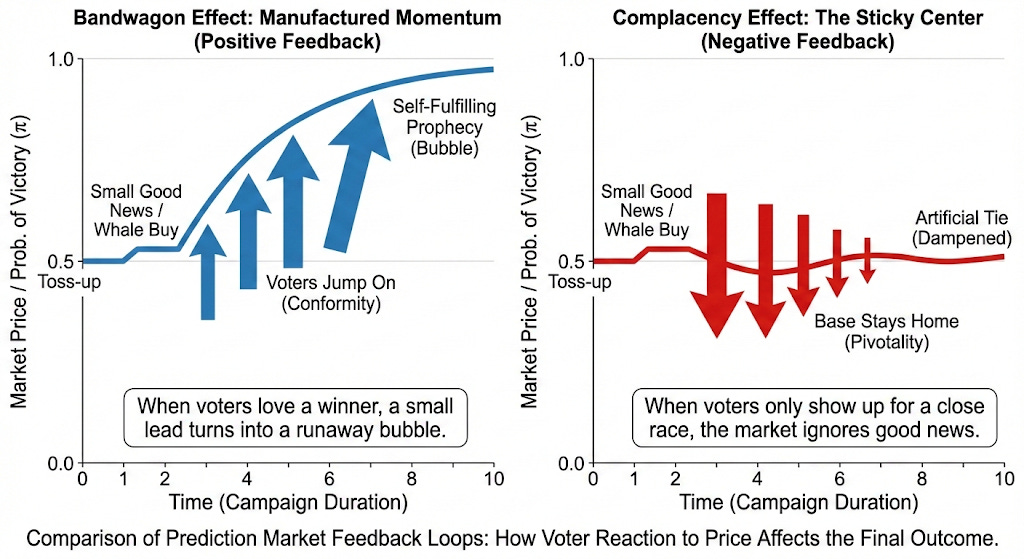
Bandwagon Effect

The bandwagon effect refers to voters' tendency to support the candidate who appears to be winning, whether due to herd mentality, the satisfaction of backing a winner, or the belief that market odds reflect the candidate's quality.

If popularity helps a candidate gain more support, then broadcasting prediction market prices in the news creates an incentive to push those prices higher. A manipulator might try to inflate their preferred candidate's odds, hoping to trigger a feedback loop: market prices rise → voters perceive momentum → voters shift support → prices rise again.

In the Vance-Cuban example, the manipulator's bet is that making Vance appear stronger will help him actually win.

Complacency Effect

On the other hand, if the candidate a voter supports is far ahead, they might choose not to vote. But if the race is tight, or their candidate seems to be losing, they might be more motivated to vote. In this case, widely disseminated prediction market行情 creates a market pressure to keep the odds close to 50-50. Once the market starts leaning towards a candidate, traders know that candidate's supporters begin to lose enthusiasm, pulling the price down.

This also facilitates market manipulation. A leading candidate worried about over-optimism among supporters might quietly buy the opponent's shares to tighten the market and suggest a closer race. Conversely, supporters of a trailing candidate might further depress their stock price to诱使 the other side into thinking victory is assured and not voting. In this scenario, the market becomes a self-defeating prophecy: a signal meant to reflect expectations instead acts to颠覆 them.

Although highly controversial, some argue that Brexit is an example of this phenomenon. As a London School of Economics report noted: "It is well known that polls influence turnout and voting behavior, especially when one side seems certain to win. It appears that more Remain supporters chose the easier option of not voting, likely because they thought Remain would win."

Voters Don't Care Much About How Close the Race Is

But the problem is, even if bandwagon or complacency effects exist, existing evidence suggests their impact is usually small. U.S. elections are quite stable—driven primarily by fundamentals like partisanship and the economy—so if voters reacted strongly to who's leading or similar narratives, election outcomes would look much more chaotic. Moreover, when researchers try to directly alter perceptions of how close or critical an election is, the behavioral impact has consistently been limited.

Take the current best-case example for the theory "the closer the race, the higher the turnout": Enos and Fowler's study of a Massachusetts state legislative election that actually ended in a tie. In the re-held election, they randomly informed some voters that the previous election in their district was decided by a single vote. Even with this extreme approach, the impact on turnout was minimal.

Similarly, Gerber et al. showed voters various poll results in large-scale field experiments. People updated their views on how competitive the election was, but turnout barely changed. A study on Swiss popular referendums found a slightly larger, but still very limited, effect: in this case, closely watched close polls seemed to slightly increase turnout, but only by a few percentage points.

It's possible that at times, signals of a close election do prompt some voters to change their minds, but the effect might be marginal. This doesn't mean election fraud shouldn't be worried about, but rather that attention should focus on subtle influences in close elections, not on distorting factors that turn close races into landslides.

Manipulating Markets is Difficult and Expensive

This leads to the second question: How difficult is it to manipulate prediction market prices?

Rhode and Strumpf's study of the Iowa Electronic Market during the 2000 election found that manipulation attempts were costly and difficult to sustain. In a typical case, a trader repeatedly sent large buy orders to the market, trying to push the price higher for their favored candidate. Each push briefly altered the odds, but was quickly arbitraged away by other traders exploiting the distortion, pulling the price back to its normal level. The manipulator lost significant money for little gain, and the market showed strong mean reversion and resilience.
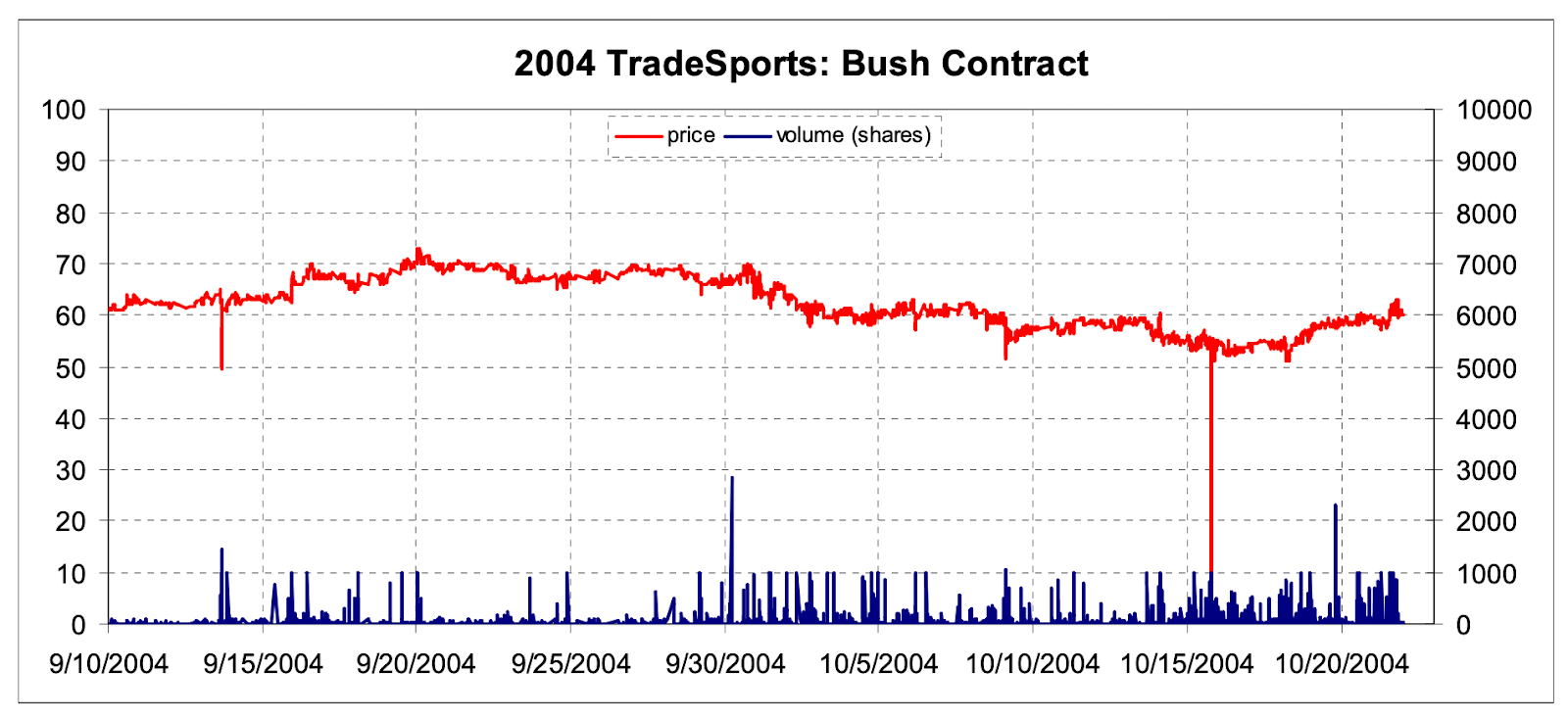
This is crucial in the hypothetical Vance-Cuban case. Manipulating a presidential election market in October would require substantial capital, and there would be many traders waiting to sell after a price spike. Such a small fluctuation might last long enough to be broadcast on CNN, but by the time CNN anchor Anderson Cooper starts talking about it, the price might have already fallen back to its original level.

But the situation is different when markets are illiquid. Researchers have shown that in low-liquidity environments, long-term price manipulation is possible: no one can stop it.

Recommendations

Perhaps there is evidence that manipulating major election markets is unlikely to have a significant impact, but that doesn't mean inaction is warranted. In the new world where prediction markets merge with social media and cable news, the impact of price manipulation could be greater than ever before. Even if the price manipulation itself has little effect, the concern could affect the shared perception of the political system's fairness. How to address this?

For Broadcasters:

Implement liquidity floors. CNN and other news organizations, when reporting prediction market prices for elections and other political events, should focus on markets with high trading activity, as prices there are more likely to reflect accurate expectations and are costlier to manipulate; they should not report prices from markets with poor liquidity, as these prices are less accurate and cheaper to manipulate.

Incorporate other election expectation signals. News organizations should also pay close attention to opinion polls and other indicators of election expectations. Although these have other flaws, they are less likely to be strategically manipulated. If significant discrepancies are found between market prices and other signals, news organizations should look for evidence of manipulation.

For Prediction Markets:

Build monitoring capabilities. Establish systems and personnel capable of detecting spoofing, wash trading, sudden spikes in one-sided volume, and coordinated account activity. Companies like Kalshi and Polymarket likely already have some of these capabilities, but they could invest more resources if they wish to be seen as responsible platforms.

Consider interventions during sharp price movements with no apparent cause. This includes simple circuit breakers in illiquid markets for sudden price moves, and pausing trading followed by a call auction to re-establish prices when movements look abnormal.

Report price indicators considering how to make them more manipulation-resistant. For prices displayed on television, use time-weighted or volume-weighted prices.

Continuously improve trading transparency. Transparency is crucial: publish metrics on liquidity, concentration, and abnormal trading patterns (without revealing individual identities) so journalists and the public can understand whether price fluctuations reflect real information or order book noise. Large markets like Kalshi and Polymarket already display order book, but more detailed metrics and public-friendly dashboards would be very useful.

For Policymakers:

Combat market manipulation. The first step is to clearly state that any attempt to manipulate election prediction market prices (with the aim of influencing public opinion or media coverage) falls under the jurisdiction of existing anti-manipulation regulations. Regulatory agencies can then act quickly when unexplained large price swings occur on the eve of an election.

Regulate intervention in markets by domestic and foreign political forces. Given election markets' vulnerability to foreign influence and campaign finance issues, policymakers should consider two safeguards:

(1) Monitor foreign manipulation by tracking traders' nationalities, facilitated by existing U.S. "KYC" laws, which are crucial for prediction market operation.

(2) Establish disclosure rules or bans targeting campaigns, Political Action Committees (PACs), and senior political staff. If spending to manipulate prices constitutes an undeclared political expenditure, regulators should treat it as such.

Conclusion

Prediction markets can make elections clearer rather than more chaotic, but only if they are established responsibly. The CNN-Kalshi partnership heralds a future where market signals become part of the political information environment alongside polls, models, and reporting. This is a real opportunity: in an AI-flooded world, tools are needed that can mine dispersed information without distortion. But this prospect depends on good governance, including liquidity standards, regulation, transparency, and a more prudent way of interpreting market dynamics. If these aspects are handled properly, prediction markets can improve public understanding of elections and support a healthier democratic ecosystem in the algorithmic age.


Twitter:https://twitter.com/BitpushNewsCN

Bitpush TG Discussion Group:https://t.me/BitPushCommunity

Bitpush TG Subscription: https://t.me/bitpush

Original link:https://www.bitpush.news/articles/7595679

İlgili Sorular

QWhat are the two main ways that prediction markets could potentially influence election outcomes, as described in the article?

AThe two main ways are the Bandwagon Effect, where voters support a candidate who appears to be winning, and the Complacency Effect, where supporters of a leading candidate may become less motivated to vote.

QAccording to the article, why is it difficult and expensive to manipulate a major prediction market like a US presidential election?

AIt is difficult and expensive because such markets are highly liquid. Large manipulative orders only cause temporary price distortions, which are quickly corrected by other traders exploiting arbitrage opportunities, causing the manipulator to lose money.

QWhat historical example from 2012 is given to show a failed attempt to manipulate a prediction market?

AThe article cites an example from October 23, 2012, when a trader placed a large buy order for Mitt Romney contracts on InTrade, causing his price to spike about 8 points. The price quickly retraced, media largely ignored it, and the manipulator's identity was never confirmed.

QWhat is one key recommendation the article makes for broadcasters like CNN regarding their reporting on prediction markets?

AThe article recommends that broadcasters implement liquidity floors, meaning they should focus on reporting prices from highly active markets that are more resistant to manipulation, and avoid reporting on illiquid markets where prices are easier to manipulate.

QWhat broader technological trend is making traditional polls more vulnerable, thus increasing the potential value of prediction markets?

AThe trend is the saturation of AI, which creates an environment with extremely low response rates to polls and makes it difficult for pollsters to distinguish between AI-generated responses and those from real human respondents.

İlgili Okumalar

KOL's Perspective: Why Is SOL Set to Rise from This Point?

**Summary: Why SOL is Positioned for Growth at This Level** The article argues that SOL is poised for an upward move from its current price point, citing several key factors. Primarily, SOL has just broken out of a 4-month consolidation phase. This breakout signals a return of risk appetite to the broader crypto market, as SOL is seen as a key indicator of overall crypto health. The token's ownership has reportedly shifted from short-term traders and tourists to long-term accumulators, leading to low volume. Any meaningful increase in trading activity could thus trigger significant upward momentum. Fundamental strengths include strong institutional adoption, integration with DeFi and RWAs (Real-World Assets), and the potential benefits from the Clarity Act. Despite its high volatility—having dropped 70% from its all-time high but still up 12x from its bear market low—SOL is highlighted as one of the few tokens from the last cycle to reach new highs. It boasts a robust ecosystem of applications, users, and protocols. Future catalysts include the expected influx of AI developers following the Miami Accelerate conference, which focused on AI on Solana. Furthermore, Solana is positioned as the premier chain for memecoin activity, a trend expected to continue and drive network usage and fees. The article concludes that recent price action reflects a healthy transfer to long-term holders, setting the stage for growth.

marsbit37 dk önce

KOL's Perspective: Why Is SOL Set to Rise from This Point?

marsbit37 dk önce

Those Pre-Bitcoin PoW Protocols Have Recently Been Reimplemented

This article details a recent surge in replicating pre-Bitcoin Proof-of-Work (PoW) protocols, specifically focusing on Hal Finney's 2004 RPOW (Reusable Proofs of Work). Within five days in May 2026, multiple independent builders in the Bitcoin/cypherpunk community launched projects inspired by this early electronic cash proposal. The initiative began with Fred Krueger's `rpow2.com`, a centralized but auditable system that replaced RPOW's original IBM 4758 hardware with Ed25519 signatures. Initially a faithful replica, it later adopted Bitcoin-like features (21M supply cap, difficulty adjustment) and a controversial 5.24% founder allocation. This sparked rapid forks, including `rpow4.com` which incorporated full Bitcoin parameters, a prediction market (`rpowmarket.com`), and a DEX (`rpow2swap.com`). Concurrently, Mike In Space created a prototype of Wei Dai's 1998 b-money proposal (`b-money.replit.app`), pushing the historical exploration even further back. The article contrasts these centralized, server-dependent experiments with Bitcoin's core innovation of decentralized, trustless consensus. It also highlights a parallel development: the `HASH` project on Ethereum, which uses smart contract hooks to enable a purely fair-launch, browser-mineable PoW token with 0% allocations to team or VCs. The collective activity is framed as a meme-driven, educational exploration of cypherpunk history rather than a serious financial movement, with all projects heavily disclaiming any investment value.

marsbit42 dk önce

Those Pre-Bitcoin PoW Protocols Have Recently Been Reimplemented

marsbit42 dk önce

South Korean Exchanges 'Battle' Regulators, Challenging the Boundaries of Enforcement and Legislation

South Korea's cryptocurrency industry is engaged in a rare, direct confrontation with regulators. The Financial Intelligence Unit (FIU), the primary anti-money laundering (AML) watchdog, has recently imposed heavy penalties on major exchanges like Upbit and Bithumb for alleged violations involving unregistered overseas VASPs and AML procedures. However, exchanges are now actively challenging these actions in court and through industry associations. In a significant shift, the Seoul Administrative Court ruled in favor of Upbit's operator, Dunamu, overturning part of an FIU-ordered business suspension. The court found the FIU's penalty criteria and justification insufficiently clear. Similarly, the court suspended the enforcement of a six-month business suspension against Bithumb pending a final ruling, citing potential irreversible harm to the exchange. Beyond legal battles, the industry is contesting proposed legislative amendments. The Digital Asset eXchange Alliance (DAXA) strongly opposes a draft rule that would mandate Suspicious Transaction Reports (STRs) for all crypto transfers over 10 million KRW (~$6,800). DAXA argues this "poison pill" clause violates legal principles and would overwhelm the STR system, increasing reports from 63,000 to an estimated 5.45 million annually for major exchanges, thereby crippling effective AML monitoring. This conflict highlights a structural tension in South Korea's crypto governance: comprehensive digital asset laws are still developing, while regulators rely heavily on AML enforcement. The industry's move from passive compliance to active legal and legislative challenges signifies a new phase, pressing for clearer rules and more proportionate enforcement. While short-term disputes may intensify, this clash could ultimately lead to a more mature and sustainable regulatory framework for South Korea's vibrant crypto market.

marsbit1 saat önce

South Korean Exchanges 'Battle' Regulators, Challenging the Boundaries of Enforcement and Legislation

marsbit1 saat önce

After 50x Storage Surge, Justin Sun Always Looks to the Next Decade

Sun Yuchen, known for his controversial stunts like a $30 million lunch with Warren Buffett (canceled due to a kidney stone) and eating a $6.2 million duct-taped banana, is often overshadowed by a significant fact: his decade-long track record of spotting major investment trends. In 2016, he famously advised young people to invest in Bitcoin, Nvidia, Tesla, and Tencent instead of buying property. A hypothetical $20,000 investment in Nvidia and Tesla from that list would now be worth over 50 million RMB. His latest major call was on November 6, 2025, predicting a "50x storage opportunity" tied to the AI boom, which materialized with Sandisk's stock surging nearly 50-fold by 2026. Looking ahead, Sun now focuses on the next frontier: Physical AI. He identifies four key areas: 1. **Embodied AI/Robotics**: He sees this reaching its "iPhone moment," with companies like UBTech and Galaxy General leading in commercialization. 2. **Drones**: Viewed as the first commercially viable form of Physical AI, revolutionizing sectors from warfare (e.g., AeroVironment's Switchblade) to logistics. 3. **Spatial Computing**: Beyond VR, it's about AI understanding physical space, a foundational technology for robotics and autonomous systems, exemplified by Apple's Vision Pro. 4. **Space Exploration**: After a 2025 suborbital flight with Blue Origin, Sun advocates for space as the ultimate frontier, discussing blockchain's potential role in space asset management and data transactions. His investment philosophy involves betting on entire, inevitable trends rather than single companies. For robotics, he sees Tesla (the body/manufacturer) and Nvidia (the brain/AI platform) as complementary plays. In defense drones, he highlights companies making tanks obsolete (AeroVironment) and those augmenting fighter jets (Kratos). For space, he participated in Blue Origin's flight and anticipates SpaceX's potential IPO to redefine the sector's valuation. Sun Yuchen's vision frames the next two decades not as a revolution in information flow (like the internet), but in the fundamental operation of the physical world through AI-powered robots, autonomous systems, and spatial intelligence, ultimately extending human and AI activity into space. While many still focus on conventional assets, he continues to look toward the next technological horizon.

marsbit2 saat önce

After 50x Storage Surge, Justin Sun Always Looks to the Next Decade

marsbit2 saat önce

İşlemler

Spot
Futures

Popüler Makaleler

CC Nasıl Satın Alınır

HTX.com’a hoş geldiniz! CC(Canton) (CC) satın alma işlemlerini basit ve kullanışlı bir hâle getirdik. Adım adım açıkladığımız rehberimizi takip ederek kripto yolculuğunuza başlayın. 1. Adım: HTX Hesabınızı OluşturunHTX'te ücretsiz bir hesap açmak için e-posta adresinizi veya telefon numaranızı kullanın. Sorunsuzca kaydolun ve tüm özelliklerin kilidini açın. Hesabımı Aç2. Adım: Kripto Satın Al Bölümüne Gidin ve Ödeme Yönteminizi SeçinKredi/Banka Kartı: Visa veya Mastercard'ınızı kullanarak anında CC(Canton) (CC) satın alın.Bakiye: Sorunsuz bir şekilde işlem yapmak için HTX hesap bakiyenizdeki fonları kullanın.Üçüncü Taraflar: Kullanımı kolaylaştırmak için Google Pay ve Apple Pay gibi popüler ödeme yöntemlerini ekledik.P2P: HTX'teki diğer kullanıcılarla doğrudan işlem yapın.Borsa Dışı (OTC): Yatırımcılar için kişiye özel hizmetler ve rekabetçi döviz kurları sunuyoruz.3. Adım: CC(Canton) (CC) Varlıklarınızı SaklayınCC(Canton) (CC) satın aldıktan sonra HTX hesabınızda saklayın. Alternatif olarak, blok zinciri transferi yoluyla başka bir yere gönderebilir veya diğer kripto para birimlerini takas etmek için kullanabilirsiniz.4. Adım: CC(Canton) (CC) Varlıklarınızla İşlem YapınHTX'in spot piyasasında CC(Canton) (CC) ile kolayca işlemler yapın.Hesabınıza erişin, işlem çiftinizi seçin, işlemlerinizi gerçekleştirin ve gerçek zamanlı olarak izleyin. Hem yeni başlayanlar hem de deneyimli yatırımcılar için kullanıcı dostu bir deneyim sunuyoruz.

189 Toplam GörüntülenmeYayınlanma 2026.04.21Güncellenme 2026.04.21

CC Nasıl Satın Alınır

BLEND Nasıl Satın Alınır

HTX.com’a hoş geldiniz! Fluent (BLEND) satın alma işlemlerini basit ve kullanışlı bir hâle getirdik. Adım adım açıkladığımız rehberimizi takip ederek kripto yolculuğunuza başlayın. 1. Adım: HTX Hesabınızı OluşturunHTX'te ücretsiz bir hesap açmak için e-posta adresinizi veya telefon numaranızı kullanın. Sorunsuzca kaydolun ve tüm özelliklerin kilidini açın. Hesabımı Aç2. Adım: Kripto Satın Al Bölümüne Gidin ve Ödeme Yönteminizi SeçinKredi/Banka Kartı: Visa veya Mastercard'ınızı kullanarak anında Fluent (BLEND) satın alın.Bakiye: Sorunsuz bir şekilde işlem yapmak için HTX hesap bakiyenizdeki fonları kullanın.Üçüncü Taraflar: Kullanımı kolaylaştırmak için Google Pay ve Apple Pay gibi popüler ödeme yöntemlerini ekledik.P2P: HTX'teki diğer kullanıcılarla doğrudan işlem yapın.Borsa Dışı (OTC): Yatırımcılar için kişiye özel hizmetler ve rekabetçi döviz kurları sunuyoruz.3. Adım: Fluent (BLEND) Varlıklarınızı SaklayınFluent (BLEND) satın aldıktan sonra HTX hesabınızda saklayın. Alternatif olarak, blok zinciri transferi yoluyla başka bir yere gönderebilir veya diğer kripto para birimlerini takas etmek için kullanabilirsiniz.4. Adım: Fluent (BLEND) Varlıklarınızla İşlem YapınHTX'in spot piyasasında Fluent (BLEND) ile kolayca işlemler yapın.Hesabınıza erişin, işlem çiftinizi seçin, işlemlerinizi gerçekleştirin ve gerçek zamanlı olarak izleyin. Hem yeni başlayanlar hem de deneyimli yatırımcılar için kullanıcı dostu bir deneyim sunuyoruz.

179 Toplam GörüntülenmeYayınlanma 2026.04.24Güncellenme 2026.04.24

BLEND Nasıl Satın Alınır

ACN Nasıl Satın Alınır

HTX.com’a hoş geldiniz! AITECH CLOUD NETWORK (ACN) satın alma işlemlerini basit ve kullanışlı bir hâle getirdik. Adım adım açıkladığımız rehberimizi takip ederek kripto yolculuğunuza başlayın. 1. Adım: HTX Hesabınızı OluşturunHTX'te ücretsiz bir hesap açmak için e-posta adresinizi veya telefon numaranızı kullanın. Sorunsuzca kaydolun ve tüm özelliklerin kilidini açın. Hesabımı Aç2. Adım: Kripto Satın Al Bölümüne Gidin ve Ödeme Yönteminizi SeçinKredi/Banka Kartı: Visa veya Mastercard'ınızı kullanarak anında AITECH CLOUD NETWORK (ACN) satın alın.Bakiye: Sorunsuz bir şekilde işlem yapmak için HTX hesap bakiyenizdeki fonları kullanın.Üçüncü Taraflar: Kullanımı kolaylaştırmak için Google Pay ve Apple Pay gibi popüler ödeme yöntemlerini ekledik.P2P: HTX'teki diğer kullanıcılarla doğrudan işlem yapın.Borsa Dışı (OTC): Yatırımcılar için kişiye özel hizmetler ve rekabetçi döviz kurları sunuyoruz.3. Adım: AITECH CLOUD NETWORK (ACN) Varlıklarınızı SaklayınAITECH CLOUD NETWORK (ACN) satın aldıktan sonra HTX hesabınızda saklayın. Alternatif olarak, blok zinciri transferi yoluyla başka bir yere gönderebilir veya diğer kripto para birimlerini takas etmek için kullanabilirsiniz.4. Adım: AITECH CLOUD NETWORK (ACN) Varlıklarınızla İşlem YapınHTX'in spot piyasasında AITECH CLOUD NETWORK (ACN) ile kolayca işlemler yapın.Hesabınıza erişin, işlem çiftinizi seçin, işlemlerinizi gerçekleştirin ve gerçek zamanlı olarak izleyin. Hem yeni başlayanlar hem de deneyimli yatırımcılar için kullanıcı dostu bir deneyim sunuyoruz.

111 Toplam GörüntülenmeYayınlanma 2026.04.28Güncellenme 2026.04.28

ACN Nasıl Satın Alınır

Tartışmalar

HTX Topluluğuna hoş geldiniz. Burada, en son platform gelişmeleri hakkında bilgi sahibi olabilir ve profesyonel piyasa görüşlerine erişebilirsiniz. Kullanıcıların A (A) fiyatı hakkındaki görüşleri aşağıda sunulmaktadır.

活动图片














