AI Can’t Save the Market Alone, But It Can Transform It: How SUBBD Token Redefines Content Economics

bitcoinist2026-02-10 tarihinde yayınlandı2026-02-10 tarihinde güncellendi

Özet

While AI cannot single-handedly save the market from volatility, it is a powerful tool for creating efficiency and disrupting legacy industries. The market is shifting focus from speculative AI trading bots to projects that apply AI to solve real-world problems. SUBBD Token exemplifies this trend by targeting the $191 billion creator economy. It uses AI automation and Web3 infrastructure to address issues like high platform fees and censorship, offering creators tools like an AI Personal Assistant and voice cloning. The project has raised $1.47M in its presale and offers a 20% APY for staking to encourage long-term holding and stabilize its token economy.

Trusted Editorial content, reviewed by leading industry experts and seasoned editors. Ad Disclosure

Quick Facts:

  • ➡️ Experts like Nickel Digital’s Anatoly Crachilov argue that AI is a tool for efficiency, not a magical solution for market volatility or prediction.
  • ➡️ The market is rotating focus from speculative AI trading bots to projects using AI to solve tangible infrastructure problems.
  • ➡️ SUBBD Token uses AI automation and Web3 rails to disrupt the $85 billion creator economy, offering a solution to high fees and censorship.
  • ➡️ The project offers a fixed 20% APY in its first year to encourage long-term holding and stabilize the token economy during its launch phase.

The idea that artificial intelligence serves as a fail-safe against market volatility is starting to crack. While algorithmic trading and predictive models have become sophisticated, they aren’t immune to the chaotic human elements driving crypto cycles.

Anatoly Crachilov of Nickel Digital Asset Management put it best recently: relying solely on AI to navigate rough market conditions is a flawed strategy. Algorithms crush pattern recognition in stable environments. But during black swan events or extreme macro-economic stress? Human intuition still wins.

That distinction signals a maturity in how the crypto sector views this technology. The ‘AI as a savior’ narrative is fading, replaced by a pragmatic ‘AI as a utility’ thesis. The market is realizing that AI’s true value isn’t in predicting Bitcoin’s price with 100% accuracy, an impossible feat, but in optimizing workflows and disrupting legacy industries.

Smart money is moving away from speculative trading bots and toward infrastructure projects that apply machine learning to solve tangible problems.

When the speculative froth settles, the projects left standing are those offering genuine utility. Nowhere is this more evident than in the $191B content creation industry, where the convergence of Web3 and generative AI is fixing inefficiencies traditional platforms can’t touch.

As the market seeks refuge in utility over hype, SUBBD Token ($SUBBD) has emerged as a solution, merging decentralized finance with advanced AI tools to return control to creators.

Learn more about $SUBBD here.

Transforming the $191B Creator Economy With Decentralized AI Tools

Right now, a centralized monopoly strangles the creator economy. Platforms frequently extract up to 70% of creator earnings while retaining the right to arbitrary bans and shadow-banning.

That centralization creates a single point of failure for millions of livelihoods. SUBBD Token ($SUBBD) addresses these systemic risks by deploying a suite of AI-driven tools on the Ethereum blockchain, ensuring transparency and ownership that Web2 platforms simply can’t match.

It’s not just about payments; it’s about workflow. SUBBD integrates an AI Personal Assistant designed to automate creator interactions, alongside AI Voice Cloning and AI Influencer Creation tools. These features allow creators to scale their output without increasing labor hours—a critical factor in an industry where burnout is rampant.

By using EVM-compatible smart contracts, the project ensures payment flows are automated and immune to the delays typical of traditional banking rails.

The utility here extends to the consumers, too. Users gain access to token-gated exclusive content and loyalty rewards, creating a circular economy. Governance is also decentralized; token holders vote on feature rollouts and creator onboarding, shifting the power dynamic from corporate boardrooms to the community.

In a market skeptical of vaporware, SUBBD’s deployment of proprietary AI models for object recognition and chatbots demonstrates they are actually building.

You can buy $SUBBD here.

SUBBD Token Presale Metrics Signal Shift Toward Utility-Based Assets

While the broader market grapples with volatility, capital is rotating into early-stage projects with clear revenue models. The SUBBD Token presale data reflects this appetite for utility-focused assets.

According to live metrics, the project has successfully raised $1.47M, with tokens currently priced at $0.057495. This capital inflow suggests that despite broader market uncertainty, investors are willing to back protocols that disrupt high-value sectors like the content economy.
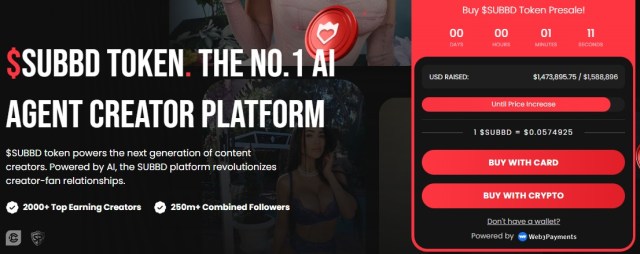
The project’s tokenomics are structured to incentivize the long haul rather than short-term flipping. A key feature is the staking protocol, which offers a fixed 20% APY for the first year. This high yield serves a dual purpose: it rewards early adopters for their capital commitment and reduces circulating supply during the critical development phase.

Beyond simple yield, staking unlocks ‘platform benefits,’ including access to exclusive livestreams, behind-the-scenes drops, and XP multipliers for the platform’s gamified elements.

The risk here, as with any utility token, is adoption execution. Can the platform onboard enough creators? However, by targeting both the payment friction (Web3) and the production friction (AI) of the creator economy simultaneously, SUBBD positions itself to capture value from two high-growth narratives.

The data points to a growing demand for platforms that offer reduced fees and greater autonomy, and SUBBD’s presale performance indicates it’s capitalizing on this shift.

Buy $SUBBD here.

The content provided in this article is for informational purposes only and does not constitute financial advice. Cryptocurrency investments, including presales and AI-related tokens, carry high risks, including the potential for total loss. Always perform independent due diligence.

Editorial Process for bitcoinist is centered on delivering thoroughly researched, accurate, and unbiased content. We uphold strict sourcing standards, and each page undergoes diligent review by our team of top technology experts and seasoned editors. This process ensures the integrity, relevance, and value of our content for our readers.

patrubogdan

Follow

Full Profile

Related Posts

Meme Coins Outpace Blue Chips as Retail Liquidity Rotates, Igniting Maxi Doge’s $4.5M Rise

Russian Lawmaker Predicts Bitcoin Collapse While Smart Money Rotates into Layer 2 Utility

Solana’s Low Fees Create Strong Competition for Base, BNB, and Polygon and Fuel SUBBD Token

Chainlink Founder Sergey Nazarov Identifies 3 Trends That Will Define the Cryptosphere as Hyper Token Soars

Bitcoin Demand Plunges Per CryptoQuant, Yet Maxi Doge Endures

Crypto Markets Catch A Breather As Outflows Begin To Slow: Analysts

Trend Kriptolar

İlgili Sorular

QAccording to the article, why is the 'AI as a savior' narrative for market volatility fading?

AThe 'AI as a savior' narrative is fading because experts like Anatoly Crachilov argue that AI is a tool for efficiency, not a magical solution. Algorithms are good in stable environments but cannot reliably predict or navigate black swan events or extreme macro-economic stress, where human intuition still prevails.

QWhat specific problem in the creator economy does SUBBD Token aim to solve?

ASUBDD Token aims to solve the problems of high fees (platforms taking up to 70% of earnings) and arbitrary censorship/bans by centralized platforms. It uses AI and Web3 to give creators more autonomy, transparent payments, and ownership over their content and livelihoods.

QWhat are two key AI-driven tools that SUBBD integrates for creators?

ATwo key AI-driven tools SUBBD integrates are an AI Personal Assistant to automate creator interactions and AI Voice Cloning technology. These tools help creators scale their output without proportionally increasing their workload.

QWhat is the purpose of the fixed 20% APY staking reward offered by SUBBD in its first year?

AThe fixed 20% APY staking reward serves a dual purpose: to incentivize and reward long-term holding by early adopters, and to reduce the circulating supply of tokens during the project's critical launch and development phase, helping to stabilize the token economy.

QBeyond financial investment, what additional benefits do SUBBD token holders receive from staking?

ABeyond the APY, staking SUBBD tokens unlocks 'platform benefits' such as access to token-gated exclusive content, exclusive livestreams, behind-the-scenes drops, and XP multipliers within the platform's gamified ecosystem.

İlgili Okumalar

Wall Street's Most Famous 'Cassandra' Now Has His Sights Set on Nvidia

Michael Burry, the famed "Big Short" investor, has once again captured Wall Street's attention with a series of short positions against major tech and semiconductor stocks, most notably Nvidia. In late June and July, through his "Cassandra Unchained" newsletter, Burry disclosed short bets against Nvidia, Tesla, Applied Materials, Caterpillar, the SOXX semiconductor ETF, and later, Micron Technology. His core thesis revolves around potential distortions in the AI infrastructure boom, specifically questioning whether extended depreciation schedules (e.g., 6 years vs. a realistic 2-3 years for AI chips) by cloud giants like Microsoft and Google artificially inflate profits. He also raises concerns about possible "off-balance-sheet circular financing," where chip demand might be propped up by vendor-backed funding to clients. Nvidia's stock experienced volatility following these disclosures, briefly dipping but largely holding near Burry's reported entry points, leaving his positions roughly flat or slightly underwater as of late July. This move is part of a pattern for Burry, whose track record since his legendary 2008 bet is mixed. He has faced notable losses, such as on Tesla in 2021, while scoring on broader market turns like the 2020 pandemic crash. His methodology focuses intensely on free cash flow and scrutinizing original financial documents to spot overvaluation and structural risks, but it often struggles with timing the market. The article contrasts Burry's stance with other prominent investors. Steve Eisman, another "Big Short" figure, is not shorting Nvidia, citing strong fundamentals but expressing nervousness about sustainability. Jim Chanos agrees with the broad "accounting mismatch" concern—comparing it to the dot-com bubble—but targets financial leverage in private equity firms rather than the chip stocks themselves. While Nvidia's short interest remains relatively low at 1.3-1.4% of float, the massive stock size means absolute short losses have been significant, exceeding $5 billion earlier this year. The piece concludes that for ordinary investors, the key takeaway is not replicating specific short bets but learning from the critical frameworks these investors use: questioning rosy accounting, identifying structural vulnerabilities, and maintaining skepticism during market euphoria, even if pinpointing the exact catalyst for a downturn remains elusive.

marsbit26 dk önce

Wall Street's Most Famous 'Cassandra' Now Has His Sights Set on Nvidia

marsbit26 dk önce

Weekly Selection丨Epic Stock Market Volatility, Changxin Tech's IPO Reshapes Storage Landscape, Saylor Aims to Re-Anchor STRC Around September 8th

PANews Weekly Digest: Market Turmoil, Tech Breakthroughs, and Crypto Developments. The week saw significant volatility across global markets. South Korea's KOSPI index experienced extreme turbulence, including multiple trading halts, largely driven by sharp declines in AI hardware stocks like SK Hynix. In contrast, China's Changxin Xinqiao (CXC) achieved a landmark IPO with a market cap surpassing 4 trillion yuan, marking a major success for the domestic DRAM industry after a decade of losses. In the crypto and Web3 space, several key narratives emerged. AI is driving demand for new infrastructure, with projects like AI agent wallets and programmable payments gaining traction, attracting interest from firms like Coinbase. The Bitcoin mining sector is pivoting, with companies like MARA focusing on energy management as electricity becomes a core AI-era asset. Meanwhile, the RWA (Real World Assets) sector faces a "utilization puzzle," with hundreds of billions in on-chain assets remaining dormant. Notable market movements included a historic single-day surge of over 17% for the KOSPI index and a significant migration of $16.5 billion in staked ETH within the Lido ecosystem. Michael Saylor announced a target to re-peg the STRC stablecoin around September 8th. Other highlights include discussions on Ethereum's ambitious 2030 roadmap for scaling and privacy, analysis showing high protocol revenues not always translating to token price gains, and warnings from Citi about potential extreme commodity price shocks by late 2026.

marsbit32 dk önce

Weekly Selection丨Epic Stock Market Volatility, Changxin Tech's IPO Reshapes Storage Landscape, Saylor Aims to Re-Anchor STRC Around September 8th

marsbit32 dk önce

When the Market Begins to Question AI Capex: A Full Analysis of Q2 Earnings Reports from Five Tech Giants

In late July 2026, five major US tech giants—Alphabet, Intel, Microsoft, Meta, and Apple—released their Q2 earnings reports. While all companies exceeded revenue and profit expectations, driven by strong AI-related business growth, investor reactions diverged sharply due to concerns over escalating AI capital expenditures (capex) and their impact on free cash flow. Alphabet reported strong revenue growth and a surging cloud business, but its stock fell after announcing a doubled year-on-year capex and negative quarterly free cash flow for the first time. Intel posted its strongest revenue growth in over 15 years, but its stock experienced volatile trading after significantly raising its full-year capex guidance. Microsoft saw its stock surge after beating estimates and, crucially, lowering its capex forecast while projecting positive free cash flow. Meta faced the most severe sell-off as its profits declined despite revenue beats, with free cash flow plunging over 90% and its capex guidance raised. Apple reported record June-quarter results, but its stock plummeted after providing Q4 revenue guidance that fell short of expectations, citing supply chain constraints and forex headwinds. The overall takeaway is that the market's focus has shifted from validating AI demand to scrutinizing the timeline for returns on massive AI investments. Companies demonstrating a clearer path to managing capex and preserving free cash flow, like Microsoft, were rewarded, while those signaling continued aggressive spending faced investor skepticism.

Odaily星球日报41 dk önce

When the Market Begins to Question AI Capex: A Full Analysis of Q2 Earnings Reports from Five Tech Giants

Odaily星球日报41 dk önce

a16z: From Companies to DAOs, DUNA May Become the Next Generation Organizational Form

This article, "From Companies to DAOs: How DUNA Could Become the Next Organizational Form," traces the 500-year evolution of business collaboration. It begins with medieval structures like the *commenda* and Florentine *compagnia*, which exposed partners to personal risk. The modern corporation, exemplified by the Dutch East India Company (VOC), was a revolutionary leap, enabling large-scale, capital-intensive ventures by offering limited liability and reducing coordination costs. However, corporations introduced new challenges like principal-agent problems and bureaucratic overhead. The piece argues that software and internet-native protocols are now reducing these traditional overheads. Decentralized Autonomous Organizations (DAOs) emerged as a new model for coordination without centralized management. Yet, DAOs face a significant legal vacuum: they lack legal recognition, leaving members exposed to unlimited personal liability, and their tokens are vulnerable to being classified as securities under unclear regulations (e.g., the Howey Test). This has forced projects into suboptimal workarounds like offshore foundations. The article identifies the Decentralized Unincorporated Nonprofit Association (DUNA) as a potential solution. Recently legalized in states like Wyoming, the DUNA provides a legal wrapper for decentralized networks. It grants key protections—legal personality, limited liability, and perpetual existence—to a group without imposing a traditional hierarchical management structure. This allows token-holder communities to govern, hold assets, and contract as a single legal entity, aligning with their decentralized nature. While DUNA doesn't solve all governance challenges or magically resolve securities law questions, it represents a crucial step. It fills the legal recognition gap, offering a native legal form for internet-scale, decentralized collaboration and extending the separation of personal risk from organizational venture into a new domain.

marsbit1 saat önce

a16z: From Companies to DAOs, DUNA May Become the Next Generation Organizational Form

marsbit1 saat önce

2026 Mid-Year Report On-Chain RWA: Tokenized Stock Market Cap Doubles in a Year, But 90% of Rights Are Hollow Shells

The 2026 Mid-Year Report on On-Chain RWA highlights a significant growth in tokenized stock market capitalization, which nearly doubled from $951 million in March to $1.89 billion by July. However, the report reveals a fundamental contradiction in this "layer 2.5" ecosystem: products with the strongest legal foundation (like regulated U.S. infrastructure) lack liquidity and distribution, while freely tradable offshored wrapper products often lack substantive ownership rights. The increase is driven largely by a few products (SECZ, FGRS, STRCx) and platforms (Ondo, xStocks, Securitize collectively hold over 85% share). While distributed value across networks like Ethereum, Solana, and BNB Chain has grown, the market remains fragmented. Products referencing the same underlying asset (e.g., Apple stock) are distinct legal liabilities with different intermediaries and jurisdictional rules, offering varying degrees of legal claim. The report cautions that headline numbers are misleading, as they reflect changes in distributed token value—driven by issuance, conversions, and price movements—not pure investor inflows. True "canonical shares" with legal ownership, wide wallet distribution, institutional liquidity, and independent on-chain price discovery do not yet exist at scale. Tokenized treasuries show stronger product-market fit, and ETFs may be easier to scale than single stocks. The core takeaway is a trade-off: legal certainty versus liquidity and composability.

marsbit2 saat önce

2026 Mid-Year Report On-Chain RWA: Tokenized Stock Market Cap Doubles in a Year, But 90% of Rights Are Hollow Shells

marsbit2 saat önce

İşlemler

Spot

Popüler Makaleler

T Nasıl Satın Alınır

HTX.com’a hoş geldiniz! Threshold Network Token (T) satın alma işlemlerini basit ve kullanışlı bir hâle getirdik. Adım adım açıkladığımız rehberimizi takip ederek kripto yolculuğunuza başlayın. 1. Adım: HTX Hesabınızı OluşturunHTX'te ücretsiz bir hesap açmak için e-posta adresinizi veya telefon numaranızı kullanın. Sorunsuzca kaydolun ve tüm özelliklerin kilidini açın. Hesabımı Aç2. Adım: Kripto Satın Al Bölümüne Gidin ve Ödeme Yönteminizi SeçinKredi/Banka Kartı: Visa veya Mastercard'ınızı kullanarak anında Threshold Network Token (T) satın alın.Bakiye: Sorunsuz bir şekilde işlem yapmak için HTX hesap bakiyenizdeki fonları kullanın.Üçüncü Taraflar: Kullanımı kolaylaştırmak için Google Pay ve Apple Pay gibi popüler ödeme yöntemlerini ekledik.P2P: HTX'teki diğer kullanıcılarla doğrudan işlem yapın.Borsa Dışı (OTC): Yatırımcılar için kişiye özel hizmetler ve rekabetçi döviz kurları sunuyoruz.3. Adım: Threshold Network Token (T) Varlıklarınızı SaklayınThreshold Network Token (T) satın aldıktan sonra HTX hesabınızda saklayın. Alternatif olarak, blok zinciri transferi yoluyla başka bir yere gönderebilir veya diğer kripto para birimlerini takas etmek için kullanabilirsiniz.4. Adım: Threshold Network Token (T) Varlıklarınızla İşlem YapınHTX'in spot piyasasında Threshold Network Token (T) ile kolayca işlemler yapın.Hesabınıza erişin, işlem çiftinizi seçin, işlemlerinizi gerçekleştirin ve gerçek zamanlı olarak izleyin. Hem yeni başlayanlar hem de deneyimli yatırımcılar için kullanıcı dostu bir deneyim sunuyoruz.

671 Toplam GörüntülenmeYayınlanma 2024.12.10Güncellenme 2026.06.02

T Nasıl Satın Alınır

Tartışmalar

HTX Topluluğuna hoş geldiniz. Burada, en son platform gelişmeleri hakkında bilgi sahibi olabilir ve profesyonel piyasa görüşlerine erişebilirsiniz. Kullanıcıların T (T) fiyatı hakkındaki görüşleri aşağıda sunulmaktadır.

活动图片