AI at a Crossroads: Why Wall Street is Saying "No" to ChatGPT and Claude?

链捕手2026-07-13 tarihinde yayınlandı2026-07-13 tarihinde güncellendi

Özet

The article "AI at a Crossroads: Why Wall Street Says 'No' to ChatGPT and Claude" explores the growing tension between the adoption of powerful, closed-source AI models and the imperative for data privacy and intellectual property (IP) protection in enterprises, particularly in high-stakes sectors like finance. It details how the fundamental architecture of services like OpenAI and Anthropic involves sending user data in plaintext to the vendors' servers, creating risks of IP leakage ("alpha transfer"). While enterprise contracts with "zero-data-retention" clauses offer some assurance, they rely on trust. A significant problem is "shadow AI," where employees use personal accounts, bypassing corporate policies and leading to data breaches. For consumers, the article highlights that AI conversations lack legal protections like attorney-client privilege and can be subpoenaed in legal cases, a fact many users are unaware of. The core of the piece analyzes the technical spectrum of privacy solutions, contrasting **protocol-level privacy** (contracts, anonymous proxies) with more robust **structural-level privacy**. The latter includes: * **TEEs (Trusted Execution Environments) / Confidential Computing:** Running models in hardware-sealed enclaves with remote attestation. * **End-to-End Encryption (E2EE):** Encrypting prompts so only the target enclave can read them. * **Fully Homomorphic Encryption (FHE):** Performing computations on encrypted data without decryption (cur...

Author: Jeff @IOSG


Why Private AI is Needed

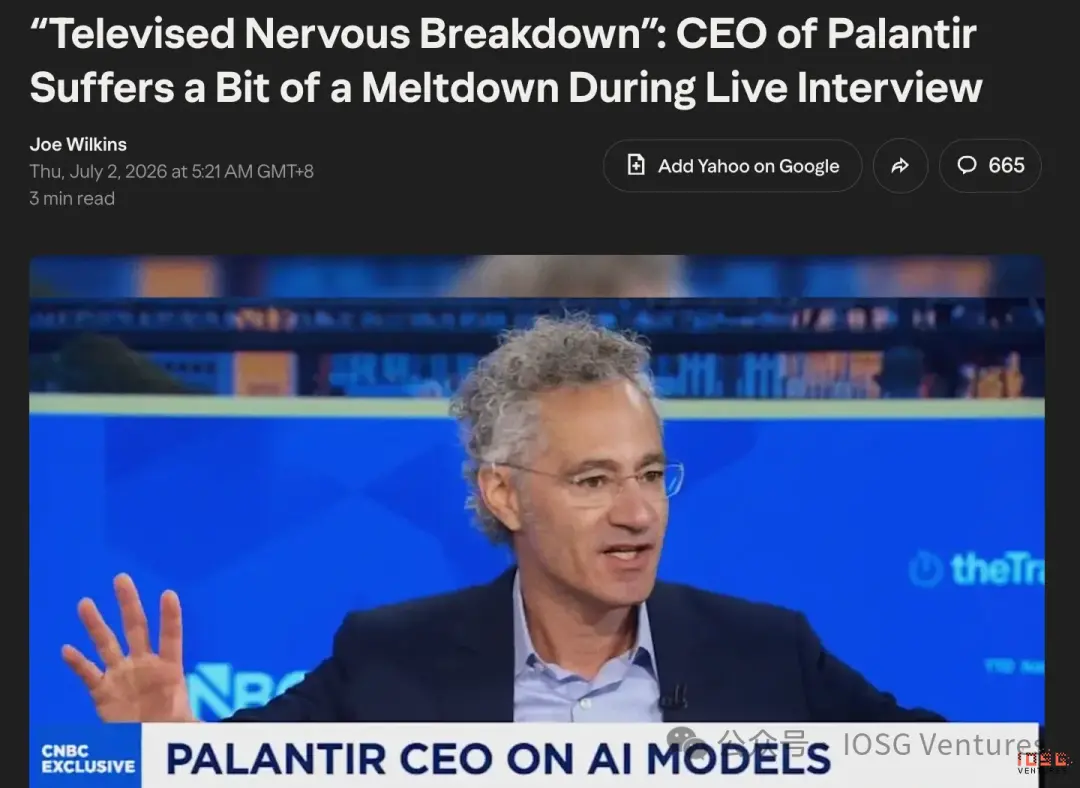
On July 1st, Palantir CEO Alex Karp gave a 20-minute interview on CNBC, which some media described as "a mental breakdown." According to Karp, enterprises are paying a token premium to frontier labs while watching their own IP flow to the model providers. He called this leakage a transfer of alpha, occurring at the architectural layer: every request sent to a closed-source model arrives in plaintext on the service provider's servers. Just days before the broadcast, Palantir announced a partnership with NVIDIA to run the open-source Nemotron model in a customer-controlled environment, accompanied by a nine-point AI sovereignty declaration. PLTR's stock jumped 8% after the CNBC segment aired.
For the past two decades, enterprises adopted cloud software based on trust at the protocol level, and it worked. Each SaaS vendor saw only a slice of enterprise data, and most had little incentive to use customer data to enhance their core products. Salesforce saw sales pipelines, Workday saw personnel, Jira saw development iterations, and AWS provided the storage and compute foundation. Today's AI workflows, however, advocate uploading the entire corpus, along with structured context linking all departments, to maximize productivity. Regardless of intent, upstream providers can now use this data for new features rather than letting it sit idle on servers.

No one is slowing down. Anthropic's annualized revenue reached $47 billion in May, a significant jump from $9 billion at the end of 2025. OpenAI surpassed 900 million weekly active users in February. Both companies completed new funding rounds this spring, with valuations nearing $1 trillion and expected to IPO at even higher market caps. Years of privacy and IP allegations have not dented their momentum.

Some enterprises acted long ago. By February 2023, less than three months after ChatGPT's release, major Wall Street banks had restricted its use. In May 2023, after Samsung engineers leaked chip source code into ChatGPT, the company banned generative AI across its network. In response, OpenAI launched ChatGPT Enterprise in August 2023, promising not to use business data for training and offering a zero-data-retention (ZDR) agreement, which later became a standard requirement for enterprise procurement.

But contracts only lock down corporate accounts. IBM found that by 2025, shadow AI (employees feeding company data into unauthorized AI tools via personal accounts) was involved in one-fifth of data breaches, with heavy shadow AI use adding an average of $670,000 to breach costs. In a 2025 survey by security training company Anagram, 40% of employees said they were willing to violate AI usage policies to complete tasks faster.

Enterprises can at least buy their way out with ZDR contracts, non-training service tiers, and sovereign deployments for governments or Palantir's clients. For ordinary users like us, the debate over whether private AI matters continues—until a court subpoena arrives.

In May 2025, a court order forced OpenAI to retain even deleted consumer chats. In November, a judge ordered 20 million of those records to be handed over to *The New York Times*'s lawyers as evidence. Then came criminal cases: ChatGPT records of a defendant in the Palisades arson case entered evidence, and an affidavit for a Florida double homicide cited a suspect's queries about body disposal. In a July 2025 interview, Sam Altman also acknowledged that ChatGPT conversations are not protected by legal privilege, and OpenAI "could be compelled to hand over" user chat logs in litigation.

The point isn't that only criminals need private conversations. The fact that people's AI conversations are logged and subpoenable is a surveillance surface most users don't know exists. A Kolmogorov Law survey of 1,000 U.S. AI users in October 2025 found that 50% didn't know these conversations could be subpoenaed, while two-thirds believed such chats should receive protections equal to consulting a lawyer or doctor.

Self-hosted or open-source models running in verifiable environments are catching up fast, but the strongest ones still lag the frontier closed-source models by about 4 months in general capability. This puts token-maximizing enterprises and individuals at a crossroads: either forfeit a few months of model quality for privacy, or continue sending sensitive material to Anthropic's servers because that's what competitors are doing to seize productivity advantages.
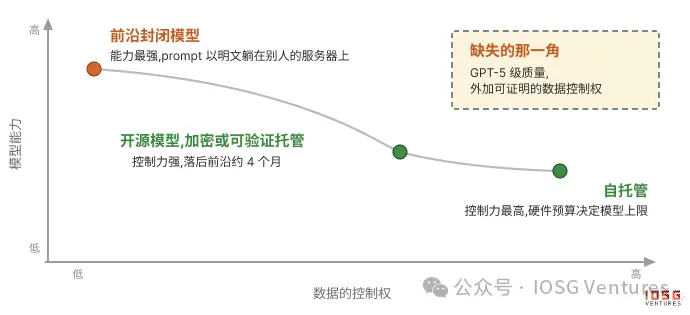
Currently, there is no perfect solution. This report examines attempts to bridge the gap, observing how far frontier intelligence with provable privacy is from being delivered to enterprises and ordinary users.

How Privacy is Currently Achieved

Private AI is not a single engineering feat, but each mechanism in the market today addresses the same event: a prompt leaves your device, travels over the network, lands on a machine running a model, and a response returns. The differences lie in where plaintext exists on this path, who can read it there, and what verifies the privacy of the response.

Protocol-Level Privacy

At this layer, someone other than you reads your plaintext prompt. What happens next relies entirely on a promise.
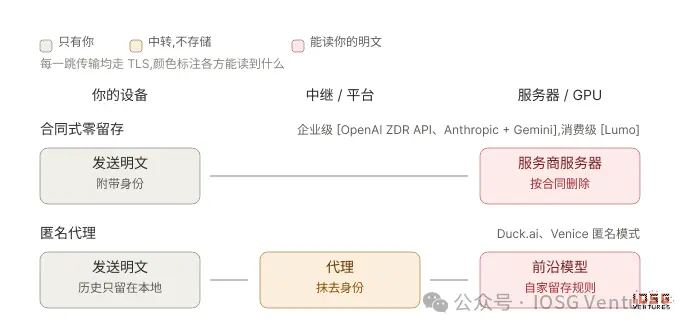
  • Contractual Zero-Retention is the enterprise version. The service provider knows who you are, processes your prompt, and promises not to retain it, enforced by contract and reputation.

  • Anonymous Proxy erases who you are but does not encrypt what you say; the downstream provider still handles plaintext per their own policy. Terms vary: proxies like Duck.ai (DuckDuckGo's chatbot) negotiate deletion agreements with model providers, while Venice advises users to assume providers keep everything. Neither side can verify.

Every segment of the machine-to-machine path runs over TLS, which only encrypts the pipe; the receiving party can read all information. Relays typically use Oblivious HTTP (RFC 9458) to split this knowledge, like asking a friend to pass a note. The friend knows who passed it but can't read the content; the recipient can read the content but doesn't know who wrote it. OHTTP became an IETF standard in January 2024, and many companies now run production traffic over OHTTP relays rented from Cloudflare and Fastly.

This is also the privacy ceiling for accessing closed-source models, due to a matter of arithmetic. A single flagship training run now costs billions of dollars, and these labs' near-trillion-dollar valuations hinge on exclusive ownership of model weights. The duration of the capability gap sustains the premium, so labs guard the weight files like state secrets.

Meta has already unwittingly conducted this experiment. The LLaMA model released in February 2023 was initially available only to researchers, but within a week, its weights were leaked as a torrent on 4chan. Another week later, llama.cpp allowed the smallest 7B model to run locally on a MacBook. Three days after that, Stanford fine-tuned a chat assistant, Alpaca, on the same model for under $600. This leak brought the cost of running Llama down to electricity; anyone with the file could run it at home. In July 2023, Meta officially open-sourced Llama 2 under a commercial license with a 700-million-monthly-active-user exclusion clause. The weights leaked, and the premium followed.

Frontier labs could theoretically provide attestation (remote attestation) for closed-source model inference, but attestation can only prove which piece of code read the prompt, not what that code did with it. To determine if the server retained data, we would need to audit the serving code and reconstruct it to the hash reported by the hardware. But once the serving code is handed over, the lab also surrenders the batching and caching techniques underpinning its profit margins—techniques that will migrate to every future model generation. Apple and Meta can provide remote attestation for the service stacks behind iPhone and WhatsApp because their profits come from devices and ads; revealing the service code costs them almost nothing.

This is why flagship model weights and serving code don't reach external operators. Without external operators, there is no third-party attestation; without attestation, verifiable privacy only exists for open-source models.

Structural-Level Privacy

Each mechanism in this category replaces trust promises with proofs based on hardware, cryptography, or physics. However, each pays a different price for the privacy upgrade, the primary one being that they can only run open-source models.
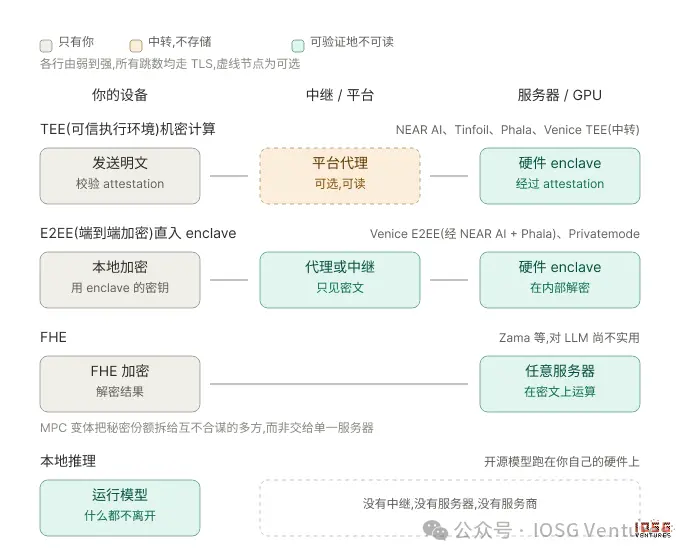
  • TEE (Trusted Execution Environment) Confidential Computing runs inference inside a hardware enclave (a sealed compartment on the chip that even the machine operator cannot open). The chip signs an attestation stating exactly which model and which code were run.

  • The prompt is only sealed at the destination. On the path relayed by the platform proxy, there remains a party that can read plaintext, and what prevents the proxy from logging or leaking the relayed content is only the protocol.
  • E2EE (End-to-End Encryption) seals the readable relay. The user's device encrypts the prompt using the enclave's key; every hop in between carries a sealed envelope only the enclave can open.

  • Trust is placed in the client. The code responsible for encrypting the prompt and verifying the attestation also has the power to revoke this guarantee. Therefore, verifiable E2EE requires both a proven enclave and open, reproducible client code.

  • Compared to TEE's simplicity, E2EE's cost is engineering overhead, which slows feature integration. E2EE turns the proxy into a blind messenger, so all features that rely on reading plaintext must be rebuilt around the client key or reconstructed solely within the enclave.

  • FHE (Fully Homomorphic Encryption, and MPC variants) removes the trusted party entirely. The server performs computations on ciphertext within a locked box it can never open; the key stays with you. MPC (Multi-Party Computation) splits the prompt into secret shares distributed among multiple parties; unless all participants collude, the effect is the same.

  • The cost is speed. FHE natively only performs addition and multiplication, so the non-linear steps required for transformer operation must be rebuilt at high cost. Inference on ciphertext is 10,000 to 100,000 times more expensive than on plaintext, taking seconds to minutes per token for small models, compared to milliseconds unencrypted.

  • Chips customized for encrypted operations promise to narrow the gap, but the first prototype was demoed only in early 2026, with commercial versions still years away.

  • Local Inference removes the path entirely. The model runs on your own hardware. No relay, no server, no service provider, and no verification needed.

  • The obvious costs are expense and model capability. gpt-oss-120b scores about half of GLM-5.2 on the Artificial Analysis index but is 65GB in size, exceeding the combined VRAM of two flagship gaming graphics cards. The full-precision GLM-5.2 can only run on 8-card data center nodes, with GPUs alone costing over $300,000.

Beyond these structural limitations, the cost of putting inference into an enclave is shrinking. For single-card inference, benchmarks from enclave cloud provider Phala show that enclave-mode H100 throughput loss averages less than 7%, and approaches zero for large models because the main cost is moving data onto the chip, not computing within it. For multi-card inference, NVIDIA's new Blackwell GPU supports direct encryption of inter-chip traffic, whereas older H100s can only achieve the same effect by routing through the CPU host at one-seventh the bandwidth. NVIDIA's own benchmarks on Blackwell show less than 8% throughput loss for a 397B model in enclave mode. With these advancements, the performance penalty of private inference itself is no longer a decisive constraint.

In fact, the enclave itself adds almost no extra operating cost for the provider. Every H100 shipped since 2023 has enclave mode built-in; the extra cost is the throughput loss from encryption, not additional chips. Currently, confidential H100 SKUs on Azure rent for $8.90 per hour, compared to $6.98 without enclave, a 27% premium over traditional cloud infrastructure. On the other hand, specialized enclave providers like Phala rent confidential-mode H100s starting at $3.80 per hour, lower than Lambda's price range of $3.99 to $4.29 for regular SXM cards. For managed API solutions, NEAR AI offers gpt-oss-120b endpoints with attestation at $0.15 per million input tokens and $0.55 per million output tokens, on par with plaintext routes from Amazon Bedrock, Together, and Groq. Even for models requiring multiple chips, NEAR AI's pricing for GLM 5.2 matches Fireworks exactly and is 15% cheaper for input and 4% cheaper for output on the larger Kimi K2.6.

While these new private inference providers may be burning profits to gain market share (a statement that holds for any company seeking growth), the structural trend is that the cost of privacy is decreasing for both consumers and operators.

How Can Open-Source Models Win?

Despite shrinking performance overhead, a visible gap remains between frontier models and SOTA open-source models. An entity pursuing maximum productivity must still trust frontier labs not to steal its IP to stay in the top tier.

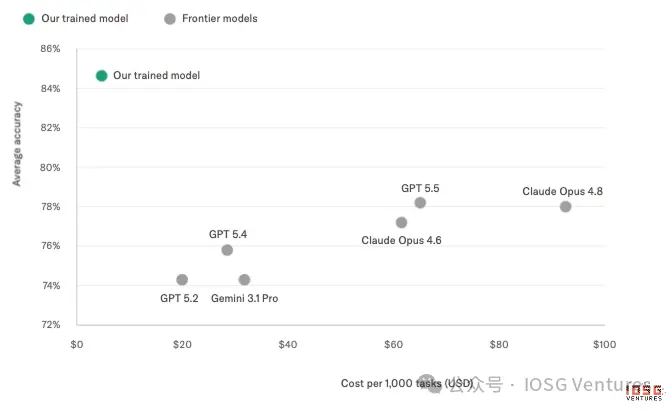
The gap persists, but Bridgewater's AIA Labs and Thinking Machines presented a case on June 30: an open model fine-tuned with expert annotations beat frontier models in both accuracy and cost.

In the study, the team fine-tuned Qwen3-235B on Tinker (Thinking Machines' managed fine-tuning API service). They first sourced annotations from vendors, used that data for initial training, then sent disputed samples to the firm's investment professionals for re-labeling. Training used reinforcement learning (GRPO) with three modifications: round-robin batching (each task takes turns providing a batch), CISPO loss (limiting how far a single answer can shift the model), and on-policy distillation (anchoring to the current best checkpoint to prevent the model from learning from weaker copies).

Tasks were all from investment professionals' daily workflows: determining if a news article was important for C-suite investment professionals, if a central bank document hinted at future interest rate changes, and where templated language began in a document or email. Scores came from an independent test set. Frontier models averaged about 50% with simple prompts and only reached 78.2% with expert prompts, below the 80% threshold set by investment professionals. The fine-tuned Qwen achieved 84.7%, which, per the original wording, means making 29.8% fewer errors than the frontier best, at 13.8x lower inference cost.
https://thinkingmachines.ai/news/learning-to-replicate-expert-judgment-in-financial-tasks/

This case proves open-source models can win in accuracy and cost, but the training process was still not private. The expert annotations used were Bridgewater's private data, passing through Tinker's third-party service, residing at the same trust level as ZDR agreements. The fund also rented compute; the entire training ran on machines it never controlled. Buyers wanting this recipe without trust assumptions have few choices today. Renting bare GPU clusters leaves the training process readable to the cloud operator. Buying the cluster solves data hosting but sends costs skyrocketing.

Routes with attestation have just arrived. In March, Workshop Labs and Tinfoil released Silo, a post-training stack running in Tinfoil enclaves on a single 8-card node, with keys controlled only by the customer. The article states the enclave cost adds 11 minutes to a two-hour training run, and by freezing base weights and training only small adapters on top, the stack can accommodate a trillion-parameter model (Kimi K2 Thinking). The challenge is that reinforcement learning requires moving data back and forth between components, precisely where enclave costs lie.

Less than a month after Silo's release, Workshop Labs was acquired by Thinking Machines. The components needed to run the next Bridgewater-style RL loop within an enclave are now under the same roof.

Privacy at the Harness Layer

Another problem exists outside all private inference mechanisms. These mechanisms manage the path from prompt to model, but every external tool call initiated by an agent opens a path the inference layer cannot touch. The recent harness engineering trend magnifies the problem: every tool, memory store, and data source connected to the model is another destination that reads its slice of the workflow in plaintext. The calendar server reads schedules, the database server reads queries. A fully local agent needing anything outside its training set must still send search terms in plaintext to a search engine; the server cannot answer without reading the plaintext.

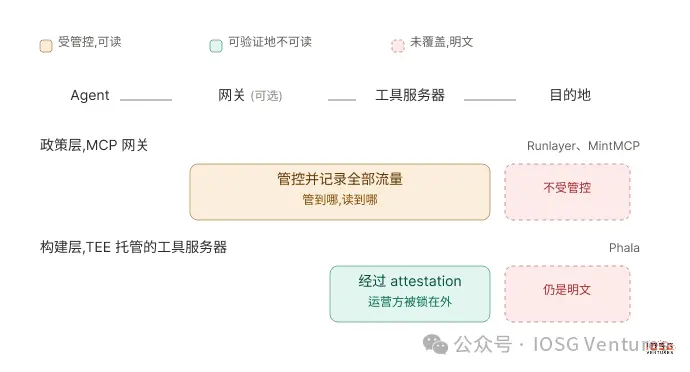
Mainstream solutions still default to the protocol layer. Companies like Runlayer and MintMCP use a central gateway to manage all tool traffic, stripping personally identifiable information (PII) before requests leave. The gateway also decides which servers receive traffic, blocking unvetted ones, and logs each call's destination and content for forensics. Even with independent audits (SOC 2), the tool server must still read the plaintext query to respond; whether it retains a copy depends on its own retention terms, multiplied by every tool in the harness. Furthermore, the gateway itself is an additional trust-dependent reader on the path, not a verification.

Structural solutions target the middle layer. For example, Phala hosts MCP servers directly in TEEs, with directories covering wallets, code execution, and data sources; users can verify privacy claims via attestation rather than trusting the operator. However, TEE-hosted tools ultimately must pass queries in plaintext to the service provider; the enclave seals only the messenger, not the destination.
Only a few destinations have learned to respond without reading, but only for structured queries. Apple provides Private Information Retrieval for iPhones, allowing phone number checks against spam databases without exposing the number; Microsoft uses the same scheme for passwords in Edge. MongoDB's Queryable Encryption encrypts fields client-side before they leave, enabling the server to perform equality and range matches on ciphertext alone.

For open-ended search, today's best answer stops at trust; verifiable encrypted search hasn't left the lab. Brave promises zero data retention on its own 40-billion-page index (not Google's), but it's still at the protocol layer. Exa built a neural index that embeds user keywords into semantics, ranking results by semantic match, but the embedding step still computes from plaintext on Exa's servers. MIT's 2023 Tiptoe paper ranked results on 360 million web pages without exposing the query, but each search burned significant server compute, with ranking quality lagging unencrypted search. Apple's 2024 Wally paper hid real queries among decoys, reducing communication cost up to 31x, but this math only becomes cheap at millions of concurrent queries—a scale no private search system has today.

Encrypted search is possible; it's just that performance and price aren't commercially viable yet.

Outlook

Demand for private AI is growing. Venice AI recently surpassed 3.5 million registered users and 1.3 trillion monthly tokens, followed by a Series A equity funding round at a $1 billion valuation. Proton is a direct competitor; its chat product Lumo surpassed 10 million users within a year of launch. On the infrastructure side, Phala currently processes 2 to 3 billion tokens daily on OpenRouter. Duck.ai routes gpt-oss-120b and Gemma into Tinfoil enclaves, providing verifiable privacy beyond proxy anonymity. This doesn't even count self-hosting, likely the largest channel for private inference, as models run on one's own hardware, leaving no usage trail.

Yet within the massive wave of mainstream AI, private AI occupies only a tiny fraction, and this gap will only close if frontier labs intentionally meet this demand. In May, Google's entire product line processed 3,200 trillion tokens; by that measure, Venice's monthly throughput equals about 18 minutes of Google's. Last November, Google launched Private AI Compute (PAC), running some Gemini-powered features in sealed TPU enclaves isolated from the company itself, with the design independently audited by NCC Group. But the issue is that PAC only covers a few Pixel features like personalized recommendations and recording summaries, not the Gemini app used by hundreds of millions. Google dares to submit the design for audit because these features monetize via devices and ads, not token sales.

Current hosting solutions are also imperfect. Users seeking maximum privacy via E2EE must wait for new features to be rebuilt where the service provider can't read. Private harnesses still rely on protocols at the service layer. Affordable post-training still requires trusting third-party vendors for the best fine-tuning results. Self-hosting sheds all service providers at once, but running the strongest open-source model locally may cost more than the house it's in.

Flaws aside, private AI is already a real and affordable option, and the remaining gaps are narrowing. For ordinary consumers, private chats with open models under no-logging promises cost nothing on Lumo and Venice, while $18–$20 subscriptions from Venice or Tinfoil seal the same chat into enclaves, no more expensive than a ChatGPT subscription. For enterprise workflows, attested endpoints are now even cheaper than plaintext routes. Endpoints like NEAR's E2EE API can already bring encrypted context into enclaves; memory, file uploads, and custom instructions can now operate over E2EE. For attested post-training, NVIDIA's upcoming Vera Rubin NVL72 will expand confidential computing from Blackwell's 8-card nodes to 72-card racks, making frontier RL loops more feasible without exposing IP.

However, the crucial value capture lies beyond these layers of price compression. Privacy is nearly free where it already exists, but it hasn't covered mainstream agentic workflows. Operators focused on renting/selling enclaves hold a switch on standard chips, not a moat, while protocol-layer gateways compete with traditional middleware. The defensible ground is the half of the problem not yet solved in this report: training loops locked in enclaves, end-to-end sealed tool calls, search indexes that cannot see terms. Whoever builds one of these first sells something no price war can commoditize. Capital chasing private AI should buy the gap, not the switch.

So, trust or verify? For execution-heavy, agent-heavy tasks, choose trust, because each tool call already hands plaintext to destinations an enclave cannot seal, and frontier models deserve their price in such loops. For the high-order thinking that distinguishes a company from its competitors, choose verification. Strategy, planning, and judgment distilled from years of professional experience are precisely the alpha in dispute. The path forward is fine-tuning open-source models with these proprietary insights within company-controlled boundaries. In areas central to a company's alpha, expert-tuned open models have already beaten the frontier in both accuracy and cost, and the infrastructure to build them in privacy is arriving node by node.

Trend Kriptolar

İlgili Sorular

QWhy are Wall Street banks and corporations increasingly saying 'no' to using models like ChatGPT and Claude, according to the article?

APrimarily due to intellectual property and data privacy concerns. The article highlights that when using closed-source AI models, every prompt is sent as plaintext to the vendor's servers, creating a risk of IP and sensitive data leakage ('alpha transfer'). This is especially critical for industries like finance and for companies whose competitive edge relies on proprietary data and strategies.

QWhat are the main approaches to achieving private AI, as outlined in the article?

AThe article categorizes private AI approaches into two main layers: 1) **Protocol-level privacy**: Relying on trust and contracts, such as Zero Data Retention (ZDR) agreements and anonymous proxies. 2) **Structural-level privacy**: Using technology to enforce privacy, including TEE (Trusted Execution Environment) confidential computing, End-to-End Encryption (E2EE), Fully Homomorphic Encryption (FHE), and local (on-premise) inference. Structural methods can only be used with open-source models.

QWhat case study does the article provide to show that open-source models can outperform frontier models?

AThe article cites a study by Bridgewater's AIA Labs and Thinking Machines. They fine-tuned the open-source model Qwen3-235B on expert-annotated financial tasks (e.g., analyzing news importance, central bank documents). The fine-tuned model achieved an 84.7% accuracy rate, surpassing the best frontier model's 78.2% (with expert prompting), while also being 13.8x cheaper in inference costs, demonstrating superior accuracy and cost-effectiveness for specialized domains.

QWhat is the 'harness layer' privacy challenge mentioned in the article, and why is it difficult to solve?

AThe 'harness layer' challenge refers to the privacy risks when AI agents interact with external tools (e.g., databases, search engines, calendars). Even if the core model inference is private, every tool call sends a plaintext query to an external server, creating new data leakage points. Solving this with structural privacy is hard because most tools need to read the plaintext query to function. Truly private, verifiable solutions for complex tasks like open-ended web search are still in the research phase and not commercially viable due to performance and cost barriers.

QWhat is the article's conclusion regarding the future and investment opportunity in private AI?

AThe article concludes that while basic private inference is becoming affordable and commoditized, the significant value and investment opportunity lie in solving the remaining, harder technical gaps. These include: 1) Private training/fine-tuning loops within enclaves, 2) End-to-end private tool/agent calls, and 3) Private search over encrypted indexes. Capital chasing private AI should focus on these unsolved problems ('the gap'), not just the enabling infrastructure ('the switch'), as solutions here will create defensible, non-commoditized value.

İlgili Okumalar

DistributeX Unveils DX Coin Ecosystem Roadmap, Advancing Preparations for Its On-Chain Launch

DistributeX has unveiled the DX Coin Ecosystem Roadmap, detailing its preparations for the upcoming on-chain launch of DX Coin. The roadmap outlines key phases focusing on community governance, technical readiness, blockchain deployment, and ecosystem growth. Current efforts are centered on building community consensus and completing technical groundwork. This includes launching community votes to select the official DX Coin logo and decide on the preferred blockchain network for integration. The platform will also implement features like on-chain wallet binding and contribution tracking to prepare for future data synchronization and rewards. Before the official launch, DistributeX will publish a Tokenomics White Paper detailing the token's issuance, governance, and long-term strategy, and will take a snapshot of eligible community accounts for future asset allocation. The subsequent deployment phase will involve smart contract deployment, security audits, community airdrops, and developing liquidity on decentralized exchanges. Looking further ahead, planned utilities for DX Coin encompass cross-chain interoperability, decentralized governance, digital rights, staking, and other Web3 applications. This roadmap aims to provide the community with clear visibility into the platform's plans, as DistributeX works to establish a solid foundation for DX Coin's on-chain ecosystem and long-term expansion.

TheNewsCrypto47 dk önce

DistributeX Unveils DX Coin Ecosystem Roadmap, Advancing Preparations for Its On-Chain Launch

TheNewsCrypto47 dk önce

Let Funds Flow at Internet Speed

Tokenization bridges the distinct worlds of always-on, permissionless DeFi and traditional funds with scheduled, permissioned settlements, unlocking significant value for those who can manage this integration. The tokenized Real World Asset (RWA) market exceeds $33 billion, with U.S. Treasuries comprising nearly half. It offers corporate treasurers options from low-risk, liquid Treasury funds to higher-yield, programmable investments, all benefiting from the same audit standards as traditional bonds. The core advantage is *composability*: tokenized funds can combine yield, liquidity, and transferability simultaneously, unlike traditional finance which forces a trade-off. However, achieving this requires sophisticated coordination. Tokenized funds remain legally bound to daily net asset value (NAV) updates, KYC-verified holder lists, and redemption cut-offs based on traditional settlement infrastructure (e.g., 5 PM ET). Key challenges in this hybrid model are: 1) **Price**: Determining token value between NAV updates to prevent manipulation; 2) **Compliance**: Embedding KYC/whitelisting (e.g., within a vault) to allow free circulation of receipt tokens in DeFi; and 3) **Cross-chain Consistency**: Maintaining a single source of truth for ownership and value across multiple blockchains. Projects like Centrifuge (with its deRWA framework and V3 architecture) and LayerZero address these by using a hub-and-spoke model. A central "hub" chain manages NAV, accounting, and compliance, while a messaging layer (LayerZero) synchronizes this data with "spoke" chains where tokens are used, enabling DeFi composability. This coordination layer, which handles in-transit asset accounting and prevents redemption gateway conflicts, becomes a critical and valuable piece of infrastructure—akin to SWIFT or Visa in traditional finance. For institutions, effective tokenization enables strategies like rehypothecation, where tokenized Treasury funds are used as collateral to borrow stablecoins for reinvestment, amplifying yield. However, failures in price synchronization, redemption limits, or cross-chain messaging pose risks that must be meticulously managed to build institutional trust. Ultimately, the goal is to break the old rules that force a choice between yield, liquidity, and transferability. If tokenization can make capital work simultaneously in multiple ways without compromising security, it will attract the attention of institutions managing billions in idle cash. The entities that successfully orchestrate this coordination between traditional finance timelines and blockchain speed are positioning themselves for a central role in the future capital markets.

链捕手1 saat önce

Let Funds Flow at Internet Speed

链捕手1 saat önce

On the Eve of the US Stock Inflation Test, Wall Street Faces the Most Severe 'Data Deception' in History

On the eve of the crucial US June CPI release, a significant credibility gap is emerging between official inflation data and consumer sentiment. While May CPI and PCE figures suggested a "concerning but not critical" picture, the University of Michigan Consumer Sentiment Index plummeted to its lowest level in nearly 50 years. This contradiction is prompting economists to question the reliability of key macroeconomic indicators. The core issue, as highlighted by labor economist Kathryn Anne Edwards, lies in a systemic flaw within the current inflation measurement framework. The Consumer Price Index (CPI) averages prices across a "market basket" meant for a "typical consumer," thereby masking vastly different inflation experiences across demographic groups. For instance, Bureau of Labor Statistics (BLS) research indicates that from 2006 to 2023, the lowest income quintile faced a cumulative inflation rate 7.7 percentage points higher than the highest quintile—a disparity largely invisible in the headline CPI number. This averaging effect means investors and policymakers relying on aggregate CPI may be basing decisions on a statistically smoothed figure that fails to capture the true distribution of economic pressure. Edwards argues that expanding this measurement framework is technically feasible, requiring primarily political will rather than new data collection. The BLS already tracks 100,000 items monthly; creating more granular indices for different family types, income levels, and housing statuses would mainly involve re-weighting existing data. The BLS has produced such experimental series before. A more nuanced data picture is crucial for accurate policy and market forecasting. Ultimately, improving measurement cannot solve underlying economic stresses. Edwards notes concurrent pressures like slowing hiring, stagnant wage growth, persistently high prices, rising credit card debt, a subdued housing market due to high rates, and AI's potential disruption to jobs. These factors collectively explain the deep chasm between official statistics and consumer pessimism. The key takeaway for markets is the need to look beyond a single headline CPI number. Understanding the divergence in inflation experiences across the population is critical for accurately assessing the real pressure within the economy, the path of Federal Reserve policy, and risks on the consumer side.

marsbit1 saat önce

On the Eve of the US Stock Inflation Test, Wall Street Faces the Most Severe 'Data Deception' in History

marsbit1 saat önce

İşlemler

Spot

Popüler Makaleler

GROK AI Nedir

Grok AI: Web3 Döneminde Konuşma Teknolojisini Devrim Niteliğinde Yenilik Giriş Hızla gelişen yapay zeka alanında, Grok AI, ileri teknoloji ve kullanıcı etkileşimi alanlarını birleştiren dikkate değer bir proje olarak öne çıkıyor. Ünlü girişimci Elon Musk'ın liderliğindeki xAI tarafından geliştirilen Grok AI, yapay zeka ile etkileşim şeklimizi yeniden tanımlamayı hedefliyor. Web3 hareketi devam ederken, Grok AI, karmaşık sorgulara yanıt vermek için konuşma yapay zekasının gücünden yararlanmayı amaçlıyor ve kullanıcılara sadece bilgilendirici değil, aynı zamanda eğlenceli bir deneyim sunuyor. Grok AI Nedir? Grok AI, kullanıcılarla dinamik bir şekilde etkileşimde bulunmak üzere tasarlanmış sofistike bir konuşma yapay zeka sohbet botudur. Birçok geleneksel yapay zeka sisteminin aksine, Grok AI, genellikle uygunsuz veya standart yanıtların dışında kabul edilen daha geniş bir sorgu yelpazesini benimsemektedir. Projenin temel hedefleri şunlardır: Güvenilir Akıl Yürütme: Grok AI, bağlamsal anlayışa dayalı mantıklı yanıtlar sağlamak için sağduyu akıl yürütmeyi vurgular. Ölçeklenebilir Denetim: Araç yardımı entegrasyonu, kullanıcı etkileşimlerinin hem izlenmesini hem de kalite için optimize edilmesini sağlar. Resmi Doğrulama: Güvenlik en önemli önceliktir; Grok AI, çıktılarının güvenilirliğini artırmak için resmi doğrulama yöntemlerini entegre eder. Uzun Bağlam Anlayışı: AI modeli, kapsamlı konuşma geçmişini saklama ve hatırlama konusunda mükemmel bir performans sergileyerek anlamlı ve bağlamsal olarak farkında tartışmaların yapılmasını kolaylaştırır. Saldırgan Dayanıklılık: Manipüle edilmiş veya kötü niyetli girdilere karşı savunmalarını geliştirmeye odaklanarak, Grok AI kullanıcı etkileşimlerinin bütünlüğünü korumayı hedefler. Özünde, Grok AI sadece bir bilgi alma cihazı değil; dinamik diyalogu teşvik eden, etkileyici bir konuşma partneridir. Grok AI'nın Yaratıcısı Grok AI'nın arkasındaki beyin, otomotiv, uzay yolculuğu ve teknoloji gibi çeşitli alanlarda yenilikle özdeşleşen Elon Musk'tır. Yapay zeka teknolojisini faydalı yollarla geliştirmeye odaklanan xAI çatısı altında, Musk'ın vizyonu, yapay zeka etkileşimlerinin anlaşılmasını yeniden şekillendirmeyi amaçlıyor. Liderlik ve temel etik, Musk'ın teknolojik sınırları zorlamaya olan bağlılığı tarafından derinden etkilenmektedir. Grok AI'nın Yatırımcıları Grok AI'yi destekleyen yatırımcılarla ilgili spesifik detaylar sınırlı kalmakla birlikte, projenin kuluçka merkezi olan xAI'nin, esasen Elon Musk tarafından kurulduğu ve desteklendiği kamuya açık bir şekilde kabul edilmektedir. Musk'ın önceki girişimleri ve mülkleri, Grok AI'nın güvenilirliğini ve büyüme potansiyelini daha da artıran sağlam bir destek sağlar. Ancak, şu anda Grok AI'yı destekleyen ek yatırım fonları veya kuruluşlarıyla ilgili bilgiye kolayca erişim sağlanamamaktadır; bu da potansiyel gelecekteki keşif alanını işaret etmektedir. Grok AI Nasıl Çalışır? Grok AI'nın operasyonel mekanikleri, kavramsal çerçevesi kadar yenilikçidir. Proje, benzersiz işlevselliklerini kolaylaştıran birkaç son teknoloji ürünü teknolojiyi entegre eder: Sağlam Altyapı: Grok AI, konteyner orkestrasyonu için Kubernetes, performans ve güvenlik için Rust ve yüksek performanslı sayısal hesaplama için JAX kullanılarak inşa edilmiştir. Bu üçlü, sohbet botunun verimli çalışmasını, etkili bir şekilde ölçeklenmesini ve kullanıcılara zamanında hizmet vermesini sağlar. Gerçek Zamanlı Bilgi Erişimi: Grok AI'nın ayırt edici özelliklerinden biri, X platformu (önceden Twitter olarak biliniyordu) aracılığıyla gerçek zamanlı verilere erişim yeteneğidir. Bu yetenek, yapay zekaya en son bilgilere erişim sağlar ve diğer yapay zeka modellerinin gözden kaçırabileceği zamanında yanıtlar ve öneriler sunmasına olanak tanır. İki Etkileşim Modu: Grok AI, kullanıcılara “Eğlenceli Mod” ve “Normal Mod” arasında seçim yapma imkanı sunar. Eğlenceli Mod, daha eğlenceli ve mizahi bir etkileşim tarzı sağlarken, Normal Mod, kesin ve doğru yanıtlar vermeye odaklanır. Bu çok yönlülük, çeşitli kullanıcı tercihlerine hitap eden özelleştirilmiş bir deneyim sağlar. Özünde, Grok AI performansı etkileşimle birleştirerek, hem zenginleştirici hem de eğlenceli bir deneyim yaratmaktadır. Grok AI'nın Zaman Çizelgesi Grok AI'nın yolculuğu, gelişim ve dağıtım aşamalarını yansıtan önemli dönüm noktalarıyla işaretlenmiştir: İlk Geliştirme: Grok AI'nın temel aşaması, modelin ilk eğitim ve ince ayarının yapıldığı yaklaşık iki ay boyunca gerçekleşmiştir. Grok-2 Beta Yayını: Önemli bir ilerleme olarak, Grok-2 beta duyurulmuştur. Bu sürüm, sohbet etme, kodlama ve akıl yürütme yetenekleriyle donatılmış iki versiyon—Grok-2 ve Grok-2 mini—sunmuştur. Halka Açık Erişim: Beta geliştirmesinin ardından, Grok AI X platformu kullanıcılarına sunulmuştur. Telefon numarasıyla doğrulanan ve en az yedi gün aktif olan hesap sahipleri, sınırlı bir versiyona erişim sağlayarak teknolojiyi daha geniş bir kitleye ulaştırmaktadır. Bu zaman çizelgesi, Grok AI'nın kuruluşundan kamu etkileşimine kadar sistematik büyümesini kapsar ve sürekli iyileştirme ve kullanıcı etkileşimine olan bağlılığını vurgular. Grok AI'nın Ana Özellikleri Grok AI, yenilikçi kimliğine katkıda bulunan birkaç ana özelliği kapsamaktadır: Gerçek Zamanlı Bilgi Entegrasyonu: Güncel ve ilgili bilgilere erişim, Grok AI'yı birçok statik modelden ayırarak, etkileyici ve doğru bir kullanıcı deneyimi sağlar. Çeşitli Etkileşim Tarzları: Farklı etkileşim modları sunarak, Grok AI çeşitli kullanıcı tercihlerine hitap eder ve yapay zeka ile konuşurken yaratıcılığı ve kişiselleştirmeyi teşvik eder. Gelişmiş Teknolojik Altyapı: Kubernetes, Rust ve JAX kullanımı, projeye güvenilirlik ve optimal performans sağlamak için sağlam bir çerçeve sunar. Etik Tartışma Dikkati: Görüntü üreten bir işlevin dahil edilmesi, projenin yenilikçi ruhunu sergiler. Ancak, aynı zamanda tanınabilir figürlerin saygılı bir şekilde tasvir edilmesi ve telif hakkı ile ilgili etik konuları da gündeme getirir—bu, yapay zeka topluluğunda süregelen bir tartışmadır. Sonuç Konuşma yapay zekası alanında öncü bir varlık olarak Grok AI, dijital çağda dönüştürücü kullanıcı deneyimlerinin potansiyelini kapsar. xAI tarafından geliştirilen ve Elon Musk'ın vizyoner yaklaşımıyla yönlendirilen Grok AI, gerçek zamanlı bilgiyi gelişmiş etkileşim yetenekleriyle birleştirir. Yapay zekanın neler başarabileceği konusunda sınırları zorlamayı hedeflerken, etik konulara ve kullanıcı güvenliğine odaklanmayı sürdürmektedir. Grok AI, sadece teknolojik ilerlemeyi değil, aynı zamanda Web3 manzarasında yeni bir konuşma paradigmasını da temsil eder ve kullanıcılara hem yetkin bilgi hem de eğlenceli etkileşim sunma vaadinde bulunur. Proje gelişmeye devam ederken, teknolojinin, yaratıcılığın ve insan benzeri etkileşimin kesişim noktasında nelerin başarılabileceğinin bir kanıtı olarak durmaktadır.

458 Toplam GörüntülenmeYayınlanma 2024.12.26Güncellenme 2024.12.26

GROK AI Nedir

ERC AI Nedir

Euruka Tech: $erc ai ve Web3'teki Hedefleri Üzerine Bir Genel Bakış Giriş Blockchain teknolojisi ve merkeziyetsiz uygulamaların hızla gelişen manzarasında, her biri benzersiz hedefler ve metodolojilerle yeni projeler sıkça ortaya çıkmaktadır. Bu projelerden biri, kripto para ve Web3 alanında faaliyet gösteren Euruka Tech'tir. Euruka Tech'in, özellikle $erc ai token'ının ana odak noktası, merkeziyetsiz teknolojinin büyüyen yeteneklerinden yararlanmak için tasarlanmış yenilikçi çözümler sunmaktır. Bu makale, Euruka Tech'in kapsamlı bir genel görünümünü, hedeflerini, işlevselliğini, yaratıcısının kimliğini, potansiyel yatırımcılarını ve Web3'teki daha geniş bağlam içindeki önemini keşfetmeyi amaçlamaktadır. Euruka Tech, $erc ai Nedir? Euruka Tech, Web3 ortamının sunduğu araçlar ve işlevsellikleri kullanan bir proje olarak tanımlanmaktadır ve operasyonlarında yapay zekayı entegre etmeye odaklanmaktadır. Projenin çerçevesine dair spesifik detaylar biraz belirsiz olsa da, kullanıcı etkileşimini artırmayı ve kripto alanındaki süreçleri otomatikleştirmeyi amaçlamaktadır. Proje, yalnızca işlemleri kolaylaştırmakla kalmayıp, aynı zamanda yapay zeka aracılığıyla öngörücü işlevsellikleri de entegre eden merkeziyetsiz bir ekosistem yaratmayı hedeflemektedir; bu nedenle token'ının adı $erc ai'dir. Amaç, büyüyen Web3 alanında daha akıllı etkileşimleri ve verimli işlem işleme süreçlerini kolaylaştıran sezgisel bir platform sunmaktır. Euruka Tech'in Yaratıcısı Kimdir, $erc ai? Şu anda, Euruka Tech'in arkasındaki yaratıcı veya kurucu ekip hakkında bilgi verilmemiştir ve bu durum biraz belirsizdir. Bu veri eksikliği, ekibin geçmişi hakkında bilgi sahibi olmanın genellikle blockchain sektöründe güvenilirlik oluşturmak için gerekli olduğu endişelerini doğurmaktadır. Bu nedenle, somut detaylar kamuya sunulana kadar bu bilgiyi bilinmeyen olarak sınıflandırdık. Euruka Tech'in Yatırımcıları Kimlerdir, $erc ai? Benzer şekilde, Euruka Tech projesinin yatırımcıları veya destekleyen organizasyonları hakkında mevcut araştırmalarla kolayca sağlanan bir bilgi yoktur. Euruka Tech ile etkileşimde bulunmayı düşünen potansiyel paydaşlar veya kullanıcılar için kritik bir unsur, kurumsal finansal ortaklıklar veya saygın yatırım firmalarından gelen destekle sağlanan güvencedir. Yatırım ilişkileri hakkında açıklamalar olmadan, projenin finansal güvenliği veya sürdürülebilirliği hakkında kapsamlı sonuçlar çıkarmak zordur. Bulunan bilgilere paralel olarak, bu bölüm de bilinmeyen durumundadır. Euruka Tech, $erc ai Nasıl Çalışır? Euruka Tech için detaylı teknik spesifikasyonların eksik olmasına rağmen, yenilikçi hedeflerini göz önünde bulundurmak önemlidir. Proje, yapay zekanın hesaplama gücünden yararlanarak kripto para ortamında kullanıcı deneyimini otomatikleştirmeyi ve geliştirmeyi hedeflemektedir. AI'yi blockchain teknolojisiyle entegre ederek, Euruka Tech otomatik ticaret, risk değerlendirmeleri ve kişiselleştirilmiş kullanıcı arayüzleri gibi özellikler sunmayı amaçlamaktadır. Euruka Tech'in yenilikçi özü, kullanıcılar ile merkeziyetsiz ağların sunduğu geniş olanaklar arasında kesintisiz bir bağlantı yaratma hedefinde yatmaktadır. Makine öğrenimi algoritmaları ve AI kullanarak, ilk kez kullanıcı zorluklarını en aza indirmeyi ve Web3 çerçevesindeki işlem deneyimlerini düzene sokmayı amaçlamaktadır. AI ve blockchain arasındaki bu simbiyoz, $erc ai token'ının önemini vurgulamakta ve geleneksel kullanıcı arayüzleri ile merkeziyetsiz teknolojilerin gelişmiş yetenekleri arasında bir köprü işlevi görmektedir. Euruka Tech, $erc ai Zaman Çizelgesi Maalesef, Euruka Tech hakkında mevcut olan sınırlı bilgiler nedeniyle, projenin yolculuğundaki önemli gelişmeler veya kilometre taşları hakkında detaylı bir zaman çizelgesi sunamıyoruz. Genellikle bir projenin evrimini haritalamak ve büyüme eğrisini anlamak için değerli olan bu zaman çizelgesi şu anda mevcut değildir. Önemli olaylar, ortaklıklar veya işlevsel eklemeler hakkında bilgiler belirgin hale geldikçe, güncellemeler kesinlikle Euruka Tech'in kripto alanındaki görünürlüğünü artıracaktır. Diğer “Eureka” Projeleri Üzerine Açıklama Birden fazla projenin ve şirketin “Eureka” benzeri bir isimlendirmeye sahip olduğunu belirtmek önemlidir. Araştırmalar, robotlara karmaşık görevler öğretmeye odaklanan NVIDIA Research'ten bir AI ajanı gibi girişimleri, ayrıca eğitim ve müşteri hizmetleri analitiğinde kullanıcı deneyimini geliştiren Eureka Labs ve Eureka AI'yi tanımlamıştır. Ancak, bu projeler Euruka Tech'ten farklıdır ve hedefleri veya işlevleri ile karıştırılmamalıdır. Sonuç Euruka Tech, $erc ai token'ı ile birlikte, Web3 manzarasında umut verici ancak şu anda belirsiz bir oyuncuyu temsil etmektedir. Yaratıcısı ve yatırımcıları hakkında detaylar açıklanmamış olsa da, yapay zekayı blockchain teknolojisiyle birleştirme konusundaki temel hedefi ilgi odağı olmaktadır. Projenin, gelişmiş otomasyon aracılığıyla kullanıcı etkileşimini teşvik etme konusundaki benzersiz yaklaşımları, Web3 ekosistemi ilerledikçe onu farklı kılabilir. Kripto piyasası gelişmeye devam ederken, paydaşların Euruka Tech etrafındaki gelişmelere dikkat etmeleri önemlidir; belgelenmiş yeniliklerin, ortaklıkların veya tanımlanmış bir yol haritasının gelişimi, önümüzdeki dönemde önemli fırsatlar sunabilir. Şu an itibarıyla, Euruka Tech'in potansiyelini ve rekabetçi kripto manzarasındaki konumunu açığa çıkarabilecek daha somut içgörüler beklemekteyiz.

430 Toplam GörüntülenmeYayınlanma 2025.01.02Güncellenme 2025.01.02

ERC AI Nedir

DUOLINGO AI Nedir

DUOLINGO AI: Dil Öğrenimini Web3 ve AI İnovasyonu ile Entegre Etmek Teknolojinin eğitimi yeniden şekillendirdiği bir çağda, yapay zeka (AI) ve blok zinciri ağlarının entegrasyonu dil öğrenimi için yeni bir ufuk açmaktadır. DUOLINGO AI ve ona bağlı kripto para birimi $DUOLINGO AI ile tanışın. Bu proje, önde gelen dil öğrenme platformlarının eğitimsel yeteneklerini merkeziyetsiz Web3 teknolojisinin faydalarıyla birleştirmeyi hedefliyor. Bu makale, DUOLINGO AI'nın temel yönlerini, hedeflerini, teknolojik çerçevesini, tarihsel gelişimini ve gelecekteki potansiyelini incelerken, orijinal eğitim kaynağı ile bu bağımsız kripto para girişimi arasındaki netliği korumaktadır. DUOLINGO AI Genel Görünümü DUOLINGO AI'nın temelinde, öğrenicilerin dil yeterliliğinde eğitimsel kilometre taşlarına ulaşmaları için kriptografik ödüller kazanabilecekleri merkeziyetsiz bir ortam oluşturma hedefi yatmaktadır. Akıllı sözleşmeler uygulayarak, proje beceri doğrulama süreçlerini ve token tahsislerini otomatikleştirmeyi amaçlamakta, şeffaflık ve kullanıcı sahipliğini vurgulayan Web3 ilkelerine uymaktadır. Model, dil edinimindeki geleneksel yaklaşımlardan ayrılarak, token sahiplerinin kurs içeriği ve ödül dağıtımları üzerinde iyileştirmeler önermesine olanak tanıyan topluluk odaklı bir yönetişim yapısına dayanmaktadır. DUOLINGO AI'nın bazı dikkat çekici hedefleri şunlardır: Oyunlaştırılmış Öğrenme: Proje, dil yeterlilik seviyelerini temsil etmek için blok zinciri başarıları ve değiştirilemez tokenleri (NFT'ler) entegre ederek, katılımcıları motive eden dijital ödüller sunmaktadır. Merkeziyetsiz İçerik Üretimi: Eğitmenler ve dil meraklılarının kendi kurslarını katkıda bulunmalarına olanak tanıyarak, tüm katkıda bulunanların fayda sağladığı bir gelir paylaşım modeli oluşturmaktadır. AI Destekli Kişiselleştirme: Gelişmiş makine öğrenimi modellerini kullanarak, DUOLINGO AI dersleri bireysel öğrenme ilerlemesine uyacak şekilde kişiselleştirmekte, köklü platformlarda bulunan uyarlamalı özelliklere benzer bir deneyim sunmaktadır. Proje Yaratıcıları ve Yönetişim Nisan 2025 itibarıyla, $DUOLINGO AI'nın arkasındaki ekip takma isimler kullanmaktadır; bu, merkeziyetsiz kripto para alanında sıkça görülen bir uygulamadır. Bu anonimlik, bireysel geliştiricilere odaklanmak yerine kolektif büyümeyi ve paydaş katılımını teşvik etmek amacıyla tasarlanmıştır. Solana blok zincirinde dağıtılan akıllı sözleşme, geliştiricinin cüzdan adresini not etmekte, bu da yaratıcıların kimliğinin bilinmemesine rağmen işlemlerle ilgili şeffaflık taahhüdünü simgelemektedir. Yol haritasına göre, DUOLINGO AI, Merkeziyetsiz Otonom Organizasyon (DAO) haline gelmeyi hedeflemektedir. Bu yönetişim yapısı, token sahiplerinin özellik uygulamaları ve hazine tahsisleri gibi kritik konularda oy kullanmalarına olanak tanımaktadır. Bu model, çeşitli merkeziyetsiz uygulamalarda bulunan topluluk güçlendirme ethosu ile uyumlu olup, kolektif karar verme sürecinin önemini vurgulamaktadır. Yatırımcılar ve Stratejik Ortaklıklar Şu anda, $DUOLINGO AI ile bağlantılı olarak kamuya açık tanımlanabilir kurumsal yatırımcılar veya risk sermayedarları bulunmamaktadır. Bunun yerine, projenin likiditesi esas olarak merkeziyetsiz borsa (DEX) kaynaklıdır ve bu, geleneksel eğitim teknolojisi şirketlerinin finansman stratejileriyle keskin bir zıtlık oluşturmaktadır. Bu tabandan gelen model, merkeziyetsizliğe olan bağlılığını yansıtan topluluk odaklı bir yaklaşımı işaret etmektedir. DUOLINGO AI, beyaz kitabında, kurs tekliflerini zenginleştirmeyi amaçlayan belirsiz “blok zinciri eğitim platformları” ile işbirlikleri kurmayı planladığını belirtmektedir. Belirli ortaklıklar henüz açıklanmamış olsa da, bu işbirlikçi çabalar, blok zinciri yeniliğini eğitim girişimleri ile birleştirmeyi amaçlayan bir stratejiyi ima etmektedir ve çeşitli öğrenme yollarında erişimi ve kullanıcı katılımını genişletmektedir. Teknolojik Mimari AI Entegrasyonu DUOLINGO AI, eğitimsel tekliflerini geliştirmek için iki ana AI destekli bileşen içermektedir: Uyarlanabilir Öğrenme Motoru: Bu sofistike motor, kullanıcı etkileşimlerinden öğrenmekte olup, büyük eğitim platformlarından gelen özel modellere benzer. Belirli öğrenici zorluklarını ele almak için ders zorluğunu dinamik olarak ayarlamakta ve zayıf alanları hedeflenmiş alıştırmalarla pekiştirmektedir. Konuşma Ajanları: GPT-4 destekli sohbet botlarını kullanarak, DUOLINGO AI kullanıcıların simüle edilmiş konuşmalara katılmalarına olanak tanıyarak, daha etkileşimli ve pratik bir dil öğrenme deneyimi sunmaktadır. Blok Zinciri Altyapısı $DUOLINGO AI, Solana blok zincirinde inşa edilmiş kapsamlı bir teknolojik çerçeve kullanmaktadır: Beceri Doğrulama Akıllı Sözleşmeleri: Bu özellik, yeterlilik testlerini başarıyla geçen kullanıcılara otomatik olarak token ödülleri vermekte, gerçek öğrenim sonuçları için teşvik yapısını güçlendirmektedir. NFT Rozetleri: Bu dijital tokenler, öğrenicilerin kurslarının bir bölümünü tamamlamak veya belirli becerileri ustalaşmak gibi ulaştıkları çeşitli kilometre taşlarını simgelemekte ve bunları dijital olarak takas etmelerine veya sergilemelerine olanak tanımaktadır. DAO Yönetişimi: Token sahibi topluluk üyeleri, anahtar öneriler üzerinde oy kullanarak yönetişime katılabilir, bu da kurs teklifleri ve platform özelliklerinde yeniliği teşvik eden katılımcı bir kültürü kolaylaştırmaktadır. Tarihsel Zaman Çizelgesi 2022–2023: Kavramsallaştırma DUOLINGO AI için temel, dil öğrenimindeki AI ilerlemeleri ile blok zinciri teknolojisinin merkeziyetsiz potansiyeli arasındaki sinerjiyi vurgulayan bir beyaz kağıdın oluşturulmasıyla başlar. 2024: Beta Lansmanı Sınırlı bir beta sürümü, popüler dillerdeki teklifleri tanıtarak, erken kullanıcıları token teşvikleri ile ödüllendirir ve projenin topluluk katılım stratejisinin bir parçası olarak sunulmaktadır. 2025: DAO Geçişi Nisan ayında, tokenlerin dolaşıma girmesiyle tam bir ana ağ lansmanı gerçekleşir ve topluluk, Asya dillerine ve diğer kurs gelişmelerine olası genişlemeler hakkında tartışmalara başlar. Zorluklar ve Gelecek Yönelimleri Teknik Engeller Hırslı hedeflerine rağmen, DUOLINGO AI önemli zorluklarla karşı karşıyadır. Ölçeklenebilirlik, AI işleme ile merkeziyetsiz bir ağı sürdürme maliyetleri arasında denge kurma konusunda sürekli bir endişe kaynağıdır. Ayrıca, merkeziyetsiz bir teklif arasında kaliteli içerik üretimi ve moderasyonu sağlamak, eğitim standartlarını koruma konusunda karmaşıklıklar yaratmaktadır. Stratejik Fırsatlar İleriye dönük olarak, DUOLINGO AI, akademik kurumlarla mikro yeterlilik ortaklıkları kurma potansiyeline sahiptir ve dil becerilerinin blok zinciri ile doğrulanmış onaylarını sağlamaktadır. Ayrıca, çapraz zincir genişlemesi, projenin daha geniş kullanıcı tabanlarına ve ek blok zinciri ekosistemlerine erişim sağlamasına olanak tanıyabilir, böylece birlikte çalışabilirliğini ve erişimini artırabilir. Sonuç DUOLINGO AI, yapay zeka ve blok zinciri teknolojisinin yenilikçi bir birleşimini temsil etmekte olup, geleneksel dil öğrenim sistemlerine topluluk odaklı bir alternatif sunmaktadır. Takma isimli geliştirme süreci ve ortaya çıkan ekonomik modeli bazı riskler taşısa da, projenin oyunlaştırılmış öğrenme, kişiselleştirilmiş eğitim ve merkeziyetsiz yönetişim konusundaki taahhüdü, Web3 alanında eğitim teknolojisi için bir yol haritası aydınlatmaktadır. AI gelişmeye devam ederken ve blok zinciri ekosistemi evrim geçirirken, DUOLINGO AI gibi girişimler, kullanıcıların dil eğitimi ile etkileşim biçimlerini yeniden tanımlayabilir, toplulukları güçlendirebilir ve yenilikçi öğrenme mekanizmaları aracılığıyla katılımı ödüllendirebilir.

478 Toplam GörüntülenmeYayınlanma 2025.04.11Güncellenme 2025.04.11

DUOLINGO AI Nedir

Tartışmalar

HTX Topluluğuna hoş geldiniz. Burada, en son platform gelişmeleri hakkında bilgi sahibi olabilir ve profesyonel piyasa görüşlerine erişebilirsiniz. Kullanıcıların AI (AI) fiyatı hakkındaki görüşleri aşağıda sunulmaktadır.

活动图片