After UFO Files Released, Why Does Prediction Market Only Price Alien Existence Probability at 20%?

marsbit2026-05-09 tarihinde yayınlandı2026-05-09 tarihinde güncellendi

Özet

Following the official release of over 160 declassified UFO/UAP files by the U.S. Department of Defense, featuring videos, photos, and historical reports from NASA, FBI, and other agencies, public discussion has surged. However, the prediction market platform predict.fun shows measured skepticism. The probability for the event "Will the US confirm that aliens exist before 2027?" remains at only 20%. This is because the market does not trade on the philosophical question of extraterrestrial existence, but specifically on whether the U.S. government will officially and explicitly acknowledge it by the end of 2026. While the document release increases transparency and provides compelling, unexplained cases—like a jellyfish-shaped object over the UAE or anomalies near Apollo missions—it presents historical data without official interpretation or confirmation. The market views this as expanding the pool of evidence rather than providing a definitive conclusion that would compel a governmental statement. The 20% probability reflects a time-discounted assessment, acknowledging potential for future disclosures while doubting a conclusive official acknowledgment within the tight deadline. Thus, the event highlights how prediction markets concretize abstract mysteries into tradable contracts based on verifiable outcomes and specific timelines.

Author | Asher(@Asher_ 0210)

Last night, the U.S. Department of Defense officially launched a UFO archive disclosure website and released the first batch of government documents related to UAPs, unidentified flying objects, and suspected extraterrestrial life. According to public reports, this initial release consists of over 160 documents, including videos, photos, mission records, sighting reports, communication logs, and historical archives, involving multiple U.S. federal agencies such as NASA, the FBI, and the Department of Defense.

This batch of documents is not just abstract government reports; it contains a large amount of specific imagery and historical records. Among them, an Apollo mission spacecraft once captured three anomalous light points suspended above the Moon from lunar orbit, and Apollo 17 communication logs also contain discussions among astronauts about a mysterious object approaching the spacecraft. Another set of materials indicates that unexplained unidentified objects have appeared in places like the United Arab Emirates, Greece, and Iraq.

Even more widely disseminated are the unresolved cases in the files with specific visuals. A jellyfish-like object once appeared over the UAE; some materials document suspected luminous spheres and unidentified flying objects with shapes resembling an eight-pointed star; the U.S. Federal Bureau of Investigation also once captured an anomalous target near a U.S. military aircraft. A picture released by the U.S. Department of Defense also shows that an unidentified object appeared over the western U.S. in September 2025.
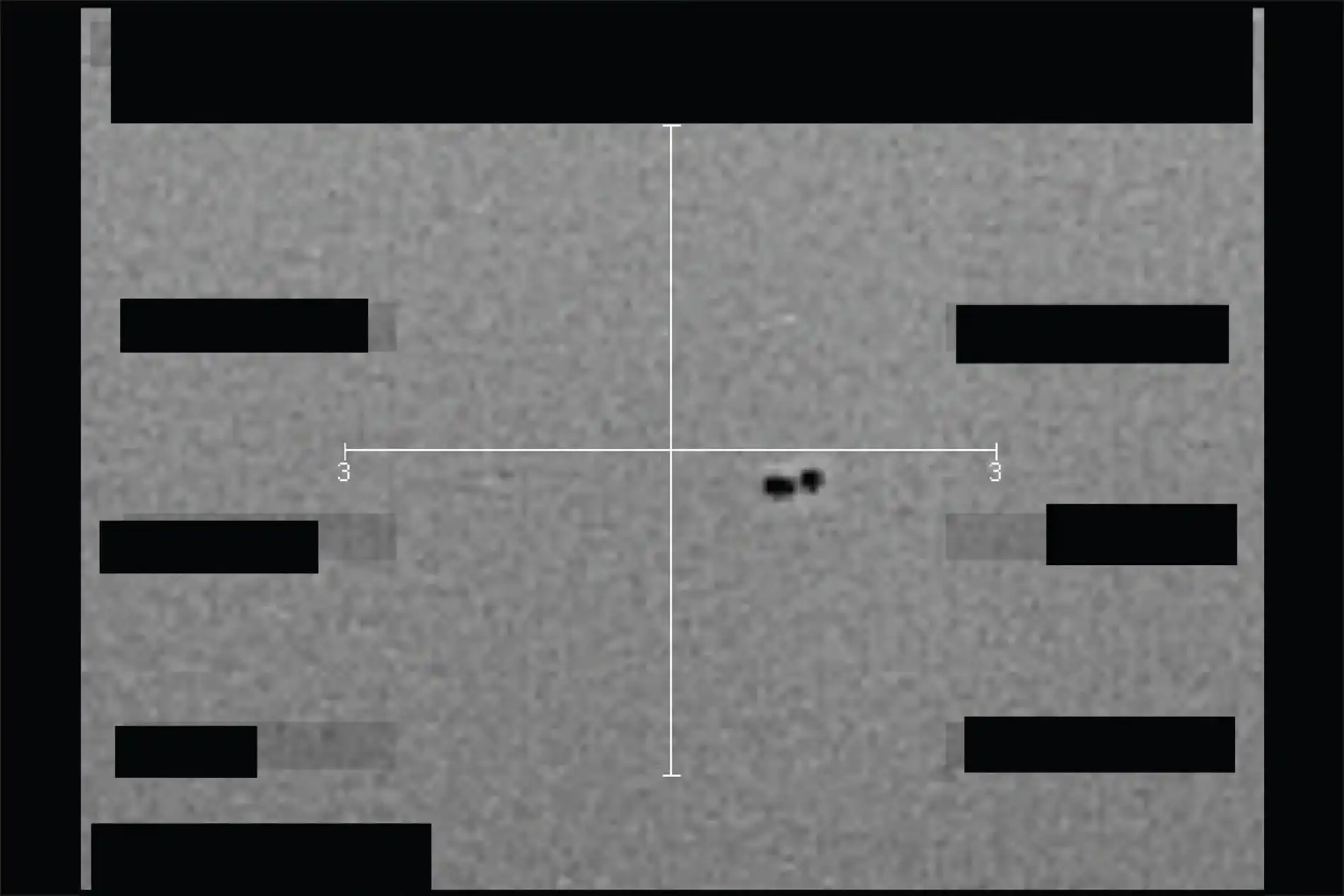
A picture released by the U.S. Department of Defense claims to show an unidentified object appearing over the western U.S. in September 2025 (Source: U.S. Department of Defense)

Compared to mere text reports, these images and eyewitness records are more likely to cause UFO discussions to spread rapidly, making this release appear more like a concentrated display of "declassified archives."

However, the answer given by the prediction market is much cooler than social media. After the initial UFO files were released, the event probability for "Will the U.S. confirm the existence of aliens by December 31, 2026" on the prediction market predict.fun did not surge significantly due to this explosive news. The market did not directly interpret this disclosure as "the U.S. is about to confirm the existence of aliens." The probability remains only 20%.
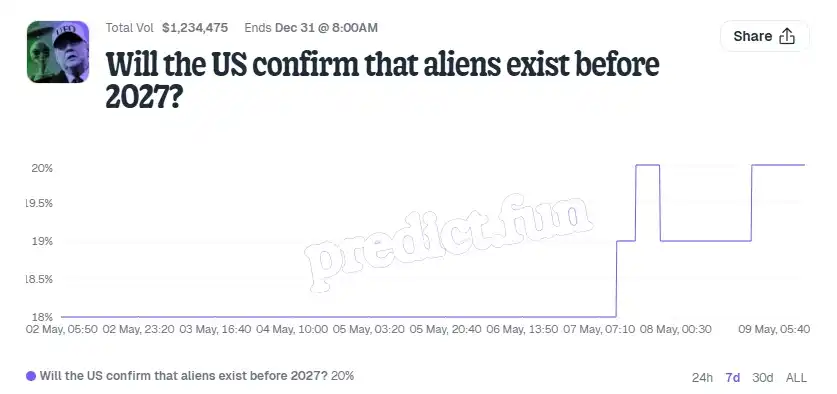
Source: https://predict.fun/market/will-the-us-confirm-that-aliens-exist-before-2027

So, why did this UFO file release not significantly change the prediction market's judgment?

The Prediction Market Bets Not on Whether Aliens Exist, But on Whether the U.S. Government Will Acknowledge It

Upon seeing the 20% probability, many people's first reaction might be that the prediction market believes the probability of aliens existing is only 20%. But this misunderstands the market itself.

Markets like predict.fun do not actually trade on whether extraterrestrial life exists in the universe, but on whether the U.S. government will explicitly confirm the existence of extraterrestrial life or alien technology before 11:59 PM EST on December 31, 2026. According to the market's settlement rules, only if the U.S. President, a member of the U.S. Cabinet, the Joint Chiefs of Staff, or a U.S. federal agency explicitly makes such a statement will the market settle to Yes; otherwise, it will settle to No. The primary settlement sources are official U.S. government information, with reference also made to consensus formed by credible media reports.

This rule is crucial. It means that a video of an unidentified flying object is not enough, a blurry photo is not enough, an astronaut communication log is not enough, and even military acknowledgment that some phenomena are temporarily unexplained is not enough. What can truly trigger a Yes is the U.S. government stating clearly enough, acknowledging that extraterrestrial life or alien technology indeed exists.

File disclosure merely places more materials before the public; official confirmation means the government is endorsing the conclusion. The former generates discussion, the latter triggers settlement. Between them lies a line that is very difficult to cross.

Archive Disclosure Is Not Answer Announcement

This UFO file release is indeed not an ordinary information update. The U.S. Department of Defense concentratedly released relevant materials through a dedicated website and indicated that more files will continue to be released in batches subsequently. For the public, this means that UFO and UAP materials previously scattered across different agencies, eras, and archival systems are being reorganized into an official portal. It makes the discussion more centralized and makes it easier for outsiders to track what materials the U.S. government actually possesses.

However, judging from the currently disclosed content, this batch of files seems more like placing historical sightings, anomalous imagery, mission records, and old archives before the public, rather than providing a unified explanation for these materials. The U.S. Department of Defense did not directly tell the world "what this is," but released more unresolved cases, leaving the judgment space to the public.

This places the release in a subtle position. It increases transparency but does not change the nature of the events. UFO discussions thus gain more material, but these materials primarily expand the questions themselves rather than pushing unexplained phenomena toward extraterrestrial confirmation.

For the prediction market, this file release is more like a new starting point for observation, rather than evidence sufficient to change the odds. It brings the UFO issue back to the main stage and gives subsequent file updates trading value; but the initial materials are still dominated by historical records, sighting reports, and unexplained imagery. What the market is truly waiting for are higher-level, harder-to-ignore signals closer to an official conclusion.

Is 20% an Underestimation or an Overestimation?

From an emotional perspective, 20% might seem low. After all, the release of UFO files has entered an official cadence, with more materials still to be released. If clearer military videos, higher-level internal records appear in the future, or a federal agency provides a more direct judgment, the Yes price could still be rapidly reassessed.

But from a market pricing perspective, 20% is not that low. Because this market trades not on an open-ended question, but one with a clear deadline. What the market must judge is not just whether the U.S. will confirm the existence of extraterrestrial life or alien technology, but also whether such confirmation will happen before the end of 2026.

Time itself is a threshold. Even if files continue to be released, even if more unresolved cases enter public view, it does not mean the U.S. government will complete evidence review, internal coordination, political assessment, and deliver a sufficiently clear conclusion within a few months. For an official system, continuing to disclose materials is one thing; completing a definitive statement within a short timeframe is another.

Therefore, the current 20% probability is more like a tail-priced assessment with a time discount. It does not deny that subsequent files may continue to create volatility, but it also indicates that the market does not believe the initial release materials have fundamentally changed the judgment of the event. For traders, the file disclosure itself is not scarce; what is truly scarce are the key signals that could push for an official conclusion before the end of this year. Before such signals appear, the Yes price is unlikely to be significantly pushed up by archive updates alone.

When UFOs Enter the Prediction Market, Truth Begins to Have a Price

The most noteworthy aspect of this event is no longer just a particular photo, a video clip, or some jellyfish-shaped object. UFO discussions have long lingered between emotion, belief, and conspiracy narratives. Believers see more clues in every file release, while skeptics continue to emphasize insufficient evidence, misidentification, and technical noise. The two sides have argued for years but can hardly truly persuade each other, because they are often not discussing the same question.

The prediction market pulls this issue one step closer to reality. It does not try to answer whether other life exists in the universe, but narrows the question to a more specific level—will the U.S. government explicitly acknowledge the existence of extraterrestrial life or alien technology before the end of this year? It turns what was originally a difficult-to-ground imagination into an event that can be traded, settled, and constantly adjusted with changing information.

So, this ~20% probability is not a final judgment on whether extraterrestrial life exists, but the market's judgment on whether U.S. officials will relent before the end of the year. It truly reflects traders' comprehensive assessment of the evidence chain, official statements, and the time window.

When humanity's oldest mystery enters the prediction market, truth is no longer just awaited and discussed; it also begins to be priced. UFOs may still hang in the sky, but the question of when they will be officially confirmed, when they will turn from unexplained phenomena into factual conclusions, has landed in the betting pool.


İlgili Sorular

QWhat is the event being traded on predict.fun regarding UFOs and aliens?

AThe market is trading on whether the US government will officially confirm the existence of extraterrestrial life or alien technology by December 31, 2026.

QWhy did the market probability only stay at 20% after the initial release of UFO documents by the U.S. Department of Defense?

AThe market distinguishes between the release of historical records and unexplained materials, which expands public discussion, and an official government confirmation, which would trigger a 'Yes' settlement. The release itself did not constitute the required official statement.

QAccording to the article, what specific criteria must be met for the prediction market to settle as 'Yes'?

AFor a 'Yes' settlement, the confirmation must come directly from high-level US officials like the President, a Cabinet member, a member of the Joint Chiefs of Staff, or a federal agency, stating explicitly that extraterrestrial life or technology exists.

QFrom a market pricing perspective, why is a 20% probability for a 'Yes' outcome by the end of 2026 not considered low?

AThe 20% probability factors in a time discount. While more documents may be released, the market assesses that achieving the necessary internal government consensus and definitive public confirmation within a few months is a significant hurdle, making 20% a meaningful 'tail risk' price.

QHow does the article suggest prediction markets change the nature of the UFO discussion?

APrediction markets reframe the abstract debate about alien existence into a specific, tradable event based on verifiable government action. This shifts the focus from personal belief to collective, market-based judgment on the likelihood and timing of an official announcement.

İlgili Okumalar

Warsh's First Day in Office, Markets Deliver a 'Wake-up Call': Rate Hike Expected This Year

On his first day in office, newly inaugurated Federal Reserve Chairman Warsh received a stark market warning, with expectations now fully pricing in a 25-basis-point interest rate hike this year. The shift was triggered by hawkish remarks from Fed Governor Waller, who stated that inflation is now the key policy "driver" and that the odds of a hike or cut are evenly split. This sent short-term Treasury yields higher. Waller signaled a significant pivot in his stance, citing disappointing inflation and labor data. He suggested removing "easing bias" language from Fed statements and did not rule out future rate increases if inflation fails to recede, though he noted immediate action isn't warranted without signs of unanchored inflation expectations. Chairman Warsh faces immediate pressure at his first FOMC meeting in June. With the preferred inflation gauge at a three-year high, analysts warn that failing to hike could be interpreted as an implicit easing of policy. The geopolitical situation in the Middle East is adding to existing price pressures. The market's expectation for a hike contrasts sharply with earlier forecasts for multiple cuts. While long-term Treasury yields have been contained by lower energy prices recently, analysts note they remain under structural upward pressure. Warsh's swearing-in at the White House highlights political scrutiny over Fed independence. However, the market has made it clear that inflation is the most urgent challenge, leaving the new chairman little time to settle in.

marsbit7 saat önce

Warsh's First Day in Office, Markets Deliver a 'Wake-up Call': Rate Hike Expected This Year

marsbit7 saat önce

Has Microsoft Lost Its Way in the AI Race, and Can Copilot Bring It Back on Track?

Microsoft, once seen as an early AI frontrunner due to its investment in OpenAI, is navigating a strategic shift amid increased competition. Its initial reliance on OpenAI’s GPT models has been complicated by OpenAI’s growing ambitions as a direct competitor, rapid advancements from rivals like Claude and Gemini, and the disruptive rise of AI agents, which challenge its traditional SaaS business model. These factors contributed to stock declines and slower-than-expected adoption of its flagship Copilot products. In response, CEO Satya Nadella has taken a hands-on role in product development, signaling the urgency of change. Microsoft is pivoting from a model-centric strategy to a "model-agnostic" enterprise platform approach. It aims to become the foundational layer connecting various AI models—from OpenAI, Anthropic, or its own new "Superintelligence" team—with enterprise workflows, data, security, and cloud services. Recent organizational changes merged consumer and enterprise Copilot teams to accelerate innovation, exemplified by new products like Copilot Tasks and Copilot Cowork. However, this transformation comes at a high cost. Microsoft faces massive capital expenditures, potentially reaching ~$190 billion by 2026, to support AI infrastructure. While its platform strategy shows early signs of traction with growing Azure AI revenue, it must balance startup-like agility with the reliability expected by enterprise clients. The core challenge is no longer being the sole AI winner but defending its position as the essential enterprise software entry point amidst rapid technological commoditization and the shift towards always-on AI agents.

marsbit7 saat önce

Has Microsoft Lost Its Way in the AI Race, and Can Copilot Bring It Back on Track?

marsbit7 saat önce

Why Haven't Forex Stablecoins Taken Off?

Why FX Stablecoins Never Took Off: A Path Forward via Synthetic FX Despite the explosive growth of stablecoin-powered digital banking, which has seen ~$6B in VC investment and a 24x surge in crypto card spending in under a year, a major limitation persists: these banks are essentially dollar-only accounts. This leaves 95-99% of global accounts, which are denominated in non-USD currencies, underserved. Attempts to create native foreign currency (FX) stablecoins (like EURC) have largely failed, with total FX stablecoin TVL at ~$600M compared to $400B for USD stablecoins—a 700x gap. These FX tokens face critical challenges: fragile pegs due to low liquidity, limited exchange/FinTech acceptance, poor on/off-ramps, complex regional compliance, and a chicken-and-egg adoption problem. The article argues that the solution lies not in competing with entrenched USD stablecoin networks (USDT/USDC), but in adopting a synthetic FX model inspired by traditional finance. Specifically, it advocates for Mark-to-Market Non-Deliverable Forwards (NDFs)—cash-settled FX derivatives that allow users to maintain underlying USD stablecoin holdings while having their account balance and P&L denominated in a foreign currency. This approach offers key advantages: strong oracle-based pegs, retention of deep USD stablecoin liquidity and yield, superior on/off-ramps, scalability to any currency with a reliable feed, and capital efficiency. It mirrors how modern institutional FX markets operate. Primary use cases for on-chain NDFs include: 1. **Digital Banks/Wallets:** Enabling multi-currency accounts for international users without leaving the USD stablecoin ecosystem, boosting deposits and retention. 2. **FX Carry Trade Vaults:** Offering access to sovereign interest rate differentials (e.g., earning yield on BRL) in a more stable and scalable format than crypto-native products like Ethena. 3. **Global Enterprise Payments:** Allowing merchants to receive payments in local currency equivalents while settling in USD stablecoins, similar to services offered by Stripe for fiat. The conclusion is that synthetic FX, not native FX stablecoins, is the viable path to integrating foreign exchange into the growing stablecoin digital banking landscape, potentially unlocking the next phase of institutional DeFi and multi-trillion-dollar global adoption.

链捕手8 saat önce

Why Haven't Forex Stablecoins Taken Off?

链捕手8 saat önce

İşlemler

Spot
Futures

Popüler Makaleler

NIGHT Nasıl Satın Alınır

HTX.com’a hoş geldiniz! Midnight (NIGHT) satın alma işlemlerini basit ve kullanışlı bir hâle getirdik. Adım adım açıkladığımız rehberimizi takip ederek kripto yolculuğunuza başlayın. 1. Adım: HTX Hesabınızı OluşturunHTX'te ücretsiz bir hesap açmak için e-posta adresinizi veya telefon numaranızı kullanın. Sorunsuzca kaydolun ve tüm özelliklerin kilidini açın. Hesabımı Aç2. Adım: Kripto Satın Al Bölümüne Gidin ve Ödeme Yönteminizi SeçinKredi/Banka Kartı: Visa veya Mastercard'ınızı kullanarak anında Midnight (NIGHT) satın alın.Bakiye: Sorunsuz bir şekilde işlem yapmak için HTX hesap bakiyenizdeki fonları kullanın.Üçüncü Taraflar: Kullanımı kolaylaştırmak için Google Pay ve Apple Pay gibi popüler ödeme yöntemlerini ekledik.P2P: HTX'teki diğer kullanıcılarla doğrudan işlem yapın.Borsa Dışı (OTC): Yatırımcılar için kişiye özel hizmetler ve rekabetçi döviz kurları sunuyoruz.3. Adım: Midnight (NIGHT) Varlıklarınızı SaklayınMidnight (NIGHT) satın aldıktan sonra HTX hesabınızda saklayın. Alternatif olarak, blok zinciri transferi yoluyla başka bir yere gönderebilir veya diğer kripto para birimlerini takas etmek için kullanabilirsiniz.4. Adım: Midnight (NIGHT) Varlıklarınızla İşlem YapınHTX'in spot piyasasında Midnight (NIGHT) ile kolayca işlemler yapın.Hesabınıza erişin, işlem çiftinizi seçin, işlemlerinizi gerçekleştirin ve gerçek zamanlı olarak izleyin. Hem yeni başlayanlar hem de deneyimli yatırımcılar için kullanıcı dostu bir deneyim sunuyoruz.

277 Toplam GörüntülenmeYayınlanma 2025.12.08Güncellenme 2025.12.08

NIGHT Nasıl Satın Alınır

Tartışmalar

HTX Topluluğuna hoş geldiniz. Burada, en son platform gelişmeleri hakkında bilgi sahibi olabilir ve profesyonel piyasa görüşlerine erişebilirsiniz. Kullanıcıların NIGHT (NIGHT) fiyatı hakkındaki görüşleri aşağıda sunulmaktadır.

活动图片












