After Tokenization of Assets, How to Exit?

marsbit2026-06-16 tarihinde yayınlandı2026-06-16 tarihinde güncellendi

Özet

Title: How to Exit After Asset Tokenization? Author: Symbiotic Compiled by: Hu Tao, ChainCatcher Summary: Tokenization addresses how assets go on-chain but largely leaves the redemption question unresolved. While tokenized assets can settle instantly, the underlying redemption for assets like treasuries, private credit, or real estate can take from T+1 to 180 days. This gap hinders DeFi adoption of Real World Assets (RWAs). Three emerging models aim to provide instant exit liquidity, differing primarily in their capital structure and efficiency: 1. **Balance Sheet Model (e.g., Grove Basin):** A single entity (like Sky) provides immediate liquidity from its balance sheet, acting as a bridge during the settlement period. It offers simplicity and deep initial liquidity but is constrained by a single entity's capacity and risk appetite. 2. **Asset-Specific Vault Model (e.g., Upshift Clear):** Independent liquidity providers fund dedicated vaults for each supported asset, earning fees. It decentralizes capital sources but isolates liquidity and capital per asset, leading to potential fragmentation. 3. **Shared Liquidity Layer Model (e.g., Symbiotic Liquid Lane):** A shared capital pool supports multiple RWA types simultaneously. Funds remain productive between redemptions (e.g., earning yield in lending markets). Exits are settled via a competitive RFQ market. This model aims for higher capital efficiency, scalability across assets, and serves longer-duration assets like priva...

Author: Symbiotic

Compiled by: Hu Tao, ChainCatcher

 
Summary:
  • All three methods allow holders to exit immediately, so their speeds are comparable. The real difference lies in the capital structure behind the exit.

  • The key distinction is how each model handles redemption capital: Grove Basin uses a single balance sheet, Upshift Clear sets up a dedicated vault for each asset, while Symbiotic's Liquid Lane settles through a public market via a shared liquidity layer.

  • Grove Basin provides instant liquidity for tokenized vaults, with capital from Sky's balance sheet, launched in partnership with institutional collaborators. Upshift Clear extends this model to independent liquidity provider (LP) capital, with each supported asset having a dedicated vault.

  • Launched by Symbiotic, Liquid Lane is built on shared capital that can support multiple assets simultaneously, continues to earn yield from multiple sources between redemptions, and settles through an open RFQ marketplace where qualified market makers compete.

  • The result is higher capital efficiency per deposit, and the capacity of the liquidity layer grows with increased market participation, precisely where reliable exit mechanisms are hardest to provide and most valuable.


Exit is the Unresolved Half of the Tokenization Problem

Tokenization solves how assets get on-chain, but barely addresses how holders redeem them. A tokenized treasury or private credit fund can be issued, transferred, and distributed efficiently on-chain, while the underlying redemption process still takes approximately T+1 day for a treasury and 60 to 180 days for private credit, real estate, and structured products. The time gap between a token settling in one block and a fund settling in months is the crux of this long-standing issue.

This gap is crucial because DeFi markets need confidence that tokenized assets can be converted into liquid value when needed. With reliable liquidity infrastructure, RWAs can move beyond simple asset representation to become efficient financial primitives: they can serve as credit collateral, leverage backing, debt coverage, and assets underwriting risk in on-chain markets.


Emerging Instant Liquidity Architectures

Three models have emerged aiming to provide immediate exit pathways for tokenized real-world assets, but they differ in their sources and structuring of capital:

  1. Balance Sheet Model. In this model, a well-capitalized single entity provides liquidity immediately from its own reserves when an eligible holder redeems for stablecoins, then waits in the background for the underlying settlement. Grove’s Basin is an example, funded from Sky’s balance sheet.

  2. Dedicated Vault Model. Independent liquidity providers fund separate pools for each supported asset, earning the redemption spread. Upshift Clear, initially launched in partnership with Superstate, adopts this model.

  3. Shared Liquidity Layer Model. Independent capital providers fund a common capital base that supports multiple assets simultaneously, settling through an open, competitive market. Symbiotic’s Liquid Lane is built on this model.

The question worth exploring is which architecture is best suited for liquidity that must scale across assets, issuers, and risk profiles while remaining capital efficient.


How to Evaluate a Liquidity Layer for Tokenized Assets

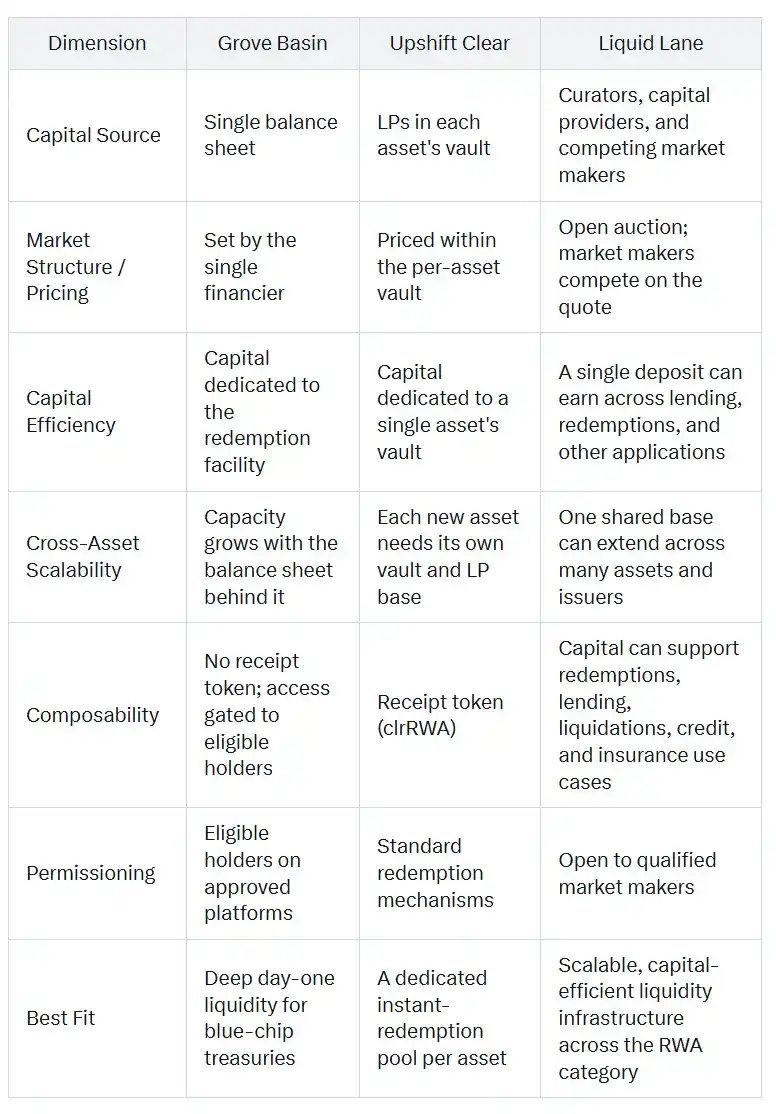
Exit speed itself is nearly uniform and tells little. The meaningful comparison is everything that happens in the five-dimensional space behind the exit.

  1. Who supplies the capital and bears the risk? Where does the liquidity come from? Who bears the duration and credit risk of the underlying asset during the redemption settlement?

  2. Redemption Pricing. The mechanism that determines the discount a holder pays for early redemption—whether it's a single provider's quote, fixed parameters of a dedicated pool, or bidding among multiple participants.

  3. Capital Efficiency and Cost of Supply. How much committed capital a model requires to support redemptions and the opportunity cost of tying up that capital for settlement events. This cost ultimately reflects in the spread holders pay and whether liquidity providers can sustain the model.

  4. How does the model scale to different asset types? What is required to extend coverage to new assets and issuers as the market grows?

  5. Composability. Whether and how holders' claims and providers' funds can be used elsewhere in on-chain finance. This determines if liquidity is siloed in a single venue or can support other uses.

These five categories describe how robust and scalable a liquidity model is as the tokenization market grows in size and variety. The next sections apply them to each model in turn.


Balance Sheet Liquidity for Tokenized Treasuries and Credit

Grove Basin provides instant stablecoin liquidity for RWAs by prefunding when an eligible holder initiates an approved redemption via a supported tokenization platform. Grove Basin serves as a programmable credit facility against pending settlements.

Strengths of this design:

  • Immediate balance sheet depth. Since Basin is funded by an existing reserve base, it can provide considerable liquidity from day one.

  • Simple user experience. Basin operates through supported tokenization platforms, so eligible holders can exit faster while the traditional redemption process continues in the background.

  • An ideal solution for bonds and money market funds with short settlement cycles. These typically settle in T+1 to T+2, making the balance sheet bridge efficient for bridging the gap.

These trade-offs stem from the same design choices:

  • Capacity depends on a single balance sheet. The liquidity ceiling is ultimately tied to the size and risk appetite of the funding balance sheet. This means capacity growth relies on a single reserve base, not a broader capital market forming around the opportunity.

  • Access is restricted. Basin is only available to eligible holders, approved transactions, and supported platforms. This allows the model to control how liquidity scales but also limits how widely it can be accessed and reused across the broader market.

  • First application is for the most liquid part of the market. Tokenized T-bills and money market funds have inherently shorter settlement cycles.

Grove Basin is a powerful, vertically integrated solution to improve exit mechanisms for tokenized treasuries. Its main drawback is that liquidity depth, risk allocation, and economic benefits are tied to a single balance sheet model.


Upshift Clear: Asset-Specific Vaults for Instant Liquidity

Upshift Clear, initially launched with Superstate, applies the instant redemption model to independent USDC liquidity providers through dedicated vaults. LPs deposit USDC into a vault to back RWAs, receiving a composable receipt token clrRWA and earning fees from the redemption spread.

Strengths of this model:

  • Independent capital. Liquidity comes from LPs who opt in, so capacity can grow with the market, independent of any single institution's reserves.

  • General-purpose design. The platform aims to support any RWA with a standard redemption mechanism, providing issuers with a repeatable path to instant redemptions.

  • Clear, voluntarily assumed risk. Upshift Clear prices the settlement spread as a yield opportunity LPs knowingly take on, achieving a clear risk-reward match.

  • Composable receipts. The clrRWA token can circulate in DeFi, so LP positions aren't confined to the vault itself.

Where the model is more constrained:

  • Capital siloed by asset. Each supported asset has its own dedicated funding pool, so each new asset must attract its own liquidity. As coverage expands, the number of pools grows with the number of assets, potentially fragmenting market liquidity coordination.

  • Capital serves one asset at a time. Funds within a specific vault are committed to that specific asset, limiting what each dollar can do between redemption events.

  • The launch asset tests a more specific liquidity problem. Superstate's USCC is a ~$267M crypto arbitrage fund, advantaged by instant exit, but its liquidity challenges differ from longer-duration private credit or structured assets. It provides a solid starting point for the model, while raising a broader question: how well does the same design perform for less liquid, longer-duration assets?

Upshift Clear offers a flexible option for issuers looking to set up dedicated instant redemption pools for specific assets. Its main drawback is that liquidity, risk, and capital efficiency are allocated on an asset-by-asset basis.

Liquid Lane: Shared, Efficient, Cross-Asset Liquidity

Symbiotic Liquid Lane is a shared liquidity layer for tokenized assets. Redemption funding comes from Symbiotic vaults, which can support multiple tokenized assets simultaneously, rather than being tied to a single balance sheet or isolated in pools dedicated to a single asset. Between settlement events, these funds continue to earn yield from multiple sources and are ready when holders need to exit.

Vault managers decide how to deploy the capital. They choose which issuers and assets to support, set risk parameters, and develop vault strategies based on asset type, redemption patterns, and yield opportunities. This makes the liquidity layer configurable, not one-size-fits-all: different managers can build different strategies on the same shared infrastructure.

When a holder wants to redeem, qualified market makers bid on the redemption discount via a request-for-quote layer. Once a quote is accepted, vault funds settle the redemption atomically on-chain immediately, while the issuer's redemption process proceeds in the background.

The resulting model has four structural advantages:

  • Shared capital across multiple assets. A single vault can support redemptions for multiple RWA types. New assets tap into the same capital base, so liquidity capacity grows with market participation, not fragmented asset-by-asset.

  • Funds earn yield between redemptions. Collateral isn't idle waiting for redemption demand. It can earn underlying lending yields in whitelisted lending markets like Morpho and Aave, earn redemption spreads when settling redemptions, and back financial obligations in other Symbiotic applications (e.g., credit and insurance). Thus, a single deposit generates yield from multiple sources, maximizing capital efficiency and DeFi composability.

  • Configurable risk and yield strategies. Managers can tailor vault strategies by choosing supported assets, issuers, limits, and risk parameters. This means liquidity can be deployed according to different risk appetites and market views, rather than forcing all assets into the same pool design.

  • Open, competitive settlement. Liquid Lane uses a competitive request-for-quote (RFQ) marketplace where qualified market makers bid to settle exit trades. The redemption discount is set by market competition, and the yield is split among makers, capital providers, and managers.

This design aims to serve the part of the market where providing reliable exit is hardest and thus most valuable: tokenized private credit, structured assets, and other products with lengthy redemption windows. These can have windows of 60 to 180 days, and reliable exit infrastructure would transform how assets are held, financed, and used on-chain.

Initial integrations for Liquid Lane include Fasanara (first vault manager) and Midas (first issuer via mGLOBAL and mF-ONE), alongside additional vault managers such as Avantgarde Finance, Barter, and Kpk.


Side-by-Side Comparison

Conclusion: From Liquidity Patches to Shared Infrastructure

Tokenized assets need reliable exit mechanisms to achieve broad adoption. The question is whether these exits are built as one-off solutions or as infrastructure that can scale with the market.

If each asset requires its own liquidity pool, each issuer its own financing channel, or each exit relies on a separate reserve, the market gets faster exits but not truly scalable liquidity. A sustainable liquidity model is different: it is shared, efficient, and flexible—growing with market participation without fragmenting capital each time coverage expands.

That is what Symbiotic Liquid Lane aims to be. It turns redemption liquidity from a single-purpose mechanism into a shared layer for the tokenized market: a single capital base that can support multiple assets, multiple obligations, and multiple yield sources.

For issuers, this means increased demand, distribution, and assets under management (AUM), as tokenized assets become easier to hold and use as collateral. For market makers, it means participating in RWA settlement without needing to hold idle inventory upfront. For capital providers, it means a single deposit earning across lending, redemption, and Symbiotic applications.

Liquid Lane is the shared liquidity infrastructure for RWAs: cross-asset, capital-efficient, T+0.


İlgili Sorular

QWhat is the core challenge addressed in the article regarding tokenized real-world assets (RWAs)?

AThe article identifies 'exit' or redemption as the core, unsolved challenge for tokenized RWAs. While assets can be efficiently issued and transferred on-chain, the underlying redemption process remains slow (e.g., T+1 day for treasuries, 60-180 days for private credit), creating a critical gap with the speed of blockchain settlements.

QAccording to the article, what are the three emerging models for providing instant exit liquidity for tokenized RWAs?

AThe three models are: 1) The Balance Sheet Model (e.g., Grove Basin), where a single, well-capitalized entity provides immediate liquidity from its own reserves. 2) The Dedicated Vault Model (e.g., Upshift Clear), where independent liquidity providers fund separate vaults for each supported asset. 3) The Shared Liquidity Layer Model (e.g., Symbiotic's Liquid Lane), where shared capital from multiple providers supports multiple assets simultaneously via a competitive settlement market.

QWhat are the five key dimensions the article uses to evaluate and compare the different liquidity layer models?

AThe five key dimensions are: 1) Source of capital and who bears the risk. 2) Mechanism for pricing redemptions. 3) Capital efficiency and cost of supply. 4) Scalability across different asset types. 5) Composability (whether the capital and claims can be reused elsewhere in DeFi).

QWhat is the main structural advantage of Symbiotic's Liquid Lane model compared to the others?

AIts main structural advantage is the use of a shared liquidity pool where a single vault can support redemptions for multiple tokenized assets. This shared capital base is more efficient, can earn yield from multiple sources (like lending, other Symbiotic apps) between redemptions, and scales liquidity capacity with overall market participation rather than requiring separate pools per asset.

QWhat asset types does the article suggest are the primary target for the most valuable exit infrastructure?

AThe article suggests that the most valuable and challenging application for reliable exit infrastructure is for tokenized private credit, structured assets, and other products with long redemption windows (60-180 days), as opposed to short-duration assets like tokenized treasuries. Reliable exit mechanisms for these longer-term assets would fundamentally change how they are held, financed, and used on-chain.

İlgili Okumalar

Do Robots Also Need Encrypted Wallets? Stablecoin Giant Tether Bets on German Company NEURA Robotics

Do Robots Need Crypto Wallets? Stablecoin Giant Tether Bets on German Firm NEURA Robotics German robotics company NEURA Robotics has secured up to $1.4 billion in what is claimed to be the largest-ever funding round in the full-stack robotics industry, valuing the company at $7 billion. The Series C round attracted major investors like Tether, Qualcomm, Amazon, NVIDIA, Bosch, and the European Investment Bank. NEURA, founded in 2019, initially focused on AI-powered collaborative robots (cobots) for industrial automation, later expanding to autonomous mobile robots, service robots, and humanoid robots. Its core strategy is evolving from a hardware manufacturer to the operator of "Neuraverse," a platform designed to enable different robots to share learned experiences and data, creating network effects. A key, crypto-focused aspect of this investment is Tether's involvement. Tether plans to integrate its open-source Wallet Development Kit (WDK) into NEURA's robot platforms. This would embed self-custody wallet functionality, allowing robots to autonomously handle payments and settlements for tasks under pre-set rules—envisioning use cases in logistics or Robotics-as-a-Service (RaaS) models. This move could position stablecoins and crypto wallets as potential "machine payment infrastructure." Additionally, the partnership will see Tether's QVAC (QuantumVerse Automatic Computer) edge-AI framework tested and deployed within Neuraverse. This aims to enable low-latency, offline-capable AI decision-making directly on robots, reducing reliance on cloud computing for critical, time-sensitive operations. The investment underscores Tether's broader ambition to expand beyond being just a stablecoin issuer into AI, energy, and digital infrastructure, with NEURA's robotics network serving as a testbed for merging crypto-based financial layers with edge-based intelligence for the future of automation.

marsbit13 dk önce

Do Robots Also Need Encrypted Wallets? Stablecoin Giant Tether Bets on German Company NEURA Robotics

marsbit13 dk önce

AMD Launches Compact AI Host, Directly Challenging NVIDIA DGX Spark

In June 2026, AMD announced the Ryzen AI Halo, a compact AI developer desktop to rival NVIDIA's DGX Spark. Both feature 128GB unified memory for running 200B+ parameter models locally. Priced from $2,949 to $3,999, AMD undercuts NVIDIA's $3,999+ DGX Spark. The core divergence lies in architecture and philosophy. Ryzen AI Halo uses an x86-based Ryzen AI Max+ 395 APU (CPU+GPU+NPU), runs standard Windows/Linux, and emphasizes general-purpose PC flexibility. DGX Spark uses an ARM-based Grace Blackwell Superchip, runs a custom DGX OS, and includes a high-speed ConnectX-7 NIC for cluster prototyping, anchoring it to NVIDIA's full-stack CUDA ecosystem. AMD's ROCm software has improved, with simpler installation and support for major frameworks, but still lags behind CUDA's 17-year maturity in community support and cutting-edge library availability. AMD's broader strategy focuses on becoming a viable second-source supplier. Key moves include acquiring design capabilities via ZT Systems (while outsourcing manufacturing) and securing two major 6GW GPU supply deals with OpenAI and Meta in late 2025/early 2026. These contracts validate AMD's role in diversifying the AI supply chain, rather than outright beating NVIDIA. NVIDIA counters with a tightly integrated stack from desktop (DGX Spark) to data center, emphasizing seamless scalability and enterprise software subscriptions (AI Enterprise). In summary, Ryzen AI Halo represents AMD's pragmatic path: offering a cost-effective, open-ecosystem alternative for developers wary of vendor lock-in, while its large data center contracts aim to capture share from customers seeking a second GPU supplier. The choice boils down to a familiar, flexible PC environment with potential software gaps (AMD) versus a premium, optimized, but locked-in ecosystem (NVIDIA).

marsbit13 dk önce

AMD Launches Compact AI Host, Directly Challenging NVIDIA DGX Spark

marsbit13 dk önce

Sharplink CEO: One Million Ethereum Developers, Who Can Compete?

Etherean Ecosystem: One Million Developers and a Formidable Moat The Ethereum network has surpassed a significant milestone: over one million unique lifetime developers, with approximately 232,000 active in the past year. This vast and growing talent pool is Ethereum's core advantage, far more critical than transient metrics like speed or transaction fees. The central question is not which blockchain is fastest, but where the best builders choose to build long-term. Ethereum's answer lies in a decade-long accumulation of infrastructure, standards, tools, liquidity, and collaborative culture that is exceptionally difficult to replicate. It has become the default operating system for programmable finance. This massive developer base is actively working on complex, high-risk challenges that deepen Ethereum's strategic moat: * **Glamsterdam Upgrade (2026):** Focused on core protocol scalability (ePBS, parallel execution) while preserving core values like credible neutrality. * **Synchronous Composability:** Aims to make numerous Rollups interoperate like a single chain, directly addressing fragmentation concerns. * **Quantum Resistance:** Ethereum leads mainstream ecosystems in coordinated preparation for post-quantum cryptography, with a targeted migration plan around 2029. This developer advantage is self-reinforcing, fueled by: * **Deep Composability:** Applications interact like interoperable financial Lego bricks via shared standards (e.g., EVM, Solidity). * **Credible Neutrality:** Secured by over 900,000 validators, making it trusted by major institutions. * **Modularity:** Rollups (Base, Arbitrium, etc.) expand, rather than fracture, the ecosystem into a tightly connected modular internet economy. * **Culture:** Attracts top-tier researchers and standard-setters who guide the entire industry. In essence, while other chains generate activity, Ethereum is consolidating as the trusted, long-term coordination layer for internet-native finance. Its future is being built now by the architects of the next-generation financial infrastructure.

Odaily星球日报1 saat önce

Sharplink CEO: One Million Ethereum Developers, Who Can Compete?

Odaily星球日报1 saat önce

Ethereum Reaches the Milestone of One Million Developers, Sharplink CEO Delves Deep into Ethereum's Future Possibilities

Ethereum Surpasses One Million Developers Milestone: A Look at Its Unshakeable Dominance and Future Joseph Chalom, CEO of Sharplink, reflects on his recent Asia trip where he engaged deeply with Ethereum developers and ecosystem leaders. The most striking takeaway was not just the industry's vibrancy, but the rigorous, long-term vision of local builders. This context brings to life a pivotal statistic: Ethereum has now surpassed one million cumulative developers (1,012,824), with approximately 232,000 remaining active in the past year—a talent pool unmatched by any other crypto ecosystem. The critical question isn't which blockchain is fastest, but where top developers choose to build long-term. Ethereum's answer is unequivocal. Its decade-long lead stems from a unique convergence of technology, institutional culture, economic systems, and composability, cementing its role as the foundational operating system for programmable finance. This massive developer base is tackling the industry's hardest problems, continuously strengthening Ethereum's moat. Key initiatives include: * **The Glamsterdam Upgrade (planned 2026):** Introducing ePBS and Block-level Access Lists for parallel execution and higher throughput while preserving core values like credible neutrality and fair MEV distribution. * **Synchronous Composability:** Projects are working to enable atomic transactions across dozens of Rollups, making them function as one unified chain and eliminating ecosystem fragmentation. * **Post-Quantum Security:** Ethereum is far ahead in preparing for quantum computing threats, with a dedicated foundation working group and testnets targeting a full migration by ~2029—a crucial factor for institutional adoption. Beyond developers, Ethereum's core network effects are its unparalleled composability and unified standards (like EVM and Solidity), which create a powerful flywheel: more developers → better tools → greater liquidity → more institutional participation. Its other decisive advantages include credible neutrality (over 900k validators), a secure modular architecture with interconnected Rollups, and a deeply entrenched culture shaped by top-tier researchers. Ultimately, there's a vast difference between generating short-term activity and becoming the trusted, long-term coordination layer for global native finance. Major institutions prioritize security, trust, and liquidity—areas where Ethereum holds dominant mindshare. The industry's trajectory shows resources consolidating around unified standards, deep liquidity, and developer consensus. After meeting the builders in Seoul and Hong Kong, Chalom is more convinced than ever: Ethereum's unshakeable future is being built right now.

Foresight News1 saat önce

Ethereum Reaches the Milestone of One Million Developers, Sharplink CEO Delves Deep into Ethereum's Future Possibilities

Foresight News1 saat önce

Saylor's Latest Long Read: Bitcoin is Not Money, It's Digital Capital, and Money is Built Upon It

Michael Saylor presents his "Digital Asset Stack" theory, positioning Bitcoin as the foundational layer of digital capital. He argues Bitcoin itself should remain unchanged—no staking, inflation, or protocol alterations. Instead, a five-layer financial architecture should be built atop it: Digital Capital (BTC), Digital Credit (e.g., yield instruments like STRC), Digital Currency (stable, yield-bearing instruments pegged to fiat), Digital Yield (leveraged/structured products), and Digital Equity (e.g., MSTR stock, absorbing residual volatility). Saylor asserts this stack transforms Bitcoin's high-volatility, high-energy capital into tailored products: stable currencies for payments/savings, yield instruments for income seekers, and equity for growth investors. This approach meets diverse needs—corporate treasuries, banks, retirees, emerging market users—without compromising Bitcoin's core properties (scarcity, decentralization). The "killer use case" is rebuilding global money, credit, and capital markets on Bitcoin, bridging the fiat world with a superior digital asset foundation. The system leverages traditional finance principles (risk layering, structured products) while using Bitcoin as the ultimate collateral. This expands Bitcoin's utility, drives adoption, and offers a better monetary experience: digital, yield-bearing, stable-value tools for everyday use.

marsbit1 saat önce

Saylor's Latest Long Read: Bitcoin is Not Money, It's Digital Capital, and Money is Built Upon It

marsbit1 saat önce

İşlemler

Spot
Futures
活动图片