After SpaceX's Debut: Is a $2.1 Trillion Market Cap Still Worth Chasing?

Odaily星球日报2026-06-13 tarihinde yayınlandı2026-06-13 tarihinde güncellendi

Özet

After a highly anticipated IPO, SpaceX (SPCX) debuted on Nasdaq at a $135 price, opening at $150 and closing at $160.95, achieving a market cap of $2.1 trillion. The offering was significantly oversubscribed, with a notable 20-30% allocation to retail investors. Despite the success, the first-day performance fell slightly short of some pre-market expectations of a $2.2+ trillion valuation. Analysts point to the stark disconnect between the company's massive valuation and its current financials. SpaceX remains unprofitable, with Starlink as its primary revenue driver while core launch operations are loss-making, partly due to heavy investments in the Starship program. Furthermore, ambitious future plans, like deploying a 100GW orbital AI computing cluster targeting a $28.5 trillion market, were viewed by some as highly speculative. The stock's near-term trajectory faces key tests. First, its potential fast-track inclusion into the Nasdaq 100 index around mid-July could trigger significant passive fund buying. Second, the release of Q2 2026 earnings in August, coupled with the potential unlocking of up to 20% of some employee and early investor shares, presents a major volatility risk. The market showed belief in Elon Musk's vision but also demonstrated caution regarding the company's present fundamentals and lofty projections.

Original | Odaily Planet Daily (@OdailyChina)

Author|Golem(@web 3_golem)
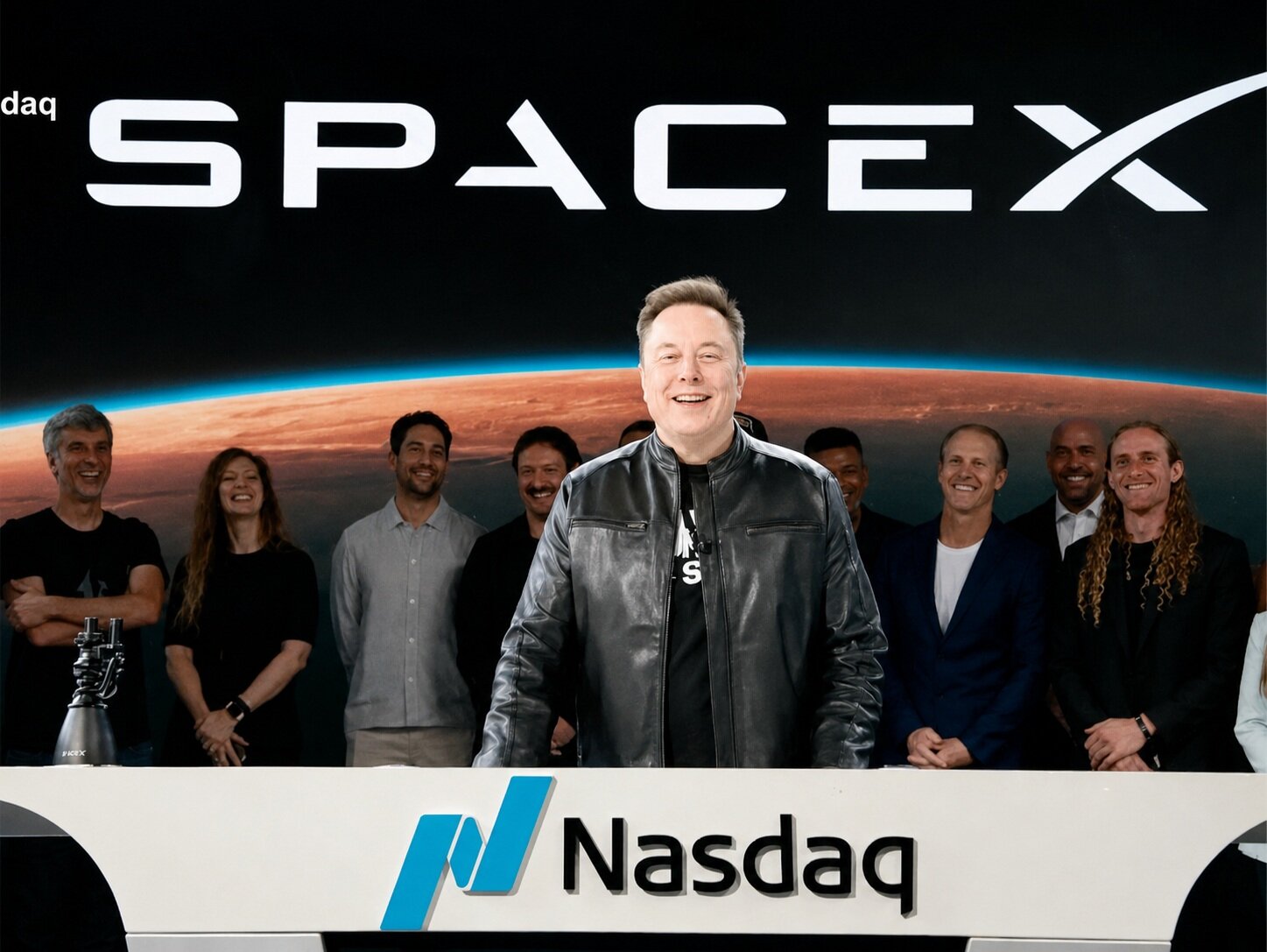
On June 12th, US local time, Musk did not go to New York. Before SpaceX stock (Nasdaq: SPCX) officially listed on Nasdaq, he chose to stay at the company's Texas headquarters, standing among a group of employees to conduct a remote bell-ringing ceremony.

During this ceremony, Musk once again told SpaceX's story to a wider audience. He stated that the company's goal is to send humans to the Moon, Mars, and even more distant stars. After the bell ringing, Nasdaq's live channel played Elton John's "Rocketman," adding a romantic footnote to the most anticipated IPO in the history of space commercialization.

But the sentimental moments ended there, as the game of the capital market immediately began. The SpaceX IPO was priced at $135. On its first trading day, it opened at $150, surged to over $176 during the session, and finally closed at $160.95, with its market capitalization temporarily fixed at $2.1 trillion.

Opening at $150, First-Day Market Cap Settles at $2.1 Trillion

SpaceX's IPO has attracted global attention since it submitted its IPO registration information to the US SEC. The company ultimately decided to issue approximately 555.6 million Class A ordinary shares at a fixed price of $135, corresponding to a valuation of $1.77 trillion.

Regarding equity allocation, Musk personally holds about 42% of the shares, Valor Equity holds about 7.3%, Google holds about 5%, other early-stage venture capital firms collectively hold about 10-12%, and current and former employees hold about 10-15%. The shares offered in this IPO account for only 4.2% of the total. Although Musk and his surrounding interest groups hold the majority of SpaceX shares, their holdings cannot be sold immediately after the listing day. The lock-up period for core investors like Musk and Valor Equity is 366 days, while ordinary IPO shareholders (institutions and employees) also face a basic 180-day lock-up, meaning they cannot sell until at least the end of 2026.

Therefore, on June 12th, the initial trading day, the freely tradable shares consisted only of the approximately 555.6 million Class A ordinary shares offered in the IPO. SpaceX is a typical "low float, high FDV" project. According to its valuation model, the first-day free-float market cap was about $75 billion, roughly matching SpaceX's initially planned fundraising amount.

Investors familiar with crypto projects may not be strangers to high-control models. During the subscription phase, market sentiment quickly turned FOMO. Reports indicate SpaceX received over four times oversubscription, with combined institutional and retail subscription demand exceeding $250 billion. Retail investor subscription amounts alone surpassed $100 billion, far exceeding the $75 billion issue size. Crypto players certainly participated in this feast, but unfortunately, most ended up empty-handed.(Related reading:SpaceX On-Chain Subscription Dreams Shattered: Only 4 Shares in a Trillion-Dollar IPO Feast)

Notably, SpaceX unusually planned to allocate up to 30% of the IPO shares to retail investors, significantly lowering the participation barrier for this tech feast. Typically, such large IPOs allocate only 5% to 10% to retail investors. Although SpaceX ultimately allocated about 20%, it was still double the norm for regular IPOs.

The reason for this is that SpaceX management believes retail investors will hold their stock long-term, much like Tesla's core investor base now consists largely of retail investors. Essentially, they believe retail investors will buy into the dream Musk describes. However, this time, retail investors proved more rational than expected. (Detailed explanation below)

Before SPCX officially started trading on Nasdaq, its pre-market price on Hyperliquid fluctuated between $170-$175, corresponding to a company valuation exceeding $2.2 trillion. Before the official opening, during Nasdaq's pre-open auction, SPCX's opening indicative price was initially set at $172, representing an increase of about 29% over the IPO price, roughly matching pre-market expectations. However, an hour later, SPCX's opening indicative price quickly dropped, finally opening at $150, only about 11% above the IPO price.

According to Gate's US stock market data, SPCX rose to around $176 during the session and finally closed at $160.95, about 19% above the IPO price but only about 7.3% above the opening price. Its first-day market cap settled at $2.1 trillion. Judging by the results, SpaceX's first-day performance was undoubtedly successful. Musk became the world's first trillionaire. However, this outcome wasn't spectacular and even fell short of full market expectations.

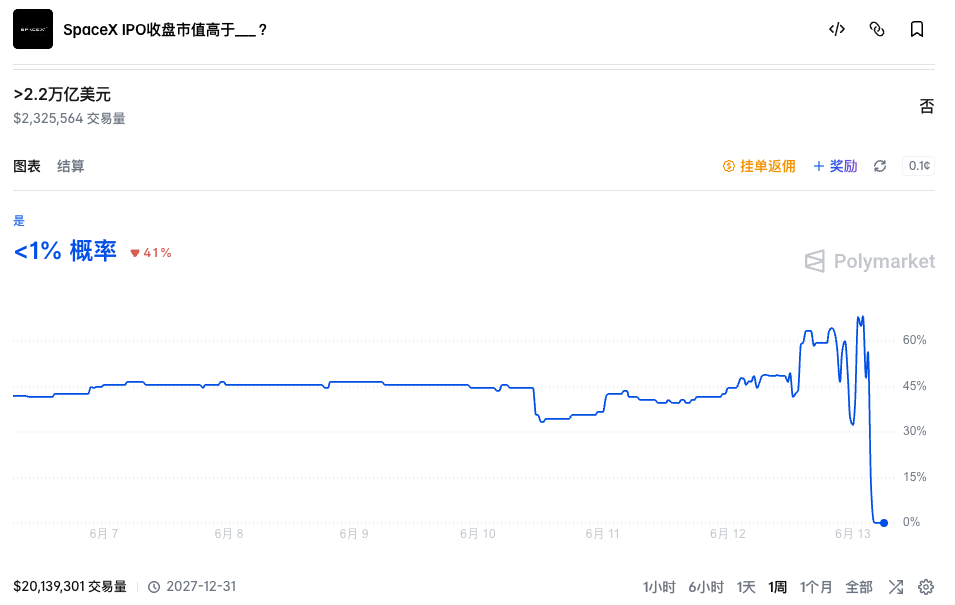
In pre-IPO pricing for SpaceX, not only did Pre-IPO platforms somewhat stumble, but prediction markets also weren't accurate. Hours before the SpaceX IPO, the market was generally optimistic that its market cap could exceed $2.2 trillion. On Polymarket, the probability of "SpaceX IPO closing market cap above $2.2 trillion" was still above 65%, once surging to 70%.

But as SPCX opened "relatively low," the probability for this event also began to fluctuate violently. Finally, the SpaceX IPO closing market cap settled around $2.1 trillion, and the event was settled as "No."
Retail Investors Affect Volatility, Not Gains

The reason for this phenomenon is simple: although the market is still willing to believe in SpaceX's narrative and the "Musk premium," SpaceX is just too expensive. At the right price, even the firmest convictions can be sold.

SpaceX is the first super behemoth in human history to directly descend upon the capital markets with a "trillion-dollar valuation," becoming the world's ninth-largest company by market cap on its first trading day, surpassing giants like Meta and Samsung. But even the craziest retail investors know that SpaceX's current revenue simply cannot support its massive valuation. SpaceX is still not profitable, with a net loss of $4.9 billion for full-year 2025 and a net loss of about $4.28 billion in Q1 2026.

Starlink is currently SpaceX's only profitable business. Prospectus data shows that Starlink generated $11.387 billion in revenue in 2025, accounting for 61% of SpaceX's total revenue, with operating profit of $4.423 billion. Its global user base exceeds 10.3 million, with over 9,600 satellites in orbit. In Q1 2026, it generated $3.257 billion in revenue and $1.188 billion in operating profit. However, this "cash cow" business is just a side venture for SpaceX.

Space launch is SpaceX's flagship. As of the prospectus disclosure, the Falcon rocket series has conducted over 650 launches with a success rate of 99%. Its reusable booster technology provides significant cost advantages and technological leadership within the industry. However, SpaceX's largest external customer for launch services is the US government, and this segment is still operating at a loss. In 2025, SpaceX's launch business recorded an operating loss of $657 million, with a loss margin of 16.1%. In Q1 2026, the operating loss surged to $662 million, with a loss margin of 107%.

The massive losses are due to increased investment related to Starship. However, based on current technological and application bottlenecks, Starship is still some distance away from true commercial-scale production.

Beyond these two businesses, SpaceX's still speculative space computing business is also part of its valuation framework. Compared to the more mature Starlink and launch businesses, Musk's claims about the space computing business seem a bit exaggerated.

SpaceX's plan can be simply understood as sending GPUs into low Earth orbit, using solar power to provide cloud computing capabilities for global AI computing clusters. Musk stated in the SpaceX prospectus that the company aims to deploy 100GW of AI computing capacity into orbit annually. Currently, the global AI industry's annual power demand is roughly in the 15-25GW range. This means SpaceX's planned orbital computing system could theoretically support today's global AI industry expanding about fivefold.

In case readers don't understand what 100GW means: The installed capacity of the Three Gorges Dam is about 22.5GW. That means the scale of one space computing center in Musk's plan is equivalent to 4.4 Three Gorges Dams operating at full capacity.

Moreover, SpaceX explicitly stated in the prospectus that its future (mainly AI-related) business could potentially unlock a $28.5 trillion market. For perspective, China, currently the world's second-largest economy, had a nominal GDP of approximately $19.4 trillion in 2025. The figure proposed by SpaceX is already equivalent to 1.47 times China's 2025 nominal GDP.

Reading this content makes one wonder if this is an IPO prospectus or a sci-fi essay. Even the most FOMO-driven investors need to cool down when seeing these numbers. Research firm CFRA gave SpaceX a "Sell" rating after its listing, with a target price of $115.

Besides the mismatch between actual business and valuation, the large proportion of IPO shares allocated to retail investors might also be a reason suppressing SPCX's stock price. Musk allocated 20-30% of the IPO shares to retail investors. A higher proportion of retail ownership inherently implies greater volatility. Retail investors can buy recklessly due to FOMO but can also sell emotionally at the slightest fluctuation. Therefore, retail investors truly affect volatility, not the final gains.

Important Upcoming Pivotal Moments

Whether you're watching from the sidelines or have already cashed out, the following three time points are particularly important for investors following SpaceX.

Approximately 15 Trading Days After IPO (Estimated around July 6th - July 7th)

This is the most important time point because SpaceX is expected to be directly included in the Nasdaq-100 index after about 15 trading days. In March, Nasdaq specifically revised its rules. Originally, newly listed companies had to wait three months to be eligible for index inclusion, but now they can be fast-tracked into the index after just 15 trading days if they meet the criteria. The requirement for at least about 10% free float was also removed. These new rules seem tailor-made for SpaceX and a subsequent wave of AI tech giants.

If successfully included in the index, it would mean over tens of billions of dollars in global passive funds would be forced to buy SpaceX stock, becoming a significant support for its price.So, if it's known that SpaceX has an extremely high probability of being included in the Nasdaq index in July, and top-tier funds will be buying the stock then, would you, as an investor, choose to buy now in advance and sell to them at a higher price later?

However, on the other hand, some US pension funds and long-term insurance funds have already expressed protest. In May 2026, three of the largest US public pension fund managers (managing over $1 trillion in assets) jointly wrote to Musk, expressing concerns about the risks passive funds might face due to rapid post-IPO index inclusion. In the same month, American Federation of Teachers President Randi Weingarten (representing about 1.8 million teachers, healthcare workers, and public sector employees) directly wrote to the SEC, requesting special scrutiny of the SpaceX IPO.

SpaceX Q2 Earnings Report (Mid-to-late August)

The second crucial time point is the release of SpaceX's Q2 2026 earnings report in August. This will be the first financial report SpaceX submits after going public. If the business shows no significant progress compared to the current state (realistically, major progress is unlikely so soon), its stock price may face further pressure.Furthermore, SpaceX's prospectus also stipulates that two days after the company announces its Q2 2026 earnings report, eligible insider shareholders (employees, former employees, some early investors) may sell a portion of their locked-up shares, up to 20% of their locked holdings. If the stock price has risen 30% above the IPO price at that time and meets this standard for 5 out of 10 trading days, an additional 10% may be unlocked.

This means that in August, the market will not only face volatility from SpaceX's earnings report but also the first major post-IPO share unlock, presenting a significant challenge.

Whether we will be "suffocated" by Musk's dream remains to be seen. At least judging from the first-day performance, the market chose to believe the story but didn't completely lose its rationality. What determines SpaceX's fate next is its own real performance.

Recommended Reading:

SpaceX On-Chain Subscription Dreams Shattered: Only 4 Shares in a Trillion-Dollar IPO Feast

Trend Kriptolar

İlgili Sorular

QWhat was the closing market capitalization of SpaceX on its first day of trading, and how did it compare to pre-market expectations?

ASpaceX closed its first day of trading with a market capitalization of approximately $2.1 trillion. This fell short of some pre-market expectations, which had anticipated a valuation exceeding $2.2 trillion.

QAccording to the article, what is the primary reason for the 'relatively low opening' and restrained first-day gain of SpaceX stock?

AThe primary reason cited is that SpaceX is considered too expensive, as its current revenue and significant losses do not justify its massive valuation. Investors, while believing in the narrative, are pricing in the fundamentals.

QWhat are the three key business areas of SpaceX mentioned in the article, and which one is currently profitable?

AThe three key business areas are Starlink (satellite internet), Space Launch services, and the proposed Space Computing business. Currently, only the Starlink business is profitable.

QWhat is a major upcoming catalyst for SpaceX stock mentioned in the article, and around what date is it expected?

AA major catalyst is SpaceX's potential fast-track inclusion into the Nasdaq-100 index. This could happen approximately 15 trading days after its IPO, around July 6-7, 2026, which would trigger significant passive fund buying.

QWhat two significant events related to stock supply and financial performance are expected to occur in August 2026 for SpaceX?

AIn August 2026, SpaceX is expected to release its Q2 2026 earnings report. Furthermore, following this report, a portion of locked-up shares held by employees, former employees, and some early investors could become eligible for sale, potentially increasing the tradable supply.

İlgili Okumalar

EF's Epic Reorganization: 20% Layoffs, Budget Halved, Is Ethereum Gearing Up for a Leaner Future?

The Ethereum Foundation (EF) has announced a major organizational restructuring, involving a 20% staff reduction (approx. 54 employees) and a division into functional clusters like Protocol, Access, User, Community, and Institutional layers. Co-founder Vitalik Buterin further revealed plans to cut the EF's budget by around 40% over the coming years, aiming to reduce its annual spending rate from about 15% to roughly 5% by 2030, transitioning to an endowment-driven model. This overhaul is seen as a long-overdue correction to the EF's ambiguous role. As Ethereum grew, the foundation faced persistent criticism over ETH sales, perceived lack of execution, and unclear strategy, often becoming a focal point for community frustration amid ETH's price stagnation. The reform aims to redefine the EF's boundaries, narrowing its focus to core protocol research, public goods funding, and ecosystem coordination, while offloading more applied development work to the broader market. Concurrently, ecosystem forces like the newly formed Ethlabs (founded by ex-EF researchers) and other independent groups are stepping in to fill the space, signaling a shift from a centralized model to a more distributed, collaborative ecosystem structure. The move was notably praised by Solana co-founder toly, who viewed a "leaner" EF as potentially more decisive and agile.

Odaily星球日报24 dk önce

EF's Epic Reorganization: 20% Layoffs, Budget Halved, Is Ethereum Gearing Up for a Leaner Future?

Odaily星球日报24 dk önce

Dragonfly Partner Haseeb: The Fastest-Growing Companies of the Future May All Get Stuck at 149 Employees

Dragonfly partner Haseeb explores the distorted economics of AI model pricing, drawing parallels to tax policy. He notes that startups and small teams (under 150 users) enjoy heavily subsidized, fixed-price AI subscriptions (like Claude Code), where the marginal cost of an additional token is effectively zero. This creates a powerful incentive for them to maximize token usage ("token-maxxing") and innovate aggressively with AI automation. In contrast, large enterprises (over 150 users) are forced onto "Enterprise" plans, paying per-token API fees with high (~75%) markups. This acts like a steep "tax" on AI-powered labor, disincentivizing marginal automation and experimental use, and encouraging them to retain more human workers. Haseeb argues this pricing creates a "150-person cliff," a regulatory notch similar to labor laws in France that discourage firms from growing past 50 employees. He predicts the fastest-growing future companies may deliberately cap their headcount at 149 to avoid the punitive enterprise pricing. This would foster an "AI-first" management philosophy obsessed with automation and outsourcing to stay lean. While not intentionally designed, this bifurcated pricing could become one of the most influential de facto tax policies, shaping how AI replaces labor—not through mass layoffs at big firms, but through agile, AI-native startups outcompeting them.

marsbit36 dk önce

Dragonfly Partner Haseeb: The Fastest-Growing Companies of the Future May All Get Stuck at 149 Employees

marsbit36 dk önce

How xBubble Breaks Through in the VC-Heavily-Backed OPC Economy

xBubble: Addressing the Structural Gap in the VC-Backed OPC Economy The concept of OPC (One Person Company) is evolving from a buzzword to a significant AI-driven market. While AI coding tools like Replit and Lovable have validated demand from non-technical users wanting to build applications, a key gap remains: the leap from creating a demo to running a stable, evolving business. These tools still require users to manage the development process, including technical judgments for integrations, modifications, and deployments—a major hurdle for OPCs. xBubble, by DAPPOS, tackles this by shifting from "Prompt-to-Code" to "SOP-to-Business." Instead of generating code from instructions, its core is a system of pre-organized SOPs (Standard Operating Procedures) that translate business goals—like "sell World Cup merchandise"—into complete, executable workflows. This includes generating cohesive assets, pages, payment systems, and backend logic. The platform is augmented by a network of third-party service providers who handle infrastructure (hosting, domains, payment setup), acting like "on-site service engineers." Users can pay for these services directly with xBubble credits, simplifying onboarding. This ecosystem aims to deliver not just an app, but a complete, modifiable business launch path. xBubble targets a clear OPC segment: small commercial nodes (e.g., creators, merchants) with existing products, customers, or channels, but for whom a full tech team is unjustifiable. Its potential lies in SOPs accumulating expertise from real cases, improving reliability and reducing delivery costs over time. Additionally, its native support for crypto payments caters to global or digital-native OPCs. In summary, as AI democratizes software creation, xBubble's opportunity is to prove that "SOP-to-Business" provides more immediate value for launching a real, operational business than a powerful but unstructured AI coding tool.

链捕手39 dk önce

How xBubble Breaks Through in the VC-Heavily-Backed OPC Economy

链捕手39 dk önce

If It's Not a Clear Yes, It's a No: A Nine-Year Retrospective by a VC Who Survived Four Cycles

**"Invest Only When Certain": A Nine-Year Retrospective from a VC Across Four Cycles** IOSG founder Jocy shares hard-earned lessons from nine years and over a hundred investments in Web3. The core challenge isn't identifying successful founders, but understanding why talented founders with solid ideas still fail. Through building a "failed founder database," IOSG identified six recurring failure patterns. **Founder Trait Red Flags:** 1. **Emotionally Unstable:** Founders who react defensively to criticism or publicly lash out under pressure (e.g., 80% drawdowns) often fail. Resilience is key. 2. **Lacking Hunger / Having a Fallback:** Founders with significant safety nets (family wealth, cushy fallback jobs) may lack the "do-or-die" commitment needed to survive crypto's brutal cycles. 3. **Unchecked Ego:** Includes "polished execution machines" who excel in known frameworks but struggle when paradigms shift, and "professor-types" who are technically brilliant but resistant to commercial feedback or coaching. **Project Structure Red Flags:** 4. **Token-First, Not Product-First:** Treating the token solely as a fundraising tool with no real utility or connection to product value is a major warning sign. The project should have value even if the token goes to zero. 5. **No Day-1 Exit Thesis:** Founders must have a clear, staged capital strategy from the start, understanding what each funding round needs to prove to unlock the next. "Exit before entry" is crucial. 6. **No Full-Cycle Experience:** Founders who haven't lived through a complete crypto bull/bear cycle (e.g., 2018, 2022) often underestimate their vulnerability. IOSG limits initial checks for such teams to $250k, sizing for risk. **The Positive Flipside: Desirable Founder Traits** The ideal candidate exhibits: obsessive problem-depth, being a second-time founder with a non-consensus vision, strong communication skills with *controlled* ego, relentless perseverance, and a global perspective with agency and taste (increasingly vital in the AI era). **Three Survival Tips for Founders:** 1. **Cash Flow Over Narrative:** Real revenue is what sustains projects, not vanity metrics. 2. **Tokens Are a Liability:** Avoid issuing a token unless absolutely necessary. The hidden costs (market making, liquidity, compliance) are immense, often a multi-million-dollar burden. 3. **Respect Liquidity:** Sell during peaks to build treasury, buy back to support the protocol during troughs. Be realistic about valuations and your ability to deliver for the next round. The final principle is simple yet paramount: **"If it's a borderline 'yes' or 'no,' don't invest."** In an industry that reinvents itself every few years, the discipline to consistently say "no" is the ultimate secret to longevity.

Foresight News1 saat önce

If It's Not a Clear Yes, It's a No: A Nine-Year Retrospective by a VC Who Survived Four Cycles

Foresight News1 saat önce

İşlemler

Spot
Futures

Popüler Makaleler

$S$ Nedir

SPERO'yu Anlamak: Kapsamlı Bir Genel Bakış SPERO'ya Giriş İnovasyonun manzarası gelişmeye devam ederken, web3 teknolojilerinin ve kripto para projelerinin ortaya çıkışı dijital geleceği şekillendirmede önemli bir rol oynamaktadır. Bu dinamik alanda dikkat çeken projelerden biri SPERO, $$s$$ olarak adlandırılmaktadır. Bu makale, SPERO hakkında ayrıntılı bilgi toplamak ve sunmak amacıyla, meraklılar ve yatırımcıların web3 ve kripto alanlarındaki temellerini, hedeflerini ve yeniliklerini anlamalarına yardımcı olmayı amaçlamaktadır. SPERO,$$s$$ Nedir? SPERO,$$s$$, kripto alanında merkeziyetsizlik ve blok zinciri teknolojisi ilkelerini kullanarak etkileşimi, faydayı ve finansal kapsayıcılığı teşvik eden bir ekosistem yaratmayı amaçlayan benzersiz bir projedir. Proje, kullanıcıların yenilikçi finansal çözümler ve hizmetler sunarak eşler arası etkileşimleri yeni yollarla kolaylaştırmayı hedeflemektedir. SPERO,$$s$$'nin temel amacı, bireyleri güçlendirmek ve kripto para alanındaki kullanıcı deneyimini artıran araçlar ve platformlar sağlamaktır. Bu, daha esnek işlem yöntemlerini mümkün kılmayı, topluluk odaklı girişimleri teşvik etmeyi ve merkeziyetsiz uygulamalar (dApp'ler) aracılığıyla finansal fırsatlar yaratmayı içermektedir. SPERO,$$s$$'nin temel vizyonu kapsayıcılık etrafında dönmekte olup, geleneksel finansal sistemlerdeki boşlukları kapatmayı ve blok zinciri teknolojisinin faydalarından yararlanmayı hedeflemektedir. SPERO,$$s$$'nin Yaratıcısı Kimdir? SPERO,$$s$$'nin yaratıcısının kimliği bir miktar belirsizdir, çünkü kurucusu(ları) hakkında ayrıntılı arka plan bilgisi sağlayan sınırlı kamuya açık kaynaklar bulunmaktadır. Bu şeffaflık eksikliği, projenin merkeziyetsizlik taahhüdünden kaynaklanabilir—birçok web3 projesinin paylaştığı bir etik anlayışı, bireysel tanınmanın yerine kolektif katkıları önceliklendirmektedir. Topluluk ve onun kolektif hedefleri etrafında tartışmaları merkezileştirerek, SPERO,$$s$$, belirli bireyleri öne çıkarmadan güçlendirme özünü taşımaktadır. Bu nedenle, SPERO'nun etik anlayışını ve misyonunu anlamak, tek bir yaratıcının kimliğini belirlemekten daha önemlidir. SPERO,$$s$$'nin Yatırımcıları Kimlerdir? SPERO,$$s$$, kripto sektöründe yeniliği teşvik etmeye adanmış girişim sermayedarlarından melek yatırımcılara kadar çeşitli yatırımcılar tarafından desteklenmektedir. Bu yatırımcıların odak noktası genellikle SPERO'nun misyonuyla uyumlu olup, toplumsal teknolojik ilerlemeyi, finansal kapsayıcılığı ve merkeziyetsiz yönetimi vaat eden projeleri önceliklendirmektedir. Bu yatırımcı temelleri, yalnızca yenilikçi ürünler sunan projelere değil, aynı zamanda blok zinciri topluluğuna ve ekosistemlerine olumlu katkılarda bulunan projelere de ilgi duymaktadır. Bu yatırımcıların desteği, SPERO,$$s$$'yi hızla gelişen kripto projeleri alanında dikkate değer bir rakip haline getirmektedir. SPERO,$$s$$ Nasıl Çalışır? SPERO,$$s$$, onu geleneksel kripto para projelerinden ayıran çok yönlü bir çerçeve kullanmaktadır. İşte benzersizliğini ve yeniliğini vurgulayan bazı temel özellikler: Merkeziyetsiz Yönetim: SPERO,$$s$$, kullanıcıların projenin geleceğiyle ilgili karar alma süreçlerine aktif olarak katılmalarını sağlayan merkeziyetsiz yönetim modellerini entegre etmektedir. Bu yaklaşım, topluluk üyeleri arasında sahiplik ve hesap verebilirlik duygusunu teşvik etmektedir. Token Kullanımı: SPERO,$$s$$, ekosistem içinde çeşitli işlevler sunmak üzere tasarlanmış kendi kripto para token'ını kullanmaktadır. Bu token'lar, işlemleri, ödülleri ve platformda sunulan hizmetlerin kolaylaştırılmasını sağlayarak genel etkileşimi ve faydayı artırmaktadır. Katmanlı Mimari: SPERO,$$s$$'nin teknik mimarisi, modülerlik ve ölçeklenebilirliği destekleyerek projenin evrimi sırasında ek özelliklerin ve uygulamaların sorunsuz bir şekilde entegrasyonuna olanak tanımaktadır. Bu uyum sağlama yeteneği, sürekli değişen kripto manzarasında geçerliliği sürdürmek için hayati öneme sahiptir. Topluluk Katılımı: Proje, işbirliği ve geri bildirim teşvik eden mekanizmalar kullanarak topluluk odaklı girişimlere vurgu yapmaktadır. Güçlü bir topluluk oluşturarak, SPERO,$$s$$, kullanıcı ihtiyaçlarını daha iyi karşılayabilir ve piyasa trendlerine uyum sağlayabilir. Kapsayıcılığa Odaklanma: Düşük işlem ücretleri ve kullanıcı dostu arayüzler sunarak, SPERO,$$s$$, daha önce kripto alanında yer almamış bireyler de dahil olmak üzere çeşitli bir kullanıcı tabanını çekmeyi hedeflemektedir. Bu kapsayıcılık taahhüdü, erişilebilirlik yoluyla güçlendirme misyonuyla uyumludur. SPERO,$$s$$ Zaman Çizelgesi Bir projenin tarihini anlamak, gelişim yolculuğu ve kilometre taşları hakkında kritik bilgiler sağlar. Aşağıda, SPERO,$$s$$'nin evriminde önemli olayları haritalayan önerilen bir zaman çizelgesi bulunmaktadır: Kavram Geliştirme ve Fikir Aşaması: SPERO,$$s$$'nin temelini oluşturan ilk fikirler, blok zinciri endüstrisindeki merkeziyetsizlik ve topluluk odaklılık ilkeleriyle yakından uyumlu olarak geliştirildi. Proje Beyaz Kağıdının Yayınlanması: Kavramsal aşamayı takiben, SPERO,$$s$$'nin vizyonunu, hedeflerini ve teknolojik altyapısını ayrıntılı bir şekilde açıklayan kapsamlı bir beyaz kağıt yayımlandı ve topluluk ilgisini ve geri bildirimini toplamak amacıyla sunuldu. Topluluk Oluşturma ve Erken Katılımlar: Projenin hedefleri etrafında tartışmalar yürüterek destek toplamak ve erken benimseyenler ile potansiyel yatırımcılar için bir topluluk oluşturmak amacıyla aktif iletişim çabaları gerçekleştirildi. Token Üretim Etkinliği: SPERO,$$s$$, yerel token'larını erken destekçilere dağıtmak ve ekosistem içinde başlangıç likiditesini sağlamak amacıyla bir token üretim etkinliği (TGE) gerçekleştirdi. İlk dApp'in Yayınlanması: SPERO,$$s$$ ile ilişkili ilk merkeziyetsiz uygulama (dApp) faaliyete geçti ve kullanıcıların platformun temel işlevleriyle etkileşimde bulunmalarını sağladı. Sürekli Gelişim ve Ortaklıklar: Projenin tekliflerine sürekli güncellemeler ve iyileştirmeler yapılmakta olup, blok zinciri alanındaki diğer oyuncularla stratejik ortaklıklar, SPERO,$$s$$'yi rekabetçi ve gelişen bir oyuncu haline getirmiştir. Sonuç SPERO,$$s$$, web3 ve kripto paranın finansal sistemleri devrim niteliğinde dönüştürme ve bireyleri güçlendirme potansiyelinin bir kanıtıdır. Merkeziyetsiz yönetime, topluluk katılımına ve yenilikçi tasarlanmış işlevselliğe olan bağlılığıyla, daha kapsayıcı bir finansal manzaraya doğru bir yol açmaktadır. Hızla gelişen kripto alanındaki herhangi bir yatırımda olduğu gibi, potansiyel yatırımcılar ve kullanıcılar, SPERO,$$s$$ içindeki devam eden gelişmelerle ilgili olarak kapsamlı bir araştırma yapmaları ve düşünceli bir şekilde katılmaları teşvik edilmektedir. Proje, kripto endüstrisinin yenilikçi ruhunu sergileyerek, sayısız olasılığını keşfetmeye davet etmektedir. SPERO,$$s$$'nin yolculuğu hala devam ederken, temel ilkeleri, teknoloji, finans ve birbirimizle etkileşim biçimimizi etkileyebilir.

102 Toplam GörüntülenmeYayınlanma 2024.12.17Güncellenme 2024.12.17

$S$ Nedir

AGENT S Nedir

Agent S: Web3'te Otonom Etkileşimin Geleceği Giriş Web3 ve kripto para dünyasında sürekli gelişen manzarada, yenilikler bireylerin dijital platformlarla etkileşim biçimlerini sürekli olarak yeniden tanımlıyor. Bu tür öncü projelerden biri olan Agent S, açık ajans çerçevesi aracılığıyla insan-bilgisayar etkileşimini devrim niteliğinde değiştirmeyi vaat ediyor. Otonom etkileşimlerin yolunu açarak, Agent S karmaşık görevleri basitleştirmeyi ve yapay zeka (AI) alanında dönüştürücü uygulamalar sunmayı hedefliyor. Bu detaylı inceleme, projenin karmaşıklıklarına, benzersiz özelliklerine ve kripto para alanındaki etkilerine dalacaktır. Agent S Nedir? Agent S, bilgisayar görevlerinin otomasyonunda üç temel zorluğu ele almak üzere özel olarak tasarlanmış çığır açıcı bir açık ajans çerçevesidir: Alan Spesifik Bilgi Edinimi: Çerçeve, çeşitli dış bilgi kaynaklarından ve iç deneyimlerden akıllıca öğrenir. Bu çift yönlü yaklaşım, alan spesifik bilgi açısından zengin bir veri havuzu oluşturmasını sağlar ve görev yürütmedeki performansını artırır. Uzun Görev Ufukları Üzerinde Planlama: Agent S, karmaşık görevlerin verimli bir şekilde parçalanmasını ve yürütülmesini kolaylaştıran deneyim artırımlı hiyerarşik planlama kullanır. Bu özellik, çoklu alt görevleri etkili ve verimli bir şekilde yönetme yeteneğini önemli ölçüde artırır. Dinamik, Homojen Olmayan Arayüzlerle Başlama: Proje, ajanlar ve kullanıcılar arasındaki etkileşimi geliştiren yenilikçi bir çözüm olan Ajan-Bilgisayar Arayüzü'ni (ACI) tanıtmaktadır. Çok Modlu Büyük Dil Modellerini (MLLM'ler) kullanarak, Agent S çeşitli grafik kullanıcı arayüzlerini sorunsuz bir şekilde gezinebilir ve manipüle edebilir. Bu öncü özellikler aracılığıyla, Agent S, makinelerle insan etkileşimini otomatikleştirmede karşılaşılan karmaşıklıkları ele alan sağlam bir çerçeve sunarak, AI ve ötesinde birçok uygulama için zemin hazırlıyor. Agent S'nin Yaratıcısı Kimdir? Agent S'nin kavramı temelde yenilikçi olsa da, yaratıcısı hakkında spesifik bilgiler belirsizliğini koruyor. Yaratıcı şu anda bilinmiyor, bu da projenin yeni aşamasını veya kurucu üyeleri gizli tutma stratejik tercihini vurguluyor. Anonimlikten bağımsız olarak, odak çerçevenin yetenekleri ve potansiyeli üzerinde kalıyor. Agent S'nin Yatırımcıları Kimlerdir? Agent S, kriptografik ekosistemde oldukça yeni olduğundan, yatırımcıları ve finansal destekçileri hakkında ayrıntılı bilgiler açıkça belgelenmemiştir. Projeyi destekleyen yatırım temelleri veya organizasyonları hakkında kamuya açık bilgilerdeki eksiklik, finansman yapısı ve gelişim yol haritası hakkında sorular doğuruyor. Destekleyicilerin anlaşılması, projenin sürdürülebilirliğini ve potansiyel pazar etkisini değerlendirmek için kritik öneme sahiptir. Agent S Nasıl Çalışır? Agent S'nin temelinde, çeşitli ortamlarda etkili bir şekilde çalışmasını sağlayan son teknoloji bir sistem yatmaktadır. İşleyiş modeli birkaç ana özellik etrafında inşa edilmiştir: İnsan Benzeri Bilgisayar Etkileşimi: Çerçeve, bilgisayarlarla etkileşimleri daha sezgisel hale getirmeyi amaçlayan gelişmiş AI planlaması sunar. Görev yürütmedeki insan davranışını taklit ederek, kullanıcı deneyimlerini yükseltmeyi vaat eder. Anlatı Belleği: Yüksek düzeyde deneyimlerden yararlanmak için kullanılan Agent S, görev geçmişlerini takip etmek amacıyla anlatı belleğini kullanarak karar verme süreçlerini geliştirir. Episodik Bellek: Bu özellik, kullanıcılara adım adım rehberlik sağlayarak, çerçevenin görevler gelişirken bağlamsal destek sunmasına olanak tanır. OpenACI Desteği: Yerel olarak çalışabilme yeteneği ile Agent S, kullanıcıların etkileşimleri ve iş akışları üzerinde kontrol sağlamasına olanak tanır ve Web3'ün merkeziyetsiz felsefesiyle uyumlu hale gelir. Dış API'lerle Kolay Entegrasyon: Çeşitli AI platformlarıyla uyumluluğu ve çok yönlülüğü, Agent S'nin mevcut teknolojik ekosistemlere sorunsuz bir şekilde entegre olmasını sağlar ve geliştiriciler ile organizasyonlar için cazip bir seçenek haline getirir. Bu işlevsellikler, Agent S'nin kripto alanındaki benzersiz konumuna katkıda bulunarak, karmaşık, çok aşamalı görevleri minimum insan müdahalesi ile otomatikleştirir. Proje geliştikçe, Web3'teki potansiyel uygulamaları dijital etkileşimlerin nasıl gelişeceğini yeniden tanımlayabilir. Agent S'nin Zaman Çizelgesi Agent S'nin gelişimi ve kilometre taşları, önemli olaylarını vurgulayan bir zaman çizelgesinde özetlenebilir: 27 Eylül 2024: Agent S'nin kavramı, “Bilgisayarları İnsan Gibi Kullanan Açık Bir Ajans Çerçevesi” başlıklı kapsamlı bir araştırma makalesi ile tanıtıldı ve projenin temelini sergiledi. 10 Ekim 2024: Araştırma makalesi arXiv'de kamuya açık olarak yayınlandı ve çerçevenin derinlemesine bir incelemesini ve OSWorld benchmark'ına dayalı performans değerlendirmesini sundu. 12 Ekim 2024: Agent S'nin yetenekleri ve özellikleri hakkında görsel bir içgörü sağlayan bir video sunumu yayımlandı ve potansiyel kullanıcılar ve yatırımcılarla daha fazla etkileşim sağlandı. Bu zaman çizelgesindeki işaretler, sadece Agent S'nin ilerlemesini değil, aynı zamanda şeffaflık ve topluluk katılımına olan bağlılığını da göstermektedir. Agent S Hakkında Ana Noktalar Agent S çerçevesi gelişmeye devam ederken, birkaç ana özellik öne çıkmakta ve yenilikçi doğasını ve potansiyelini vurgulamaktadır: Yenilikçi Çerçeve: İnsan etkileşimine benzer bir bilgisayar kullanımı sağlamak üzere tasarlanan Agent S, görev otomasyonuna yeni bir yaklaşım getiriyor. Otonom Etkileşim: GUI aracılığıyla bilgisayarlarla otonom olarak etkileşim kurabilme yeteneği, daha akıllı ve verimli hesaplama çözümlerine doğru bir sıçrama anlamına geliyor. Karmaşık Görev Otomasyonu: Sağlam metodolojisi ile karmaşık, çok aşamalı görevleri otomatikleştirerek süreçleri daha hızlı ve daha az hata payı ile gerçekleştirebilir. Sürekli İyileştirme: Öğrenme mekanizmaları, Agent S'nin geçmiş deneyimlerden öğrenmesini sağlar ve sürekli olarak performansını ve etkinliğini artırır. Çok Yönlülük: OSWorld ve WindowsAgentArena gibi farklı işletim ortamlarında uyumlu olması, geniş bir uygulama yelpazesine hizmet edebilmesini sağlar. Agent S, Web3 ve kripto alanında kendini konumlandırırken, etkileşim yeteneklerini artırma ve süreçleri otomatikleştirme potansiyeli, AI teknolojilerinde önemli bir ilerlemeyi temsil etmektedir. Yenilikçi çerçevesi aracılığıyla, Agent S dijital etkileşimlerin geleceğini örneklemekte ve çeşitli sektörlerde kullanıcılar için daha sorunsuz ve verimli bir deneyim vaat etmektedir. Sonuç Agent S, AI ve Web3'ün birleşiminde cesur bir sıçramayı temsil ediyor ve teknoloji ile etkileşim biçimimizi yeniden tanımlama kapasitesine sahip. Henüz erken aşamalarında olmasına rağmen, uygulama olanakları geniş ve çekici. Kritik zorlukları ele alan kapsamlı çerçevesi ile Agent S, otonom etkileşimleri dijital deneyimin ön plana çıkmasına taşımayı hedefliyor. Kripto para ve merkeziyetsizlik alanlarına daha derinlemesine girdikçe, Agent S gibi projelerin teknoloji ve insan-bilgisayar işbirliğinin geleceğini şekillendirmede önemli bir rol oynayacağı kesin.

595 Toplam GörüntülenmeYayınlanma 2025.01.14Güncellenme 2025.01.14

AGENT S Nedir

S Nasıl Satın Alınır

HTX.com’a hoş geldiniz! Sonic (S) satın alma işlemlerini basit ve kullanışlı bir hâle getirdik. Adım adım açıkladığımız rehberimizi takip ederek kripto yolculuğunuza başlayın. 1. Adım: HTX Hesabınızı OluşturunHTX'te ücretsiz bir hesap açmak için e-posta adresinizi veya telefon numaranızı kullanın. Sorunsuzca kaydolun ve tüm özelliklerin kilidini açın. Hesabımı Aç2. Adım: Kripto Satın Al Bölümüne Gidin ve Ödeme Yönteminizi SeçinKredi/Banka Kartı: Visa veya Mastercard'ınızı kullanarak anında Sonic (S) satın alın.Bakiye: Sorunsuz bir şekilde işlem yapmak için HTX hesap bakiyenizdeki fonları kullanın.Üçüncü Taraflar: Kullanımı kolaylaştırmak için Google Pay ve Apple Pay gibi popüler ödeme yöntemlerini ekledik.P2P: HTX'teki diğer kullanıcılarla doğrudan işlem yapın.Borsa Dışı (OTC): Yatırımcılar için kişiye özel hizmetler ve rekabetçi döviz kurları sunuyoruz.3. Adım: Sonic (S) Varlıklarınızı SaklayınSonic (S) satın aldıktan sonra HTX hesabınızda saklayın. Alternatif olarak, blok zinciri transferi yoluyla başka bir yere gönderebilir veya diğer kripto para birimlerini takas etmek için kullanabilirsiniz.4. Adım: Sonic (S) Varlıklarınızla İşlem YapınHTX'in spot piyasasında Sonic (S) ile kolayca işlemler yapın.Hesabınıza erişin, işlem çiftinizi seçin, işlemlerinizi gerçekleştirin ve gerçek zamanlı olarak izleyin. Hem yeni başlayanlar hem de deneyimli yatırımcılar için kullanıcı dostu bir deneyim sunuyoruz.

1.6k Toplam GörüntülenmeYayınlanma 2025.01.15Güncellenme 2026.06.02

S Nasıl Satın Alınır

Tartışmalar

HTX Topluluğuna hoş geldiniz. Burada, en son platform gelişmeleri hakkında bilgi sahibi olabilir ve profesyonel piyasa görüşlerine erişebilirsiniz. Kullanıcıların S (S) fiyatı hakkındaki görüşleri aşağıda sunulmaktadır.

活动图片