After $HYPE Hits a New High, Is It Worth Considering the Stock of "HYPE Version MicroStrategy" $PURR?

marsbit2026-05-25 tarihinde yayınlandı2026-05-25 tarihinde güncellendi

Özet

**HYPE Hits New Highs: Is $PURR, the "HYPE Version of MicroStrategy," Worth Considering?** The stock of Hyperliquid Strategies (NASDAQ: $PURR), a publicly-traded company that exclusively buys and holds the cryptocurrency HYPE, has gained over 100% year-to-date, mirroring HYPE's own 150% surge to new all-time highs. This has sparked discussions about PURR being a more "capital-efficient" play than MicroStrategy's bitcoin strategy, given its reported ~$1 billion unrealized gain on a ~$220 million investment. The article clarifies that PURR is essentially a pure-play wrapper for HYPE, with no other business. It resulted from a 2025 SPAC merger led by firms like Paradigm and Atlas Merchant Capital, bringing traditional finance veterans to its board. Its value is entirely derived from the price of HYPE. While PURR offers a crucial compliance bridge for US-based institutional and retirement accounts unable to access HYPE directly, the analysis questions the "capital efficiency" narrative. The outsized gains are attributed to HYPE's exceptional performance, not superior corporate strategy. For investors who can buy HYPE directly, holding PURR introduces unnecessary risks: potential shareholder dilution from future stock offerings, incomplete passthrough of staking rewards, market hour mismatches, and counterparty risk via its single custodian. A key metric is its mNAV (modified net asset value). Current calculations show PURR trades at a discount to its HYPE holdings, but this c...

Author: Deep Tide TechFlow

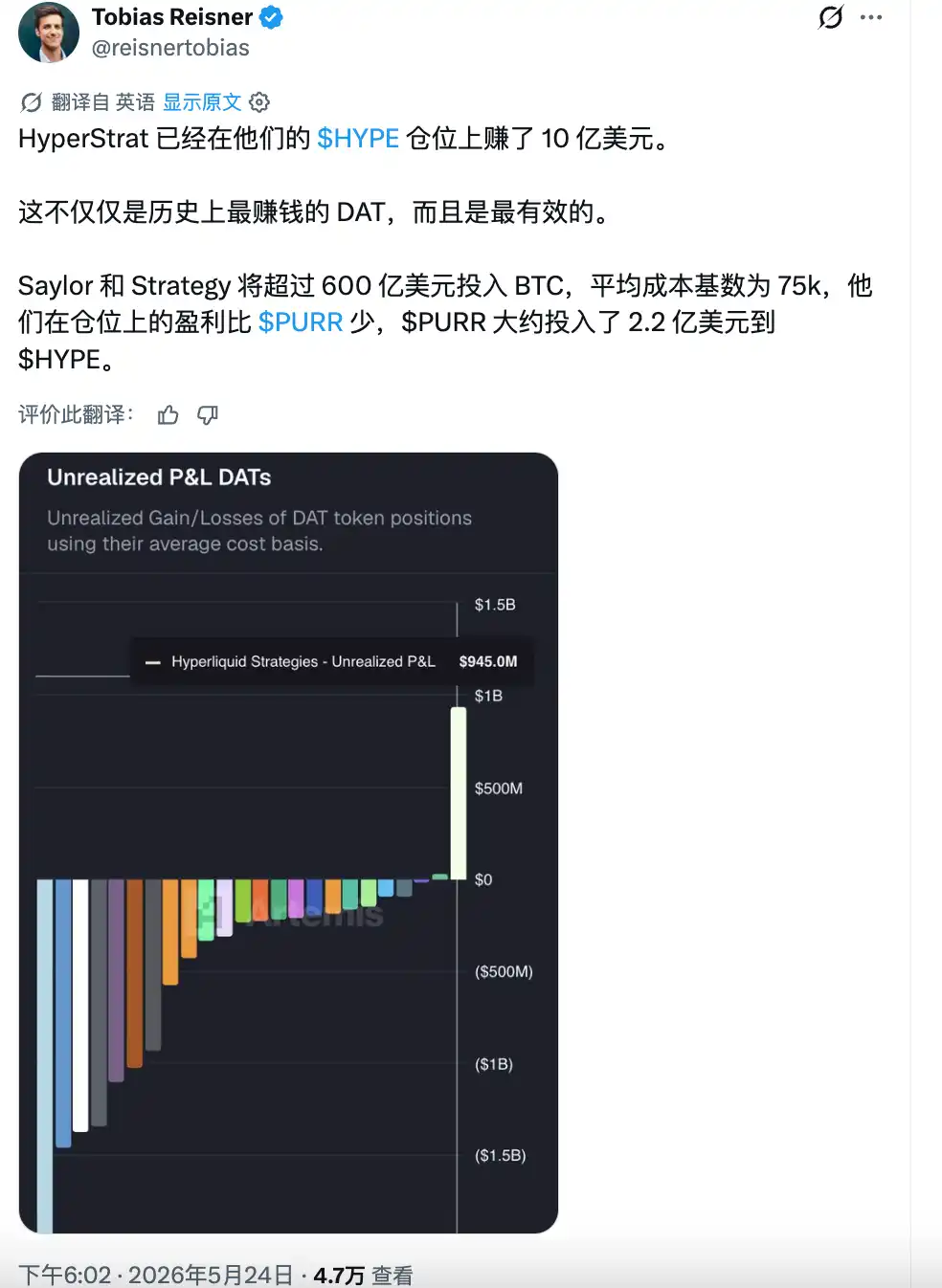
On May 24, a tweet about Hyperliquid Strategies(NASDAQ: PURR) sparked considerable discussion in the English Crypto Twitter (CT) space:

This company used approximately $220 million to buy HYPE, and its current unrealized profit has neared $1 billion, even surpassing the profit efficiency of Michael Saylor's Strategy (formerly MicroStrategy) on BTC.
This topic is now gradually spreading to the Chinese-speaking community. HYPE recently hit a new all-time high above $62, with a year-to-date increase of over 150%, making it one of the strongest-performing mainstream crypto assets this year.

As the only listed company proxy for HYPE, PURR has also risen over 100% year-to-date, naturally becoming a target of FOMO during US stock research.
However, before following the trend, several questions need to be clarified:

1. What exactly is this company?

2. What's the difference between investing in it and directly buying HYPE?

3. Does the claim that its "capital efficiency exceeds MicroStrategy" hold up under scrutiny?

$PURR, a Pure DAT

First, the conclusion: PURR is not a company with actual operations; it's essentially a pure stock-wrapped product for $HYPE.

Its business model can be summarized in one sentence: buy HYPE, stake HYPE, hold HYPE. As of April 2026, public information shows the company holds approximately 20.8 million HYPE tokens, with about $114 million in cash and zero debt.

This means the entire value of this stock depends on one thing: the price of HYPE.

Since there is no business to analyze, evaluating such a company comes down to two dimensions: the underlying asset itself, and who is operating this shell.

The latter determines capital operation capabilities—such as when to issue shares to buy more tokens, when to buy back shares to support the price, how to manage the premium/discount between the stock price and net asset value... This also influences whether institutional capital is willing to enter through this vehicle.
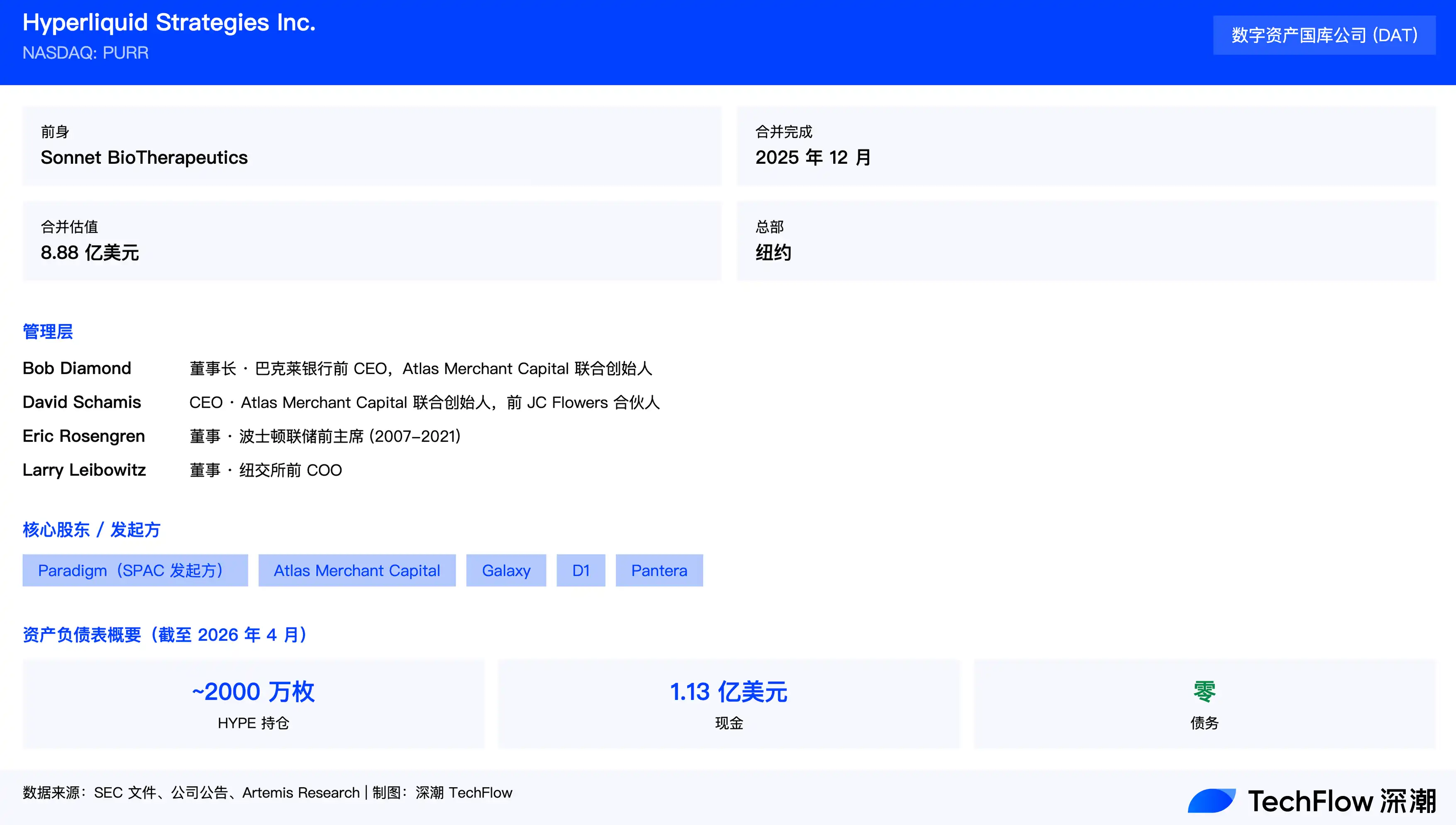
Historically, PURR's predecessor was Sonnet BioTherapeutics, a small biotech company listed on NASDAQ. In July 2025, it announced a merger with Rorschach I, completed the transaction in December of the same year, with an overall valuation of $888 million, renamed Hyperliquid Strategies, and ticker changed to PURR.

Notably, the initiators of this transaction were Paradigm and Atlas Merchant Capital.

Paradigm is one of the top-tier venture capital firms in the crypto industry, having invested in projects like Uniswap, Blur, Friend.tech, and has deep involvement in the Hyperliquid ecosystem, directly participating in the formation of this SPAC.

Atlas Merchant Capital is a financial services investment firm based in New York and London. Its two founders took key positions at PURR: Chairman Bob Diamond is the former CEO of Barclays, and CEO David Schamis is a former partner at JC Flowers.

The board also includes former Boston Fed President Eric Rosengren and former NYSE COO Larry Leibowitz. Other participants include Galaxy, D1, and Pantera, all leading institutions in crypto and macro fields.

While most DAT company management teams come from the crypto-native circle, PURR's team is almost entirely composed of traditional finance veterans.

$HYPE's Strength Propels $PURR Skyward

The reason PURR caught the attention of the Chinese-speaking community is directly tied to HYPE's own strength.

HYPE has surged from around $25 at the beginning of the year, breaking through $62 in May to set a new all-time high, with a year-to-date increase exceeding 150%. Against the backdrop of BTC's sideways movement and ETH and SOL's relatively flat performance this year, HYPE stands out as the most impressive mainstream crypto asset.

Our previous articles have deconstructed Hyperliquid's fundamental flywheel: a perp DEX with about 70% market share, weekly fee revenue exceeding ten million dollars, and 97% of protocol fees used for HYPE buyback and burn. This flywheel continues to accelerate.

(Reference reading: "Market Watch: From HYPE to ZEC, Grasping the 4 Narrative Threads Behind Recent Altcoin Hype")

When HYPE rises, PURR naturally follows suit.

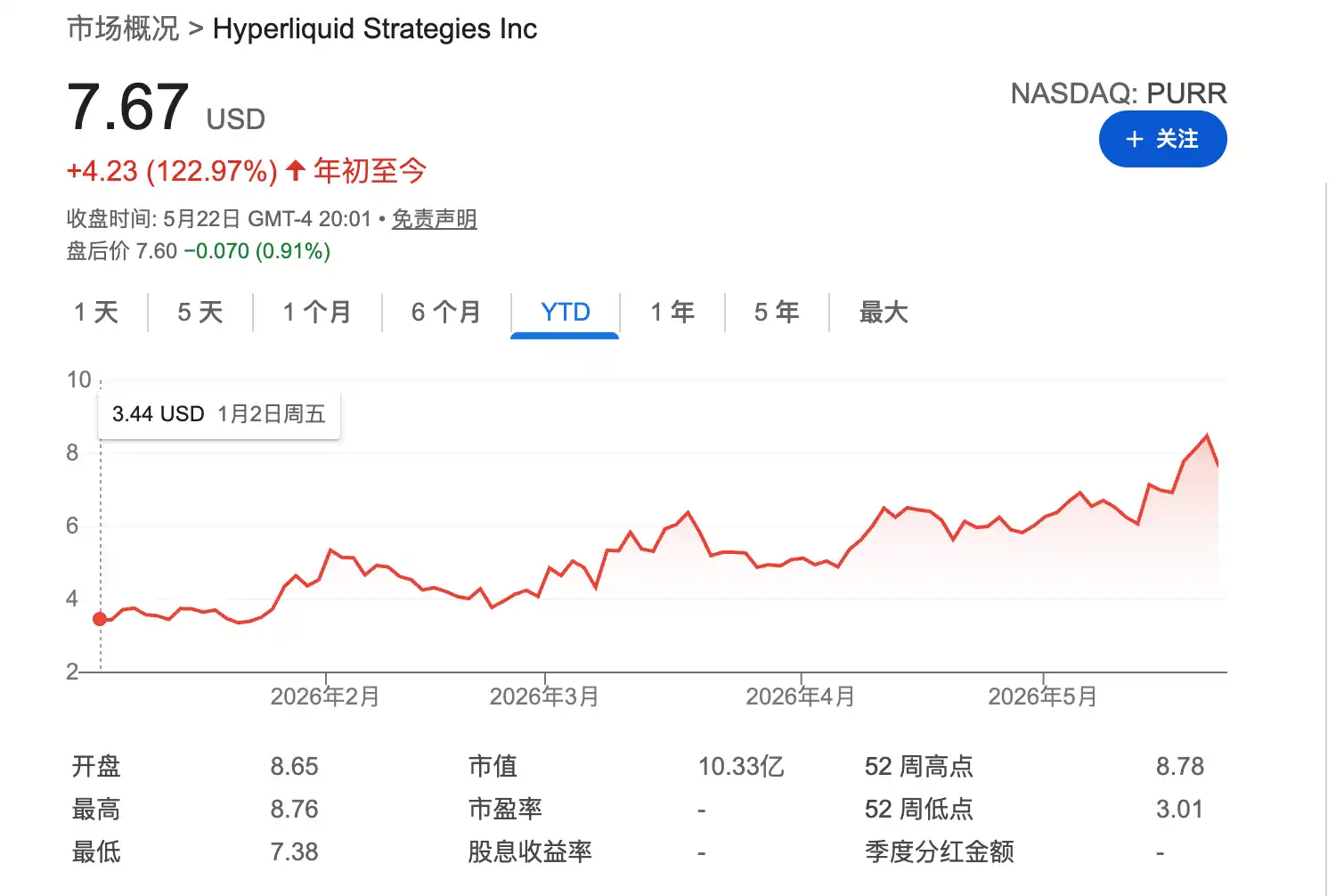
As the only HYPE proxy listed on US stock exchanges, PURR has gained over 100% year-to-date, rising from the $3 range to a recent high of $8.79.

For investors with only US stock accounts who do not directly access the crypto market, PURR is almost the only choice to gain HYPE exposure. However, what propelled PURR from a "niche asset" to a "social media topic" were several concentrated institutional signals materializing since May.

Goldman Sachs disclosed in its Q1 13F filing the purchase of approximately 650,000 PURR shares. While the amount isn't huge (around $3.3 million), the Goldman Sachs name itself serves as endorsement. Concurrently, 21Shares and Bitwise's HYPE spot ETFs were listed on NASDAQ and NYSE respectively, and Cantor Fitzgerald raised its PURR price target from $6 to $8.

These events, superimposed on the timing of HYPE's new high, pushed PURR into more people's field of vision.

Then came the tweet mentioned at the beginning of the article: PURR used $220 million principal to buy HYPE, and its current unrealized profit is nearly $1 billion. Calculated in the short term, its capital efficiency definitely surpasses MicroStrategy's.

Under such a sharp rally, it's bound to attract significant attention. However, if you're considering trading this stock, caution is still advised.

The DAT with the Highest Capital Efficiency, Really?

Strategy (formerly MicroStrategy) invested over $60 billion to buy BTC at an average cost of around $75,000; PURR only used about $220 million to buy HYPE, yet its unrealized profit is close to or even exceeds the former's. The conclusion is that PURR's "capital efficiency" far surpasses MicroStrategy's?

This comparison holds up numerically but is logically misleading.

PURR's early HYPE holdings have an average cost of around $7, with the current price at $62, a nearly 9x increase. Strategy's BTC average cost is around $75,000, and BTC is currently hovering around that level, having barely moved.

Therefore, PURR's higher unrealized profit isn't due to any smarter operations by the company; it's simply because the underlying asset's appreciation is on a completely different scale. Anyone, at the same time, directly buying HYPE spot with the same amount of money could have achieved the same return rate, without bearing the risk of equity dilution.

In other words, it's a victory of "picking the right coin." If PURR's establishment date were pushed back half a year, entering when HYPE was at $40, this "capital efficiency" story wouldn't exist at all.

For US stock investors only noticing PURR today, a more practical question is: At the current price for PURR, are you paying a premium or a discount relative to the value of HYPE held by the company?

This involves the core valuation metric for DAT companies—mNAV (modified Net Asset Value per share).
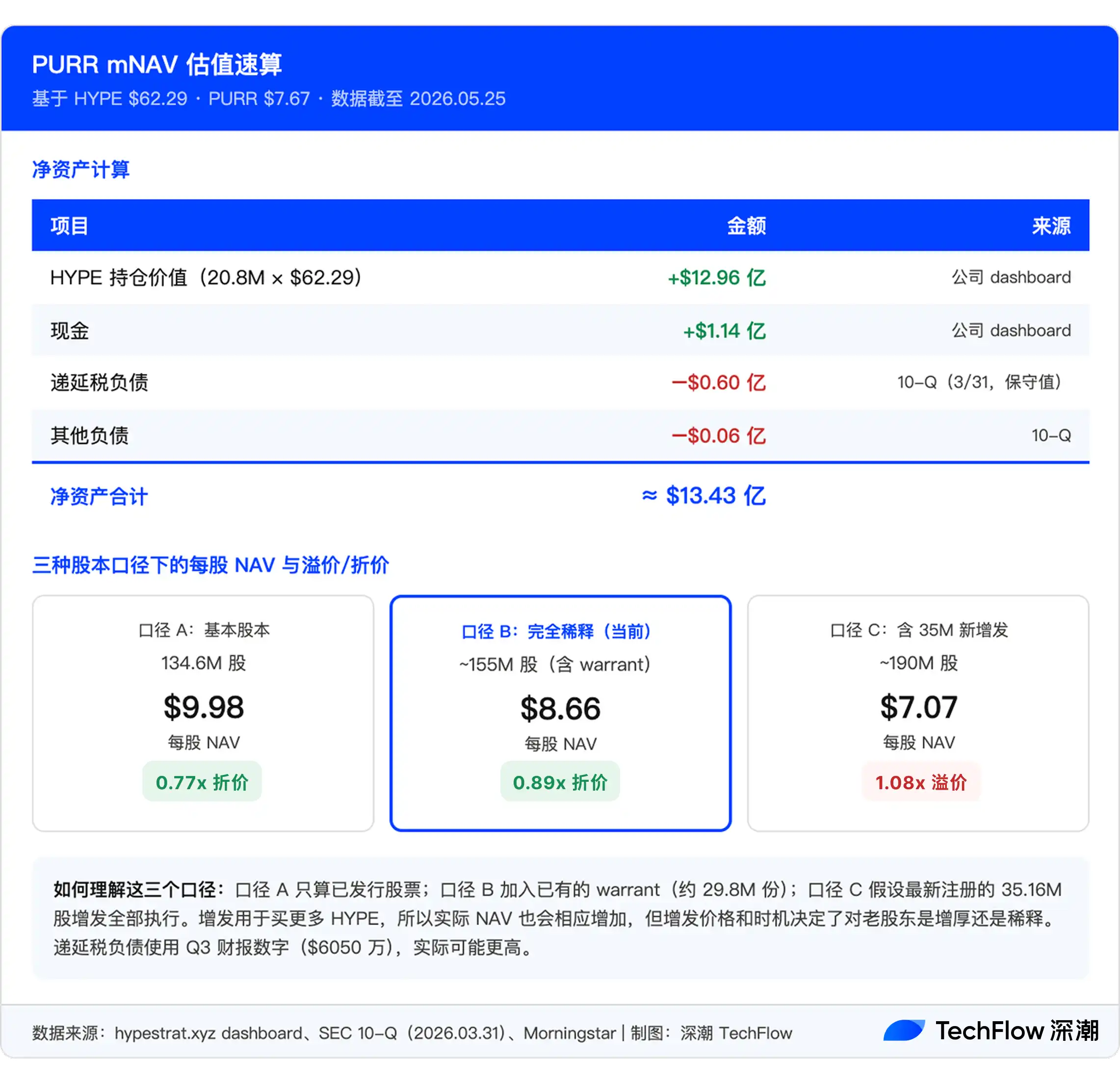
We pulled data from PURR's official dashboard and SEC filings for a quick mNAV calculation.

The company currently holds 20.8 million HYPE tokens (worth approximately $1.296 billion at the current price), plus $114 million in cash. After deducting deferred tax liabilities and other liabilities, the net asset value is around $1.34 billion.

Based solely on the 134.6 million shares issued, the NAV per share is about $9.98. With the current stock price at $7.67, this represents a discount of about 23%. If we include the approximately 29.8 million existing warrants, fully diluted to about 155 million shares, the NAV per share becomes about $8.66, a discount of about 11%. However, the company just registered an additional 35.16 million shares for issuance. If all these are executed, expanding the denominator to about 190 million shares, the NAV per share drops to $7.07, and the stock price would instead represent a slight premium of 1.08x.

Therefore, whether PURR is "cheap" or "expensive" depends on how much future dilution you anticipate.

Issuance itself isn't necessarily bad. If management issues shares at a high premium and uses the raised capital to buy more HYPE, the HYPE holdings per share could actually increase. But if they issue shares when market sentiment cools and the stock price falls below NAV, that dilutes existing shareholders.

This company has only been operating for half a year and hasn't experienced a full downcycle. There is no historical record to reference how management will operate under extreme market conditions.

Also note that the deferred tax liability used in the above calculation is $60.5 million from the Q3财报 cutoff date (March 31). However, HYPE has risen significantly since the end of March, so the tax liability corresponding to unrealized gains has likely increased further. The actual NAV might be slightly lower than our calculation.

What's the Difference Between Buying PURR and Directly Buying HYPE

This is the most practical question. Since PURR's entire value derives from HYPE, why not skip the middle layer and buy HYPE directly?

The answer is simple: for some investors, they can't. US retirement accounts (IRA, 401k), traditional brokerage accounts, and some institutionally-managed funds with strict compliance requirements cannot directly hold crypto assets.

Moreover, the Hyperliquid platform explicitly restricts access for US residents.

Therefore, PURR provides a NASDAQ-listed stock wrapper, allowing such capital to gain HYPE exposure through standard stock trading. The shell built by Paradigm essentially sells this compliant access channel.

If you belong to this category of investors, PURR is indeed currently almost the only option. Although 21Shares and Bitwise's HYPE spot ETFs were listed in mid-May, these products have been live for a very short time, and their liquidity and tracking error remain to be observed.

But if you have the ability to buy HYPE directly, then PURR's stock wrapper layer becomes purely a friction cost with negative effects; it cannot be considered a source of extra alpha on top of HYPE's beta.

This cost manifests on several levels:

First, dilution risk. By directly holding HYPE, your share cannot be diluted by others. But by holding PURR stock, the company can issue new shares at any time to buy more HYPE.

Second, incomplete profit transmission. Direct HYPE holders can stake themselves to earn staking rewards, and future airdrops/ecosystem incentives go directly to them. Through PURR, staking rewards go to the company's accounts first, and only indirectly reflect in the net asset value per share after deducting operational expenses and taxes.

Third, trading time and pricing friction. HYPE trades 24/7, while PURR trades only during US stock market hours. If HYPE experiences significant volatility over the weekend or after-hours, PURR holders must wait for the market to open to react.

Fourth, counterparty risk. SEC filings disclose that PURR's entire HYPE holdings are custodied with a single custodian. By holding PURR, your asset safety relies on this custodian's performance capability and the company's operational continuity.

The author's judgment is that PURR is more of a "channel product" than an "investment product." Its value lies in bridging the channel from traditional financial accounts to HYPE, nothing more. If you don't need this channel, then every additional risk brought by the middle layer is unnecessary.

Therefore, for crypto and US stock investors in the Chinese-speaking community, the conclusion is relatively straightforward:

The judgment you need to make is whether you are bullish on HYPE, not whether you are bullish on the PURR shell itself.


İlgili Sorular

QWhat is Hyperliquid Strategies (NASDAQ: PURR), and what is its core business model?

AHyperliquid Strategies (NASDAQ: PURR) is a publicly traded company that is essentially a pure-play investment vehicle for the HYPE cryptocurrency. Its business model is solely to buy, stake, and hold HYPE. As of April 2026, it held approximately 20.8 million HYPE tokens and around $113 million in cash, with zero debt. Therefore, the company's entire value depends on the price of HYPE.

QHow does PURR's claimed 'capital efficiency' compare to MicroStrategy (now Strategy) investing in Bitcoin, and is the comparison valid?

APURR has generated nearly $1 billion in unrealized gains from an initial investment of about $220 million in HYPE, which appears more capital efficient than Strategy's massive Bitcoin investments. However, this comparison is misleading. The difference in returns is primarily due to HYPE's price rising nearly 9x from PURR's average cost basis, while Bitcoin's price has remained relatively flat near Strategy's average cost. The 'efficiency' stems from choosing a high-performing asset, not from superior corporate strategy. An investor buying HYPE directly at the same time would have achieved the same return.

QWhat are the main risks or costs associated with investing in PURR compared to directly buying HYPE?

AInvesting in PURR instead of directly buying HYPE introduces several risks and costs: 1) **Dilution Risk**: PURR can issue new shares, diluting existing shareholders' ownership. 2) **Incomplete Yield**: Staking rewards, airdrops, or ecosystem incentives for HYPE go to the company first and are only indirectly reflected in net asset value after expenses and taxes. 3) **Trading Friction**: PURR trades only during U.S. market hours, while HYPE trades 24/7, creating a lag in price reaction. 4) **Counterparty Risk**: Investors rely on the security of PURR's single custodian and the company's operational continuity.

QAccording to the article, who are the key players behind the formation of PURR, and what is their background?

AThe formation of PURR was led by major traditional finance figures. The key participants include crypto venture capital firm Paradigm and investment firm Atlas Merchant Capital. Atlas Merchant Capital's founders hold core positions: Bob Diamond (former Barclays CEO) is Chairman, and David Schamis (former JC Flowers partner) is CEO. The board also includes former Boston Fed President Eric Rosengren and former NYSE COO Larry Leibowitz. Other backers include Galaxy, D1, and Pantera. Unlike many Digital Asset Trusts (DATs), PURR's leadership is dominated by traditional finance veterans rather than crypto-native individuals.

QFor which type of investor does PURR represent a valuable or necessary investment vehicle?

APURR is primarily valuable for investors who cannot directly purchase HYPE cryptocurrency due to regulatory or platform restrictions. This includes U.S.-based retirement accounts (IRAs, 401ks), traditional brokerage accounts, and certain institutional funds with strict compliance rules. Furthermore, the Hyperliquid platform restricts U.S. residents. For these investors, PURR provides a Nasdaq-listed, compliant channel to gain exposure to HYPE's price movements, making it practically their only option. For investors who can buy HYPE directly, PURR's wrapper adds unnecessary layers of cost and risk.

İlgili Okumalar

ETH Bull and Bear Views Compilation: Can Ethereum's Value Flow Back to ETH?

Titled "ETH Bull and Bear Views: Can Ethereum's Value Flow Back to ETH?", this article synthesizes the current heated debate around Ethereum's native token, ETH, following Bankless co-founder David Hoffman's decision to sell his entire ETH holdings. The **bullish case**, represented by figures like Tom Lee (BitMine CEO) and Raoul Pal, argues that ETH's core thesis remains intact. They contend Ethereum is the essential, secure, and neutral foundational layer for future finance—encompassing stablecoins, RWA, DeFi, L2s, and Agentic AI. Bulls bet on ETH's long-term revaluation as institutional adoption of on-chain finance grows, with significant buying activity from entities like BitMine and Consensys cited as evidence. Conversely, the **bearish perspective**, led by Hoffman and analysts like Markus Thielen, questions ETH's value capture mechanism. They acknowledge Ethereum's network success but argue that the value created by L2s, DeFi, and applications does not sufficiently accrue to the ETH token itself. Bears point to ETH's prolonged underperformance versus the broader crypto market, lack of traditional cash flows, weakening "ultrasound money" narrative, and apparent institutional retreat (e.g., Harvard Management Company exiting its ETH ETF position) as key concerns. The debate highlights a pivotal shift: ETH is no longer just a community belief asset. The central question is whether ETH can transition from being a "**used infrastructure**" to a "**continuously bought and held core asset**" as more value enters the Ethereum ecosystem. The market is now critically examining the direct link between network growth and ETH's value.

marsbit38 dk önce

ETH Bull and Bear Views Compilation: Can Ethereum's Value Flow Back to ETH?

marsbit38 dk önce

Crypto is dead, Perps are forever

The crypto industry is shifting from a focus on creating native assets (like altcoins and protocol tokens) to becoming a "global asset pipeline." Native cryptocurrencies, except for Bitcoin, are seen as failing in their value storage and utility promises, with demand driven largely by speculation. Attention and liquidity are now moving toward real-world assets (RWAs) like U.S. stocks, bonds, gold, and oil traded on-chain via perpetual contracts (Perps). Stablecoins like USDT and USDC set the precedent, proving blockchain's core strength is efficient global settlement and transfer, not inventing new monetary systems. Meanwhile, assets like Ethereum and many DeFi tokens struggle as their narratives weaken against tangible traditional assets and the rapid real-world progress of AI. Perpetual contracts have emerged as a pivotal innovation. They simplify trading by offering pure price exposure to any asset, bypassing complexities of ownership, custody, and traditional market hours. Projects like Hyperliquid gained traction by combining CEX-like efficiency with on-chain transparency, capitalizing on post-FTX distrust, macroeconomic volatility, and the surge in demand for 24/7 stock trading. In conclusion, while the era of speculative native "crypto assets" may be over, perpetual contracts persist as the industry's most potent financial instrument—transforming all assets into globally accessible, constantly tradable instruments centered on price speculation.

marsbit44 dk önce

Crypto is dead, Perps are forever

marsbit44 dk önce

Tencent, Alibaba, ByteDance in a Battle for the Skill Store

Skill is becoming a key concept in the AI field, essentially serving as a structured "instruction manual" for AI Agents that specifies tool calls, decision logic, and output standards. This allows Agents to execute predefined tasks. As the number of Skills grows, distribution platforms have emerged. Major tech companies are swiftly entering this space. In March, Tencent, Alibaba, and ByteDance launched Skill stores within their respective Agent platforms. Subsequently, players like Zhipu AI, Meituan, and Xiaohongshu joined the fray. This competition for the "Skill store" is fundamentally a battle for the AI-era user entry point; whoever controls distribution controls the users. While ByteDance's Coze has experimented with paid Skills, most platforms offer them for free. The real value lies not in the stores themselves but in using them to attract and retain users within an ecosystem, driving revenue from services like cloud computing, model calls, or advertising. The landscape features three main player types: 1) **Internet giants** (e.g., Alibaba, ByteDance, Tencent, Meituan), leveraging Skills to drive traffic and monetize through their broader ecosystems (cloud services, transactions, ads). 2) **Large model companies** (e.g., Zhipu AI, Moonshot AI), using Skill stores to increase user engagement and monetize model API calls. 3) **Content platforms** (e.g., Xiaohongshu), treating Skills as a new content format to generate traffic and ad revenue. However, transforming Skill stores into a sustainable business faces significant hurdles. Key challenges include: the **difficulty in pricing Skills** due to inconsistent outputs across different models and contexts; **lack of cost transparency** (varying token consumption); **security risks** like Skill poisoning; and the **absence of standardized protocols** for development and evaluation. Unlike standardized mobile apps, Skills are often personalized workflows resistant to uniformity, which hinders the establishment of a reliable review and monetization system akin to the App Store. While there is genuine user demand for paid Skills—particularly in enterprise (e.g., contract review) and certain personal productivity scenarios—current platforms offer developers limited and unpredictable distribution. The future of Skill stores depends on overcoming these standardization, evaluation, and safety challenges to make acquiring a Skill as straightforward as downloading an app. For now, the stores function more as display shelves than robust marketplaces.

marsbit44 dk önce

Tencent, Alibaba, ByteDance in a Battle for the Skill Store

marsbit44 dk önce

The Crypto Scene Is Dead, Perpetual Swaps Are Eternal

The crypto industry is undergoing a fundamental shift. The era defined by minting novel, native digital assets (altcoins) is fading. These assets, lacking real-world cash flows or clear value, are losing relevance as attention and capital flow elsewhere. Two powerful external forces are reshaping the space. First, traditional assets like U.S. stocks, bonds, gold, and oil are being tokenized and traded on-chain. Second, the explosive growth of AI, with its tangible products, has overshadowed crypto's once-dominant "future narrative." This marks a critical pivot: crypto is transitioning from being a "factory for new assets" to becoming a "global conduit for existing assets." Its validated utility is not complex financial reinvention but efficient global settlement, transfer, and trading—the original promise of blockchain. Stablecoins like USDT and USDC exemplify this, offering faster dollar movement rather than replacing it. Consequently, native ecosystems like Ethereum face profound challenges. While still crucial infrastructure, ETH struggles to capture value as users interact with Layer 2s or trade traditional assets without needing to hold it. DeFi's grand narrative of rebuilding finance has narrowed to core needs like cheap transfers and deep liquidity. The true breakout innovation is the perpetual contract (Perp). It brilliantly bypasses the complexities of direct asset ownership (custody, compliance, dividends) by creating pure price exposure. Users can speculate on the price movement of *any* asset—NVIDIA, gold, oil—24/7, globally, and with leverage. This "price casino" model, while risky and ethically fraught, delivers unmatched liquidity and accessibility. Projects like Hyperliquid succeeded not by inventing new mechanics but by perfecting the timing and execution of this model. Key drivers included making on-chain Perps feel like centralized exchanges, post-FTX trust migration towards transparency, and rising demand to trade macro assets and equities round-the-clock. In conclusion, the crypto world's most enduring successes are the dollar (via stablecoins), Bitcoin, and trading. Its new frontier is not creating alternative assets but providing a seamless, perpetual trading layer—a new API—for the world's existing financial system. The age of native altcoins is over; the age of perpetual synthetic exposure has begun.

Odaily星球日报53 dk önce

The Crypto Scene Is Dead, Perpetual Swaps Are Eternal

Odaily星球日报53 dk önce

İşlemler

Spot
Futures
活动图片