After Doubling, How Much More 'War Dividend' Can Circle Consume?

marsbit2026-03-19 tarihinde yayınlandı2026-03-19 tarihinde güncellendi

Özet

Circle, the issuer of the USDC stablecoin, has seen its stock price more than double in weeks, a surge driven by geopolitical instability rather than its core product—a dollar-pegged stablecoin. The company's primary revenue comes from interest earned on the U.S. Treasury reserves backing USDC. Rising expectations that the Federal Reserve will keep interest rates higher for longer, partly due to global conflicts, have boosted this income stream, attracting investor demand. A short squeeze following a strong Q4 2025 earnings report further accelerated the rally. However, the company faces structural challenges: a significant portion of its revenue is shared with Coinbase under a fixed agreement, impacting profitability. While Circle is expanding into payment infrastructure, AI micro-transactions, and tokenized assets, interest income remains its financial backbone. The current valuation reflects two narratives: one of Circle as a future global payments infrastructure, and another as a leveraged bet on sustained high interest rates. The key question for investors is whether they are betting on long-term utility or a macroeconomic trend that may reverse when the Fed eventually cuts rates.

There is a category of companies that actually appreciate in value when the world becomes more unstable: defense contractors, oil unions, gold miners. These are the classic examples, whose business models are fundamentally built on instability, turning such risk into pricing power.

Circle was not originally part of this category. Its token was designed to always be equivalent to 1 US dollar. Stability is the entire purpose of its product.

However, Circle's stock price has soared from $49.90 on February 5th to about $123 today, more than doubling in just five weeks. Meanwhile, the broader cryptocurrency market remains 44% below its peak levels from last October.

A company whose product is designed to pursue price stability has become one of the market's hottest trades precisely because the world has become more turbulent.

This article will explain the reasons behind this phenomenon and the discrepancy between Circle's true nature and its current market pricing.

What Exactly is Circle (Let's Get Back to Basics)

Strip away the branding, the payment narratives, and the dictionary of infrastructure references, and what you're left with is this: Circle holds U.S. Treasury bonds.

Every USDC dollar in circulation is backed by one dollar held in reserves of short-term government bonds. The interest from this debt belongs to Circle. This accounts for roughly 90% of the company's revenue in any given quarter. Once you see this, its business model isn't complex: Circle is a money market fund that issues a stablecoin.

This means Circle's income is tied to one key metric: the federal funds rate. When interest rates are high, Treasuries yield more, and Circle earns more income for every USDC in circulation. When rates fall, income contracts. Everything else is just scaling.

Here is the chain reaction that led to the 150% rebound in the stock price from its February low:
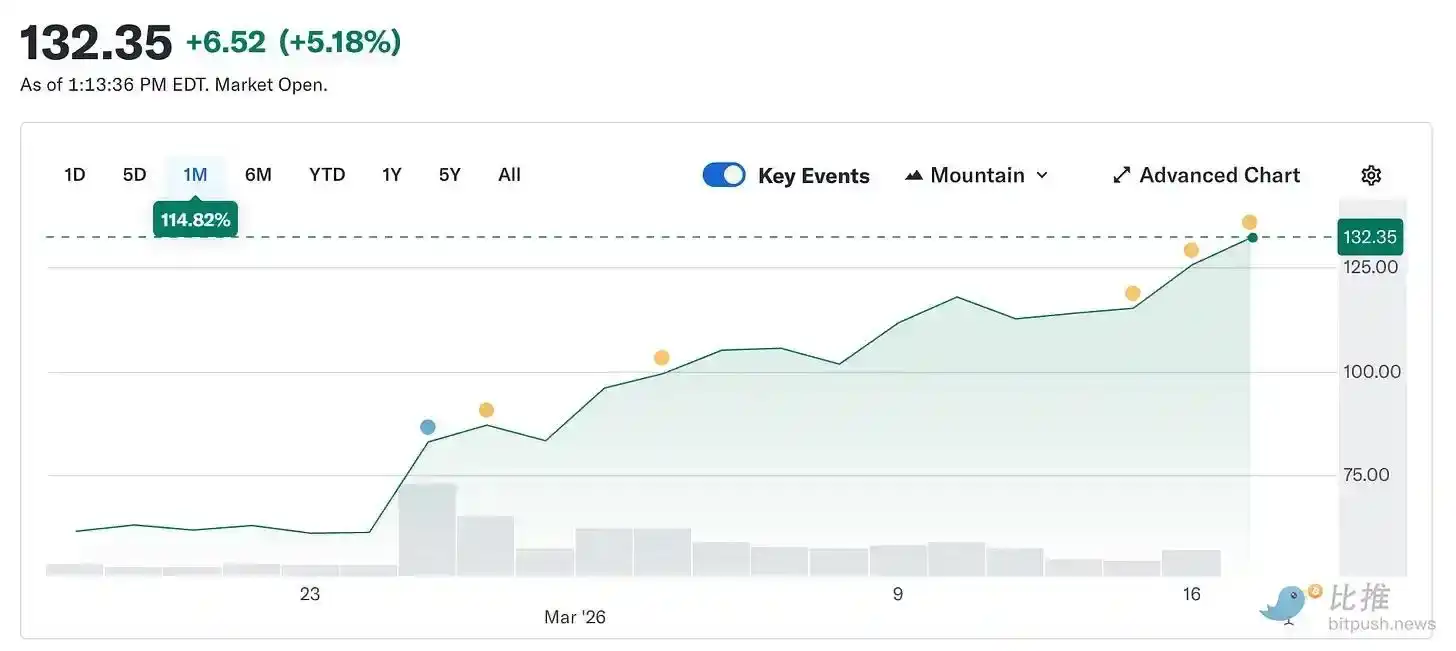
According to @finance.yahoo, the Iran conflict drove a ~35% rise since February 28th. A move to around $100 implied excessive panic, and excessive panic implied that a Fed rate cut would amplify recklessness. The decision to hold rates steady on March 18th was never really in doubt. Long before the war, CME FedWatch showed a probability of over 90% for unchanged rates.

What really changed were the expectations for rate cuts this year. Before the conflict, the market was pricing in two 25-basis-point cuts for 2026. After the conflict, this expectation shifted to one cut, prioritized for after September. The probability of no cuts at all in 2026 roughly doubled. With rates staying higher for longer, Circle's Treasury reserves continue to generate yield. More yield means more revenue, and more revenue means a higher stock price. A war broke out, and a stablecoin issuer became a beneficiary. This was a scenario that never appeared in anyone's predictive models.

Context: The bearish logic that suppressed Circle's stock price at $49 in February was essentially a bet on rate cuts.

The market was then predicting multiple Fed rate cuts in 2026, which would directly compress Circle's interest income. A rough illustration: at the current USDC supply level of $79 billion, every 25-basis-point cut would cause Circle to lose approximately $40 to $60 million in annualized revenue. Two cuts would erase nearly $100 million in top-line revenue by year-end. The war rendered this calculation obsolete overnight. Not because Circle changed, but because the macro context underpinning that bearish thesis ceased to exist.

How the Short Squeeze Began

While the interest rate story supported the stock price, the initial surge originated from positioning.

Before the Q4 earnings release on February 25th, approximately 17.8% of Circle's float was sold short. Hedge funds had built significant bearish positions. Their thesis was that rates would eventually fall, domestic income would compress, and this company's revenue wasn't defensible at the rate floor. From a fundamental perspective, this was hard to refute.

However, Circle reported Q4 earnings of $0.43 per share, versus a consensus estimate of $0.16. Revenue reached $770 million, against an expectation of $749 million. On-chain USDC transaction volume grew nearly $12 trillion quarter-over-quarter, up 247% year-over-year. Shorts covered. The stock surged 35% in a single trading session. According to 10x Research, hedge funds lost roughly $500 million on short positions that day. Subsequently, the war took the baton from the earnings report.

The Coinbase Problem

Here is a part often omitted from the updated narrative.

Circle reported a net loss of $70 million for 2025, not a profit. Q4 was strong, but the full year was not. To understand why, you need to understand its relationship with Coinbase, the most important and most underestimated fact of Circle's business.

When USDC first launched in 2018, Circle and Coinbase formed a joint consortium to manage it. This consortium was dissolved in 2023, with Circle gaining full control over USDC issuance. However, Coinbase retained a significant revenue share.

Coinbase takes 100% of the reserve yield from USDC held on its platform. For all other USDC, the yield is split 50/50 with Circle. In 2024, this arrangement directed $908 million of Circle's total $1.01 billion in distribution costs straight to Coinbase.

Roughly calculated, for every dollar of yield Circle's reserves generate, 54 cents flows to a company that neither issues the token nor handles the reserves. In early 2025, Coinbase held 22% of the total USDC supply, up from 5% in 2022. The more USDC grows on the Coinbase platform, the greater the share Circle pays out.
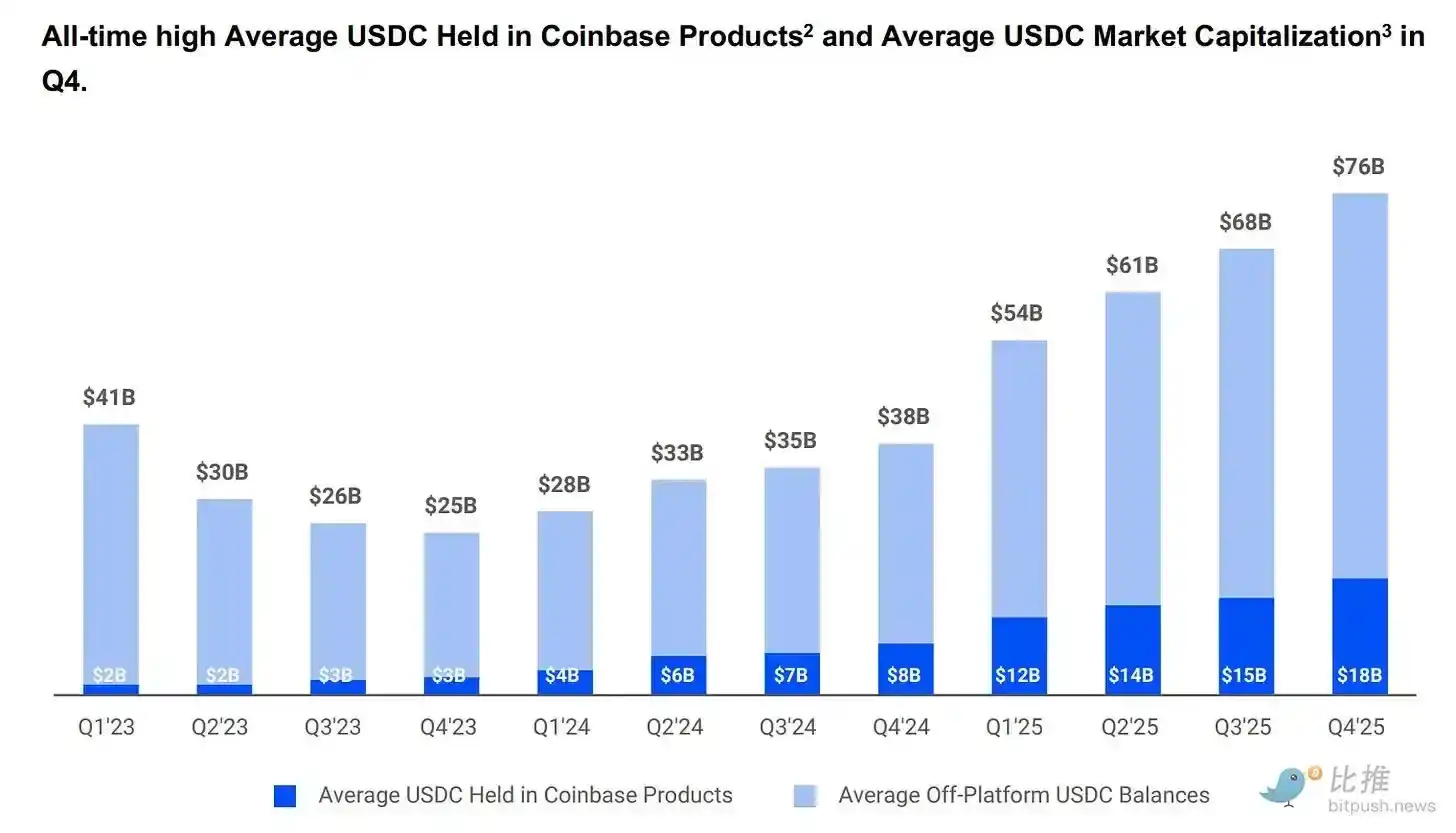
According to @q4cdn.com, the partnership automatically renews every three years, and Circle cannot unilaterally exit. Any outcome from the next renegotiation will directly impact Circle's margins. In Q4 2025, distribution costs alone were $461 million, up 52% year-over-year.

The current $70 million net loss is partly due to $424 million in stock-based compensation from IPO vesting, which makes the overall number look worse than the actual business performance. But the underlying business still faces a structural cost problem that no interest rate environment can fully solve.

The market prices Circle as infrastructure. The income statement shows it's an interest rate trade vehicle carrying expensive distribution costs. Both views can be true simultaneously. They just represent different pricing logics, and right now the market is paying for the 'best version' of both.

Why This Isn't Just a Macro Trade

USDC's supply recently reached a new all-time high of $79 billion, while the broader crypto market is down sharply, 44% from October. This divergence is worth pondering. When markets fall, speculative assets typically decline. USDC's growth suggests people are using it to move value, not just as a speculative bet.

During the Iran conflict, demand for USDC surged in the Middle East precisely because traditional banking became unreliable. When normal channels are blocked, people use it for cross-border and cross-currency transfers. This is how payment infrastructure behaves under stress: its usage increases, not decreases.

Transaction data confirms this. In February alone, USDC processed approximately $1.26 trillion in adjusted volume, compared to $514 billion for USDT. Tether (USDT)'s market cap remains $184 billion, versus USDC's $79 billion. In terms of total supply, they are not comparable. But USDC currently moves more volume than USDT.
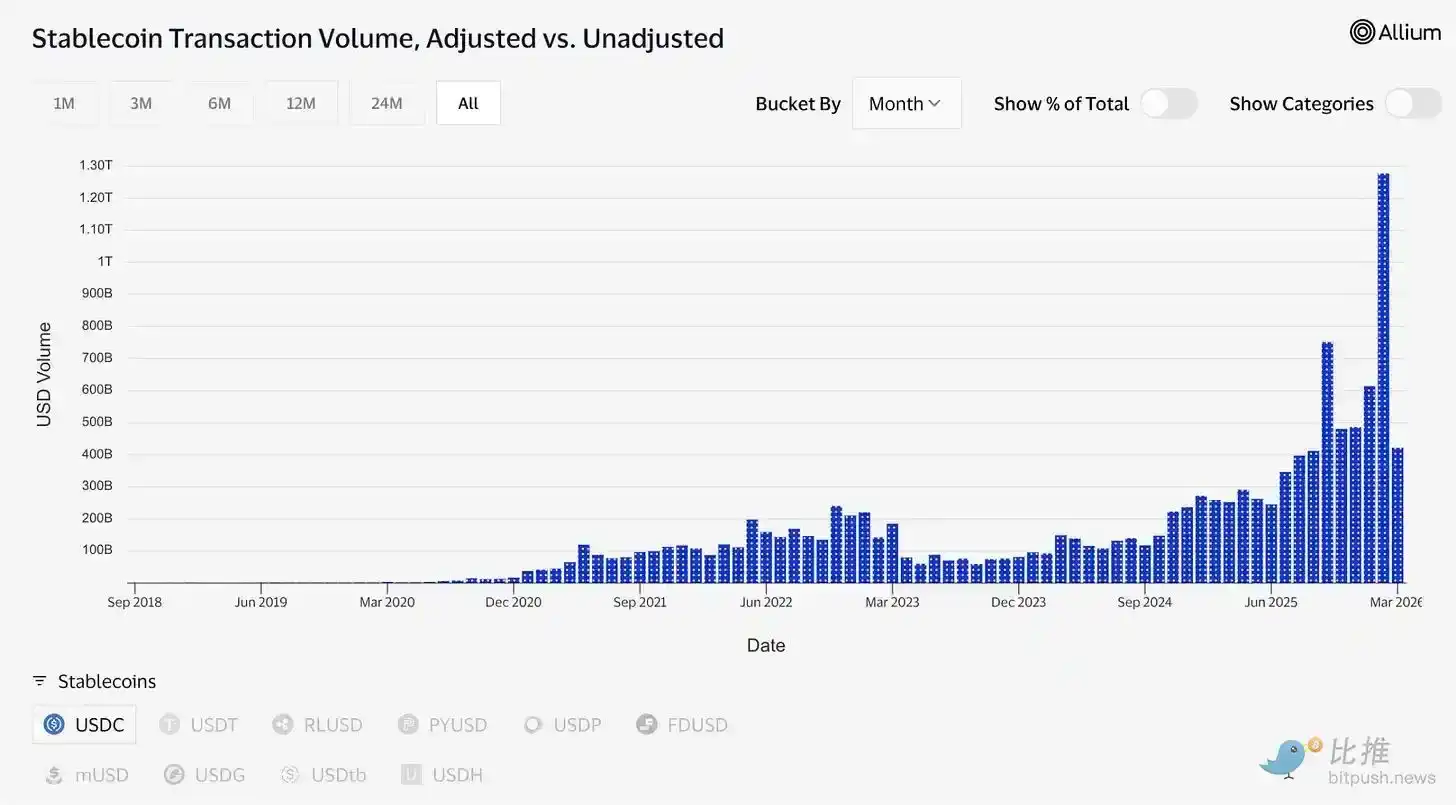
As shown by @visaonchainanalytics, "sleeping supply" is a different concept from "active settlement." The former shows where people park their dollars; the latter shows which dollar people use when they need to move value.

Druckenmiller said something relevant this week. In a Morgan Stanley interview recorded on January 30th and released on Thursday, he predicted the global payment system will run on stablecoins in 10 to 15 years, calling cryptocurrency "a solution in search of a problem."

One of the world's most trusted macro investors bifurcated the space: stablecoins are the nascent infrastructure, and everything else is still finding a reason to exist. This framework provides a bullish endorsement.

The Infrastructure Bet

Tokenized assets have grown from about $1.5 billion in early 2023 to about $26.5 billion today. Many of these products (including BlackRock's tokenized Treasury fund BUIDL, which holds over $2 billion) rely on USDC for subscriptions, redemptions, and settlement processing.

Prediction markets processed over $22 billion in volume in 2025, mostly settled in USDC (Polymarket alone). Visa currently supports stablecoin-linked cards in over 50 countries globally, with annual settlement volume of about $4.6 billion.

Circle is building the infrastructure beneath all of this. The Circle Payments Network connects 55 financial institutions, with an annualized processing volume of $5.7 billion, allowing banks and payment providers to convert USDC across borders and settle in local currency directly.

Arc is Circle's own Layer-1 blockchain, designed to fully support institutional systems. This is a settlement infrastructure that is not dependent on Ethereum or Solana. While the revenue impact from Ethereum and Solana is currently negligible, both are future-oriented strategic plays if interest rates fall.

The AI ecosystem is small in dollar terms but structurally interesting. Data released in March by Circle's Global Head of Expenditure shows that over the past 9 months, AI agents completed 140 million payments totaling $43 million. 98.6% were settled in USDC, with an average transaction size of $0.31. There are now over 400,000 AI agents with purchasing power. While the dollar amounts are still small, the trend is undeniable.

If AI agents need to pay each other for compute power, data access, and API calls with high-frequency, sub-penny transactions, they need tools that can settle instantly and send value at near-zero cost. Circle just launched Nano payments specifically for this need: supporting USDC transfers as low as $0.000001 with no gas fees, using off-chain resources and batch settlement. The testnet already supports 12 chains including Arbitrum, Base, and Ethereum mainnet.

This is the Circle the market is willing to pay $123 per share for: a company at the center of tokenized finance, AI agent commerce, cross-border payments, and prediction markets, with regulatory tailwinds from the GENIUS Act and the CLARITY Act likely to pass before summer. Bernstein has a $190 price target, Clear Street $136. Seaport Global, the most bullish on Wall Street, targets $280.

The Lingering Contradiction

Here, I want to candidly discuss a point that bulls often overlook.

Circle's profitability relies on maintaining high interest rates. This is not a permanent condition. The Fed will cut rates at some point. When that happens, the yield from the Treasury reserves backing USDC will contract, and Circle's interest income will shrink.

Circle recognizes this. It has been expanding into fees, enterprise services, the payments network, and Arc—businesses that don't rely on the interest rate environment to function. But currently, these revenue streams are small. Interest income is still the entirety.

So, you find these two logics coexisting in the same stock price, but they are not the same bet.

The infrastructure thesis posits that USDC is becoming genuine payment plumbing. The pipes are regulated, transparent, and poised to embed deeply into traditional finance, an embedding that is sticky regardless of rates. This thesis is supported by data: transaction volume digitization, integrations, Druckenmiller's framework, and Macquarie calling stablecoins the base layer of global financial infrastructure.

If this thesis is correct, Circle looks cheap in any interest rate environment because its total addressable market is the entire global payment system.

The rates trade thesis views Circle as a leveraged bet on "higher for longer" rates, with the stock price already reflecting a scenario where the Fed never cuts as expected. If this is the primary driver of the price, then every future Fed cut is a headwind, and the stock is overvalued relative to its fundamentals in a normalized rate environment.

Both views are being priced in. The war makes it difficult to discern which one the market is buying.

This is perhaps the most useful way to understand CRCL (Circle's ticker) right now. The focus isn't on whether it will hit $190, but on whether you are buying "infrastructure" or "a Treasury bill repackager that learned to tell a good story." The former is a long-term position; the latter implodes the moment Powell changes his mind.

For now, the price action keeps both possibilities alive. The dollar is doing the hard work it must. And in the gap between these two versions of the company lies its true tension—it figured out how to manufacture internet money denominated in dollars, but now must figure out how to survive the moment those dollars no longer yield 5%.

İlgili Sorular

QWhat is the primary reason behind Circle's stock price doubling in just over five weeks, despite its product being designed for stability?

AThe primary reason is the shift in market expectations regarding Federal Reserve interest rate cuts. Geopolitical tensions, particularly the Iran conflict, led to reduced expectations of rate cuts in 2026, meaning interest rates would stay higher for longer. This benefits Circle because its main revenue source is the interest earned on the U.S. Treasury reserves backing its USDC stablecoin.

QHow does Circle's relationship with Coinbase impact its profitability?

ACoinbase receives 100% of the reserve yield from USDC held on its platform and splits the remaining yield 50/50 with Circle. In 2024, this arrangement directed $908 million of Circle's $1.01 billion total distribution costs to Coinbase. This represents a significant structural cost, meaning a large portion of the revenue generated from USDC does not go to Circle, impacting its net income.

QBeyond being a 'leveraged bet on interest rates,' what long-term growth narratives are supporting Circle's high valuation?

ALong-term growth narratives include Circle's role as infrastructure for tokenized assets (growing from $1.5B to $26.5B), AI agent micropayments (with 400,000 AI agents using USDC for sub-dollar transactions), cross-border payments via the Circle Payments Network, and the potential passage of supportive legislation like the CLARITY Act. These areas represent future revenue streams less dependent on interest rates.

QWhat data suggests that USDC is being used more for active payments and transfers rather than just as a store of value?

AIn February, USDC processed approximately $1.26 trillion in adjusted transaction volume, significantly higher than USDT's $514 billion, despite USDT having a much larger market cap ($184B vs. $79B). This indicates that USDC is used more frequently for active settlement and value transfer, especially in regions with banking instability, rather than just being held ('sleeping supply').

QWhat is the central contradiction or risk inherent in Circle investment thesis according to the article?

AThe central contradiction is that Circle's current high valuation and revenue are heavily dependent on high interest rates, which are not permanent. When the Federal Reserve eventually cuts rates, Circle's interest income will contract significantly. The market is simultaneously pricing Circle as a long-term infrastructure play and a short-term利率交易 (interest rate trade), creating a risk that the stock could fall sharply if rate cuts occur before its non-interest-dependent businesses have scaled sufficiently.

İlgili Okumalar

Retail Ecology Dwindles, ZKsync Bets on Bank Pilots for a Breakthrough

Amidst declining retail activity, ZKsync is pivoting to target institutional banking as its primary growth strategy. The article explores this shift, contrasting it with the competitive "survival of the fittest" narrative by highlighting a cooperative model inspired by naturalist Peter Kropotkin. ZKsync is developing infrastructure like its private, permissioned Prividium suite for banks (e.g., Deutsche Bank's use case via Memento), enabling private transactions with public verifiability via zero-knowledge proofs. This appeals to institutions needing privacy, compliance, and Ethereum-based settlement security, unlike fully private chains (e.g., JPMorgan's Kinaxis) or consortium models (e.g., R3 Corda). However, this strategic focus has coincided with a steep decline in its public DeFi ecosystem, evidenced by plunging TVL and the departure of major protocols like Aave due to low fees. The network's future now hinges on banking adoption, with upcoming pilots like the Cari Network involving regional banks holding over $600 billion in deposits. A significant challenge is balancing this institutional focus with ZKsync's decentralized governance. Banks must operate on a network where rules and fees (denominated in the volatile ZK token) can be changed via community vote, and where a Security Council holds emergency control—a stark contrast to the predictable, contract-bound environments of traditional finance. The coming 18 months will test whether ZKsync can successfully onboard traditional banks onto a dynamically governed public chain or if institutions will ultimately revert to proprietary solutions.

Foresight News19 dk önce

Retail Ecology Dwindles, ZKsync Bets on Bank Pilots for a Breakthrough

Foresight News19 dk önce

The Recursive AI Anthropic Warned About: Tian Yuandong's New Company Has Just Taken the "First Step"

Anthropic recently highlighted the rapid progress toward "recursive self-improvement," where AI systems autonomously design and train their successors. In response, Recursive Superintelligence, a new company co-founded by former Meta researcher Tian Yuan Dong, has publicly demonstrated its first step toward automating AI research. The company released a system designed to autonomously execute the full AI research cycle: generating ideas, implementing code, running experiments, and learning from results. It validated this approach by achieving state-of-the-art results on three diverse benchmarks: 1. **NanoChat Autoresearch:** Optimizing a small language model's validation loss under a fixed 5-minute GPU budget, improving upon the community's best result. 2. **NanoGPT Speedrun:** Reducing the time to train a GPT model to a specific loss on 8 H100 GPUs from 79.7 seconds to 77.5 seconds, beating a highly optimized, human-driven community effort. 3. **SOL-ExecBench:** Improving the overall score on NVIDIA's suite of 235 GPU kernel optimization tasks by 18%, closing the gap to the hardware limit. The system discovered novel optimizations in this highly specialized domain without direct human expertise. Recursive's system operates as a general framework, capable of parallel exploration and cross-task knowledge transfer while incorporating safeguards against reward hacking. The company, backed by $650M in funding and a star-studded team including Richard Socher and Alexey Dosovitskiy, aims to create AI that recursively enhances its own research capabilities. This development represents an early but concrete move toward a new paradigm where AI accelerates its own advancement. It occurs alongside Anthropic's warnings about the need for industry coordination and potential pauses when recursive self-improvement thresholds are reached, highlighting the dual trajectory of rapid technical progress and growing calls for careful stewardship.

marsbit26 dk önce

The Recursive AI Anthropic Warned About: Tian Yuandong's New Company Has Just Taken the "First Step"

marsbit26 dk önce

The Gold Buy-on-the-Dip Guide: Watch Interest Rates, Not Just War

"Gold Buying Guide: Focus on Interest Rates, Not Just War" Four months ago, gold buyers likely didn't anticipate buying at a peak that even a war couldn't sustain. After hitting a record high of $5,596 on January 29, gold entered a bear market just 91 days later, its fastest decline since 2008. A key trigger was the Fed's hawkish shift, highlighting that monetary policy, not geopolitics, is the primary driver. The article argues that the traditional "buy gold in turmoil" script has changed. While the US-Iran conflict initially boosted prices, the sustained rally in oil prices heightened inflation fears, forcing central banks to maintain or consider tighter policy. Since gold yields no interest, higher rates increase its opportunity cost, eroding its appeal. This dynamic was evident when gold fell sharply on May 18 despite positive peace talks, as lower oil prices eased inflation and thus rate hike pressures. The recent sell-off is also part of a broader market deleveraging. Correlations between gold, Nasdaq, and Bitcoin spiked as leveraged investors sold liquid assets to cover losses, creating a synchronized downturn. Historically, gold bottoms align with policy shifts, not conflict resolutions. The 2008 and 2022 bear markets ended with shifts to extreme easing and peak inflation expectations, respectively. For potential buyers, the author suggests monitoring three signals: 1) Peak interest rate hike expectations, 2) Reopening of the Strait of Hormuz (to ease oil/inflation pressure), and 3) A return to net inflows for Gold ETFs, indicating the end of forced selling. While predicting the exact bottom is impossible, the author's personal strategy involves scaling into a position across price levels like $4000, $3700, and $3500, committing no more than 30% of the intended total allocation initially, and adding the remainder only if key signals emerge. The core conclusion: In turbulent times, watching interest rates is more crucial than watching wars.

marsbit33 dk önce

The Gold Buy-on-the-Dip Guide: Watch Interest Rates, Not Just War

marsbit33 dk önce

Recent On-Chain Review: No Clear Narrative Under U.S. Stock Market Pressure, Just Hype

This article analyzes the current state of the Solana meme coin and community token ecosystem, highlighting a market caught between two dominant forces: attention-based PvP and a gradual return to community-centric projects. The first part explores the "Attention PvP" dynamic, where success is driven by celebrity endorsements, viral events, and speed. Examples include $JOTCHUA, which surged after its meme creator's social media activity, and $WORLDCUP, which outperformed a similar Base chain project ($PITCH) largely due to influencer support. The recent "pump.fun GO" feature, allowing bounty tasks for token promotion, is critiqued for fostering sensationalist and often negative stunts—like people getting token tickers tattooed on their bodies for rewards—reminiscent of old internet shock content. In contrast, the article points to a resurgence of organic, community-driven tokens that survive market volatility through strong holder bases and shared ideology, not just hype. Influencer Ansem is cited, arguing that durable meme coins rely on communities willing to endure losses and promote their core message daily. Examples given are older tokens like $neet (anti-work ethos), $troll, $buttcoin, and $triplet, which have maintained relative price stability. A prime example of this community-build model is the new project $KINS, the token for the browser-based MMORPG Kintara. Its success stems not from advanced graphics but from consistently delivering updates, fostering player trust, and creating genuine engagement (e.g., in-game economies, events, property auctions). It has attracted a growing player base and even notable KOLs as participants, demonstrating that sustainable growth can come from building trust rather than orchestrating pumps. The article concludes by questioning whether the market is ultimately a game of mutual trust or mutual deception, expressing hope that such reflection might lead to a healthier ecosystem.

marsbit33 dk önce

Recent On-Chain Review: No Clear Narrative Under U.S. Stock Market Pressure, Just Hype

marsbit33 dk önce

İşlemler

Spot
Futures

Popüler Makaleler

WAR Nasıl Satın Alınır

HTX.com’a hoş geldiniz! WAR (WAR) satın alma işlemlerini basit ve kullanışlı bir hâle getirdik. Adım adım açıkladığımız rehberimizi takip ederek kripto yolculuğunuza başlayın. 1. Adım: HTX Hesabınızı OluşturunHTX'te ücretsiz bir hesap açmak için e-posta adresinizi veya telefon numaranızı kullanın. Sorunsuzca kaydolun ve tüm özelliklerin kilidini açın. Hesabımı Aç2. Adım: Kripto Satın Al Bölümüne Gidin ve Ödeme Yönteminizi SeçinKredi/Banka Kartı: Visa veya Mastercard'ınızı kullanarak anında WAR (WAR) satın alın.Bakiye: Sorunsuz bir şekilde işlem yapmak için HTX hesap bakiyenizdeki fonları kullanın.Üçüncü Taraflar: Kullanımı kolaylaştırmak için Google Pay ve Apple Pay gibi popüler ödeme yöntemlerini ekledik.P2P: HTX'teki diğer kullanıcılarla doğrudan işlem yapın.Borsa Dışı (OTC): Yatırımcılar için kişiye özel hizmetler ve rekabetçi döviz kurları sunuyoruz.3. Adım: WAR (WAR) Varlıklarınızı SaklayınWAR (WAR) satın aldıktan sonra HTX hesabınızda saklayın. Alternatif olarak, blok zinciri transferi yoluyla başka bir yere gönderebilir veya diğer kripto para birimlerini takas etmek için kullanabilirsiniz.4. Adım: WAR (WAR) Varlıklarınızla İşlem YapınHTX'in spot piyasasında WAR (WAR) ile kolayca işlemler yapın.Hesabınıza erişin, işlem çiftinizi seçin, işlemlerinizi gerçekleştirin ve gerçek zamanlı olarak izleyin. Hem yeni başlayanlar hem de deneyimli yatırımcılar için kullanıcı dostu bir deneyim sunuyoruz.

247 Toplam GörüntülenmeYayınlanma 2024.12.11Güncellenme 2026.06.02

WAR Nasıl Satın Alınır

Tartışmalar

HTX Topluluğuna hoş geldiniz. Burada, en son platform gelişmeleri hakkında bilgi sahibi olabilir ve profesyonel piyasa görüşlerine erişebilirsiniz. Kullanıcıların WAR (WAR) fiyatı hakkındaki görüşleri aşağıda sunulmaktadır.

活动图片