After a Three-Year Hiatus, Peking University Alumna Lilian Weng's Latest Long-Form Article Goes Viral

marsbit2026-06-26 tarihinde yayınlandı2026-06-26 tarihinde güncellendi

Özet

After a three-year hiatus, OpenAI alum and renowned AI researcher Lilian Weng has published a comprehensive blog post analyzing the "Scaling Laws" that have guided multi-billion dollar investments in large language models. Her post, "Scaling Laws, Carefully," reveals these foundational laws to be more fragile than widely assumed. She dissects a key discrepancy between OpenAI's 2020 conclusion (favoring larger models) and DeepMind's 2022 Chinchilla finding (advocating balanced growth of model size and data), tracing it to differences in parameter counting and experimental scale. Furthermore, Weng highlights a critical methodological bug in the influential Chinchilla paper, discovered in 2024, where a loss function averaging error caused premature optimizer termination. The analysis also underscores a fundamental limitation: the laws assume infinite, unique training data, a premise collapsing as high-quality text data is exhausted by 2026-2028. This scarcity is driving the industry toward alternatives like reinforcement learning, test-time computation, and synthetic data. Weng concludes that the future of AI depends not just on more compute, but on rigorously understanding and refining these scaling principles.

Lilian Weng has finally published a blog post after a three-year hiatus.

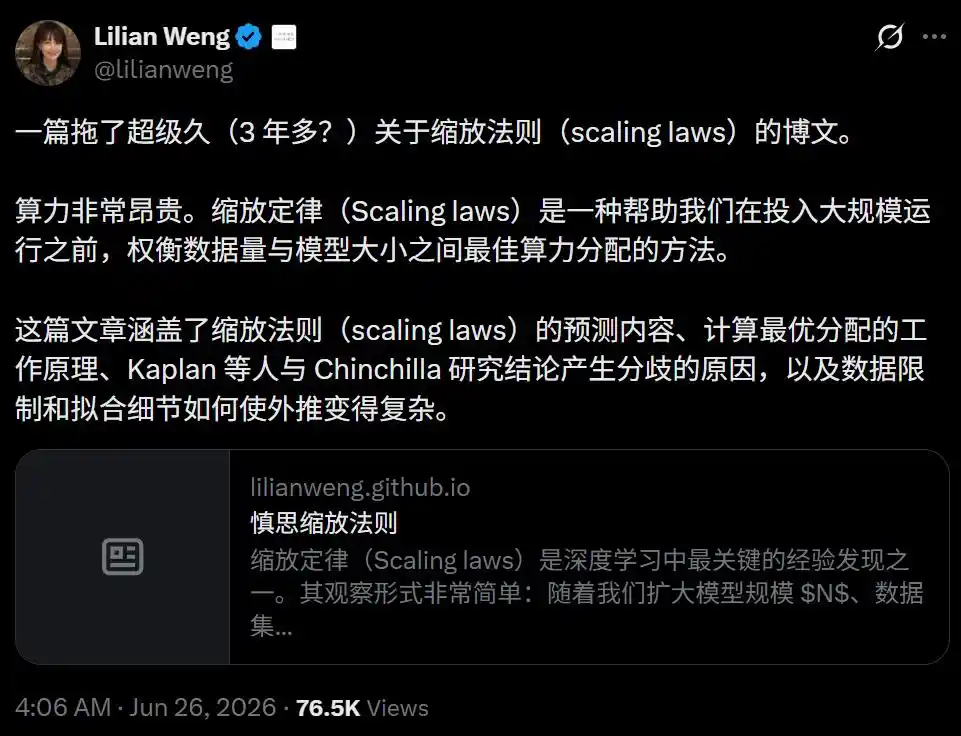
Just moments ago, a long-form article by former OpenAI Vice President Lilian Weng, delayed for over three years, went viral.

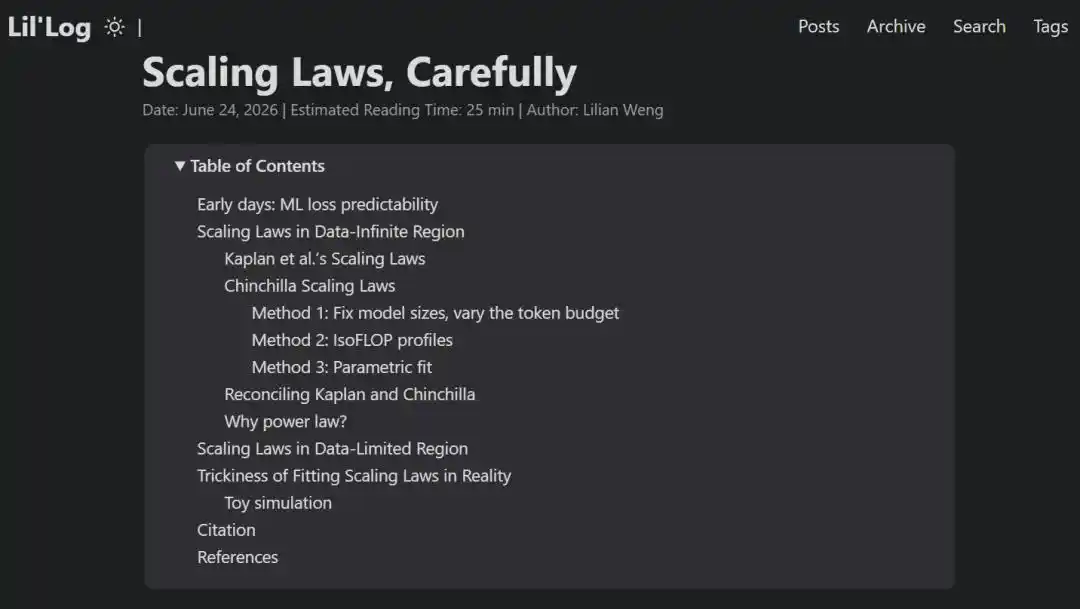
In this blog post titled "Scaling Laws, Carefully," she deconstructs Scaling Laws from start to finish—

The law on which the AI industry has bet tens of billions of dollars is far more fragile than anyone imagined.
One-Minute Summary: What This 10,000-Word Article Says

A single formula has governed the entire industry for five years. Scaling Laws state that "increasing model size, feeding more data, and scaling up compute will improve performance at a fixed rate." It turned AI from alchemy into a calculable business, indirectly directing the flow of hundreds of billions of dollars.

OpenAI and DeepMind gave opposite answers. For the same question of "how to allocate compute budget," OpenAI in 2020 said models should scale faster than data, while DeepMind in 2022 said both should scale proportionally. It was later discovered that the root of the divergence was a difference in parameter accounting plus insufficient experimental scale.

Even the winner's formula has bugs. DeepMind's optimal allocation ratio, copied industry-wide for two years, was found in 2024 during a line-by-line reproduction: the loss function used mean instead of sum, causing the optimizer to stop prematurely, and the output parameters were not the true optimum.

Applying patterns from small models to predict large models requires great caution. This curve was fitted on relatively small models; when extrapolated to trillion-parameter scale, a rounding difference can cause conclusions to diverge significantly. The blog includes an interactive simulator—drag the sliders to see it with your own eyes.

There's an even more fundamental issue: data is running out. The formula assumes infinite data supply, but high-quality text is finite. This is why the entire industry is collectively shifting towards reinforcement learning, test-time computation, and synthetic data.
One Straight Line, Hundreds of Billions of Dollars

As is well known, the core of Scaling Laws can be simply summarized in one sentence—

The larger the model, the more data, the more compute, the better the performance. And this "better" is not random; it follows precise mathematical laws.

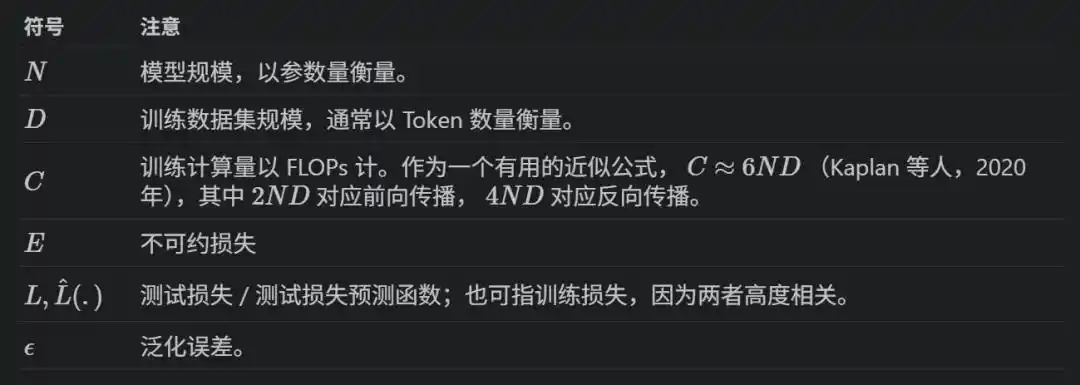
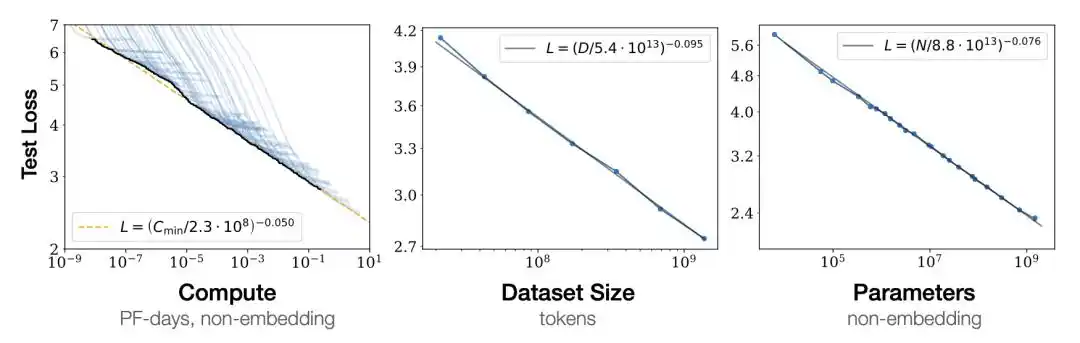
Plotting training loss on a log-log scale shows it decreases in a straight line as model parameter count N, data volume D, and compute C increase.

Written as a formula: L(x) = E + A/x^α, where x can be N, D, or C; E is the theoretical optimal loss (the entropy of the data itself); A and α are fitted constants.

Training a model with N parameters on D tokens requires total compute C ≈ 6ND—2ND for forward pass, 4ND for backward pass.

This straight line means performance gains are predictable.

Run a few small models first, fit the straight line, extrapolate to the right, and you can estimate the performance of a large model. No need to actually spend hundreds of millions training the large model to know if it works.
Before this, deep learning was often ridiculed as "alchemy"—knowing what works, but not why.

In 2020, OpenAI's Kaplan published this power law, pulling alchemy into the realm of "predictability" for the first time.

This is the confidence behind all large model companies' massive investments.

But on the most critical advice the formula gives—how to allocate compute budget between model and data—OpenAI and DeepMind gave opposite answers.

The Same Problem

OpenAI and DeepMind Produced Opposite Answers

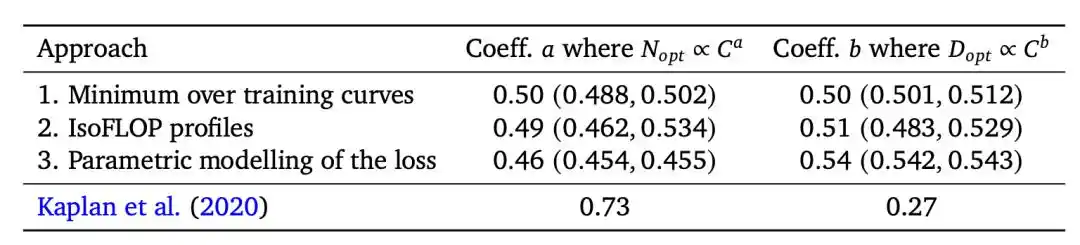
The conclusion reached by OpenAI's Kaplan team in 2020 was: optimal model size N_opt ∝ C^0.73.

Translated: if compute increases 10x, allocate 5.5x to model and 1.8x to data—models should scale much faster than data.
This directly guided GPT-3's training plan.

A 175-billion parameter model was fed only 300 billion tokens (a token is the smallest unit of text processed by a model, roughly 1-2 tokens per word).

By later standards, this was severely undertrained.

In 2022, DeepMind's Chinchilla team reached the opposite conclusion: N_opt ∝ C^0.50, models and data should scale proportionally.

Engineers later distilled it into an oft-quoted number: optimal token-to-parameter ratio is roughly 20:1.

Then DeepMind staged a head-to-head match.

Their Gopher: 280B parameters with 300B tokens. Chinchilla: 70B parameters with 1.4T tokens. Both models used the same compute.

Chinchilla dominated completely.
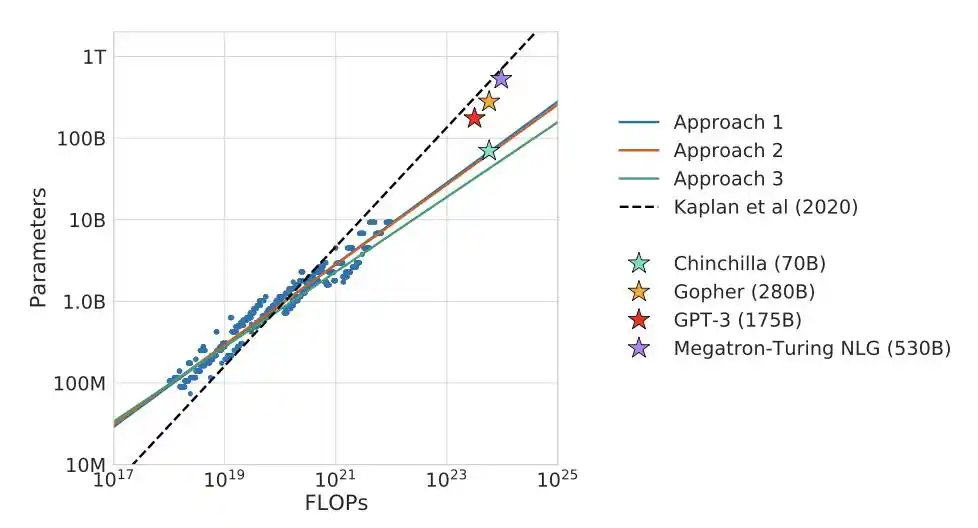
A smaller, well-fed model beat a larger, starved opponent.

Industry consensus flipped: from "scale up models" to "most models are undertrained."

0.73 vs 0.50, opposite answers to the same problem, would have you allocate your compute budget in two completely different directions.

The Reason Turned Out to be an "Accounting Problem"

In 2024, two researchers published a reconciliation paper in the top-tier machine learning journal TMLR, tracing this divergence to its root.

The conclusion is laughable.

First reason: they counted parameters differently.

Models have a type of parameter layer called embedding, responsible for converting text into numerical vectors the model understands. In small models, this layer constitutes a large proportion of total parameters—maybe one-third for models with tens of millions of parameters.

Kaplan excluded embedding when counting parameters; Chinchilla included it.

This single difference in parameter accounting was enough to distort the final fitted power-law exponent.

They gave a concise correction formula: N = N_\E + ω·N_\E^(1/3), where N_\E is parameter count without embedding, ω is a constant. For small models, the second term is large, embedding influence significant; as models grow larger, the second term approaches zero, and the two counting methods converge.

Second reason: Kaplan's experimental scale was too small.

Kaplan's largest tested model was only 1.5B parameters, while Chinchilla's experiments scanned up to over 16B. In log-log coordinates, tiny fitting deviations are magnified dramatically during extrapolation.

Using unified parameter accounting, they rederived Chinchilla's formula and discovered a key pattern—

The power-law exponent changes with compute scale. Within Kaplan's small-scale experimental range, the exponent was indeed close to 0.73; but as scale increased, the exponent converged to 0.50.
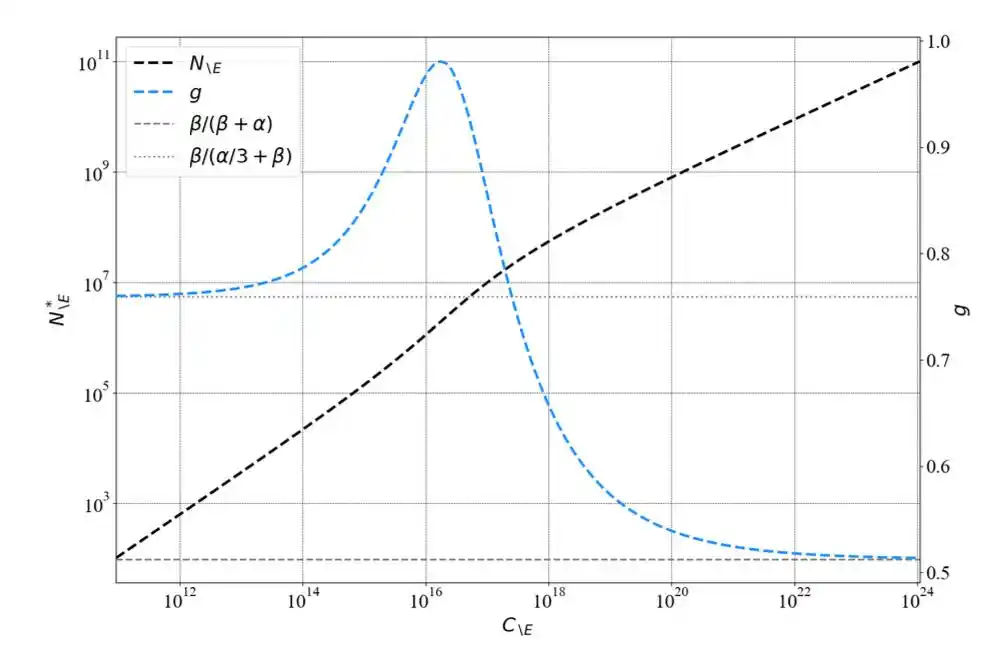
Kaplan wasn't "wrong"; he was correct within his experimental scope.

But he extrapolated a locally valid rule into a global conclusion.

An accounting issue of how to count parameters, plus insufficient experimental scale, led two top teams to give opposite resource allocation advice.

The entire industry adjusted training recipes based on this conclusion for two years.

Even the Winner Has Bugs

Kaplan was corrected by Chinchilla—that's the standard narrative everyone knows.

But Weng took a step further—Chinchilla's own methodology also has problems.

The Chinchilla paper used three independent methods to cross-validate its conclusion:

Method 1: Vary data volume with fixed model size

Method 2: Plot iso-compute curves (IsoFLOP profiles)

Method 3: Directly fit parameters to the loss formula L(N,D) = E + A/N^α + B/D^β

Three paths pointing to the same conclusion, seeming very robust.
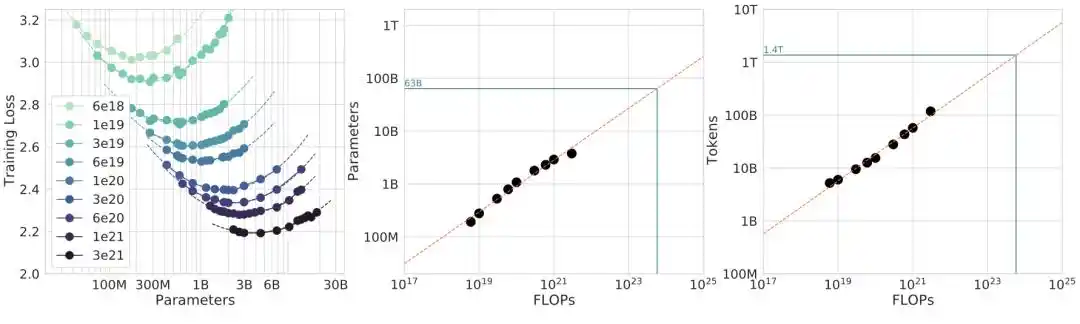
Method 3's mathematical derivation is especially elegant: Optimizing L(N,D) under constraint C ≈ 6ND yields a closed-form solution N_opt ∝ (C/6)^(β/(α+β)). When α ≈ β, the exponent is approximately 0.5, meaning models and data scale proportionally. That's the mathematical origin of 0.50.

In 2024, a team from AI research institute Epoch AI manually extracted raw data points from Chinchilla's paper charts and reran the fitting for Method 3.

Two bugs, each more astonishing than the last.

Bug 1: The loss function used mean instead of sum.

When fitting these five parameters, Chinchilla needed to minimize the gap between predicted loss and actual loss.

The complete optimization objective: min Σ Huber_δ(log L̂(Nᵢ,Dᵢ) − log Lᵢ), where Huber Loss is an outlier-insensitive loss function (δ = 10⁻³), paired with the L-BFGS-B optimizer to search for the optimum.

The problem lies in a detail: they took the mean (average) of Huber Loss per sample, not the sum. Averaging over a few hundred samples compressed the loss value to an extremely small magnitude.

The L-BFGS-B optimizer has a built-in convergence criterion. It stops automatically when the loss value is sufficiently small. Seeing such a tiny value, it mistakenly assumed convergence and stopped.

The optimizer never finished running. The output parameters were not the true optimum.

Bug 2: Key parameters were only kept to two decimal places.

In the Chinchilla paper, two core exponents controlling the power-law shape were retained only to two decimal places.

It seems like harmless rounding.

But when deriving other constants from these rough numbers, the error was amplified exponentially. The final confidence intervals were unreasonably narrow—narrow enough to require precision achievable only after over 600,000 experiments, while they actually ran fewer than 500.

A formula revered industry-wide for two years concealed a bug where the loss function didn't finish running.

Weng's blog also includes an interactive simulator with three sliders controlling loss precision, loss noise, and fitting range.

Each adjustment changes the fitted Scaling Law.
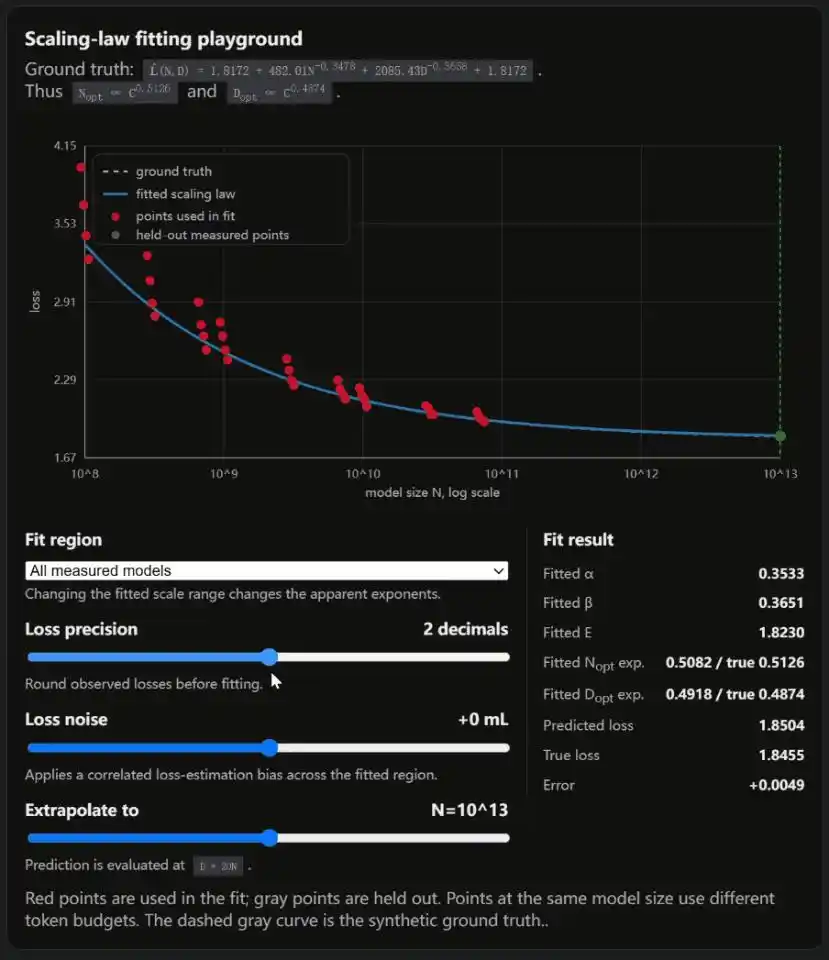
OpenAI's conclusion had local bias; DeepMind's conclusion had methodological flaws. In the AI industry's most important academic debate, both sides had cracks.

Data Is Running Out

The first three sections discussed problems with fitting methods—how to count parameters, how to calculate loss, how many decimal places to keep.

But even if all these problems were fixed, classic Scaling Laws have a more fundamental vulnerability—

They assume each training data point is unique, not repeated, not trained over multiple epochs, presuming you have infinite data.

Reality is, high-quality text data is projected to be exhausted by major labs between 2026 and 2028.

Repeated data training is inevitable; the premise of the classic formula is collapsing.
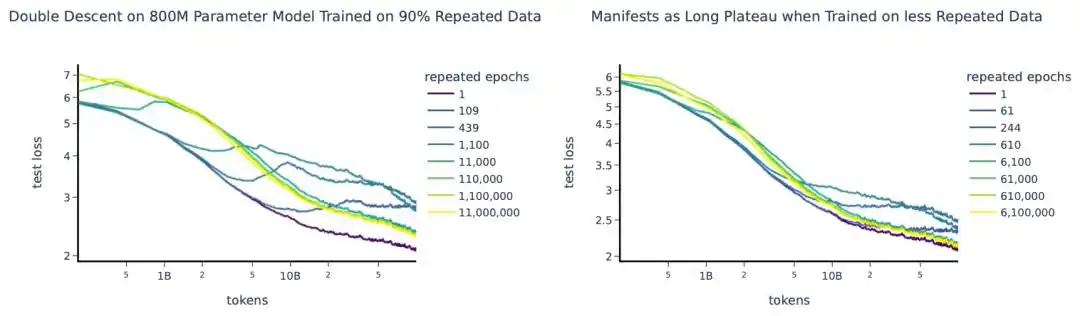
A large-scale experiment in 2023 trained about 400 models, from tens of millions to 9 billion parameters, with up to 1500 epochs of repeated training.

The core idea is to introduce the concept of "effective data volume" to replace actual data volume—

If you have U unique data points repeated R times, the effective data volume is not U×R, but converted via the exponential decay curve D_eff = U·(1 - e^(-R)). The first repetition still learns much new information; by the fifth, tenth repetition, marginal learning gains approach zero.

They also found a counterintuitive conclusion: excess parameters "depreciate" faster than repeated data. Meaning, with limited budget, running more training epochs is more cost-effective than enlarging the model.
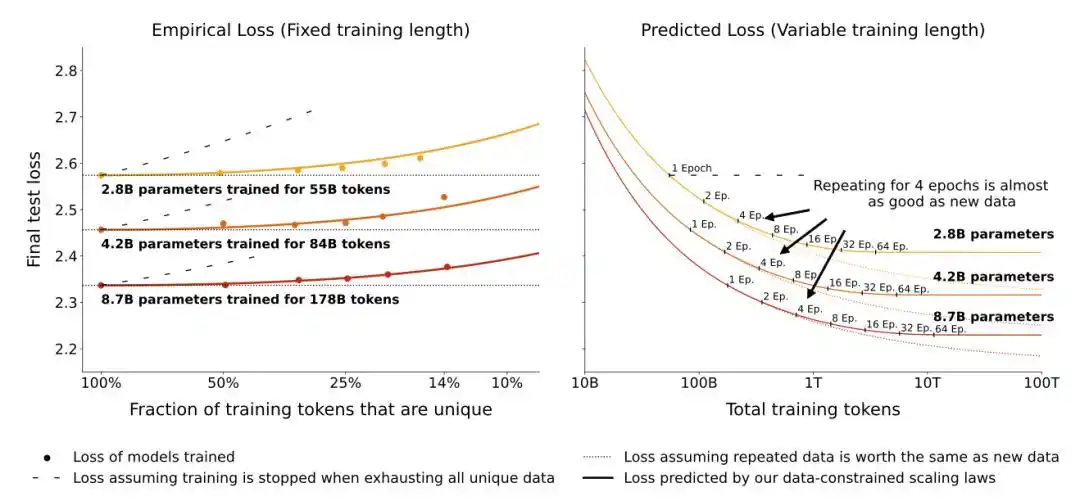
A new paper in May 2026 took a different approach.

They didn't convert to effective data volume; instead, they directly added an explicit overfitting penalty term to the classic loss formula—the more times a model sees the same data, the greater the penalty, and this penalty is tied to model size.

Their complete formula looks like this:

That last red penalty term is key.

R is repetition count, N/U is the ratio of model parameters to unique data volume (how "excessive" the model is relative to data), P, δ, κ are fitted from experiments. More repetitions, larger models, heavier penalty.

The paper's core finding: Large models are more sensitive to data repetition. Training the same data for 10 epochs, a 500M parameter model might still hold up, but a 5B parameter model's performance would degrade much more severely.

Another directly useful engineering finding: Increasing weight decay can significantly alleviate overfitting from repeated training.
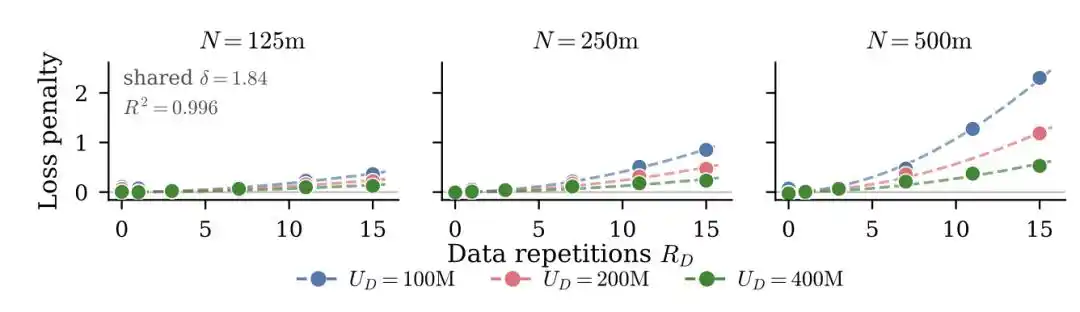
This is also why from 2025 to 2026, the industry's attention collectively shifted to three paths to bypass the data wall—

Reinforcement learning: DeepSeek R1, OpenAI o-series, letting models self-play on verifiable tasks like math and programming to generate training signals.

Test-time computation: Not increasing training cost, letting models "think" a few more steps when answering questions to exchange for better performance.

Synthetic data: Using existing strong models to generate new data to train the next generation.

The subtext of all three paths is the same: The pure "scale-up" power law is no longer sufficient.

From Peking University to OpenAI to Her Own Company

Lilian Weng, undergraduate at Peking University, PhD from Indiana University Bloomington.

Interestingly, her PhD focus wasn't deep learning, but network science and complex systems, studying how information spreads in social networks.

After graduation, she first worked in data science at Dropbox, then at fintech company Affirm, before joining OpenAI in 2018.

At OpenAI, Weng's first project was robotics. She was a core contributor to Dactyl, the robotic hand that learned to solve a Rubik's Cube in two years.

Later, she moved to build the applied research team, and after GPT-4's release, was tasked with forming the Safety Systems team, which grew to over 80 scientists, engineers, and policy experts by the time she left.

In August 2024, her title was elevated to VP of Research and Safety; three months later, she announced her departure.

In 2017, soon after starting deep learning, Weng opened a personal blog called Lil'Log, initially just to organize her study notes.

She once said, "Explaining a concept clearly is the best way to test whether you truly understand it."

Nine years later, she's still writing—reinforcement learning, diffusion models, large model agents, each article starting from foundational principles, dozens of pages long with her own diagrams.

This blog later became one of the most cited personal technical blogs in AI, used directly as textbook material by many universities.

In February 2025, she and former OpenAI CTO Mira Murati founded Thinking Machines Lab, with co-founders including OpenAI co-founder John Schulman, former research VPs Barret Zoph and Luke Metz. a16z led a $2B seed round at a $12B valuation.

And while her company was advancing rapidly, she took time to finish this long-form article on Scaling Laws, delayed for three years.

The ChatGPT, Claude, and Gemini you use every day are all governed by these formulas deciding how to train the next generation.

How good the next-generation AI is won't depend on who has more GPUs, but on who handles these details with greater precision.

References:

https://x.com/lilianweng/status/2070237256070389897?s=20

https://lilianweng.github.io/posts/2026-06-24-scaling-laws/

This article is from WeChat public account "新智元" (New AI Era), author: ASI启示录, editor: Moses

Trend Kriptolar

İlgili Sorular

QWhat were the key differences in conclusions between OpenAI's Kaplan and DeepMind's Chinchilla regarding scaling laws and resource allocation?

AOpenAI's Kaplan (2020) concluded that for a given compute budget, the optimal model size should grow faster than the data, with the relationship N_opt ∝ C^0.73. This led to large, data-starved models like GPT-3. DeepMind's Chinchilla (2022) concluded the opposite: N_opt ∝ C^0.50, meaning model and data should scale proportionally. This led to the 'Chinchilla-optimal' 20:1 token-to-parameter ratio, and models trained this way (e.g., Chinchilla itself) outperformed larger, undertrained ones.

QWhat were the two main reasons identified for the contradictory findings between Kaplan and Chinchilla?

AThe contradictions stemmed from two main issues: 1) Parameter Counting: Kaplan excluded embedding parameters from his model size count (N), while Chinchilla included them. This difference in definition significantly affected the fitted scaling law exponent for smaller models. 2) Experimental Scale: Kaplan's experiments used models up to only ~1.5B parameters, while Chinchilla scaled up to ~16B+. The scaling exponent derived from a small-scale range can be misleading when extrapolated to much larger scales, where the exponent converges to a different value.

QWhat major methodological flaw was discovered in the Chinchilla paper years later, and what was its consequence?

AIn 2024, researchers found that Chinchilla's Method 3 (fitting the loss formula L(N, D)) had a critical flaw. The optimization used the mean of the Huber loss across samples instead of the sum. This resulted in a very small loss value, which caused the L-BFGS-B optimizer to stop prematurely, believing it had converged. Consequently, the published parameters were not the true global optimum. Additionally, key parameters were reported with insufficient precision (only 2 decimal places), leading to unrealistically narrow confidence intervals.

QWhat fundamental limitation of classical scaling laws is exposed by the impending exhaustion of high-quality text data?

AClassical scaling laws assume unique, non-repeating training data and an infinite supply of it. This premise is breaking down as high-quality text data is expected to be exhausted by 2026-2028. The industry now faces data repetition, which these original laws do not account for. Performance no longer scales predictably when models are trained on the same data for multiple epochs, leading to diminishing returns and overfitting.

QAccording to the article, what three main research directions is the AI industry pursuing to overcome the data limitation problem for scaling?

ATo bypass the data wall, the industry is focusing on three main research directions: 1) Reinforcement Learning: Using models to generate their own training signals through self-play on verifiable tasks (e.g., DeepSeek R1, OpenAI o-series). 2) Test-Time Computation: Enhancing model performance not during training, but by allowing it to 'think' for more steps (compute) when generating an answer (e.g., chain-of-thought). 3) Synthetic Data: Using existing powerful models to generate new data for training the next generation of models.

İlgili Okumalar

Stablecoins Becoming the Next Policy Challenge for the Fed's Walsh Version

Fed Governor Christopher Waller's speech at the June 22 conference on the U.S. dollar's international role signifies a notable policy shift: stablecoins like USDT and USDC are now being formally considered as potential channels for transmitting U.S. dollar liquidity globally. With their combined market cap surpassing $250 billion and high transaction volumes, these digital assets are moving from the periphery of crypto policy to the core of monetary system research. The key concern for policymakers is how stablecoin flows interact with traditional dollar infrastructure. Their growth could affect bank deposits, demand for short-term Treasury securities (like T-bills), and global access to dollars, depending on whether demand originates overseas or substitutes for domestic bank balances. Issuers' reserve management—holding assets in banks, money market funds, or Treasuries—links stablecoin activity directly to these core markets. The Fed's research agenda now examines whether stablecoins, by combining payment and balance-holding functions on digital rails, could complicate monetary policy implementation or transmit liquidity stress to banks. While current Treasury holdings by issuers are under 1% of the total market, their concentrated demand could marginally impact yields, especially during periods of stress. Consequently, stablecoins are evolving from mere crypto trading tools into a private-layer dollar transmission system with public policy implications, prompting closer regulatory scrutiny of their reserve robustness, redemption mechanisms, and systemic integration.

marsbit1 saat önce

Stablecoins Becoming the Next Policy Challenge for the Fed's Walsh Version

marsbit1 saat önce

A 380% Soar, Shenzhen’s 100-Billion-Yuan IPO Rings the Bell

HKC Holdings, a major Chinese display panel manufacturer, has successfully listed on the Shenzhen Stock Exchange's main board. The company's shares surged over 380% on its debut, pushing its market capitalization to around 350 billion yuan (formerly reaching 500 billion yuan). Founded by Wang Zhiyong in Shenzhen's Huaqiangbei electronics market nearly three decades ago, HKC evolved from assembling monitors to becoming a global top-tier supplier of semiconductor display panels for TVs, monitors, and smartphones. The IPO marks a significant milestone for HKC and its backers. The company's growth into the capital-intensive panel manufacturing sector was supported through partnerships with state-owned capital from regions like Chongqing, Mianyang, and Chuzhou. Its shareholder list also includes BOE Technology's investment arm. In recent years, HKC reported strong financials, with core panel business contributing over 70% of revenue and clients including Samsung, TCL, and Xiaomi. This listing is seen as part of a broader trend in Shenzhen's evolving tech landscape. Beyond established giants, the city is nurturing clusters of leading companies in specialized sectors like robotics—exemplified by the "Shenzhen Robot Valley"—and storage chips, where a group of firms dubbed the "Storage Five Tigers" has achieved a combined trillion-yuan market valuation. Shenzhen's strategic focus on emerging industries such as AI terminals, low-altitude economy, and humanoid robotics aims to build new industrial depth and foster the next generation of tech champions.

marsbit1 saat önce

A 380% Soar, Shenzhen’s 100-Billion-Yuan IPO Rings the Bell

marsbit1 saat önce

İşlemler

Spot
Futures

Popüler Makaleler

$S$ Nedir

SPERO'yu Anlamak: Kapsamlı Bir Genel Bakış SPERO'ya Giriş İnovasyonun manzarası gelişmeye devam ederken, web3 teknolojilerinin ve kripto para projelerinin ortaya çıkışı dijital geleceği şekillendirmede önemli bir rol oynamaktadır. Bu dinamik alanda dikkat çeken projelerden biri SPERO, $$s$$ olarak adlandırılmaktadır. Bu makale, SPERO hakkında ayrıntılı bilgi toplamak ve sunmak amacıyla, meraklılar ve yatırımcıların web3 ve kripto alanlarındaki temellerini, hedeflerini ve yeniliklerini anlamalarına yardımcı olmayı amaçlamaktadır. SPERO,$$s$$ Nedir? SPERO,$$s$$, kripto alanında merkeziyetsizlik ve blok zinciri teknolojisi ilkelerini kullanarak etkileşimi, faydayı ve finansal kapsayıcılığı teşvik eden bir ekosistem yaratmayı amaçlayan benzersiz bir projedir. Proje, kullanıcıların yenilikçi finansal çözümler ve hizmetler sunarak eşler arası etkileşimleri yeni yollarla kolaylaştırmayı hedeflemektedir. SPERO,$$s$$'nin temel amacı, bireyleri güçlendirmek ve kripto para alanındaki kullanıcı deneyimini artıran araçlar ve platformlar sağlamaktır. Bu, daha esnek işlem yöntemlerini mümkün kılmayı, topluluk odaklı girişimleri teşvik etmeyi ve merkeziyetsiz uygulamalar (dApp'ler) aracılığıyla finansal fırsatlar yaratmayı içermektedir. SPERO,$$s$$'nin temel vizyonu kapsayıcılık etrafında dönmekte olup, geleneksel finansal sistemlerdeki boşlukları kapatmayı ve blok zinciri teknolojisinin faydalarından yararlanmayı hedeflemektedir. SPERO,$$s$$'nin Yaratıcısı Kimdir? SPERO,$$s$$'nin yaratıcısının kimliği bir miktar belirsizdir, çünkü kurucusu(ları) hakkında ayrıntılı arka plan bilgisi sağlayan sınırlı kamuya açık kaynaklar bulunmaktadır. Bu şeffaflık eksikliği, projenin merkeziyetsizlik taahhüdünden kaynaklanabilir—birçok web3 projesinin paylaştığı bir etik anlayışı, bireysel tanınmanın yerine kolektif katkıları önceliklendirmektedir. Topluluk ve onun kolektif hedefleri etrafında tartışmaları merkezileştirerek, SPERO,$$s$$, belirli bireyleri öne çıkarmadan güçlendirme özünü taşımaktadır. Bu nedenle, SPERO'nun etik anlayışını ve misyonunu anlamak, tek bir yaratıcının kimliğini belirlemekten daha önemlidir. SPERO,$$s$$'nin Yatırımcıları Kimlerdir? SPERO,$$s$$, kripto sektöründe yeniliği teşvik etmeye adanmış girişim sermayedarlarından melek yatırımcılara kadar çeşitli yatırımcılar tarafından desteklenmektedir. Bu yatırımcıların odak noktası genellikle SPERO'nun misyonuyla uyumlu olup, toplumsal teknolojik ilerlemeyi, finansal kapsayıcılığı ve merkeziyetsiz yönetimi vaat eden projeleri önceliklendirmektedir. Bu yatırımcı temelleri, yalnızca yenilikçi ürünler sunan projelere değil, aynı zamanda blok zinciri topluluğuna ve ekosistemlerine olumlu katkılarda bulunan projelere de ilgi duymaktadır. Bu yatırımcıların desteği, SPERO,$$s$$'yi hızla gelişen kripto projeleri alanında dikkate değer bir rakip haline getirmektedir. SPERO,$$s$$ Nasıl Çalışır? SPERO,$$s$$, onu geleneksel kripto para projelerinden ayıran çok yönlü bir çerçeve kullanmaktadır. İşte benzersizliğini ve yeniliğini vurgulayan bazı temel özellikler: Merkeziyetsiz Yönetim: SPERO,$$s$$, kullanıcıların projenin geleceğiyle ilgili karar alma süreçlerine aktif olarak katılmalarını sağlayan merkeziyetsiz yönetim modellerini entegre etmektedir. Bu yaklaşım, topluluk üyeleri arasında sahiplik ve hesap verebilirlik duygusunu teşvik etmektedir. Token Kullanımı: SPERO,$$s$$, ekosistem içinde çeşitli işlevler sunmak üzere tasarlanmış kendi kripto para token'ını kullanmaktadır. Bu token'lar, işlemleri, ödülleri ve platformda sunulan hizmetlerin kolaylaştırılmasını sağlayarak genel etkileşimi ve faydayı artırmaktadır. Katmanlı Mimari: SPERO,$$s$$'nin teknik mimarisi, modülerlik ve ölçeklenebilirliği destekleyerek projenin evrimi sırasında ek özelliklerin ve uygulamaların sorunsuz bir şekilde entegrasyonuna olanak tanımaktadır. Bu uyum sağlama yeteneği, sürekli değişen kripto manzarasında geçerliliği sürdürmek için hayati öneme sahiptir. Topluluk Katılımı: Proje, işbirliği ve geri bildirim teşvik eden mekanizmalar kullanarak topluluk odaklı girişimlere vurgu yapmaktadır. Güçlü bir topluluk oluşturarak, SPERO,$$s$$, kullanıcı ihtiyaçlarını daha iyi karşılayabilir ve piyasa trendlerine uyum sağlayabilir. Kapsayıcılığa Odaklanma: Düşük işlem ücretleri ve kullanıcı dostu arayüzler sunarak, SPERO,$$s$$, daha önce kripto alanında yer almamış bireyler de dahil olmak üzere çeşitli bir kullanıcı tabanını çekmeyi hedeflemektedir. Bu kapsayıcılık taahhüdü, erişilebilirlik yoluyla güçlendirme misyonuyla uyumludur. SPERO,$$s$$ Zaman Çizelgesi Bir projenin tarihini anlamak, gelişim yolculuğu ve kilometre taşları hakkında kritik bilgiler sağlar. Aşağıda, SPERO,$$s$$'nin evriminde önemli olayları haritalayan önerilen bir zaman çizelgesi bulunmaktadır: Kavram Geliştirme ve Fikir Aşaması: SPERO,$$s$$'nin temelini oluşturan ilk fikirler, blok zinciri endüstrisindeki merkeziyetsizlik ve topluluk odaklılık ilkeleriyle yakından uyumlu olarak geliştirildi. Proje Beyaz Kağıdının Yayınlanması: Kavramsal aşamayı takiben, SPERO,$$s$$'nin vizyonunu, hedeflerini ve teknolojik altyapısını ayrıntılı bir şekilde açıklayan kapsamlı bir beyaz kağıt yayımlandı ve topluluk ilgisini ve geri bildirimini toplamak amacıyla sunuldu. Topluluk Oluşturma ve Erken Katılımlar: Projenin hedefleri etrafında tartışmalar yürüterek destek toplamak ve erken benimseyenler ile potansiyel yatırımcılar için bir topluluk oluşturmak amacıyla aktif iletişim çabaları gerçekleştirildi. Token Üretim Etkinliği: SPERO,$$s$$, yerel token'larını erken destekçilere dağıtmak ve ekosistem içinde başlangıç likiditesini sağlamak amacıyla bir token üretim etkinliği (TGE) gerçekleştirdi. İlk dApp'in Yayınlanması: SPERO,$$s$$ ile ilişkili ilk merkeziyetsiz uygulama (dApp) faaliyete geçti ve kullanıcıların platformun temel işlevleriyle etkileşimde bulunmalarını sağladı. Sürekli Gelişim ve Ortaklıklar: Projenin tekliflerine sürekli güncellemeler ve iyileştirmeler yapılmakta olup, blok zinciri alanındaki diğer oyuncularla stratejik ortaklıklar, SPERO,$$s$$'yi rekabetçi ve gelişen bir oyuncu haline getirmiştir. Sonuç SPERO,$$s$$, web3 ve kripto paranın finansal sistemleri devrim niteliğinde dönüştürme ve bireyleri güçlendirme potansiyelinin bir kanıtıdır. Merkeziyetsiz yönetime, topluluk katılımına ve yenilikçi tasarlanmış işlevselliğe olan bağlılığıyla, daha kapsayıcı bir finansal manzaraya doğru bir yol açmaktadır. Hızla gelişen kripto alanındaki herhangi bir yatırımda olduğu gibi, potansiyel yatırımcılar ve kullanıcılar, SPERO,$$s$$ içindeki devam eden gelişmelerle ilgili olarak kapsamlı bir araştırma yapmaları ve düşünceli bir şekilde katılmaları teşvik edilmektedir. Proje, kripto endüstrisinin yenilikçi ruhunu sergileyerek, sayısız olasılığını keşfetmeye davet etmektedir. SPERO,$$s$$'nin yolculuğu hala devam ederken, temel ilkeleri, teknoloji, finans ve birbirimizle etkileşim biçimimizi etkileyebilir.

128 Toplam GörüntülenmeYayınlanma 2024.12.17Güncellenme 2024.12.17

$S$ Nedir

AGENT S Nedir

Agent S: Web3'te Otonom Etkileşimin Geleceği Giriş Web3 ve kripto para dünyasında sürekli gelişen manzarada, yenilikler bireylerin dijital platformlarla etkileşim biçimlerini sürekli olarak yeniden tanımlıyor. Bu tür öncü projelerden biri olan Agent S, açık ajans çerçevesi aracılığıyla insan-bilgisayar etkileşimini devrim niteliğinde değiştirmeyi vaat ediyor. Otonom etkileşimlerin yolunu açarak, Agent S karmaşık görevleri basitleştirmeyi ve yapay zeka (AI) alanında dönüştürücü uygulamalar sunmayı hedefliyor. Bu detaylı inceleme, projenin karmaşıklıklarına, benzersiz özelliklerine ve kripto para alanındaki etkilerine dalacaktır. Agent S Nedir? Agent S, bilgisayar görevlerinin otomasyonunda üç temel zorluğu ele almak üzere özel olarak tasarlanmış çığır açıcı bir açık ajans çerçevesidir: Alan Spesifik Bilgi Edinimi: Çerçeve, çeşitli dış bilgi kaynaklarından ve iç deneyimlerden akıllıca öğrenir. Bu çift yönlü yaklaşım, alan spesifik bilgi açısından zengin bir veri havuzu oluşturmasını sağlar ve görev yürütmedeki performansını artırır. Uzun Görev Ufukları Üzerinde Planlama: Agent S, karmaşık görevlerin verimli bir şekilde parçalanmasını ve yürütülmesini kolaylaştıran deneyim artırımlı hiyerarşik planlama kullanır. Bu özellik, çoklu alt görevleri etkili ve verimli bir şekilde yönetme yeteneğini önemli ölçüde artırır. Dinamik, Homojen Olmayan Arayüzlerle Başlama: Proje, ajanlar ve kullanıcılar arasındaki etkileşimi geliştiren yenilikçi bir çözüm olan Ajan-Bilgisayar Arayüzü'ni (ACI) tanıtmaktadır. Çok Modlu Büyük Dil Modellerini (MLLM'ler) kullanarak, Agent S çeşitli grafik kullanıcı arayüzlerini sorunsuz bir şekilde gezinebilir ve manipüle edebilir. Bu öncü özellikler aracılığıyla, Agent S, makinelerle insan etkileşimini otomatikleştirmede karşılaşılan karmaşıklıkları ele alan sağlam bir çerçeve sunarak, AI ve ötesinde birçok uygulama için zemin hazırlıyor. Agent S'nin Yaratıcısı Kimdir? Agent S'nin kavramı temelde yenilikçi olsa da, yaratıcısı hakkında spesifik bilgiler belirsizliğini koruyor. Yaratıcı şu anda bilinmiyor, bu da projenin yeni aşamasını veya kurucu üyeleri gizli tutma stratejik tercihini vurguluyor. Anonimlikten bağımsız olarak, odak çerçevenin yetenekleri ve potansiyeli üzerinde kalıyor. Agent S'nin Yatırımcıları Kimlerdir? Agent S, kriptografik ekosistemde oldukça yeni olduğundan, yatırımcıları ve finansal destekçileri hakkında ayrıntılı bilgiler açıkça belgelenmemiştir. Projeyi destekleyen yatırım temelleri veya organizasyonları hakkında kamuya açık bilgilerdeki eksiklik, finansman yapısı ve gelişim yol haritası hakkında sorular doğuruyor. Destekleyicilerin anlaşılması, projenin sürdürülebilirliğini ve potansiyel pazar etkisini değerlendirmek için kritik öneme sahiptir. Agent S Nasıl Çalışır? Agent S'nin temelinde, çeşitli ortamlarda etkili bir şekilde çalışmasını sağlayan son teknoloji bir sistem yatmaktadır. İşleyiş modeli birkaç ana özellik etrafında inşa edilmiştir: İnsan Benzeri Bilgisayar Etkileşimi: Çerçeve, bilgisayarlarla etkileşimleri daha sezgisel hale getirmeyi amaçlayan gelişmiş AI planlaması sunar. Görev yürütmedeki insan davranışını taklit ederek, kullanıcı deneyimlerini yükseltmeyi vaat eder. Anlatı Belleği: Yüksek düzeyde deneyimlerden yararlanmak için kullanılan Agent S, görev geçmişlerini takip etmek amacıyla anlatı belleğini kullanarak karar verme süreçlerini geliştirir. Episodik Bellek: Bu özellik, kullanıcılara adım adım rehberlik sağlayarak, çerçevenin görevler gelişirken bağlamsal destek sunmasına olanak tanır. OpenACI Desteği: Yerel olarak çalışabilme yeteneği ile Agent S, kullanıcıların etkileşimleri ve iş akışları üzerinde kontrol sağlamasına olanak tanır ve Web3'ün merkeziyetsiz felsefesiyle uyumlu hale gelir. Dış API'lerle Kolay Entegrasyon: Çeşitli AI platformlarıyla uyumluluğu ve çok yönlülüğü, Agent S'nin mevcut teknolojik ekosistemlere sorunsuz bir şekilde entegre olmasını sağlar ve geliştiriciler ile organizasyonlar için cazip bir seçenek haline getirir. Bu işlevsellikler, Agent S'nin kripto alanındaki benzersiz konumuna katkıda bulunarak, karmaşık, çok aşamalı görevleri minimum insan müdahalesi ile otomatikleştirir. Proje geliştikçe, Web3'teki potansiyel uygulamaları dijital etkileşimlerin nasıl gelişeceğini yeniden tanımlayabilir. Agent S'nin Zaman Çizelgesi Agent S'nin gelişimi ve kilometre taşları, önemli olaylarını vurgulayan bir zaman çizelgesinde özetlenebilir: 27 Eylül 2024: Agent S'nin kavramı, “Bilgisayarları İnsan Gibi Kullanan Açık Bir Ajans Çerçevesi” başlıklı kapsamlı bir araştırma makalesi ile tanıtıldı ve projenin temelini sergiledi. 10 Ekim 2024: Araştırma makalesi arXiv'de kamuya açık olarak yayınlandı ve çerçevenin derinlemesine bir incelemesini ve OSWorld benchmark'ına dayalı performans değerlendirmesini sundu. 12 Ekim 2024: Agent S'nin yetenekleri ve özellikleri hakkında görsel bir içgörü sağlayan bir video sunumu yayımlandı ve potansiyel kullanıcılar ve yatırımcılarla daha fazla etkileşim sağlandı. Bu zaman çizelgesindeki işaretler, sadece Agent S'nin ilerlemesini değil, aynı zamanda şeffaflık ve topluluk katılımına olan bağlılığını da göstermektedir. Agent S Hakkında Ana Noktalar Agent S çerçevesi gelişmeye devam ederken, birkaç ana özellik öne çıkmakta ve yenilikçi doğasını ve potansiyelini vurgulamaktadır: Yenilikçi Çerçeve: İnsan etkileşimine benzer bir bilgisayar kullanımı sağlamak üzere tasarlanan Agent S, görev otomasyonuna yeni bir yaklaşım getiriyor. Otonom Etkileşim: GUI aracılığıyla bilgisayarlarla otonom olarak etkileşim kurabilme yeteneği, daha akıllı ve verimli hesaplama çözümlerine doğru bir sıçrama anlamına geliyor. Karmaşık Görev Otomasyonu: Sağlam metodolojisi ile karmaşık, çok aşamalı görevleri otomatikleştirerek süreçleri daha hızlı ve daha az hata payı ile gerçekleştirebilir. Sürekli İyileştirme: Öğrenme mekanizmaları, Agent S'nin geçmiş deneyimlerden öğrenmesini sağlar ve sürekli olarak performansını ve etkinliğini artırır. Çok Yönlülük: OSWorld ve WindowsAgentArena gibi farklı işletim ortamlarında uyumlu olması, geniş bir uygulama yelpazesine hizmet edebilmesini sağlar. Agent S, Web3 ve kripto alanında kendini konumlandırırken, etkileşim yeteneklerini artırma ve süreçleri otomatikleştirme potansiyeli, AI teknolojilerinde önemli bir ilerlemeyi temsil etmektedir. Yenilikçi çerçevesi aracılığıyla, Agent S dijital etkileşimlerin geleceğini örneklemekte ve çeşitli sektörlerde kullanıcılar için daha sorunsuz ve verimli bir deneyim vaat etmektedir. Sonuç Agent S, AI ve Web3'ün birleşiminde cesur bir sıçramayı temsil ediyor ve teknoloji ile etkileşim biçimimizi yeniden tanımlama kapasitesine sahip. Henüz erken aşamalarında olmasına rağmen, uygulama olanakları geniş ve çekici. Kritik zorlukları ele alan kapsamlı çerçevesi ile Agent S, otonom etkileşimleri dijital deneyimin ön plana çıkmasına taşımayı hedefliyor. Kripto para ve merkeziyetsizlik alanlarına daha derinlemesine girdikçe, Agent S gibi projelerin teknoloji ve insan-bilgisayar işbirliğinin geleceğini şekillendirmede önemli bir rol oynayacağı kesin.

622 Toplam GörüntülenmeYayınlanma 2025.01.14Güncellenme 2025.01.14

AGENT S Nedir

S Nasıl Satın Alınır

HTX.com’a hoş geldiniz! Sonic (S) satın alma işlemlerini basit ve kullanışlı bir hâle getirdik. Adım adım açıkladığımız rehberimizi takip ederek kripto yolculuğunuza başlayın. 1. Adım: HTX Hesabınızı OluşturunHTX'te ücretsiz bir hesap açmak için e-posta adresinizi veya telefon numaranızı kullanın. Sorunsuzca kaydolun ve tüm özelliklerin kilidini açın. Hesabımı Aç2. Adım: Kripto Satın Al Bölümüne Gidin ve Ödeme Yönteminizi SeçinKredi/Banka Kartı: Visa veya Mastercard'ınızı kullanarak anında Sonic (S) satın alın.Bakiye: Sorunsuz bir şekilde işlem yapmak için HTX hesap bakiyenizdeki fonları kullanın.Üçüncü Taraflar: Kullanımı kolaylaştırmak için Google Pay ve Apple Pay gibi popüler ödeme yöntemlerini ekledik.P2P: HTX'teki diğer kullanıcılarla doğrudan işlem yapın.Borsa Dışı (OTC): Yatırımcılar için kişiye özel hizmetler ve rekabetçi döviz kurları sunuyoruz.3. Adım: Sonic (S) Varlıklarınızı SaklayınSonic (S) satın aldıktan sonra HTX hesabınızda saklayın. Alternatif olarak, blok zinciri transferi yoluyla başka bir yere gönderebilir veya diğer kripto para birimlerini takas etmek için kullanabilirsiniz.4. Adım: Sonic (S) Varlıklarınızla İşlem YapınHTX'in spot piyasasında Sonic (S) ile kolayca işlemler yapın.Hesabınıza erişin, işlem çiftinizi seçin, işlemlerinizi gerçekleştirin ve gerçek zamanlı olarak izleyin. Hem yeni başlayanlar hem de deneyimli yatırımcılar için kullanıcı dostu bir deneyim sunuyoruz.

1.7k Toplam GörüntülenmeYayınlanma 2025.01.15Güncellenme 2026.06.02

S Nasıl Satın Alınır

Tartışmalar

HTX Topluluğuna hoş geldiniz. Burada, en son platform gelişmeleri hakkında bilgi sahibi olabilir ve profesyonel piyasa görüşlerine erişebilirsiniz. Kullanıcıların S (S) fiyatı hakkındaki görüşleri aşağıda sunulmaktadır.

活动图片