After 500 Rejections, I Started Building Products That People Actually Use

marsbit2025-12-30 tarihinde yayınlandı2025-12-30 tarihinde güncellendi

Özet

After 500 rejections and years of failed infrastructure projects in crypto, the author shifted focus to building consumer-facing products that people actually use and pay for. Key lessons from transitioning to Solana and launching a consumer app include: Target younger users (ages 13-21) who are more open to adopting new technologies and sharing them socially. Design products that are inherently shareable to reduce marketing costs, as organic virality is critical in a low-trust, high-cost acquisition environment. Prioritize rapid user feedback—fix bugs within hours and implement requested features in days to build trust and habit formation. Choose simple, memorable app names to ease word-of-mouth sharing. Engage users directly through cold DMs (despite low reply rates) to gather honest feedback and build early supporter communities. Iterate quickly—observe user behavior rather than relying solely on feedback, and be willing to pivot radically. Simplify onboarding and avoid assumptions about user knowledge; make the product intuitive within seconds. Ultimately, speed, user-centricity, and distribution matter more than technical perfection in consumer crypto.

Editor's Note: In the crypto industry, discussions about 'whether to build infrastructure' and 'whether technical complexity equals competitive moat' have never ceased. But this article offers a counterexample from a frontline entrepreneur: from consecutive failures in betting on infra to pivoting towards consumer products that people are willing to use and pay for, the author uses personal experience to复盘 the real difficulty of 'building products' in the crypto industry.

Compared to technical complexity and grand narratives, the article focuses more on users, distribution, and execution details. In the consumer crypto space, value is not 'proven' but 'used into existence'.

The following is the original text:

As a first-time founder, I spent years working on three infrastructure protocols, all of which ultimately failed. By 2025, I began shifting to building a consumer product that people actually want to use. This piece shares the lessons I learned about user growth and fundraising 'after stepping into pitfalls'.

I've been in this industry for about 4 years.

In 2023, I started my venture in the EVM ecosystem, right when 'account abstraction' was the hottest topic. Almost everyone was developing SDKs for account abstract wallets. Meanwhile, the Rollup ecosystem heated up rapidly. Optimism, Arbitrum, and various RaaS projects dominated the mainstream view.

As someone who loves math, I was deeply attracted to ZK, believing it would change the world (I still believe it eventually will).

A core mistake I made back then was: equating 'complexity' with 'credibility'.

When VCs asked me about use cases, I would confidently list directions like zkML, zk identity, zk voting — yet in reality, almost none of these are actually used today. I mistook 'the technology looks impressive' for 'this is a useful product'.

As time went on, I even started to believe: the more complex the idea, the higher the probability of startup success.

Many investors also told me that in the crypto industry, only infrastructure has a chance to succeed. It wasn't until nearly two years and over 500 rejections later that I realized: this path wasn't for me.

So, I entered the Solana ecosystem.

For me, this was a whole new world. People here care about practical use cases. Even if it's memes, revenue matters. Speed matters. Distribution matters. (Special thanks to @superteamin for the help along the way.)

So far, we've been building consumer applications in this ecosystem for nearly 7 months. During the private testing phase, we've already processed over $12 million in transaction volume. Below are some of the lessons I've summarized:

1. Build for Young Users Willing to Try New Things

Aim to design products for a demographic that is naturally more receptive to new products.

In consumer crypto products, this usually means 'trenchers' or younger users, many concentrated in the 13–21 age range.

A 2024 study by the Consumer Technology Association (CTA) on Gen Z (11–26 years old) showed: 86% of Gen Z believe technology is an indispensable part of life, a higher proportion than any older group. They adopt new technologies earlier, with an average household owning 13 devices, using about 6 of them daily, for nearly 12 hours.

Gen Z is also more likely to personally own emerging tech products, such as crypto apps (e.g., 58% own game consoles, a significantly higher than older groups). They have a stronger willingness to spend on new technology, subscribe to more services, and their habits change and adapt noticeably faster than Millennials, Gen X, or Boomers.

They are more willing to try new apps, experiment, and quickly change usage habits.

In contrast, older users (in many cases, 25+) are generally less willing to change established workflows unless the incentives are very strong. Side note: this conclusion might not apply if you're building for institutions.

Multiple studies also show clear behavioral differences: younger users engage in social communication with more people daily, meaning they are more likely to share 'interesting products they discover' with friends. Around ages 20–21, social messaging activity typically peaks, largely related to college or being in school.
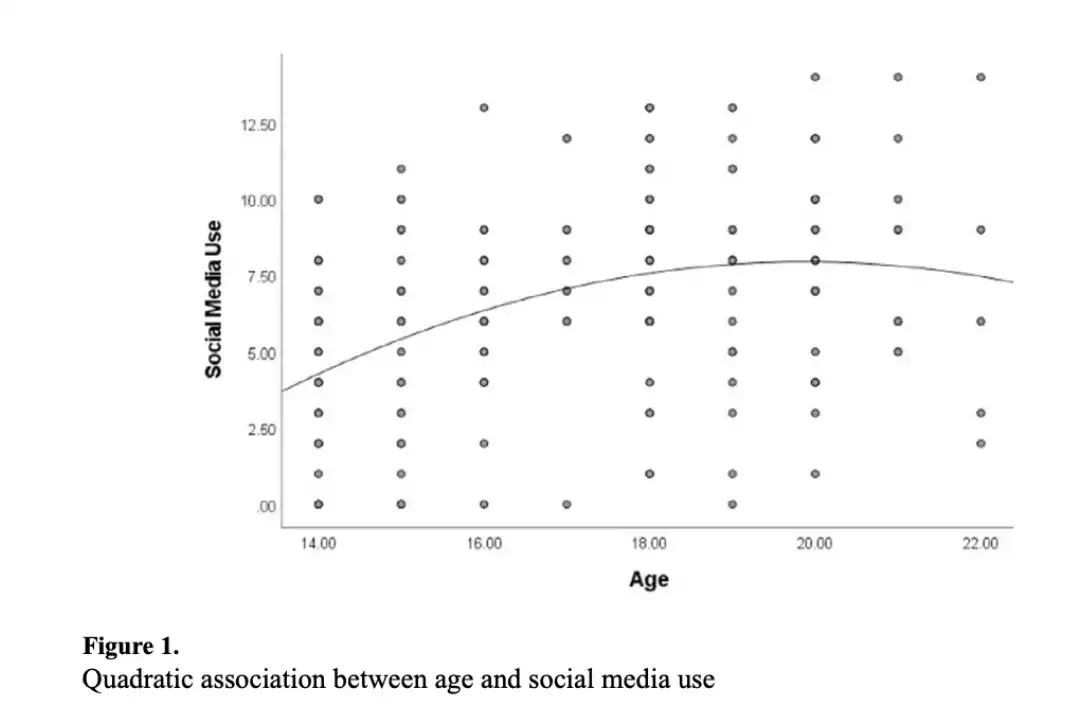
This trend leads to a very direct implication: products designed for younger users naturally have stronger virality.

2. Make the Product Itself Shareable to Reduce Marketing Costs

If you don't have ample marketing or advertising budgets, then your product itself must serve as the 'distribution channel'.

In other words, the product is the marketing, the product is the propagation.
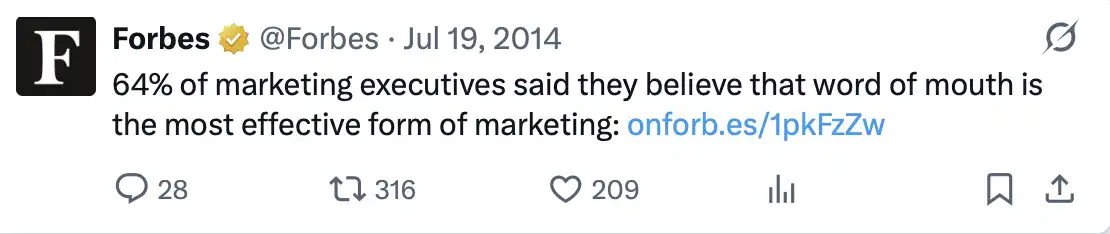
A highly shareable product can significantly reduce marketing costs.

This is especially important in the crypto industry because:

· KOL marketing is expensive

· User trust is generally low

· Most users expect rewards or incentives before participating

In such an environment, relying on traditional marketing methods is often inefficient, while organic propagation driven by the product itself is more sustainable.
If your product can give users a reason to share spontaneously, whether with friends, groups, or communities, you can achieve distribution without burning大量资金.

This isn't easy to do in crypto, but optimizing for it from day one is very worthwhile in the long run.

3. Respond to User Feedback ASAP

When users report issues with the experience, or encounter poor interactions, fix them immediately, especially those that directly block the usage flow.

My previous approach was to save bug fixes for the end of the day. But once, a user DM'd me saying: 'Your App doesn't have this feature yet, I'll use Y for now.'

I said I understood, but the result was, the user kept using product Y afterwards. I tried multiple times via DMs to win them back, but it was very difficult — they had already formed a habit of using Y.

Ultimately, once users establish habits on another product, the cost of switching them back becomes extremely high.

Therefore, try to: resolve bugs within 2–5 hours.

If multiple users repeatedly request a new feature that is very important to them and technically feasible:

· Develop and launch it within 2–3 days

· Clearly tell them it was launched based on their feedback

·甚至可以给予一定的经济激励 (this might turn them into your product's most active evangelists)
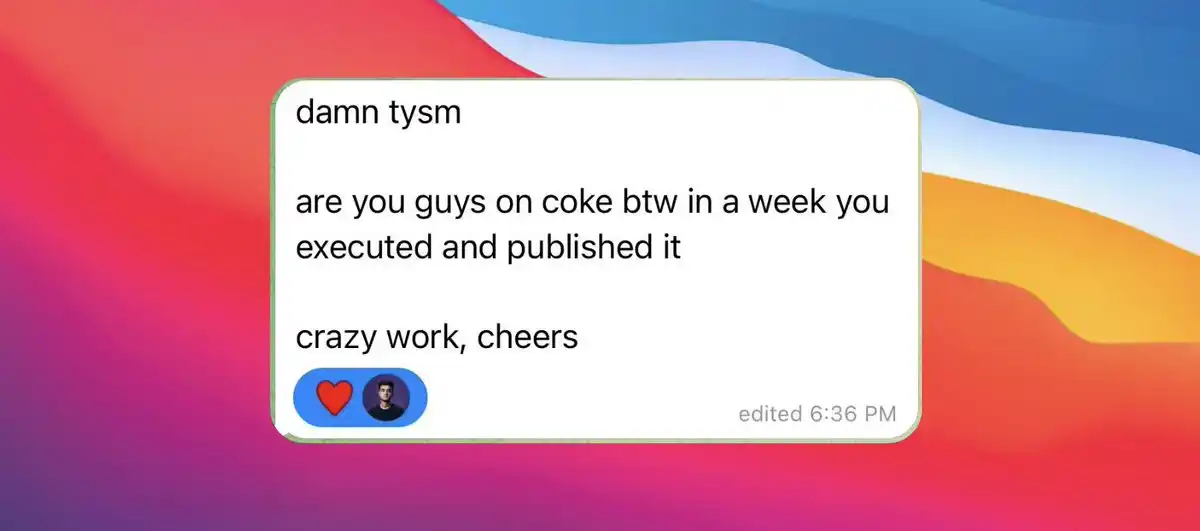
Delivering features around user needs does three things: directly improves the product, increases user frequency, and builds deep trust.

When users see their feedback taken seriously and actually turned into product features, they start to feel: this product is 'partly theirs'.

This emotional sense of 'ownership' is extremely important and powerful in early-stage consumer products.

4. The App's Name is Very Important

This might sound basic, but many people — including myself — have made serious mistakes at this step.

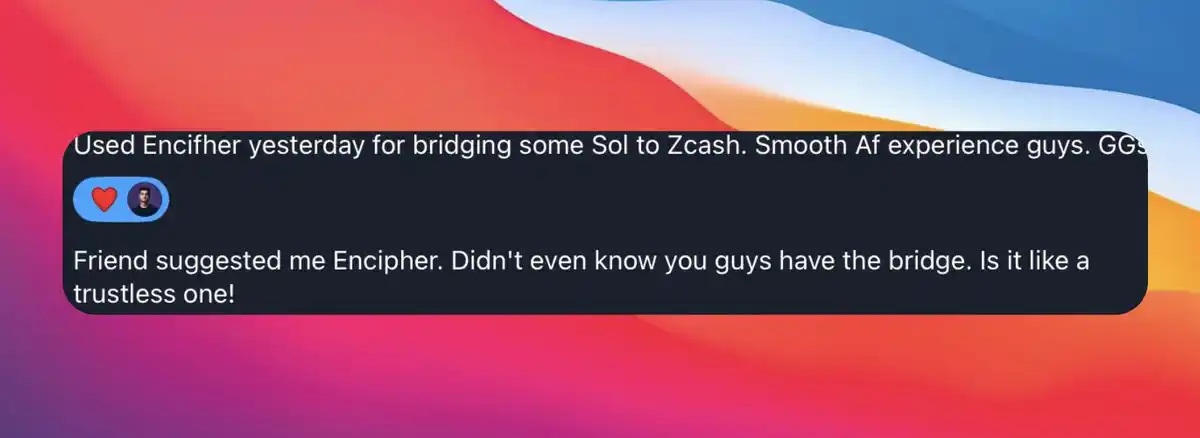
Your App's name must be highly memorable and easy enough to relay and share. Otherwise, you'll frequently receive messages like this (users want to recommend it but can't remember what it's called).
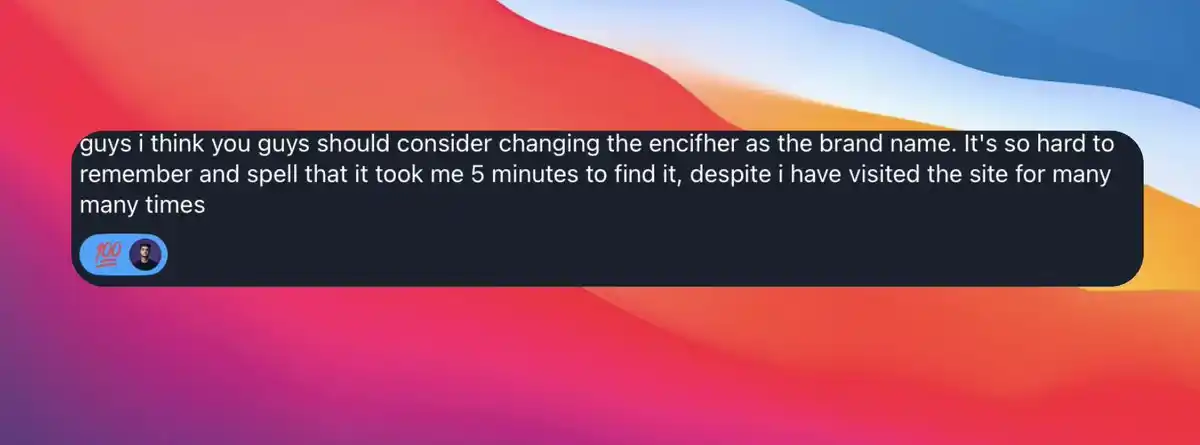
The truth is indeed so — the name 'encifher' itself was hard to remember, I really can't blame users for that.

There were even many group chats created by investors or partners where the product name was misspelled, something I can only苦笑 about now.
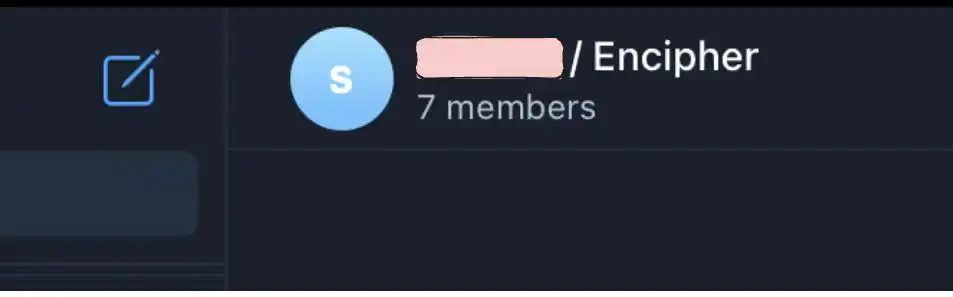
Because of this, we later changed the name to encrypt.trade.


There are plenty of existing methods and resources online for how to choose a 'memorable and shareable' name.

5. Talking to Users is Hard, But Non-Negotiable

Finding users and actually talking to them is inherently very difficult, especially when your direction isn't within the current mainstream narrative.

When I first started working on privacy-related products, it wasn't a popular niche. Although many retail users had real privacy needs, they were scattered and hard to find.

So I did something most people actively avoid: during the idea validation phase, I proactively cold-DM'd nearly 1000 people.

If lucky, about 10 out of 100 people might reply; and among those replies, only maybe 3–4 might give you useful feedback.
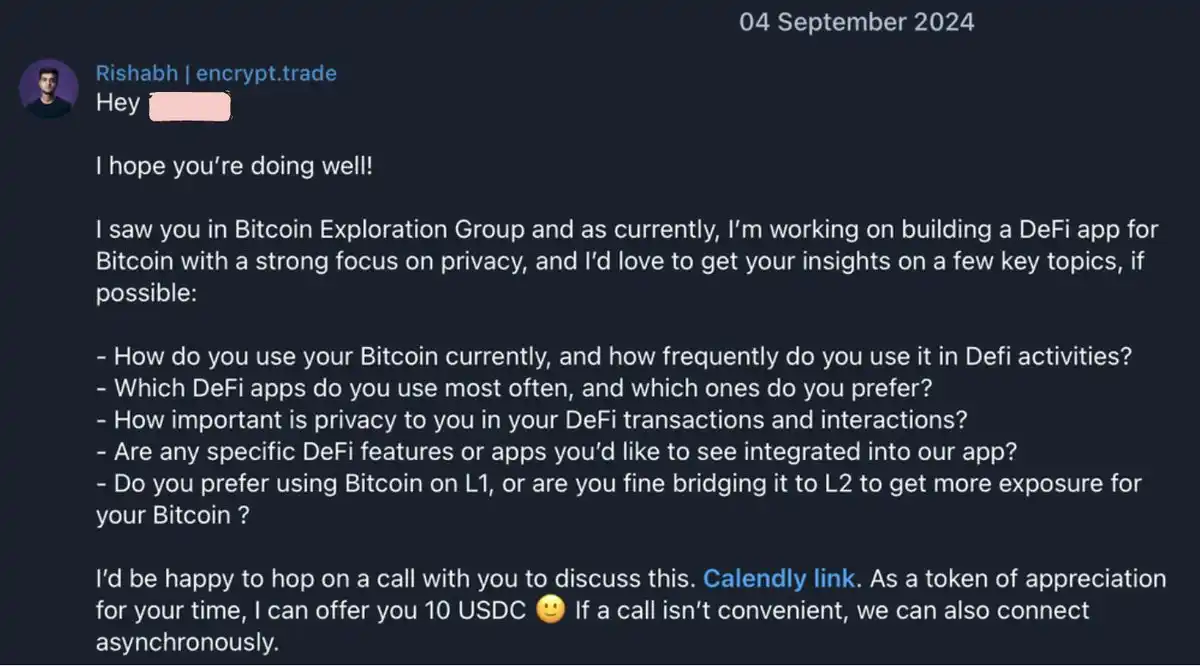
In practice, whenever someone showed even the slightest interest, I would have in-depth conversations with them, iterating on the product while communicating with users.

In fact, cold DMing itself is a process that needs constant iteration. When writing and sending cold DMs, there are several key points to note: try to start with a relatively 'soft' opener, put the most substantial information first (e.g., funding status, transaction volume processed, etc.), mention where you saw or learned about them, maintain a friendly, non-intrusive call-to-action (CTA), and definitely follow up, don't just send once and stop.

There is no such thing as a 'perfect cold DM'. You need to constantly A/B test different versions to find out which ones actually work for your target users.

Below is a high-quality cold DM template (thanks to @realsimon, from @alliance), which you can refer to directly:
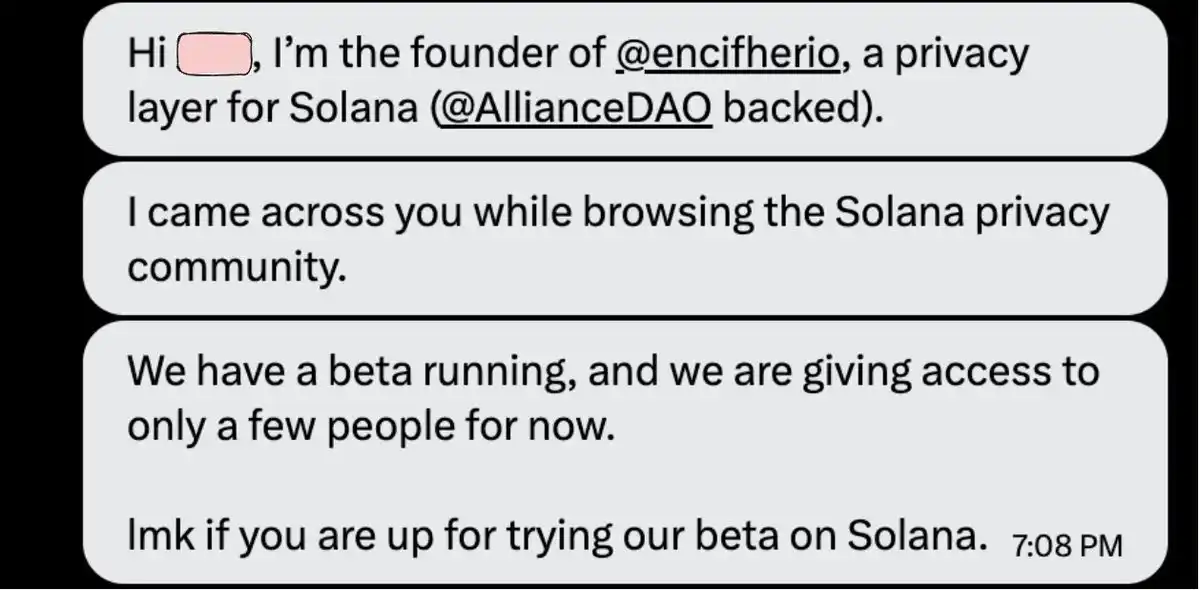
But it's important to be clear: this process is slow and psychologically draining.

In crypto, very few people are willing to reply to cold DMs because scams are everywhere. Low response rates are the norm (it is indeed a bit discouraging).

But even so, you still must do it.

At this stage, your goal is not to get 1000 users. Your goal is 10–20 early users who have the following characteristics: genuinely care about the problem you're solving, are willing to try your product, and can give honest, direct feedback.

These early users will gradually become your support system. Early products will almost certainly have frequent problems, and it is these users who help you through the most vulnerable stages.

6. Iterate Quickly

The pace of the crypto industry is extremely fast. Narratives change rapidly, and user attention spans are even shorter.

If the product you build has no real value, it's inherently hard to get attention; even if you briefly gain attention without value, that focus won't last.

It might bring a short burst of hype at best, but the product itself cannot survive long-term.

This is toly's advice for developers at Breakpoint 2025.

The core meaning is just three points: ship fast, iterate frequently, be willing to pivot radically

I also learned one very important thing: users won't always directly tell you what to do next.

You need to judge by observing their behavior: what are they doing repeatedly? What workarounds or detours are they using? What are they already willing to pay for?

Many ideas sound reasonable, but most users might not be willing to pay for them.

7. Please Make Your Website 'Idiot-Proof'

I don't know why this needs to be emphasized repeatedly, but it must be said: 'Do not make any assumptions about users.'

If you think users should understand, you are wrong. Things that are obvious to us developers who have spent hundreds of hours building the product are completely foreign to users encountering it for the first time.
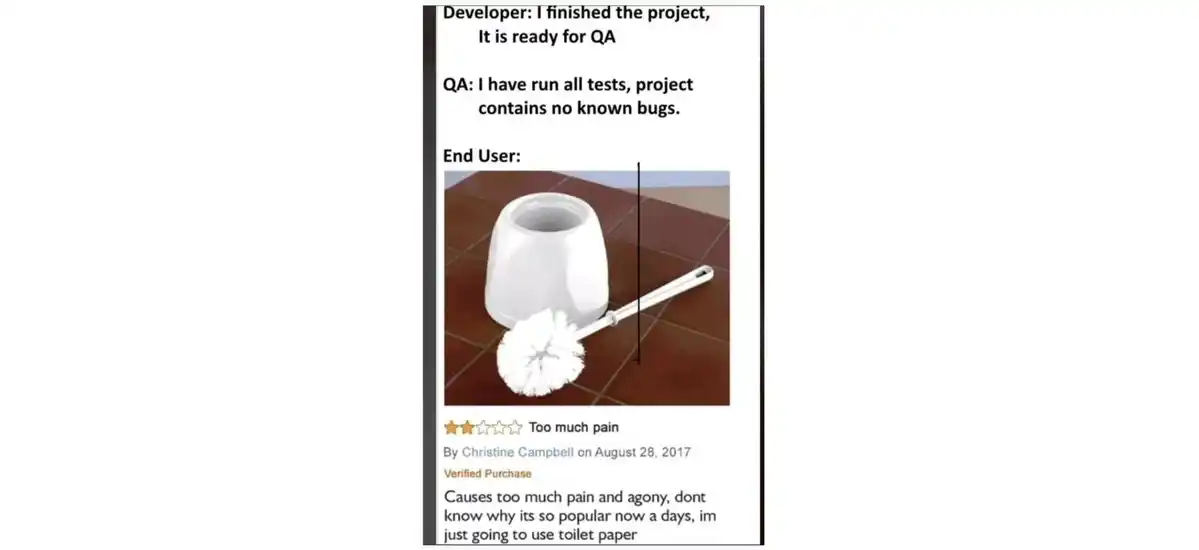
Don't introduce any new concepts or workflows. Only use simple, familiar things that genuinely make users' lives easier. The click path should be as streamlined as possible; users should be able to see, understand, or perceive the product's value within 5 seconds of entering the app (this is something we are still continuously optimizing).

I can't attach screenshots, but I've received many DMs where users completely misunderstood the purpose of a feature.

Conclusion

Building consumer crypto products is both fun and challenging.


Speed, extreme focus on users, and distribution capability are often more important than 'perfect technology'.

This is very different from B2B products, but I still believe it was the right choice we made.

This piece is already long enough; I'll save the lessons on fundraising for the next post. Finally, just use encrypt.trade :)

If this content resonates with you, or if you're also building consumer crypto products and want to chat about GTM, distribution, or the product itself, feel free to DM me.
I'm always happy to talk with other founders and developers.


Trend Kriptolar

İlgili Sorular

QWhat was the author's key mistake when building infrastructure protocols in the crypto space?

AThe author's key mistake was equating 'complexity' with 'credibility'—believing that technically impressive ideas (like zkML, zk identity, zk voting) would naturally translate to useful products, when in reality, they were rarely adopted by users.

QWhy does the author recommend building for younger users (ages 13-21) in consumer crypto products?

AYounger users (Z世代) are more likely to adopt new technologies, change habits quickly, share products with friends, and spend on emerging tech, making them ideal early adopters for consumer crypto applications.

QHow can a crypto product reduce marketing costs according to the author?

ABy designing the product itself to be highly shareable, so it acts as its own distribution channel—users naturally share it with others, reducing reliance on expensive KOL marketing or ads.

QWhat is the author's advice for handling user feedback and bug fixes?

AFix critical bugs within 2-5 hours to prevent users from switching to competitors. Implement highly requested features in 2-3 days, acknowledge user contributions, and offer incentives to turn users into advocates.

QWhy is the name of an app important for consumer crypto products?

AA memorable and easily shareable name is crucial for word-of-mouth growth. Complex or hard-to-spell names (like 'encifher') hinder users from recommending the product, reducing organic distribution.

İlgili Okumalar

Wall Street's Most Famous 'Cassandra' Now Has His Sights Set on Nvidia

Michael Burry, the famed "Big Short" investor, has once again captured Wall Street's attention with a series of short positions against major tech and semiconductor stocks, most notably Nvidia. In late June and July, through his "Cassandra Unchained" newsletter, Burry disclosed short bets against Nvidia, Tesla, Applied Materials, Caterpillar, the SOXX semiconductor ETF, and later, Micron Technology. His core thesis revolves around potential distortions in the AI infrastructure boom, specifically questioning whether extended depreciation schedules (e.g., 6 years vs. a realistic 2-3 years for AI chips) by cloud giants like Microsoft and Google artificially inflate profits. He also raises concerns about possible "off-balance-sheet circular financing," where chip demand might be propped up by vendor-backed funding to clients. Nvidia's stock experienced volatility following these disclosures, briefly dipping but largely holding near Burry's reported entry points, leaving his positions roughly flat or slightly underwater as of late July. This move is part of a pattern for Burry, whose track record since his legendary 2008 bet is mixed. He has faced notable losses, such as on Tesla in 2021, while scoring on broader market turns like the 2020 pandemic crash. His methodology focuses intensely on free cash flow and scrutinizing original financial documents to spot overvaluation and structural risks, but it often struggles with timing the market. The article contrasts Burry's stance with other prominent investors. Steve Eisman, another "Big Short" figure, is not shorting Nvidia, citing strong fundamentals but expressing nervousness about sustainability. Jim Chanos agrees with the broad "accounting mismatch" concern—comparing it to the dot-com bubble—but targets financial leverage in private equity firms rather than the chip stocks themselves. While Nvidia's short interest remains relatively low at 1.3-1.4% of float, the massive stock size means absolute short losses have been significant, exceeding $5 billion earlier this year. The piece concludes that for ordinary investors, the key takeaway is not replicating specific short bets but learning from the critical frameworks these investors use: questioning rosy accounting, identifying structural vulnerabilities, and maintaining skepticism during market euphoria, even if pinpointing the exact catalyst for a downturn remains elusive.

marsbit25 dk önce

Wall Street's Most Famous 'Cassandra' Now Has His Sights Set on Nvidia

marsbit25 dk önce

Weekly Selection丨Epic Stock Market Volatility, Changxin Tech's IPO Reshapes Storage Landscape, Saylor Aims to Re-Anchor STRC Around September 8th

PANews Weekly Digest: Market Turmoil, Tech Breakthroughs, and Crypto Developments. The week saw significant volatility across global markets. South Korea's KOSPI index experienced extreme turbulence, including multiple trading halts, largely driven by sharp declines in AI hardware stocks like SK Hynix. In contrast, China's Changxin Xinqiao (CXC) achieved a landmark IPO with a market cap surpassing 4 trillion yuan, marking a major success for the domestic DRAM industry after a decade of losses. In the crypto and Web3 space, several key narratives emerged. AI is driving demand for new infrastructure, with projects like AI agent wallets and programmable payments gaining traction, attracting interest from firms like Coinbase. The Bitcoin mining sector is pivoting, with companies like MARA focusing on energy management as electricity becomes a core AI-era asset. Meanwhile, the RWA (Real World Assets) sector faces a "utilization puzzle," with hundreds of billions in on-chain assets remaining dormant. Notable market movements included a historic single-day surge of over 17% for the KOSPI index and a significant migration of $16.5 billion in staked ETH within the Lido ecosystem. Michael Saylor announced a target to re-peg the STRC stablecoin around September 8th. Other highlights include discussions on Ethereum's ambitious 2030 roadmap for scaling and privacy, analysis showing high protocol revenues not always translating to token price gains, and warnings from Citi about potential extreme commodity price shocks by late 2026.

marsbit30 dk önce

Weekly Selection丨Epic Stock Market Volatility, Changxin Tech's IPO Reshapes Storage Landscape, Saylor Aims to Re-Anchor STRC Around September 8th

marsbit30 dk önce

When the Market Begins to Question AI Capex: A Full Analysis of Q2 Earnings Reports from Five Tech Giants

In late July 2026, five major US tech giants—Alphabet, Intel, Microsoft, Meta, and Apple—released their Q2 earnings reports. While all companies exceeded revenue and profit expectations, driven by strong AI-related business growth, investor reactions diverged sharply due to concerns over escalating AI capital expenditures (capex) and their impact on free cash flow. Alphabet reported strong revenue growth and a surging cloud business, but its stock fell after announcing a doubled year-on-year capex and negative quarterly free cash flow for the first time. Intel posted its strongest revenue growth in over 15 years, but its stock experienced volatile trading after significantly raising its full-year capex guidance. Microsoft saw its stock surge after beating estimates and, crucially, lowering its capex forecast while projecting positive free cash flow. Meta faced the most severe sell-off as its profits declined despite revenue beats, with free cash flow plunging over 90% and its capex guidance raised. Apple reported record June-quarter results, but its stock plummeted after providing Q4 revenue guidance that fell short of expectations, citing supply chain constraints and forex headwinds. The overall takeaway is that the market's focus has shifted from validating AI demand to scrutinizing the timeline for returns on massive AI investments. Companies demonstrating a clearer path to managing capex and preserving free cash flow, like Microsoft, were rewarded, while those signaling continued aggressive spending faced investor skepticism.

Odaily星球日报39 dk önce

When the Market Begins to Question AI Capex: A Full Analysis of Q2 Earnings Reports from Five Tech Giants

Odaily星球日报39 dk önce

a16z: From Companies to DAOs, DUNA May Become the Next Generation Organizational Form

This article, "From Companies to DAOs: How DUNA Could Become the Next Organizational Form," traces the 500-year evolution of business collaboration. It begins with medieval structures like the *commenda* and Florentine *compagnia*, which exposed partners to personal risk. The modern corporation, exemplified by the Dutch East India Company (VOC), was a revolutionary leap, enabling large-scale, capital-intensive ventures by offering limited liability and reducing coordination costs. However, corporations introduced new challenges like principal-agent problems and bureaucratic overhead. The piece argues that software and internet-native protocols are now reducing these traditional overheads. Decentralized Autonomous Organizations (DAOs) emerged as a new model for coordination without centralized management. Yet, DAOs face a significant legal vacuum: they lack legal recognition, leaving members exposed to unlimited personal liability, and their tokens are vulnerable to being classified as securities under unclear regulations (e.g., the Howey Test). This has forced projects into suboptimal workarounds like offshore foundations. The article identifies the Decentralized Unincorporated Nonprofit Association (DUNA) as a potential solution. Recently legalized in states like Wyoming, the DUNA provides a legal wrapper for decentralized networks. It grants key protections—legal personality, limited liability, and perpetual existence—to a group without imposing a traditional hierarchical management structure. This allows token-holder communities to govern, hold assets, and contract as a single legal entity, aligning with their decentralized nature. While DUNA doesn't solve all governance challenges or magically resolve securities law questions, it represents a crucial step. It fills the legal recognition gap, offering a native legal form for internet-scale, decentralized collaboration and extending the separation of personal risk from organizational venture into a new domain.

marsbit1 saat önce

a16z: From Companies to DAOs, DUNA May Become the Next Generation Organizational Form

marsbit1 saat önce

2026 Mid-Year Report On-Chain RWA: Tokenized Stock Market Cap Doubles in a Year, But 90% of Rights Are Hollow Shells

The 2026 Mid-Year Report on On-Chain RWA highlights a significant growth in tokenized stock market capitalization, which nearly doubled from $951 million in March to $1.89 billion by July. However, the report reveals a fundamental contradiction in this "layer 2.5" ecosystem: products with the strongest legal foundation (like regulated U.S. infrastructure) lack liquidity and distribution, while freely tradable offshored wrapper products often lack substantive ownership rights. The increase is driven largely by a few products (SECZ, FGRS, STRCx) and platforms (Ondo, xStocks, Securitize collectively hold over 85% share). While distributed value across networks like Ethereum, Solana, and BNB Chain has grown, the market remains fragmented. Products referencing the same underlying asset (e.g., Apple stock) are distinct legal liabilities with different intermediaries and jurisdictional rules, offering varying degrees of legal claim. The report cautions that headline numbers are misleading, as they reflect changes in distributed token value—driven by issuance, conversions, and price movements—not pure investor inflows. True "canonical shares" with legal ownership, wide wallet distribution, institutional liquidity, and independent on-chain price discovery do not yet exist at scale. Tokenized treasuries show stronger product-market fit, and ETFs may be easier to scale than single stocks. The core takeaway is a trade-off: legal certainty versus liquidity and composability.

marsbit2 saat önce

2026 Mid-Year Report On-Chain RWA: Tokenized Stock Market Cap Doubles in a Year, But 90% of Rights Are Hollow Shells

marsbit2 saat önce

İşlemler

Spot

Popüler Makaleler

PEOPLE Nasıl Satın Alınır

HTX.com’a hoş geldiniz! ConstitutionDAO (PEOPLE) satın alma işlemlerini basit ve kullanışlı bir hâle getirdik. Adım adım açıkladığımız rehberimizi takip ederek kripto yolculuğunuza başlayın. 1. Adım: HTX Hesabınızı OluşturunHTX'te ücretsiz bir hesap açmak için e-posta adresinizi veya telefon numaranızı kullanın. Sorunsuzca kaydolun ve tüm özelliklerin kilidini açın. Hesabımı Aç2. Adım: Kripto Satın Al Bölümüne Gidin ve Ödeme Yönteminizi SeçinKredi/Banka Kartı: Visa veya Mastercard'ınızı kullanarak anında ConstitutionDAO (PEOPLE) satın alın.Bakiye: Sorunsuz bir şekilde işlem yapmak için HTX hesap bakiyenizdeki fonları kullanın.Üçüncü Taraflar: Kullanımı kolaylaştırmak için Google Pay ve Apple Pay gibi popüler ödeme yöntemlerini ekledik.P2P: HTX'teki diğer kullanıcılarla doğrudan işlem yapın.Borsa Dışı (OTC): Yatırımcılar için kişiye özel hizmetler ve rekabetçi döviz kurları sunuyoruz.3. Adım: ConstitutionDAO (PEOPLE) Varlıklarınızı SaklayınConstitutionDAO (PEOPLE) satın aldıktan sonra HTX hesabınızda saklayın. Alternatif olarak, blok zinciri transferi yoluyla başka bir yere gönderebilir veya diğer kripto para birimlerini takas etmek için kullanabilirsiniz.4. Adım: ConstitutionDAO (PEOPLE) Varlıklarınızla İşlem YapınHTX'in spot piyasasında ConstitutionDAO (PEOPLE) ile kolayca işlemler yapın.Hesabınıza erişin, işlem çiftinizi seçin, işlemlerinizi gerçekleştirin ve gerçek zamanlı olarak izleyin. Hem yeni başlayanlar hem de deneyimli yatırımcılar için kullanıcı dostu bir deneyim sunuyoruz.

629 Toplam GörüntülenmeYayınlanma 2024.12.12Güncellenme 2026.06.02

PEOPLE Nasıl Satın Alınır

Tartışmalar

HTX Topluluğuna hoş geldiniz. Burada, en son platform gelişmeleri hakkında bilgi sahibi olabilir ve profesyonel piyasa görüşlerine erişebilirsiniz. Kullanıcıların PEOPLE (PEOPLE) fiyatı hakkındaki görüşleri aşağıda sunulmaktadır.

活动图片












